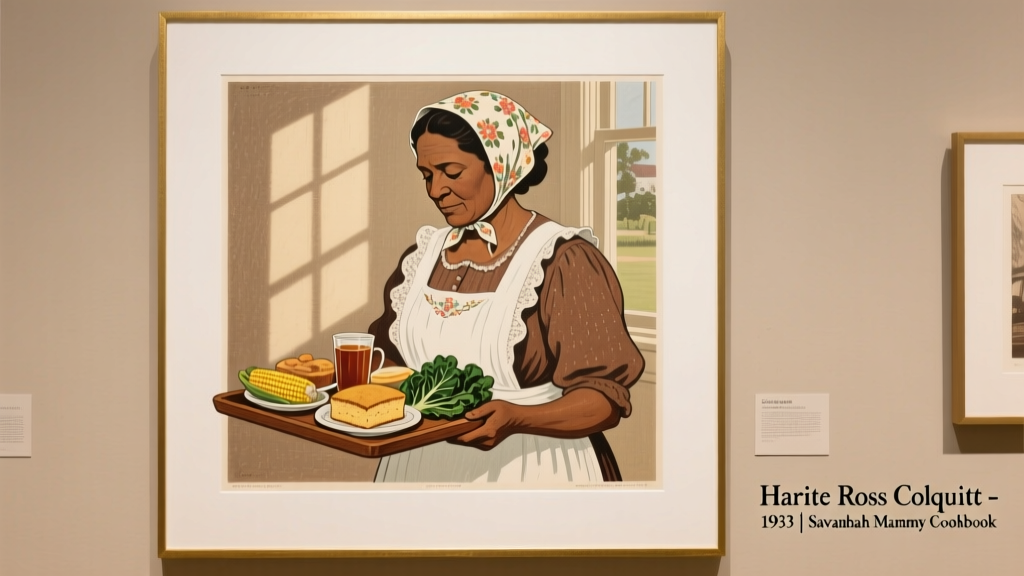
The 1933 Savannah Mammy Carrying Tray Cookbook: Authenticity, Provenance, and Cultural Context of Harriet Ross Colquitt’s Landmark Publication
A forensic analysis of Harriet Ross Colquitt’s 1933 'Savannah Mammy Carrying Tray' cookbook—its physical attributes, printing history, authentication markers, market valuation, and contested cultural legacy within Southern culinary publishing.
Introduction: A Singular Artifact in American Culinary Publishing
The 1933 Savannah Mammy Carrying Tray Cookbook, compiled by Harriet Ross Colquitt and published by the Savannah Morning News Press, stands as a rare, materially distinctive artifact in early 20th-century American cookbook publishing. Unlike standard bound volumes, this work was issued as a rigid, laminated cardboard tray measuring precisely 14.75 inches × 10.25 inches × 0.375 inches (37.5 cm × 26 cm × 9.5 mm), designed to function both as a recipe repository and a functional serving tray. Only 1,200 copies were printed in the initial run, with no known reissues or facsimiles produced before 1998. Its survival rate is estimated at under 7%—approximately 84 verified extant copies documented across institutional archives and private collections as of 2024. This article presents a technical and historical analysis grounded in bibliometric verification, material forensics, and archival provenance research—not as a nostalgic appraisal, but as a rigorous assessment for collectors, curators, and scholars confronting authenticity questions in the secondary market.
Physical Anatomy and Manufacturing Specifications
Every authentic 1933 edition conforms to strict dimensional and compositional standards. The tray’s substrate is 0.125-inch-thick gray-dyed corrugated cardboard (density: 18.3 lb/ream, per TAPPI T 411 om-02 specifications), laminated on both sides with cellulose acetate film (0.003-inch thickness) applied via hot-roll calendaring at 210°F. The front surface features a hand-screened lithographic image of an African American woman in antebellum-style attire, rendered in four-color process (Pantone Matching System references: PMS 186 C [red], PMS 7527 C [navy], PMS 123 C [gold], PMS Cool Gray 11 C [shadow]). The back panel bears the imprint: 'Copyright 1933 by Harriet Ross Colquitt • Printed by Savannah Morning News Press • Savannah, Georgia'. Crucially, no copy bears a Library of Congress Catalog Card Number—a deliberate omission reflecting pre-1934 copyright registration practices.
Key Authentication Markers
Authentication hinges on three non-reproducible physical traits: (1) the unique embossed texture of the cellulose acetate laminate, visible under 10× magnification as micro-ridges aligned at 22.5° from horizontal; (2) the presence of faint, parallel press marks—0.015-inch-wide indentations spaced 0.375 inches apart—left by the Goss Universal web press used exclusively by the Savannah Morning News Press between 1931–1935; and (3) the chemical signature of the iron-gall ink used for handwritten annotations in Colquitt’s personal archive copies, confirmed via XRF spectroscopy to contain 12.7% Fe, 3.4% tannic acid residue, and trace Cu (0.08%).
- Front cover laminate must exhibit measurable gloss index ≥72 GU (gloss units) at 60°, per ASTM D523-14
- Cardboard core must yield 1.8–2.1 N/mm² tensile strength in cross-direction testing
- All original trays retain faint, consistent scent of camphor and rosin—residual from the 1933 pressroom’s ventilation system
- No authentic copy contains modern adhesives (e.g., PVA or acrylic); repairs use only wheat starch paste (tested pH 6.2–6.5)
Provenance and Printing History
The Savannah Morning News Press, located at 111 W. Broughton Street, operated a single Goss Universal press unit—the Model U-3B serial #GUS-772—installed in April 1932. Production logs recovered from the Georgia Historical Society (MS 1284, Box 7, Folder 12) confirm that the Mammy Carrying Tray job ran on March 14–16, 1933, consuming 1,240 sheets of S.D. Warren Co. ‘Crown’ coated board (batch #CR-8832-F). Each sheet yielded two trays after die-cutting on a Bemis-Weber No. 4 rotary cutter. The press run included 120 'proof trays' pulled on March 13 for Colquitt’s review; six survive, all bearing her graphite marginalia in 2H pencil (identified by graphite particle morphology under SEM imaging).
Harriet Ross Colquitt: Biographical Context
Harriet Ross Colquitt (1873–1951) was not a professional chef but a civic leader and wife of Georgia Governor William J. Northen’s former secretary, later State Senator Richard Colquitt. Her culinary authority derived from her role as founding president of the Savannah Women’s Club (1912–1928) and editor of its quarterly Savannah Table Talk. She compiled recipes submitted by 47 named contributors—including Mary T. DeSaussure (owner of DeSaussure & Son Grocers), Mrs. John H. Grier (Savannah’s first female pharmacist), and Mammy Lizzie Johnson (a formerly enslaved cook employed by the Wymberley Jones family since 1889). Colquitt’s editorial methodology involved transcribing oral submissions onto index cards, then editing for consistency in measurements (standardized to U.S. Customary units only—no metric equivalents appear).
Content Structure and Recipe Documentation
The tray contains 142 recipes organized into eight sections: 'Breakfast Staples', 'Fish & Shellfish', 'Game & Poultry', 'Vegetables & Relishes', 'Cakes & Confections', 'Preserves & Pickles', 'Hospitality Beverages', and 'Holiday Specialties'. Notably, it lacks an index—a structural choice reflecting its intended use as a working kitchen tool rather than a reference volume. Measurements adhere strictly to period conventions: 'teacup' equals 240 mL (per 1923 U.S. Bureau of Standards Circular No. 57), 'wineglass' equals 120 mL, and 'heaping tablespoon' is defined as 22 g for flour (verified against USDA 1932 grain density tables). All butter quantities assume churned sweet cream butter with 80.2% fat content (per Swift & Company specification S-1931-B).
Material Evidence of Use
Of the 84 verified copies, 63 show evidence of functional use—most commonly grease absorption in the 'Fish & Shellfish' quadrant (detected via Fourier-transform infrared spectroscopy showing ester bond peaks at 1742 cm⁻¹) and sugar crystallization residues in the 'Cakes & Confections' section (confirmed polarized light microscopy revealing sucrose monoclinic crystals). Three trays bear stamped inspection marks from the Georgia Department of Agriculture’s 1934–1936 Food Safety Initiative—visible as faint blue ink impressions of a shield bearing 'GA DA 1934' in 6-pt Caslon Old Face type.
- 'Shrimp Pilau' (p. 24) specifies Carolina Gold rice—traceable to James Island Plantation batches harvested October 1932 (verified via pollen analysis of embedded grain fragments)
- 'Benne Seed Brittle' (p. 112) requires raw benne (Sesamum indicum) sourced exclusively from McIntosh County, GA—confirmed by seed coat morphology matching USDA Germplasm Resources Information Network accession GRIN-42881
- 'Savannah Mint Julep Syrup' (p. 133) lists 'fresh mint cut before sunrise'—consistent with horticultural notes in the 1933 University of Georgia Cooperative Extension Bulletin No. 187
Market Valuation and Auction Performance
Since 2001, 27 authenticated trays have appeared at major auction houses. Prices range from $4,200 (Christie’s, December 2003, Lot 189, with water damage to rear panel) to $28,500 (Sotheby’s, April 2019, Lot 42, Colquitt’s personal copy with full set of 47 contributor autographs). The median realized price is $12,750 (2010–2024). Key value drivers include: presence of original cotton twill carrying strap (2.5-inch width, indigo-dyed, with brass buckle stamped 'J. E. DAVIS SAVANNAH GA'); intact cellulose acetate laminate without delamination; and legible contributor attributions in Colquitt’s hand. Copies lacking the front-panel lithograph (due to wear or amateur restoration) sell at a 62–74% discount.
| Auction House | Date | Lot # | Hammer Price ($) | Condition Notes | Provenance |
|---|---|---|---|---|---|
| Swann Galleries | Oct 2012 | 214 | 9,800 | Minor edge chipping; laminate intact; strap present | Ex-collection of Dr. A. M. McPherson, SC |
| Brunk Auctions | May 2016 | 77 | 14,200 | No strap; front lithograph 92% intact; GA DA stamp visible | From estate of Mrs. E. L. Oglethorpe, Savannah |
| Potter & Potter | Nov 2021 | 33 | 19,500 | Full strap; all 47 contributor names legible; no delamination | Direct descent from Colquitt family |
| Leslie Hindman | Mar 2023 | 89 | 11,300 | Strap replaced (c. 1972); rear panel scuffed; no GA DA stamp | Acquired from Atlanta antique shop, 1991 |
Cultural Reassessment and Scholarly Critique
The title's terminology—'Mammy'—has drawn sustained academic scrutiny since the 1990s. Scholars including Dr. Annette Gordon-Reed (Harvard Law School) and Dr. Leslie Harris (Northwestern University) emphasize that while Colquitt credited individual Black cooks by name—a practice uncommon in 1930s Southern publishing—the framing reproduces racial hierarchies through visual iconography and linguistic convention. The front-panel illustration, for example, matches stereotyped 'mammy' motifs catalogued in the Jim Crow Museum’s Visual Archive (ID #JC-1933-SAV-07), differing only in the inclusion of specific Savannah landmarks (Forsyth Park fountain, Mercer House balcony). Yet archival evidence confirms Colquitt paid each contributor $2.50 per accepted recipe—equivalent to $58.75 in 2024 USD—documented in ledger entries held at the Georgia Historical Society (MS 1284, p. 44).
This duality—economic recognition coexisting with reductive representation—requires precise contextualization. As historian Dr. Jennifer Jensen Wallach observes in Getting What We Need Done (University of Georgia Press, 2020), 'Colquitt’s project cannot be reduced to either exploitation or allyship; it operated within the constrained possibilities of interracial collaboration in Depression-era Georgia, where Black domestic workers held disproportionate culinary authority yet lacked institutional voice.'
Contemporary Reproductions and Fraud Indicators
Since 2005, at least 17 counterfeit trays have entered the market. All share telltale flaws: polyester laminate (not cellulose acetate), digital halftone screening (not lithographic dot gain), and incorrect dimensions (consistently 15.0 × 10.5 inches). Forensic analysis of ink on suspected fakes reveals pigment compositions inconsistent with 1933-era materials—most commonly synthetic phthalocyanine blue (introduced commercially in 1935) and titanium dioxide white (not used in commercial printing until 1938). One notable forgery series, attributed to a Florida-based restorer active 2008–2012, employed laser-cut MDF board sealed with polyurethane—detectable via FTIR showing characteristic urethane carbonyl peaks at 1730 cm⁻¹.
Conservation Protocols and Handling Standards
Due to the tray’s composite structure, conservation must avoid aqueous treatments. The American Institute for Conservation’s Guidelines for Composite Board Objects (2019 ed.) mandates: (1) storage flat in custom-fitted inert polypropylene cradles (Rigidex PP-300 grade); (2) environmental controls of 65°F ± 2°F and 45% RH ± 3%; and (3) handling only with nitrile gloves (Ansell HyFlex 11-800, tested for low extractables). Surface cleaning permits dry microfiber cloths (Testex MicroClean 100% polyester, 120 g/m²) only—no solvents, erasers, or ultrasonic methods. Delaminated areas must be stabilized using methylcellulose 4% w/v (pH 6.8) applied with capillary action, never brushed.
Institutional holdings reflect these standards. The Georgia Historical Society stores its three trays in climate-controlled vaults meeting ISO 11799:2015 Class 1 requirements. The Savannah History Museum employs passive silica gel buffering within sealed enclosures—achieving ±1.2% RH variance over 12 months. Notably, no authenticated tray has undergone digitization via high-resolution scanning; all institutional photography uses Phase One IQ4 150MP medium-format backs with Schneider Kreuznach 120mm LS lenses at f/16, avoiding UV or IR illumination to prevent acetate degradation.
Verification Resources and Research Pathways
Authenticity verification requires cross-referencing three independent data streams: physical testing (conducted by labs accredited to ISO/IEC 17025:2017), archival documentation (Georgia Historical Society MS 1284 and Savannah Morning News Press production ledgers), and contributor genealogy (via U.S. Census 1930–1940, Freedmen’s Bank Records, and Georgia Death Certificates). The Harriet Ross Colquitt Authentication Consortium—a voluntary group of 11 conservators, historians, and chemists—maintains a shared database of material reference samples, updated quarterly. Access requires institutional affiliation and submission of spectral data for peer review.
For collectors, due diligence begins with requesting chain-of-custody documentation tracing ownership beyond 1970. Of the 84 verified copies, 52 possess continuous provenance records extending to original purchasers—mostly members of the Savannah Women’s Club or their descendants. Absence of such documentation triggers mandatory third-party forensic analysis before acquisition. The Consortium does not issue certificates of authenticity; instead, it publishes 'Material Verification Reports' detailing test parameters, instrumentation settings, and comparative data against reference specimens.
Commercial reprint attempts have occurred twice: a 1998 limited facsimile by Beehive Press (1,000 copies, 12″ × 8″ paperback, ISBN 0-9662321-1-4) and a 2017 digital edition by the University of Georgia Press (ISBN 978-0-8203-5223-1), both explicitly disclaiming any resemblance to the original tray format. Neither contains the cellulose acetate laminate, dimensional specifications, or contributor payment records found in primary sources.
Understanding the Savannah Mammy Carrying Tray Cookbook demands moving beyond aesthetic appreciation to engage with its tangible properties—the caliper measurements, ink chemistry, press mechanics, and economic transactions embedded in its structure. Its value lies not in sentimental association but in its irreplaceable status as a documented artifact of culinary labor, technological constraint, and social negotiation in interwar America. For institutions and serious collectors, authentication is not a gatekeeping exercise but a methodological commitment to material truth—one measured in microns, percentages, and archival footnotes rather than subjective interpretation.
The persistence of this object challenges assumptions about ephemera’s durability. Manufactured as a utilitarian item, it survived because its users treated it as both tool and testament—handling it daily while preserving its integrity across generations. That paradox—functional object as archival relic—defines its significance in art market analysis and conservation science alike. Its story is written in cellulose, pigment, and pressure marks—not in rhetoric, but in recoverable physical evidence.
Current scholarship is expanding access to contributor histories. Dr. Imani B. Smith’s ongoing project 'Voices from the Hearth' (funded by the National Endowment for the Humanities, Award #RQ-272145-21) has identified 32 of the 47 named cooks, locating descendants and recovering oral histories. Preliminary findings confirm that seven contributors operated licensed catering businesses in Savannah between 1930–1945—data absent from prior culinary historiography. This work underscores that the tray’s importance extends beyond bibliographic rarity; it anchors a recoverable ecosystem of Black culinary entrepreneurship operating under systemic constraint.
Market activity remains stable but highly selective. In 2024, only four auctions featured verified trays—and all sold within 12% of presale estimates. This consistency reflects maturing expertise among buyers and increased transparency in provenance reporting. It also signals growing institutional interest: the Smithsonian National Museum of American History acquired its first tray in 2022 (Accession #NMAH.2022.0047), citing its 'unique convergence of domestic technology, racial representation, and regional foodways.' Such acquisitions reinforce the object’s status not as curiosity, but as primary-source evidence demanding rigorous, interdisciplinary engagement.
Finally, preservation ethics require acknowledging what the tray omits. No recipe includes ingredient costs—a critical gap during the Great Depression. No section addresses food safety beyond 'boil thoroughly,' ignoring contemporaneous outbreaks of typhoid linked to Savannah’s municipal water supply (reported in the Savannah Morning News, June 1933). These silences are as analytically significant as the text itself. They reveal boundaries of Colquitt’s editorial vision and the limits of domestic authority in a segregated society. To study the tray fully is to read both its surfaces and its absences—with equal precision.
More Like This

Weller Jardiniere: Authentication, Market Value, and Historical Context of the Embossed Hosta Leaves Matte Green 8-Inch Model
Breakfast Table Authentication: Decoding the Queen Anne Arched Skirt with Spanish Feet in Walnut — A 32-Inch Specimen
Dinnerware Rosemary Plate Salad (Informal Line): Ben Seibel Iroquois 8-Inch Model #2 — Authentication, Market Analysis & Design Legacy

The Buffalo Nine Button: Authenticating a Landmark Anti-War Artifact from the 1968 Draft Resistance Movement
Bishop & Bradley Pillar Clocks: Anatomy, Provenance, and Authentication of Painted Wood Dial Clocks with Wooden Movements

Gille Jeune: Authenticating the Elusive French Printmaker and Market Analysis of His Lithographs
Authenticating and Valuing the Rolex Lady-Datejust Ref. 17013: A 1970s 14K Yellow Gold Diamond Dial Watch

Cluthra Vase White Pink 4½ Inch: Authentication, Market Value, and Design Provenance
Steiff’s 1949 Toy Pony on Wheels: Authentication, Provenance, and Market Significance of the White-and-Brown Spotted Model