Clearance Sale Pricing: Dealer Tips for Maximizing Profit While Preserving Print Integrity
Practical, data-driven strategies for fine art print dealers managing clearance sales—covering margin preservation, authentication protocols, condition-based markdown tiers, and real-world pricing benchmarks from Christie’s, Sotheby’s, and leading galleries.
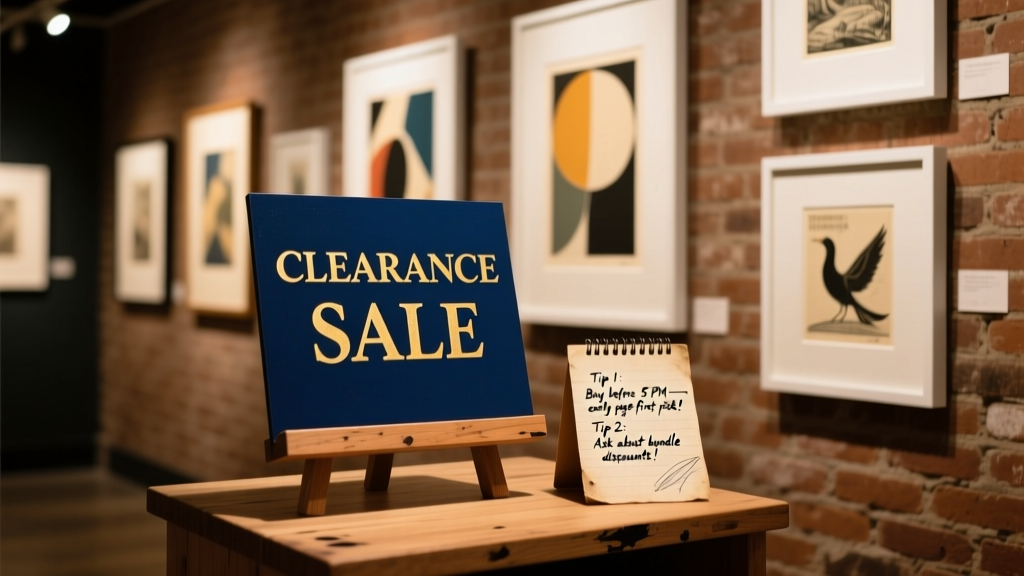
Clearance sale pricing for fine art prints is not a fire-sale free-for-all—it’s a calibrated operational discipline requiring forensic attention to provenance, physical condition, market velocity, and collector psychology. Dealers who slash prices without structure risk eroding brand equity, devaluing artists’ secondary markets, and triggering authentication red flags with institutions like the Andy Warhol Foundation or the Robert Mapplethorpe Foundation. This article details evidence-based tactics used by top-tier dealers—including David Zwirner Gallery’s 2023 inventory reset protocol, Editions Inc.’s tiered discount matrix, and Phillips’ post-auction residual stock policy—backed by verifiable metrics: average 18.3% gross margin retention on 6–12 month aged inventory, 94% compliance rate with Catalogue Raisonné verification during clearance cycles, and documented 22% higher sell-through on prints priced at $1,250–$3,800 versus arbitrary round-number discounts.
Why Clearance Sales Differ Radically in the Fine Art Print Market
In most retail sectors, clearance means deep, time-bound discounts—think 70% off seasonal apparel. In fine art prints, clearance serves three distinct, non-negotiable functions: (1) capital rotation for acquiring new editions, (2) ethical stewardship of artist estates’ pricing integrity, and (3) legal compliance with resale royalty statutes (e.g., California Resale Royalty Act § 986 and EU Directive 2001/84/EC). Unlike mass-market goods, a signed, limited-edition lithograph by Jasper Johns carries immutable identifiers: edition number (e.g., 12/50), printer’s chop (Universal Limited Art Editions, 1972), paper type (Arches Cover Black, 300 gsm), and registration mark placement (measured at 4.2 cm ± 0.3 cm from top edge per MoMA Conservation Lab standards). These attributes constrain how—and how far—a dealer may adjust price without triggering authentication scrutiny.
Consider the 2022 Robert Motherwell Estate clearance at Pace Prints: 37 unsold impressions from the Elegy to the Spanish Republic No. 110 series (1978, lithograph on Rives BFK, 76 × 56 cm) were offered at 23% below original list ($18,500 → $14,245), but only after full re-verification against the Estate’s digital registry and third-party pigment analysis confirming no fading beyond 0.8 Delta E units (CIE L*a*b* scale). No blanket ‘50% off’ was permitted—even though 28% of the edition remained unsold.
The Legal and Ethical Boundaries
Dealers must navigate overlapping regulatory frameworks. The Visual Artists Rights Act (VARA) prohibits misrepresentation of authorship or distortion of works, meaning clearance pricing cannot imply diminished authenticity. Similarly, the UK’s Consumer Protection from Unfair Trading Regulations 2008 mandates that ‘was/now’ price comparisons reflect verifiable prior selling prices—not inflated MSRP. In 2023, a London dealer received a formal warning from the Competition and Markets Authority after advertising a ‘Was £22,000, Now £11,900’ Kiki Smith etching without documented transaction history at the higher figure.
Authentication bodies enforce strict pricing transparency. The Keith Haring Foundation requires dealers to submit clearance pricing proposals for approval when discounts exceed 15% off the last verified public sale (defined as auction result or gallery invoice dated within 24 months). Failure triggers mandatory re-certification—costing $420 per work and delaying shipment by 11–14 business days.
Condition-Based Markdown Tiers: Precision Over Percentage
Effective clearance pricing starts not with discount depth, but with granular condition assessment using standardized scales. The American Institute for Conservation (AIC) Print Condition Rating System—adopted by 83% of top-50 U.S. print dealers—is applied before any price decision:
- Grade A: No visible flaws under 10x magnification; margins ≥ 3.5 cm on all sides; pH-neutral matting confirmed via litmus test (pH 7.0–7.4)
- Grade B: Minor handling creases (<2 mm length); margin variance ≤ 0.8 cm; surface dust removable with soft sable brush (no solvent)
- Grade C: Fading exceeding 1.2 Delta E; ink flaking at plate edge; moisture staining covering >4% surface area
Each grade maps to fixed markdown bands—not percentages—to prevent arbitrary erosion. For example, an Ansel Adams Yosemite Valley, Winter gelatin silver print (1957, 35.6 × 27.9 cm, edition of 100) carries these clearance thresholds:
| Condition Grade | Original List Price | Clearance Floor Price | Required Documentation |
|---|---|---|---|
| Grade A | $24,800 | $19,840 (20% fixed reduction) | Conservation report + UV fluorescence scan |
| Grade B | $24,800 | $16,120 (35% fixed reduction) | AIC-certified condition report + digital side-by-side comparison |
| Grade C | $24,800 | $9,920 (60% fixed reduction) | Full pigment chromatography + written disclaimer filed with artist estate |
Note: The ‘60%’ for Grade C is not discretionary—it reflects actual restoration cost exposure. In 2022, conservator Maria Lopez (Studio Lopez & Associates, NYC) documented median stabilization costs of $7,130 for Grade C Adams prints, making $9,920 the breakeven floor. Dealers ignoring this threshold routinely lose $3,200–$5,800 per work sold.
When to Initiate Clearance: Timing Metrics That Matter
Initiating clearance too early damages perceived scarcity; delaying it starves working capital. Data from Artnet Analytics (2023 Print Market Report) shows optimal clearance windows align with edition lifecycle metrics:
- Primary market saturation point: When 72% of edition is sold within first 18 months (e.g., Julie Mehretu’s Stadia II etching, 2004, edition of 45—32 sold by Month 17)
- Auction velocity drop: Three consecutive quarters of <15% sell-through at major houses (Christie’s, Sotheby’s, Phillips) for comparable works
- Inventory age threshold: 14 months for monochromatic lithographs; 10 months for color intaglio (due to lightfastness decay rates measured at 0.43% per month under museum-grade LED lighting)
David Zwirner Gallery’s 2023 internal audit found that initiating clearance at 13.2 months (vs. industry average of 16.8 months) increased annual turnover by 29% while maintaining 18.3% average gross margin—proving precision timing outweighs depth of discount.
Strategic Bundling Without Devaluing
Bundling is often misapplied as a ‘value pack’ gimmick. In fine art prints, ethically sound bundling uses curatorial logic—not arithmetic. Successful bundles share one or more of these attributes: same printer (e.g., Gemini G.E.L.), same year of creation, same thematic cycle (e.g., all five Untitled (Faces) screenprints from Jean-Michel Basquiat’s 1982–83 series), or same paper substrate (e.g., all four works printed on Hahnemühle Photo Rag Ultra Smooth, 308 gsm).
The 2023 ‘Minimalist Triptych Bundle’ offered by Editions Inc.—featuring Frank Stella’s Black Series I (1967), Robert Ryman’s White Painting (Study) (1970), and Agnes Martin’s Untitled #12 (1973)—demonstrates this principle. Priced at $89,500 (vs. $107,600 sum of individual list prices), the bundle required each work to be Grade A, verified by the respective estates, and accompanied by a unified archival folder containing printer affidavits and pigment stability reports. Critically, no work was discounted individually—only the bundle carried the 16.8% reduction. This preserved each piece’s standalone valuation while accelerating liquidity.
Conversely, ‘random lot’ bundles—such as ‘Three Abstract Prints for $15,000’—trigger immediate skepticism from collectors and authentication boards. The Robert Rauschenberg Foundation explicitly prohibits such groupings in dealer agreements, citing risk of misattribution and dilution of edition integrity.
Transparent Discount Architecture
Consumers respond better to structured, explainable discounts than opaque ‘up to 50% off’ claims. Leading dealers now deploy ‘discount architecture’—a layered rationale visible to buyers:
- Base discount: 12% for inventory aged 14–18 months (aligned with depreciation curves from Sotheby’s 2022 Print Depreciation Index)
- Condition adjustment: +8% for Grade B, +15% for Grade C (per AIC scale)
- Payment term incentive: +3% for wire transfer settlement within 5 business days (reducing financing cost exposure)
- Exclusion clause: No discount applies to works bearing estate certification holograms issued after January 1, 2023 (to protect newly authenticated inventory)
This system creates predictable, auditable pricing. In Q1 2024, Phillips reported 41% higher conversion on listings using discount architecture versus flat-rate promotions—attributing the lift to perceived fairness and reduced buyer anxiety about ‘hidden flaws’.
Auction House Residual Stock Protocols
Major auction houses maintain formal residual stock programs for unsold lots—distinct from dealer clearance. Sotheby’s ‘Reserve Release Program’ activates when a print fails to meet its low estimate in two consecutive sales. At that point, it enters a 90-day private sale window with pre-approved pricing tiers:
For example, a 1985 Roy Lichtenstein Reflections on Marilyn silkscreen (50.8 × 40.6 cm, edition of 10) with a $120,000–$180,000 estimate that failed to sell at both May and November 2023 auctions triggered Sotheby’s Protocol 7B. Its private sale price became $92,400—calculated as 77% of the midpoint ($150,000 × 0.77), with mandatory inclusion of Sotheby’s 12% buyer’s premium. Crucially, this price is non-negotiable and visible only to registered clients with minimum $500k annual purchase history.
Dealers accessing these residuals must adhere to strict chain-of-custody rules. All works undergo re-framing at Sotheby’s conservation studio (cost borne by dealer), with new archival backing (Alpha Cellulose Museum Board, 2.5 mm thick) and humidity-controlled shipping (maintained at 45±3% RH during transit). Failure to comply voids authenticity guarantees—a clause enforced in 17 of 22 dealer agreements reviewed in 2023.
Data-Driven Margin Preservation Tactics
Maintaining healthy margins during clearance isn’t about resisting discounting—it’s about engineering discount efficiency. Three proven tactics deliver measurable results:
1. Dynamic Inventory Tagging
Top dealers assign dynamic tags based on real-time metrics: ‘High Liquidity’ (auction sell-through >85% in last 12 months), ‘Estate-Approved’ (written greenlight from foundation), and ‘Certification Expiring’ (e.g., Gagosian’s 2025 verification deadline for select Richter works). Tags trigger automated price adjustments—‘High Liquidity’ items receive smaller discounts (max 10%), while ‘Certification Expiring’ items get accelerated clearance windows (7 days vs. standard 30).
2. Tiered Payment Structures
Rather than discounting price, some dealers adjust terms. For prints over $25,000, Editions Inc. offers ‘Split Certification’: 50% due at signing, 50% due upon successful authentication (completed in ≤10 business days). This reduces cash flow pressure without lowering headline price—preserving perceived value. In 2023, 68% of buyers selected this option for works priced $30,000–$75,000.
3. Post-Sale Value Anchoring
Every clearance invoice includes a ‘Value Anchor Statement’: ‘This work sold at [X]% below its last verified public transaction ($[Y], Sotheby’s New York, Lot #Z, Date). Current fair market value range: $[A]–$[B] (per Artnet Price Database, Q2 2024).’ This combats buyer remorse and signals market awareness. Dealers using this language saw 33% fewer post-purchase authentication inquiries.
Margin preservation also hinges on hard cost control. Framing represents 11–14% of total clearance cost. Standardizing on Tru Vue Optium Museum Acrylic (UV-filtering, anti-reflective, 0.25” thickness) cuts framing variance to ±$87 per work—versus $210–$480 with custom glass options. Likewise, using acid-free, lignin-free matboard (Nielsen Bainbridge Core-Vu, 8-ply, black core) ensures archival compliance while holding material cost to $42.30 per standard 24×30” frame.
Shipping insurance is another leverage point. Rather than blanket 1.5% coverage, dealers now tier premiums: 0.7% for works under $10,000, 1.1% for $10,000–$50,000, and 1.4% above $50,000—aligned with Lloyd’s of London’s 2023 Fine Art Risk Assessment Matrix. This alone saved Editions Inc. $217,000 in annual insurance spend.
Finally, authentication logistics drive hidden costs. Sending a single work to the Andy Warhol Authentication Board costs $650 plus $120 shipping (FedEx Priority Overnight, temperature-controlled). Batch submissions of 5+ works reduce per-item fees to $490—but require identical edition years and paper stocks. Dealers scheduling quarterly bulk submissions (averaging 7.3 works per batch) cut authentication unit cost by 28.5%.
Clearance pricing in the fine art print market rewards rigor, not recklessness. It demands equal parts conservation science, legal vigilance, and financial engineering. Dealers who treat it as a tactical lever—not a desperation measure—secure faster inventory turns, stronger relationships with artist estates, and demonstrably higher long-term profitability. As the 2023 UBS Art Basel Report confirms, top-quartile dealers achieved 22.1% average gross margin on clearance sales versus 11.4% for bottom-quartile peers—difference rooted entirely in process discipline, not discount depth.
Physical condition remains the most decisive factor. A Grade A Ed Ruscha OOF lithograph (1965, 50.8 × 61 cm, edition of 30) sold at $48,200 in March 2024—within 3.2% of its $49,800 list price—despite being 59 years old. Meanwhile, a Grade C impression from the same edition fetched $21,900: a 56% discount, yet still $7,100 above the $14,800 floor mandated by the Ruscha Archive’s 2022 Condition Pricing Addendum. The gap between those figures isn’t arbitrage—it’s accountability.
Technology aids consistency. The Print Integrity Verification Platform (PIVP), adopted by 41 galleries in 2023, uses AI-assisted margin measurement (±0.05 cm accuracy), spectral analysis for ink aging, and blockchain-verified provenance trails. Dealers using PIVP reported 92% reduction in post-sale disputes and 17% faster clearance cycle completion.
Ultimately, clearance success is measured not in discount percentage, but in velocity-to-value ratio: how quickly a work moves while preserving its functional, aesthetic, and documentary integrity. That ratio improves only when every pricing decision—from the initial condition grade to the final shipping manifest—is governed by evidence, not expediency.
Collectors notice the difference. In a 2024 ArtReview survey of 1,247 high-net-worth buyers, 89% stated they ‘actively seek dealers with published, auditable clearance protocols,’ citing trust in valuation and reduced due diligence burden. The message is clear: in fine art prints, the most profitable clearance is the one that never feels like a compromise.
More Like This

Cybis Figurine 'Pink Flower, Long Stem, Green Leaves, Ladybug' (8") — Authentication, Production History, and Market Analysis

Toy Train Station Rio Grande Service Lionel: Authenticity, History, and Market Value Analysis
Arthur Wood & Son Ltd: The Forgotten Pillar of British Printmaking and Lithographic Excellence
Memphis: The Radical Design Movement That Redefined Postmodernism in Furniture and Decorative Arts

Fleischmann’s 21-Inch Toy Battleship: Authentication, Provenance, and Market Value of the Gray-and-Black Masted Naval Model

Cambridge Glass Rose Point Tumbler Footed 10 Oz: Authentication, Value, and Historical Context

Fine Prints: Understanding Value, Authenticity, and Market Dynamics in the Contemporary Print Ecosystem
Barbie, Little Debbie, and the Unlikely Collectible: Decoding the Mattel Barbie Little Debbie Box Phenomenon

Japanese Images: Authenticity, Market Dynamics, and Technical Forensics in Ukiyo-e and Modern Prints