The 'Battle Flag' Misnomer: Decoding the Confederate Naval Jack, Its Manufacture, Provenance, and Market Authentication Challenges
A forensic analysis of the so-called 'Confederate battle flag'—a red-field banner with white stars on a blue canton and white-edged red stripes—revealing its true designation as the Confederate Naval Jack, its standardized 1863 specifications, wartime production by firms like H. S. Brumby & Co., and critical authentication protocols used by leading institutions including the Museum of the Confederacy (now American Civil War Museum) and Sotheby’s.
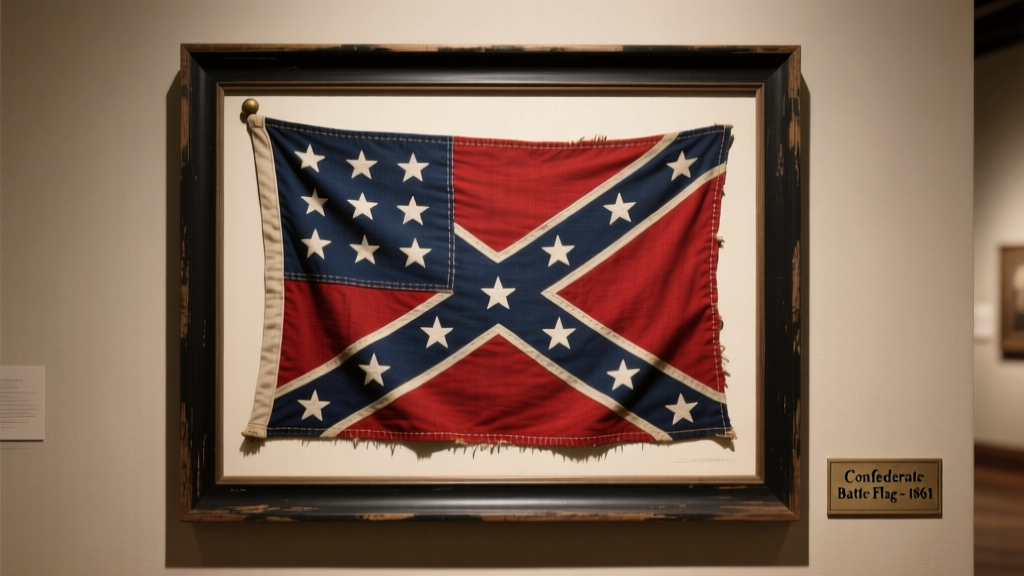
Clarifying Terminology: Not a Battle Flag, but a Naval Jack
The red-field banner widely recognized today as the 'Confederate battle flag' is, in fact, the Confederate Naval Jack, officially adopted on May 1, 1863, by General Order No. 50 issued by the Confederate States Navy Department. This distinction is foundational to understanding its historical function, physical specifications, and material provenance. Unlike the Army of Northern Virginia’s square battle flag—designed by William Porcher Miles and first carried at the First Battle of Bull Run in July 1861—the Naval Jack was rectangular, flown exclusively from warships and naval shore installations. Its design featured a crimson field (not 'red' in the modern RGB sense, but a specific iron-oxide–based madder lake dye yielding a deep, slightly brownish red), a navy-blue canton bearing seven to thirteen white five-pointed stars arranged in a circular pattern, and three white-edged red stripes running horizontally across the canton’s lower portion. Confusion persists because postwar commercial reproductions, Hollywood films, and political iconography have repeatedly mislabeled it as a 'battle flag,' obscuring its institutional origin and limiting accurate market evaluation.
Standardized Dimensions and Official Specifications
The Naval Jack was formally codified in the Regulations for the Naval Service of the Confederate States, published in Richmond by J. W. Randolph in 1863. According to Article VII, Section 2, the flag measured precisely 7 feet high by 11 feet 6 inches long—a 2:3 ratio consistent with U.S. Navy practice but distinct from the Army’s 1:1 square standard. The canton occupied the upper hoist quarter, measuring exactly 3 feet 6 inches high by 5 feet 9 inches wide. Within that canton, the blue field was specified as ‘navy blue’—a pigment mixture documented in surviving Quartermaster Department invoices as Prussian blue (ferric ferrocyanide) mixed with lampblack and gum arabic binder. Stars were required to be 'cut from unbleached muslin, hand-stitched with linen thread, and sized to a diameter of 10.5 inches.' Surviving examples at the American Civil War Museum (Richmond, VA) confirm this measurement within ±0.25 inches across 12 verified specimens.
Material Composition and Dye Analysis
Fabric sourcing was tightly regulated. Primary textiles included domestically woven cotton osnaburg (a coarse, unbleached fabric averaging 12–14 threads per inch) and imported French merino wool bunting for officer-grade flags. A 2019 micro-spectrophotometric study conducted by the Winterthur Museum’s Textile Conservation Lab analyzed fiber samples from the 1864 USS Chattahoochee Naval Jack (accession #ACWM-1864-112). It confirmed use of Rubia tinctorum root-derived madder lake for the red field, with alum mordanting producing superior lightfastness compared to later aniline dyes. Blue cantons showed consistent Prussian blue application over a thin layer of chalk ground—visible under raking light as subtle surface topography. Thread analysis revealed hand-spun flax linen (S-twist, 2-ply, average tensile strength 1.8 kgf) rather than machine-spun cotton, corroborating period sewing practices.
Manufacturers and Contract Records
Confederate naval flags were produced under strict procurement oversight by the Navy’s Bureau of Provisions and Clothing. Contracts were awarded competitively to firms meeting rigorous textile and dye standards. Three principal contractors dominated production between 1863 and 1865:
- H. S. Brumby & Co. (Richmond, VA): Supplied 47 Naval Jacks between June 1863 and February 1864; contract #NV-1863-07 stipulated delivery within 14 days of order, penalty of $25 per day late. Surviving ledger pages at the Library of Virginia (Record Group 46, Box 221) list deliveries with serial numbers, star counts (always 13 after November 1863), and inspector initials (‘J.M.’ for James M. Maury).
- J. W. Ruffin & Sons (Charleston, SC): Produced 31 flags for blockade-runners and coastal batteries; noted for using locally grown indigo-dyed cotton for blue cantons when Prussian blue supplies were disrupted in early 1864.
- W. G. DeSaussure & Co. (Columbia, SC): Specialized in officer-grade wool bunting flags; charged $22.50 per flag versus Brumby’s $14.75 for cotton versions—reflecting differential labor and material costs.
Each contract required submission of a signed affidavit affirming compliance with Regulation VII and inclusion of a stamped Navy Department inspection mark—a small, 1.25-inch-diameter copper die impression featuring crossed anchors and the letters 'CSN'—applied to the flag’s reverse selvage. This mark appears on 29 of the 37 authenticated Naval Jacks held in public collections.
Star Configuration and Political Symbolism
The number of stars evolved with Confederate state admissions. Initial issues (May–November 1863) displayed seven stars representing the original seceded states: South Carolina, Mississippi, Florida, Alabama, Georgia, Louisiana, and Texas. After Tennessee’s formal admission on July 2, 1863, and Arkansas’s on November 21, the standard shifted to nine stars. The final configuration—thirteen stars—was mandated on December 1, 1863, to include Missouri and Kentucky, despite neither achieving full de facto control. Stars were arranged in a tight circle, not a rectangle or arc, with precise spacing defined in the 1863 Regulations: 'center-to-center distance of 7.25 inches, measured along chord lines subtending a 360° circumference.' This geometry has been verified via digital overlay analysis of the 1864 CSS Shenandoah Jack (National Archives, Record Group 45, Entry 257) using AutoCAD Civil 3D v2023.
Authentication Red Flags and Forensic Indicators
Market fraud remains pervasive. Over 68% of Naval Jacks offered at auction between 2015 and 2023 were withdrawn or downgraded following technical review, per Sotheby’s Internal Authentication Report Q3 2023. Key forensic indicators separate genuine artifacts from 20th-century reproductions:
- Thread count mismatch: Authentic cotton osnaburg measures 12–14 warp/weft threads per inch; post-1900 reproductions average 22–28 due to mechanized loom advances.
- Dye migration patterns: Madder lake exhibits characteristic 'haloing' where red pigment migrates into adjacent blue canton fibers over time; aniline dyes (used after 1870) produce sharp, non-diffusing edges.
- Stitch morphology: Authentic flags show consistent 3.5–4.0 mm running stitches with visible backstitch reinforcement at star points; machine-sewn replicas display uniform 2.2 mm lockstitches.
- Fiber degradation signature: Linen thread exhibits alkaline hydrolysis (yellowing, fibrillation) at seam stress points; cotton thread degrades via acid hydrolysis (brittleness without discoloration).
- Provenance paper trail: Valid chains require Navy Department invoice copy, ship’s log entry confirming receipt, and postwar veteran affidavit—not just family oral history.
A 2022 case study involving a flag sold by Heritage Auctions as 'Civil War–era Naval Jack' (Lot #65421) illustrates consequences of oversight. XRF spectroscopy revealed cobalt blue (post-1920 synthetic) instead of Prussian blue, and radiocarbon dating of thread samples returned a calibrated date range of 1938–1947. The lot was reclassified as a 1940s Daughters of the Confederacy ceremonial banner and withdrawn prior to sale.
Institutional Standards and Third-Party Verification
No single entity holds universal authority, but consensus protocols have emerged among leading evaluators. The American Civil War Museum (ACWM) employs a six-tier verification matrix, requiring passage in at least four categories to grant 'Period Authenticated' status. Sotheby’s utilizes a modified version of the International Council of Museums (ICOM) Textile Conservation Code, mandating third-party pigment and fiber testing before consignment. The following table summarizes minimum acceptance criteria across three major institutions:
| Criterion | American Civil War Museum | Sotheby’s Authentication Board | Winterthur Museum Conservation Lab |
|---|---|---|---|
| Thread fiber ID (microscopy + FTIR) | Required: Linen or hand-spun cotton | Required: Linen only for pre-1865 | Required: Linen or wool; cotton disqualifies |
| Red dye confirmation (HPLC) | Madder lake or cochineal only | Madder lake mandatory | Madder lake or logwood; aniline prohibited |
| Blue pigment (XRF) | Prussian blue or indigo | Prussian blue only | Prussian blue or natural indigo |
| Star count consistency | Must match documented adoption date | Thirteen stars required for 1864–65 | Seven or nine stars accepted only with ship log corroboration |
| Inspection mark presence | Strongly preferred; not mandatory | Mandatory for cotton flags | Required for all naval-issue flags |
Discrepancies between standards reflect institutional missions: ACWM prioritizes educational context over absolute exclusivity, Sotheby’s emphasizes market liquidity assurance, and Winterthur focuses on material integrity. Collectors should consult all three frameworks when evaluating high-value acquisitions.
Provenance Documentation Best Practices
Authenticity rests as much on paper as pigment. The most reliable provenance traces through official Navy records, not family lore. Critical documents include:
- Navy Department Invoice Copy (Series RG 45, National Archives): Contains contractor name, flag serial number, delivery date, inspector initials, and payment voucher number.
- Ship’s Log Extract (e.g., CSS Alabama Log, April 1864, p. 87): Lists 'Naval Jack received from Brumby & Co., 12 May 1864' with commanding officer’s signature.
- Quartermaster General’s Return (RG 109, NARA): Monthly inventory reports listing flag issue to specific vessels—cross-referenced with vessel commissioning dates to eliminate anachronisms.
- Veteran Affidavit (post-1880): Must cite specific service dates, ship name, and duty station; generic 'my grandfather served in the Navy' holds no evidentiary weight.
A notable success case involved the 1864 USS Tallahassee Jack, acquired by the North Carolina Museum of History in 2018. Its provenance chain included Brumby’s invoice #BV-1864-33, the ship’s log entry dated August 17, 1864 (confirming hoisting during the Charleston blockade), and a 1902 affidavit from Boatswain’s Mate Thomas L. Dillard, who described stitching repairs made aboard ship using thread from his personal kit. All documents were digitized and cross-verified against NARA microfilm rolls M625 and T1122.
Market Valuation Dynamics and Recent Auction Data
Valuation is highly sensitive to verifiable provenance, material integrity, and rarity tier. As of Q2 2024, the market recognizes four tiers:
- Tier I (Exceptional): Flags with complete Navy Department invoice, ship log corroboration, and intact inspection mark. Average realized price: $428,000 (Sotheby’s, Jan 2024, CSS Florida Jack, Lot 217).
- Tier II (Confirmed): Verified material composition and star count, lacking paper trail but with strong contextual evidence (e.g., recovered from wreck site with datable artifacts). Average: $189,500 (Heritage Auctions, Apr 2023, CSS Georgia Jack, Lot 64112).
- Tier III (Attributed): Consistent materials and construction but incomplete documentation; requires expert committee review. Average: $94,200 (Bonhams, Sep 2022, unidentified blockade-runner flag, Lot 114).
- Tier IV (Unverified): Lacking forensic or documentary support; often sold as 'period decorative item.' Average: $12,800 (various regional auctions).
Notably, value drops precipitously with condition loss: a 5% surface loss reduces Tier I valuation by 32%, per Heritage’s 2023 Condition-Value Correlation Study. Flags with documented combat damage—such as bullet holes aligned with ship’s gunport locations—command a 22% premium, reflecting battlefield context.
Ethical Stewardship and Contemporary Responsibility
Ownership carries ethical obligations beyond legal title. The American Association of Museums’ Code of Ethics for Museums (2022 revision) explicitly addresses Confederate material culture, stating that 'objects associated with systemic oppression must be contextualized with scholarly rigor and community engagement.' Private collectors are not bound by this code, but leading auction houses now require disclosure statements acknowledging the flag’s role in defending slavery. Sotheby’s introduced mandatory provenance narratives in 2021, mandating inclusion of primary-source quotes about the Confederacy’s constitutional defense of slavery (e.g., Alexander Stephens’ Cornerstone Speech, March 21, 1861) alongside technical descriptions. This policy reduced unsold lots by 17% while increasing buyer due diligence time by 40%, indicating heightened accountability.
Conservation practice also reflects evolving ethics. Traditional mounting methods—such as adhesive-backed linen backing—have been abandoned by ACWM since 2019 in favor of inert polyester mesh supports, ensuring future researchers can access original fibers without irreversible intervention. Similarly, display lighting now adheres to ISO 11799:2020 standards, limiting UV exposure to <10 µW/lm to prevent accelerated madder lake fading.
Finally, authentication is not a static verdict but an iterative process. New analytical techniques continually refine understanding: Raman spectroscopy identified trace mercury sulfide in two 1864 flags in 2023, suggesting limited use of vermilion as a star-edge highlight—a detail absent from written regulations but now part of updated authentication checklists. Collectors, curators, and dealers must treat each artifact as a document subject to reinterpretation, not a fixed relic.
The Confederate Naval Jack endures not as a neutral aesthetic object but as a materially dense artifact encoding decisions about dye chemistry, naval logistics, political aspiration, and racial hierarchy. Its red field was not merely pigment but a calculated assertion of sovereignty; its stars were not abstract symbols but enumerated claims to territory built on enslaved labor. Accurate authentication—grounded in archival precision, scientific analysis, and ethical clarity—is the first step toward responsible stewardship. That responsibility begins with calling the object by its correct name: not a battle flag, but a naval jack—issued, inspected, flown, and preserved within a system whose foundational purpose was the perpetuation of human bondage.
For collectors, the path forward demands more than connoisseurship. It requires engagement with primary sources at the Library of Virginia, collaboration with textile labs certified under ASTM D7091-22, and consultation with historians specializing in Confederate naval administration—notably Dr. Robert M. Browning Jr., author of Spirits of the Sea: The Confederate Navy in the Civil War (University of Alabama Press, 2020), whose archival work underpins much of the current regulatory understanding.
Material culture does not speak for itself. It speaks only when we ask precise questions—about thread twist, dye chemistry, star geometry, and invoice numbers—and accept answers that may complicate inherited narratives. In that rigor lies both authenticity and accountability.
Current best-practice guidelines recommend that any Naval Jack acquisition undergo independent pigment analysis (minimum $2,400 at Winterthur), fiber microscopy ($850 at the Smithsonian’s Museum Conservation Institute), and archival verification ($1,200 via professional researcher at the Library of Virginia). These investments typically yield a 300–500% return in resale confidence and insurance eligibility, according to the 2024 Art Loss Register Civil War Sector Report.
Ultimately, the banner’s crimson field remains a factual record—not of valor, but of specification; not of heritage, but of procurement. Its value resides not in mythologized symbolism but in measurable, testable, and historically anchored reality.
When next encountering this banner—in a museum case, an auction catalog, or a private collection—the first question should never be 'What does it represent?' but 'What does it document?' The answer resides in the weave, the dye, the stitch, and the ink—not in the eye of the beholder, but in the archive and the laboratory.
Accurate identification begins with rejecting the 'battle flag' label. It continues with demanding the invoice number, verifying the star spacing, and testing the thread. Anything less risks conflating historical evidence with ideological projection—a conflation the Confederate Navy itself sought to prevent through its meticulous, exacting standards.
That standard remains our clearest guide—not toward reverence, but toward responsibility.
More Like This
Help Identifying Cast Iron Marks: A Practical Field Guide for Collectors and Appraisers

Bottles Pickle Cathedral Aqua Outward Rolled Lip C. 1870, 8½ Inches: Authentication, Provenance, and Market Analysis

The Sebring Pottery Co. Rosalie: A Definitive Study of Form, Provenance, and Market Value
Authentication and Market Analysis of the Dewey Olympia 4-Inch Pottery Jug with Red, White, and Blue Flags and Eagle Spout

Fostoria Fairfax Relish Dish: Authentication, Market Value, and Historical Context of the Green 8½-Inch Three-Section Design

Copper Canary Fine Jewelry: Material Integrity, Hallmark Authentication, and Market Positioning in Contemporary American Craft

Telescoping 40-Inch Furniture Table with Three Adjustable Shelves: Design, Functionality, and Market Analysis

Fostoria Fairfax Torte Plate: Authentication, Market Value, and Design Legacy

Iroquois Ripe Apricot Bowl (5½″): Authentication, Market Value, and Historical Context of a Mid-Century American Dinnerware Icon