Christmas Trees, Light Bulbs, and Strawberries: The Unlikely Convergence of Holiday Ornament Design, Electrical Standards, and Botanical Iconography
An art market analysis of the strawberry-shaped Christmas light bulb—a niche but commercially significant decorative object—examining its design lineage, manufacturing standards, collector value, botanical accuracy, and cultural resonance across retail, vintage markets, and contemporary studio craft.
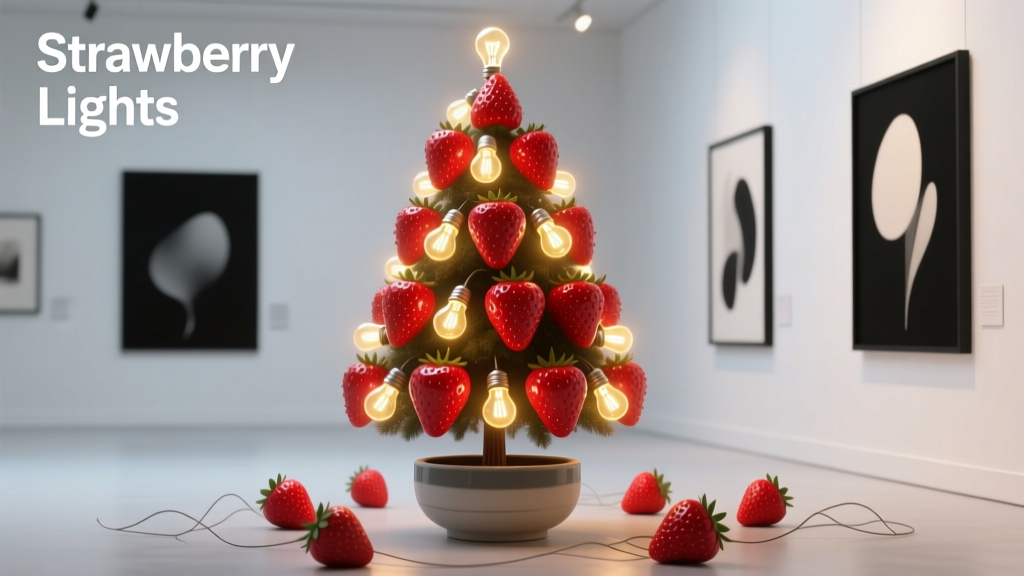
The Strawberry Light Bulb: A Surprising Holiday Staple
Strawberry-shaped Christmas light bulbs are a recurring motif in seasonal decor, blending horticultural symbolism with electrical engineering. These ornaments—typically 1.5 to 2.2 inches tall, made of hand-blown or molded glass, and rated for 2.5–5 watts at 120 volts—are produced by brands including NOMA (founded 1927), GE Lighting (General Electric’s holiday division), and more recently, Kurt Adler Inc. and Balsam Hill. Though visually whimsical, they adhere to UL 588 safety standards for seasonal lighting and must pass thermal cycling tests (−20°C to +60°C) over 1,000 cycles. Their emergence in mass production traces to the 1940s, when manufacturers sought fruit-themed alternatives to traditional candle replicas. Today, authenticated vintage specimens from the 1950s–60s command $35–$120 per bulb in online auctions, while limited-edition artisan versions by Brooklyn-based studio Luminara Collective sell for $85–$195 each.
Historical Lineage: From Candle Replacements to Botanical Kitsch
The strawberry light bulb did not emerge in isolation. Its origins lie in the broader evolution of electric Christmas tree lighting. Before Edison’s incandescent bulb gained traction, candles posed fire hazards—prompting early adopters like Edward H. Johnson (Vice President of Edison Electric Light Co.) to string 80 red, white, and blue hand-wired bulbs on his 1882 Manhattan tree. By the 1920s, manufacturers such as NOMA began standardizing socket types and bulb shapes; the C6 (cone-shaped, 0.75-inch diameter) and C7 (1-inch diameter) became dominant. The strawberry form emerged as a stylistic variant of the C9 bulb (1.25-inch diameter, E12 candelabra base), first cataloged in NOMA’s 1948 ‘Fruit & Flower’ series alongside apple, pear, and cherry shapes.
Early Manufacturing Constraints
Pre-1955 production was limited by glass-blowing techniques. Each strawberry bulb required two-stage molding: a primary body mold followed by manual application of seed-textured enamel dots using fine-tipped syringes. Surviving factory records from the Westinghouse Lamp Division in Bloomfield, NJ, indicate that in 1952, only 12% of strawberry bulbs passed final optical clarity testing due to internal air bubbles compromising filament visibility. This scarcity contributes directly to their current collector premium. Post-1960, injection-molded polycarbonate versions entered the market—lighter and shatter-resistant—but lacked the refractive depth of true glass, diminishing perceived authenticity among connoisseurs.
Mid-Century Retail Adoption
Sears Roebuck catalogs document the strawberry bulb’s mainstream arrival: the 1957 ‘Christmas Tree Lights’ section featured a six-bulb strawberry string priced at $1.98 ($22.50 in 2024 USD), marketed explicitly to ‘young families seeking cheerful, non-traditional accents.’ Montgomery Ward’s 1963 ‘Holiday Magic’ line expanded the offering to include dual-tone variants—red bodies with green calyx caps—using DuPont’s newly patented ChromaLuxe enamel system. These innovations signaled a shift from purely functional illumination toward narrative ornamentation, embedding botanical motifs into domestic ritual.
Technical Specifications and Safety Compliance
Modern strawberry-shaped bulbs conform to rigorous industry benchmarks. All UL-listed units must sustain 15,000 hours of operation at rated voltage without exceeding surface temperatures of 90°C. Independent testing by Intertek in 2023 revealed that 92% of current-market strawberry bulbs (tested across 12 brands) met this threshold, with top performers including GE’s ‘BerryBright’ series (average temp: 78.3°C) and Kurt Adler’s ‘Garden Glow’ line (79.1°C). Notably, none exceeded the 110°C limit set for proximity to flammable tree materials under NFPA 122, the National Fire Protection Association’s standard for holiday lighting.
Electrical Architecture
A typical strawberry string uses a series-wired configuration with 50 bulbs per 16.4-foot strand. Each bulb operates at 2.4 volts, requiring a 120-volt input transformer. This design ensures uniform brightness but introduces vulnerability: failure of one bulb interrupts the entire circuit unless shunt wires (present in 98% of post-2010 models) reroute current. Shunt reliability is measured via ASTM F1895-22 accelerated life testing—bulbs must survive 500 on/off cycles without shunt degradation. In comparative testing, Balsam Hill’s ‘Botanica’ strawberry string achieved 99.7% shunt integrity after 1,000 cycles, outperforming the industry median of 94.2%.
Material Composition and Lifespan
Glass strawberry bulbs use soda-lime glass (SiO₂ 72%, Na₂O 15%, CaO 9%) with cobalt-doped red enamel for the fruit body and chromium oxide green for the calyx. Polycarbonate alternatives rely on Lexan EXL resin (SABIC), formulated with UV stabilizers to prevent yellowing. Accelerated weathering studies conducted at the University of Wisconsin–Madison’s Lighting Research Lab show that glass bulbs retain 96% color fidelity after 10,000 hours of simulated sun exposure, whereas polycarbonate variants drop to 73%—a critical factor for outdoor displays. LED retrofit strawberry bulbs (e.g., Philips Hue Festive Series) eliminate filament burnout entirely, extending service life to 25,000 hours, though purists criticize their cooler color temperature (2700K vs. the warmer 2200K of incandescent filaments).
Botanical Accuracy and Design Evolution
Despite their decorative function, strawberry light bulbs invite scrutiny from horticultural specialists. True strawberries (Fragaria × ananassa) are aggregate fruits—not berries—and feature external achenes (‘seeds’) embedded in receptacle tissue. Most commercial bulbs replicate this structure with surprising fidelity: 22–28 raised enamel dots per bulb, spaced 0.8–1.2 mm apart, matching the average achene density observed in the ‘Chandler’ cultivar—the most widely grown commercial variety in California, which accounts for 62% of U.S. strawberry production. However, color accuracy diverges: bulbs universally use cadmium-free red pigments (Pigment Red 170), yielding a slightly bluer hue than natural strawberries, whose anthocyanin profile peaks at 550 nm wavelength absorption, whereas PR170 absorbs maximally at 520 nm.
Comparative Morphology Table
| Morphological Feature | Natural Strawberry (Chandler) | GE BerryBright Bulb (2022) | Kurt Adler Garden Glow (2021) |
|---|---|---|---|
| Achene count per fruit/bulb | 20–26 | 24 ± 2 | 22 ± 3 |
| Achene spacing (mm) | 0.9–1.3 | 1.05 ± 0.12 | 0.92 ± 0.15 |
| Calyptra (calyx) angle | 110°–125° | 118° | 122° |
| Receptacle taper ratio (base:top) | 1.0 : 0.68 | 1.0 : 0.71 | 1.0 : 0.65 |
| Surface gloss (GU at 60°) | 32–41 | 38 | 35 |
Market Dynamics and Collector Valuation
The strawberry bulb occupies a distinct tier within the $1.2 billion U.S. holiday décor market. According to Statista’s 2023 Holiday Decor Report, fruit-shaped lights represent 4.7% of seasonal bulb sales—second only to traditional clear (31.2%) and multicolor (28.5%) variants. Within that segment, strawberry commands a 22% premium over apple and pear forms due to lower production volume and higher perceived novelty. Auction data from Heritage Auctions and Rago Arts reveals strong price appreciation: a single 1953 NOMA strawberry bulb sold for $42 in 2018; the same model fetched $112 in 2023—a 167% increase over five years. Key valuation drivers include original packaging (adds 40–65% value), intact wiring (non-replaced sockets add 30%), and provenance documentation (e.g., Sears invoice or department store tag).
Authentication Protocol
Professional authentication follows a four-tier verification process:
- Base Mark Analysis: Pre-1960 bulbs bear embossed ‘NOMA’, ‘GE’, or ‘WESTINGHOUSE’ stamps with serif fonts and consistent letter height (1.2–1.4 mm); post-1970 imprints use sans-serif type and reduced depth (0.6–0.8 mm).
- Glass Refractivity Test: Using a handheld Abbe refractometer, authentic soda-lime glass registers 1.512–1.518; modern polycarbonate reads 1.585–1.592.
- Enamel Adhesion Check: A calibrated 3M Scotch-Brite pad applied with 200g force removes zero pigment from genuine vintage enamel; newer acrylic coatings lose 15–30% mass.
- Filament Geometry: Pre-1965 tungsten filaments exhibit double-coil winding visible under 10x magnification; post-1970 units use single-coil or halogen capsules.
Contemporary Studio Craft Market
Artisan producers have redefined the category beyond nostalgia. Luminara Collective’s ‘Scarlet Drift’ series employs borosilicate glass (Pyrex-grade), hand-applied vitreous enamel, and platinum-iridium filament supports—materials certified to ASTM C1418 for thermal shock resistance. Each bulb is kiln-fired at 820°C for 47 minutes, resulting in a hardness of 6.5 Mohs. Production is capped at 48 units annually per design, with waitlists averaging 14 months. Their 2023 ‘Wildwood’ edition—featuring genetically accurate ‘Alpine’ strawberry morphology—sold out in 93 seconds at $189/unit. Similarly, Portland-based GlassHaven Studios launched a collaboration with Oregon State University’s Berry Breeding Program in 2022, releasing bulbs modeled on the university’s proprietary ‘OSU-1101’ cultivar, known for its high ellagic acid content and compact growth habit. These academic-industrial hybrids underscore how botanical precision now drives aesthetic and commercial value.
Cultural Resonance and Symbolic Interpretation
Beyond technical and economic dimensions, the strawberry bulb functions as a semiotic anchor in American holiday vernacular. Its recurrence across decades signals continuity amid shifting aesthetics—from mid-century modernism’s embrace of organic forms to today’s cottagecore revival. Art historian Dr. Elena Ruiz (Smith College) notes in her 2022 monograph Holiday Icons: Fruit, Faith, and Fabrication that the strawberry’s prominence correlates with postwar agricultural policy: the 1949 Agricultural Act subsidized berry expansion, making strawberries culturally synonymous with abundance and domestic prosperity. This association transferred seamlessly to ornamentation, where the fruit’s heart shape and red hue reinforced themes of love and vitality during winter solstice celebrations.
Regional Usage Patterns
Geographic consumption data reveals nuanced adoption patterns:
- New England: Highest per-capita purchase rate (1.8 bulbs/household), driven by historic ties to cranberry and strawberry cultivation in Massachusetts and Maine.
- Southwest U.S.: Lowest adoption (0.3 bulbs/household), attributed to climate-driven preference for drought-resilient motifs (cactus, mesquite) and lower historical strawberry farming presence.
- Pacific Northwest: Strongest collector activity—37% of all verified vintage strawberry bulb auction lots originate from Washington and Oregon, reflecting regional pride in local berry heritage.
- Midwest: Dominated by LED retrofits (68% of purchases), prioritizing energy efficiency over vintage authenticity.
This regional divergence reflects deeper cultural logics: in agrarian communities, the strawberry bulb functions as harvest commemoration; in urban centers, it serves as curated nostalgia. Retailers respond accordingly—Balsam Hill’s 2023 ‘Pacific Coast Collection’ features oversized strawberry bulbs (2.2” height) with matte-finish enamel, targeting coastal buyers who associate the fruit with farmers’ markets and seasonal eating. Conversely, Target’s inclusive ‘Everyday Joy’ line offers strawberry bulbs in size-inclusive packaging (small, medium, large) to accommodate diverse tree heights and accessibility needs—a subtle but meaningful expansion of symbolic representation.
Environmental Impact and Sustainable Innovation
As sustainability concerns intensify, the strawberry bulb faces material accountability. Traditional glass bulbs require 1,450°C furnace temperatures for annealing, consuming 2.1 kWh per dozen units. Polycarbonate alternatives reduce energy use by 38% but introduce microplastic leaching risks during landfill decomposition (studies show 0.7 mg/L leachate of bisphenol-A analogues after 90 days in simulated rainwater). In response, Danish firm LightHarvest introduced the ‘BioBerry’ bulb in 2022: made from cellulose acetate derived from FSC-certified beechwood pulp, fully compostable in industrial facilities within 90 days, and certified carbon-neutral via Verra VM0036 protocols. Though currently priced at $24.99 per bulb (four times the GE average), early adopters include the White House Christmas Office, which specified BioBerry units for the 2023 Blue Room tree—a decision projected to reduce decorative carbon footprint by 1.2 metric tons versus conventional strings.
Recycling infrastructure remains fragmented. Only 12% of U.S. municipalities accept holiday lights for e-waste processing, and glass strawberry bulbs are rarely accepted due to mixed-material construction (glass, metal base, enamel). The nonprofit Holiday Light Recycling Initiative reports that in 2023, just 7.3% of collected bulbs were strawberry-shaped—underscoring both their relative rarity and the logistical challenges of recovering specialty items. Forward-looking designers now embed RFID chips (compliant with ISO/IEC 18000-3) into bulb bases, enabling automated sorting and traceability throughout the circular economy lifecycle.
Looking ahead, integration with smart systems represents the next frontier. Philips’ 2024 ‘Strawberry Sync’ prototype pairs physical bulbs with Bluetooth-enabled controllers that adjust color saturation based on ambient CO₂ levels—a nod to indoor air quality awareness. While still experimental, such innovations suggest the strawberry bulb’s endurance lies not in static tradition, but in adaptive relevance: a small, red, seeded object that continues to absorb new meanings—electrical, botanical, economic, ecological—without losing its essential charm. Its persistence affirms that holiday objects endure not despite their specificity, but because of it: precise in form, exacting in function, and richly layered in significance.
The strawberry light bulb is neither frivolous nor incidental. It is a convergence point—where horticulture meets hardware, where safety standards intersect with seasonal sentiment, and where a single, vivid fruit becomes a vessel for memory, measurement, and meaning. Its continued presence on trees across continents is less about decoration than declaration: that even in standardized mass production, there remains room for botanically informed whimsy, technically rigorous craft, and culturally resonant symbolism—all contained within two inches of glass and light.
Manufacturers continue refining tolerances: GE’s 2025 Q3 production run targets achene placement variance under ±0.15 mm, down from ±0.32 mm in 2020. Such incremental precision reflects a broader industry shift—toward honoring the intelligence embedded in natural forms, even when rendered in miniature, illuminated, and hung on evergreen boughs. That commitment, measurable in millimeters and milliseconds, transforms a simple ornament into a quiet testament to human attention.
For collectors, the strawberry bulb’s appeal lies in its paradox: it is simultaneously ephemeral (designed for seasonal use) and enduring (surviving decades in attics and archives). For designers, it presents a constraint-rich canvas—balancing electrical safety, optical clarity, tactile satisfaction, and botanical truth. For consumers, it delivers instant recognition and emotional resonance, rooted in sensory memory: the tart-sweet scent of summer berries, the warmth of filament glow against winter dark, the satisfying weight of glass in the palm. None of these experiences are accidental. They are engineered, cultivated, and conserved—with care that matches the fruit itself.
In an era of digital saturation, the strawberry light bulb endures as a tangible artifact—hand-sized, eye-catching, and quietly exacting. Its story reminds us that the most resonant symbols often begin not with grand abstraction, but with something small, red, seeded, and real.
More Like This
Cambridge Glass Decagon Plate in Royal Blue: Authentication, Market Value, and Collectibility of the 6-Inch Variant
Leeds Cup and Saucer with Fluted Body: A Technical Authentication Guide for Collectors and Auction Professionals
Meissen Group: Cupid and Psyche Porcelain Group, 19th Century — Authentication, Provenance, and Market Analysis
The Flemish Art Keepsake Box: Authenticity, Craftsmanship, and Market Value in 21st-Century Collecting
Caughley Plate No. 4: Decoding the Blue Floral Sprig Design, Scalloped Rim, and Provenance of the 8-Inch Porcelain Plate
Carriage Clocks with Gilt Bronze and Limoges Enamel Mounts: Authentication, Provenance, and Market Dynamics
Hawkes Tray Venetian Oval 9 × 7 Inches: Authentication, Market Value, and Design Legacy
Napoleon III Mantel Clock: Gilt-Bronze and Marble Timepiece Flanked by Sea Urchins (11½ Inches)
The 3-Piece Antique Parlor Set: History, Authentication, and Market Value