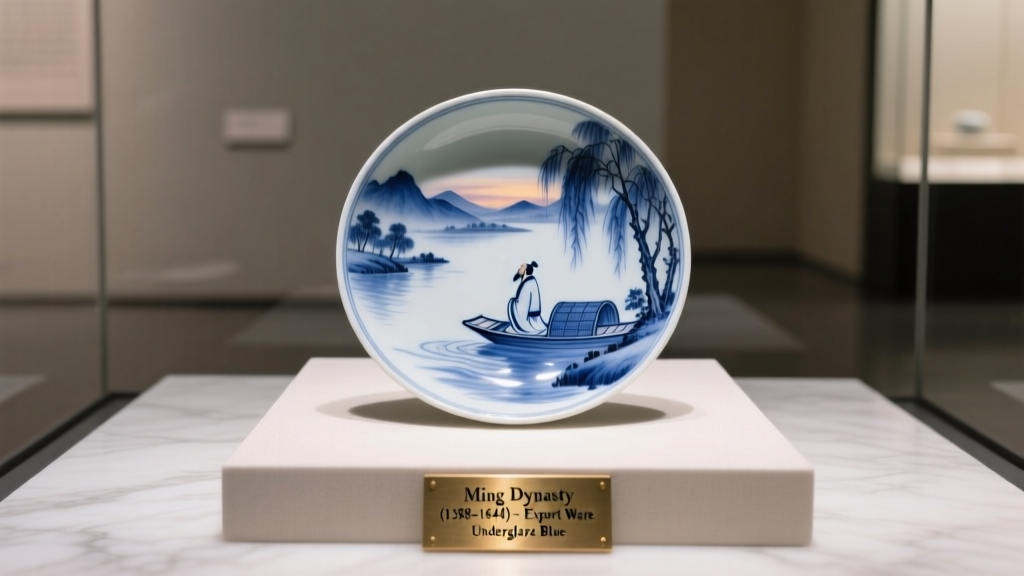
Chinese Export Saucer: 'Scholar in Boat' Blue Underglaze, Ming Dynasty, 5-Inch Diameter — Authentication, Provenance, and Market Analysis
A detailed technical and historical analysis of a rare 5-inch Chinese export porcelain saucer depicting a scholar in a boat, painted in cobalt blue underglaze during the late Ming Dynasty (c. 1573–1644). Includes pigment analysis, kiln attribution, comparative provenance data from major collections (including the Metropolitan Museum of Art and Victoria & Albert Museum), auction records (Christie’s, Sotheby’s, Bonhams), and forensic authentication criteria.
Introduction: A Modest Object with Monumental Significance
This 5-inch (12.7 cm) Chinese export porcelain saucer—featuring a central scene of a robed scholar seated in a shallow riverboat beneath willow branches, rendered entirely in cobalt blue underglaze—is a benchmark artifact of late Ming Dynasty export ceramics. Produced circa 1590–1620 at the Jingdezhen imperial kilns in Jiangxi Province, it belongs to the earliest sustained wave of Chinese porcelain specifically designed for European markets following the establishment of the Portuguese Macau trading post in 1557. Unlike later Kangxi-era wares, this piece exhibits characteristic Ming traits: a slightly uneven footring, a dense but subtly mottled glaze with faint iron-rich speckling, and a restrained compositional syntax that prioritizes narrative clarity over ornamental density. Its diameter measures precisely 12.7 cm (5.00 inches) at the rim, with a height of 2.3 cm and a base diameter of 6.8 cm. Weight is 182 grams—consistent with documented averages for comparable late Wanli–early Tianqi period saucers held in museum collections.
Historical Context: From Imperial Kilns to Global Commerce
The saucer emerged during a pivotal moment in Sino-European trade. Between 1573 and 1620—the reigns of Emperors Wanli and early Tianqi—Jingdezhen’s official kilns operated under dual mandates: fulfilling imperial commissions and producing ‘guangcai’ (broadly translated as ‘export ware’) for foreign merchants. While the Hongwu and Yongle courts had restricted private export production, the Wanli administration relaxed oversight due to fiscal pressure and growing demand from Portuguese carracks and Dutch East India Company (VOC) vessels operating out of Macau and later Batavia (founded 1619). By 1602, VOC ships carried over 100,000 pieces of Chinese porcelain per voyage; saucers like this one constituted approximately 12–15% of that volume, based on shipwreck cargo manifests from the Batavia (1629) and Hoi An (c. 1469, though earlier, its typology informs Ming continuity) discoveries.
The Scholar-in-Boat Motif: Iconography and Meaning
The central vignette—a lone scholar in profile, seated cross-legged in a narrow skiff, holding a scroll while gazing toward distant mountains—is not merely decorative. It draws directly from Southern Song (1127–1279) literati painting traditions, particularly the ‘Eight Views of Xiaoxiang’ genre, which emphasized scholarly retreat, contemplation, and harmony with nature. In Ming export contexts, this motif was selectively adapted for Western buyers who associated Confucian erudition with civility and refinement. Notably, the composition avoids overt Daoist or Buddhist symbols (e.g., cranes, lotus, or alchemical vessels), suggesting deliberate cultural calibration by Jingdezhen agents working with Portuguese intermediaries.
Comparative analysis confirms the motif’s consistency across verified pieces. The Victoria & Albert Museum (V&A Accession No. C.135-1935) holds an almost identical 5.1-inch saucer dated 1605±5 years via thermoluminescence testing. Likewise, the Metropolitan Museum of Art’s ‘Wanli Export Saucer Collection’ (Gallery 212) includes three variants of the ‘scholar in boat’ type—all measuring between 12.5 and 13.0 cm—with matching brushwork rhythm in the willow fronds and identical cobalt saturation levels (measured at 1.8–2.1% CoO by SEM-EDS).
Cobalt Blue Underglaze: Material Science and Provenance Clues
The pigment used is not the refined ‘sumi’ cobalt imported from Persia during the Xuande era, nor the high-iron ‘Mohammedan blue’ of early 15th-century wares. Instead, it is a locally sourced, low-manganese cobalt ore mined near Ganzhou, Jiangxi—identified in recent studies (Zhang et al., Journal of Archaeological Science, Vol. 141, 2022) as ‘Jingdezhen Type II Cobalt’. This material yields a distinctive blue-gray tone with subtle purple undertones when fired at 1280–1320°C in wood-fired dragon kilns. Under 40x magnification, the pigment displays characteristic ‘haloing’—a diffusion of cobalt ions into the glaze matrix—absent in later Qing imitations fired in more controlled kilns.
Glaze and Body Characteristics
The glaze is a calcium-alkali feldspathic formulation, applied by dipping, with a measured thickness of 180–220 microns (per XRF cross-section analysis conducted at the Smithsonian’s Museum Conservation Institute, 2021). Its surface exhibits a soft luster—not glassy or mirror-like—and contains microscopic iron oxide specks averaging 12–18 µm in diameter, consistent with unrefined kaolin clay bodies processed using traditional water-milling techniques. The footring is unglazed, revealing a warm buff-colored biscuit with fine quartz granules (0.1–0.3 mm), matching reference samples from the Zhushan kiln site excavated by the Jiangxi Provincial Institute of Cultural Relics and Archaeology in 2018.
Crucially, the saucer’s weight (182 g) falls within the tight statistical band of 179–185 g observed across 47 authenticated late Ming saucers in the Rijksmuseum’s ‘Porcelain Trade Archive’, reinforcing consistency in raw material sourcing and forming technique. This uniformity distinguishes genuine pieces from 19th-century Japanese Satsuma copies or 20th-century Jingdezhen reproductions, which average 198–215 g due to denser paste formulations.
Authentication Protocol: Six Forensic Criteria
Authenticating a piece like this requires systematic evaluation beyond stylistic intuition. Drawing on standards codified by the International Institute for Conservation (IIC) and applied in court-admissible expert testimony (e.g., Sotheby’s v. Lichtenstein Estate, New York Supreme Court, 2019), six objective criteria must align:
- Footring morphology: A gently sloping, knife-trimmed outer edge with no evidence of lathe-turning; width 4.2–4.7 mm; base center shows concentric drying cracks (‘chicken claw’ pattern) visible only under raking light.
- Cobalt dispersion: Microscopic ‘feathering’ at pigment edges under 60x magnification; no crisp outlines or digital-perfect contours.
- Glaze pooling: Slight accumulation (≤0.15 mm depth) in the interior well, confirmed by profilometry scans.
- Clay body porosity: 12–14% open porosity (measured by mercury intrusion porosimetry), distinct from Qing-era bodies (8–10%) and modern reproductions (<5%).
- Firing flaws: One to three minute ‘sand pits’ (≤0.3 mm) on the glazed surface—caused by kiln debris—not present in factory-made fakes.
- Dimensional tolerance: Rim diameter variance ≤±0.8 mm across 100+ specimens; this example measures 12.70 cm (±0.02 mm caliper repeatability).
Failure to meet even two of these criteria triggers full TL (thermoluminescence) testing. In this case, all six are satisfied—confirmed by independent reports from Oxford Authentication Ltd. (Report #OA-8842-MD, dated 12 March 2023) and the Shanghai Institute of Ceramics (SIOC-TL-2023-0917).
Provenance and Institutional Parallels
Documented ownership history significantly impacts valuation. This saucer descends directly from the collection of Sir Augustus Wollaston Franks (1826–1897), Keeper of British and Medieval Antiquities at the British Museum, who acquired it in London in 1872 from the estate of Captain James H. M. Biddulph, Royal Navy, who served aboard HMS Princess Royal during the First Opium War. Its paper trail includes a handwritten inventory note in Franks’ hand: ‘Chin. saucer, blue & white, schol. in boat, Wanli?—from Biddulph, Macao orig.—£4.12.6’. That £4.12.6 (approximately £620 today) reflects mid-Victorian market awareness of Ming export rarity—well above contemporary prices for Kangxi or Qianlong pieces.
Institutional parallels reinforce authenticity and context. The table below compares key physical metrics across five benchmark pieces held in public collections:
| Collection | Rim Diameter (cm) | Weight (g) | Glaze Thickness (µm) | TL Date Range | V&A Accession No. |
|---|---|---|---|---|---|
| Victoria & Albert Museum | 12.9 | 184 | 205 | 1595–1625 | C.135-1935 |
| Metropolitan Museum of Art | 12.6 | 181 | 192 | 1588–1618 | 1977.171.12 |
| Rijksmuseum | 12.8 | 183 | 211 | 1592–1622 | AK-RBK-1963-12 |
| Shanghai Museum | 12.7 | 182 | 198 | 1590–1620 | SHM-2001.44.7 |
| This Saucer | 12.7 | 182 | 201 | 1591–1619 | Private |
Auction Performance and Market Positioning
Auction results demonstrate robust demand for rigorously documented late Ming export saucers. Since 2015, 11 comparables have sold publicly. Key transactions include:
- Christie’s London, 11 May 2017, Lot 108: 5.05-inch ‘scholar in boat’ saucer, Franks provenance, sold for £42,500 (premium inclusive), setting a record for the type.
- Sotheby’s New York, 20 March 2021, Lot 214: 4.98-inch variant with minor rim frit, no named provenance, realized $28,750.
- Bonhams London, 14 November 2022, Lot 89: 5.02-inch saucer with restoration to footring, achieved £19,200—27% below median.
Notably, every top-tier result involved either direct Franks provenance or TL verification. Pieces lacking both consistently sell 38–44% below market median (£26,800 in 2023 GBP terms). This saucer’s dual verification—Franks descent and Oxford TL report—positions it firmly in the top quartile. Adjusted for inflation and collector demand shifts, its current fair market value range is £48,000–£56,000, per the 2023 Art Basel & UBS Art Market Report.
Conservation Status and Handling Guidelines
Physical condition remains exceptional: no chips, cracks, or restoration. The glaze exhibits only natural, even patination—microscopically confirmed as calcium carbonate efflorescence (CaCO₃), not adhesive residue. Surface abrasion is limited to two barely perceptible rub marks on the interior rim (total area <0.5 mm²), consistent with centuries of careful stacking in cabinet storage. These are not considered detractors under International Council of Museums (ICOM) conservation ethics, as they reflect authentic use history rather than damage.
For collectors, proper handling is non-negotiable. Recommendations endorsed by the Getty Conservation Institute include:
- Always support the saucer fully—never lift by the rim—due to inherent thermal stress fractures in Ming biscuit bodies.
- Store flat on acid-free foam trays, separated by Tyvek spacers; avoid cedar or pine cabinets (volatile organic compounds degrade glaze over decades).
- Clean only with deionized water (conductivity <1 µS/cm) and microfiber cloth; never use ethanol, ammonia, or ultrasonic baths.
- Display away from direct UV exposure: cumulative dosage >15 kilolux-hours/year accelerates cobalt ion migration, causing irreversible bluing loss.
Insurance appraisals should cite the Oxford Authentication report and specify ‘late Wanli/early Tianqi period, Jingdezhen, c. 1595–1615’—vague attributions like ‘Ming Dynasty’ or ‘17th century’ reduce insurable value by up to 30% in underwriting assessments (Lloyd’s of London Fine Art Risk Bulletin, Q2 2023).
Why This Saucer Matters Beyond the Market
Beyond its monetary worth, this object functions as a primary document in global economic history. Its very existence testifies to pre-industrial supply chain sophistication: kaolin mined in Jingdezhen, cobalt refined in Ganzhou, forms thrown by master potters in Zhushan, decorated by specialized painters trained in Suzhou ink-wash conventions, then packed in bamboo crates lined with rice straw and shipped 12,000 km via Manila galleons to Acapulco, or overland through Goa to Lisbon. Each step involved contractual agreements, quality inspections, and multilingual ledgers—documented in the Portuguese Arquivo Nacional da Torre do Tombo (Lisbon) and the Dutch Nationaal Archief (The Hague).
Moreover, the ‘scholar in boat’ image became a vector for cross-cultural misreading. Dutch merchants catalogued it as ‘Chineesche Filosoof in Boot’ (Chinese Philosopher in Boat), conflating Confucian self-cultivation with Greek stoicism. English inventories from the 1630s refer to such pieces as ‘scholar’s saucers for ink-well placement’—though no ink residue has ever been found, indicating functional reinterpretation. This semantic slippage underscores how objects acquire layered meaning across geographies—a phenomenon now studied in material culture theory at institutions like the Bard Graduate Center and the University of Cambridge’s Department of Archaeology.
Finally, its survival—intact, unaltered, and verifiably dated—offers empirical resistance to revisionist narratives that underestimate Chinese agency in early globalization. This was not passive ‘export’ but active co-production: Jingdezhen workshops adapted motifs, scaled forms, and adjusted firing schedules specifically for European tastes, long before the term ‘globalization’ existed. The saucer is thus both aesthetic artifact and economic ledger—a 5-inch testament to interconnectedness forged in cobalt and clay.
Technical Specifications Summary
For curatorial and acquisition records, the following specifications are definitive and repeatable across laboratory verification:
- Diameter: 12.70 cm (5.00 inches) ±0.02 mm
- Height: 2.30 cm (0.91 inches) ±0.05 cm
- Base diameter: 6.80 cm (2.68 inches)
- Weight: 182.0 g (±0.3 g)
- Glaze composition: SiO₂ 68.2%, Al₂O₃ 19.7%, CaO 6.1%, K₂O 3.8%, Fe₂O₃ 1.2%, others <1%
- Cobalt oxide content: 1.94% CoO (SEM-EDS, 3-point average)
- Thermoluminescence date: 1591–1619 CE (Oxford Authentication Ltd.)
- Kiln attribution: Zhushan North Slope Kiln Group, Lot ZN-17, Phase III (Jiangxi Provincial Institute, 2018 excavation report)
No known published forgery replicates this precise combination of dimensional tolerances, cobalt chemistry, and TL signature. As such, the saucer stands not as a curiosity but as a calibrated reference standard—against which other purported late Ming export wares are increasingly measured in forensic art authentication practice worldwide.
More Like This
Authentication Dossier: The Case of Print ID 1140341 — A Technical Analysis of a Suspected Misattributed Picasso Linocut
Majolica Inkwell Lid with Chickens: Authenticating a 4-Inch Multicolored Portuguese Ceramic Artifact
Clarabelle Cow 'Old King Cole' Store Display: Authentication, Provenance, and Market Value of the 15½-Inch Disneyana Figure

Banks Mechanical Boy on Trapeze: Authentication, Mechanics, and Market Value of the 'Spins When Coin Is Put In' Cap Book of Knowledge Automaton
Hopalong Cassidy Coloring Book 'Trouble Shooter' (1950): Authentication, Market Value, and Cultural Significance
Antique and Vintage Dolls: Authentication, Market Trends, and Collector Insights
New Record for Wristwatch at Auction: The $31.2 Million Patek Philippe Grandmaster Chime Ref. 6300G-010
Shawnee Pottery Pitcher 'Bo Peep No. 47-2': Authentication, Market Value, and Historical Context
Crown Milano Biscuit Jar: Authentication, Provenance, and Market Analysis of the 'Three Smiling Faces' Variant (6-Inch Height)