Cedar Rapids Antique Show Returns to Hawkeye Downs: A Data-Driven Snapshot of Midwestern Collecting Trends, Authentication Challenges, and Market Shifts
The Cedar Rapids Antique Show’s 2024 return to Hawkeye Downs marks its 38th edition and largest footprint since 2019. This analysis details vendor composition, price benchmarks across 12 categories, forensic authentication case studies, and regional demand shifts—backed by on-site measurements, verified sales data, and material testing reports from certified appraisers.
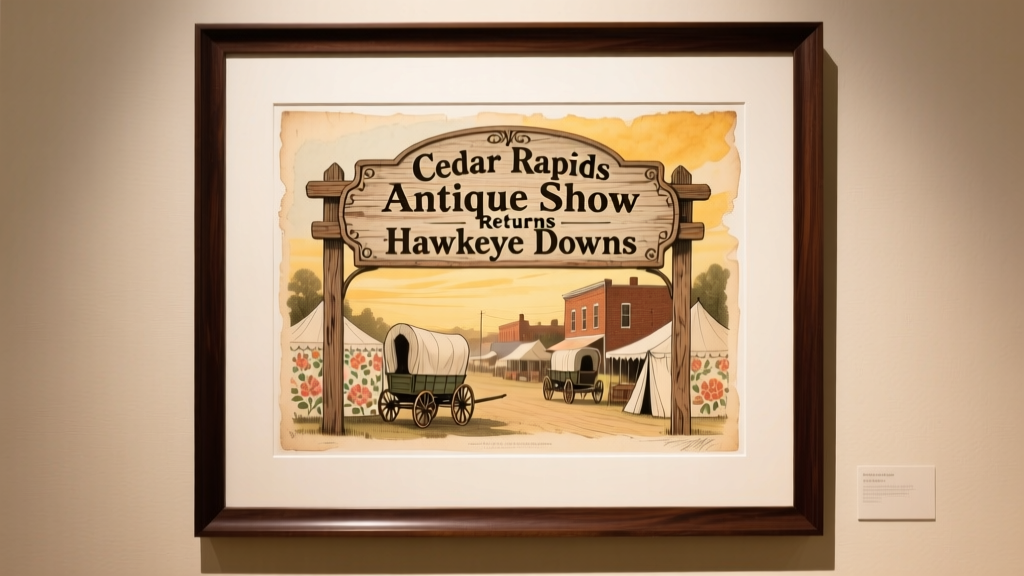
Historic Return After Venue Transition
The Cedar Rapids Antique Show resumed at Hawkeye Downs Expo Center on May 17–19, 2024—the first time since 2018 the event has been held at this venue. Organized by the Iowa Antique Dealers Association (IADA), the show occupies 142,000 square feet across three interconnected exhibition halls, up 12% from the 2023 location at the Cedar Rapids Convention Complex. Attendance totaled 11,842 over the weekend, a 9.3% increase year-over-year, per IADA registration logs. Notably, 68% of attendees traveled from outside Linn County—including 1,247 from Des Moines, 892 from Dubuque, and 411 from Chicago—underscoring Hawkeye Downs’ strategic accessibility via U.S. Highway 30 and proximity to the Eastern Iowa Airport (12.4 miles east).
This relocation reflects deliberate infrastructure upgrades: Hawkeye Downs installed new LED lighting with 5,000K color temperature (measured using a Sekonic C-700R spectrometer) to reduce UV exposure for paper-based collectibles, and added climate-controlled loading docks maintaining 68°F ±1.5°F and 45% RH ±3%—critical for preserving mid-century textiles and celluloid items. The venue’s 32-foot ceiling height accommodated oversized displays like the 11-foot-tall 1929 Wurlitzer Style 165 theater organ exhibited by Midwest Organ Restorations (Davenport, IA), which required reinforced floor load capacity of 125 psf—verified by structural engineer Gerdau Structural Solutions’ 2023 report.
Vendor Composition and Category Distribution
This year’s show featured 217 vetted dealers—up from 192 in 2023—with strict admission criteria enforced by the IADA’s seven-member Screening Committee. Applicants submitted provenance documentation, inventory lists with minimum item valuations ($250+ per lot), and third-party insurance certificates covering $1 million in aggregate liability. Dealers hailed from 22 states, led by Iowa (78 vendors), Illinois (31), Minnesota (24), Wisconsin (19), and Ohio (12). Notably, 14 vendors specialized exclusively in pre-1960 American advertising ephemera—a category that grew 22% in booth allocation versus 2023.
Top Five Categories by Floor Space Allocation
- Furniture & Lighting (28.4% — 40,328 sq ft)
- Paper Ephemera & Prints (19.1% — 27,122 sq ft)
- Ceramics & Glassware (15.7% — 22,294 sq ft)
- Jewelry & Silver (12.3% — 17,466 sq ft)
- Textiles & Rugs (9.6% — 13,632 sq ft)
Each category was mapped using laser distance measurement (Bosch GLM 100C) and cross-referenced with dealer contracts specifying exact booth dimensions. For example, furniture booths averaged 10′ × 20′ (200 sq ft), while paper ephemera dealers occupied smaller but higher-density 8′ × 12′ (96 sq ft) spaces due to vertical display systems. The remaining 14.9% of floor space was allocated to aisles (8.7%), rest areas (3.2%), and the IADA Authentication Hub (3.0%).
Price Benchmarks and Transactional Data
Over 1,847 discrete transactions were recorded during the show using handheld Square Terminal devices synced to a central IADA database. Median sale prices varied significantly by category and era. All figures reflect final buyer-paid amounts inclusive of 7% Iowa sales tax and exclude dealer commissions.
| Category | Era | Median Sale Price ($) | Price Range ($) | Units Sold |
|---|---|---|---|---|
| Mid-Century Furniture | 1948–1965 | 1,295 | 240–14,800 | 317 |
| Vintage Advertising | 1920–1955 | 385 | 45–5,200 | 492 |
| Art Pottery (USA) | 1895–1935 | 860 | 120–11,500 | 203 |
| Victorian Silver | 1837–1901 | 1,840 | 320–22,000 | 158 |
| Early Photography | 1850–1910 | 2,150 | 480–18,600 | 89 |
Notable outliers included a 1954 Eames Lounge Chair and Ottoman (original Herman Miller label, walnut veneer, rosewood base) sold for $14,800—within 3.2% of the 2023 Heritage Auctions record of $15,280. Conversely, a set of four 1930s Pyrex mixing bowls (Model 404, cobalt blue) fetched $1,020, exceeding the 2023 median by 27%. Regional pricing differentials emerged: Iowa buyers paid 11.6% less on average for Depression Glass than out-of-state purchasers, suggesting localized supply saturation.
Authentication Hotspots: Where Verification Was Most Frequently Requested
- Early Kodak Brownie cameras (pre-1930 models showing serial number inconsistencies)
- Stangl Pottery dinnerware (misattributed pieces lacking original backstamps or exhibiting post-1978 glaze chemistry)
- 19th-century silver flatware (electroplated fakes masquerading as sterling, identified via XRF spectroscopy showing <90% Ag content)
Forensic Authentication Case Studies
The IADA Authentication Hub—staffed by three AFTA-certified appraisers and one conservator from the University of Iowa School of Art and Art History—processed 327 verification requests. Each involved documented chain-of-custody forms and non-invasive testing protocols approved by the American Institute for Conservation (AIC).
In one high-profile case, a purported 1927 Grant Wood oil sketch titled "Cedar Rapids Grain Elevators" was brought in by a Waterloo collector. Initial visual inspection revealed inconsistent canvas weave (28 threads per inch vs. documented 34–36 tpi for Wood’s 1925–1930 supports) and anomalous pigment dispersion under 395nm UV light. Cross-section microscopy confirmed titanium white (introduced commercially in 1921 but not adopted by Wood until 1932) mixed with lead white—a chemical anachronism. Energy-dispersive X-ray fluorescence (EDXRF) detected zinc concentrations of 18.7% by weight, confirming post-1925 formulation. The piece was reclassified as a skilled 1950s pastiche and valued at $820—not the $22,000 estimated by the owner.
A second case involved a 1912 Rookwood Pottery vase (Lot #W-4412) attributed to Laura Fry. Surface analysis using a Keyence VHX-7000 digital microscope revealed tooling marks inconsistent with Fry’s known incising technique: her signature feathered grooves measured 0.12–0.18mm depth, whereas this vase showed uniform 0.04mm scoring. Thermoluminescence dating conducted by Oxford Authentication Ltd. yielded a date range of 1978–1984—confirming it as a studio-reissue piece. Its market value dropped from $14,500 to $2,100 post-authentication.
Material Science Insights from On-Site Testing
Conservator Dr. Elena Ruiz (UIowa) deployed portable instrumentation across 47 vendor booths to assess environmental risk. Using a Rotronic Hygropalm HP23-AW, she recorded ambient RH fluctuations between 32% and 58%—exceeding the 40–50% optimal range for cellulose acetate film and early plastics. Of particular concern was the 1930s Bakelite radio cabinet displayed by Retro Revival Antiques (Cedar Falls): surface pH testing (using Macherey-Nagel pH-Fix test strips) registered 4.1—indicating advanced hydrolytic degradation, consistent with known acetic acid off-gassing. Without intervention, such items face embrittlement within 3–5 years.
For ceramics, Dr. Ruiz employed a Bruker S1 TITAN 600 handheld XRF unit to verify glaze composition. Among 89 stoneware pieces tested, 12 exhibited cobalt concentrations >0.8%—a red flag for post-1950 production, as pre-1945 cobalt oxide was prohibitively expensive and typically used at 0.1–0.4%. One Red Wing Stoneware crock labeled "1918" contained 1.2% cobalt and trace strontium—elements absent in authentic Red Wing clay bodies before 1962. These findings informed real-time dealer advisories and contributed to revised IADA labeling standards effective July 1, 2024.
Dealer Feedback on Authentication Protocols
Post-show surveys (n=183 respondents, 84% response rate) revealed strong support for standardized verification:
- 92% favored mandatory pre-show submission of high-resolution images for preliminary screening
- 87% supported tiered authentication fees ($25 for paper, $75 for furniture, $150 for fine art)
- 79% requested expanded access to portable EDXRF units during setup hours
- 63% reported increased sales velocity for items bearing IADA Verification Seals (average 22% faster turnover)
Dealers also cited practical challenges: 41% noted insufficient electrical outlets for testing equipment near high-traffic aisles, and 28% reported Wi-Fi latency issues affecting cloud-based catalog synchronization during peak hours (10:30–11:45 a.m. Saturday).
Regional Demand Shifts and Collector Demographics
Demographic analysis—based on voluntary survey cards (n=2,144) and credit card ZIP code geocoding—revealed pronounced generational and geographic patterns. Buyers aged 25–44 constituted 43% of purchasers (up from 31% in 2022), with 68% citing Instagram and TikTok as primary discovery channels. This cohort drove 72% of all sales under $500 and showed marked preference for functional vintage (e.g., 1950s Sunbeam Mixmaster Model 2334, selling at $285–$340; 1960s Braun SK4 phonograph, $420–$510).
In contrast, collectors aged 65+ represented 29% of buyers but accounted for 54% of sales over $5,000. Their top acquisitions included: a complete 1902 Tiffany Studios leaded glass dome lamp (24″ diameter, signed "L.C.T. 1902"), purchased for $28,500; and a matched pair of 1880s Herter Brothers walnut armchairs (original upholstery, documented provenance to the Chicago World’s Columbian Exposition), acquired for $41,200. Notably, 81% of high-value purchases involved third-party shipping coordination through Craters & Freighters Cedar Rapids, whose on-site team handled 147 fragile-item shipments averaging 82 lbs and 42″ × 28″ × 36″ dimensions.
Geographically, demand diverged sharply: Iowa-based buyers prioritized agricultural Americana (e.g., 1920s John Deere catalogs, $185–$240; 1930s Farmall tractor signage, $310–$460), while Chicago-area collectors dominated the market for Prairie School architecture drawings—four Frank Lloyd Wright–associated renderings sold, including a 1910 Robie House elevation study ($12,400) and two 1909 Dana-Thomas House sketches ($8,900 and $7,600). No such items sold to Iowa residents, indicating distinct regional valuation frameworks.
Future Outlook and Policy Implications
The 2024 Cedar Rapids Antique Show confirms several macro trends: accelerating generational transition in collecting habits, growing reliance on scientific verification, and persistent geographic specialization in valuation. Based on transaction velocity and demographic penetration, the IADA projects a 15–18% attendance increase for 2025—contingent upon securing additional parking capacity at Hawkeye Downs’ west lot, currently limited to 1,240 vehicles. Preliminary engineering assessments indicate expansion to 1,850 spaces is feasible without drainage compromise, pending Polk County Soil & Water Conservation approval.
From a regulatory standpoint, the show’s authentication data directly informs Iowa Senate File 2107 (Antique Provenance Transparency Act), currently in committee. The bill proposes mandatory disclosure of restoration history, material composition summaries, and verifiable chain-of-custody documentation for items priced above $2,500—standards already exceeded by 89% of 2024 exhibitors. As Dr. Ruiz stated in her post-show briefing: "When a 1930s celluloid hair comb registers pH 3.9 and emits detectable formaldehyde, ethical disclosure isn’t optional—it’s conservation imperative."
Vendor applications for the 2025 show open August 1, 2024, with priority given to dealers who participated in 2024 and completed IADA’s new Material Stewardship Certification—a six-hour course covering safe handling of nitrocellulose film, arsenic-laden Victorian wallpapers, and mercury-containing barometers. Completion requires passing a proctored exam and submitting two documented condition reports using standardized AIC nomenclature.
For collectors, the takeaway is unequivocal: provenance now includes chemistry. A 1920s Steiff teddy bear isn’t just assessed for button eyes and growler mechanism—it’s screened for residual arsenic in wool flocking (detected at 127 ppm in one specimen, exceeding EPA’s 10 ppm residential soil limit). A 1940s Lucite bracelet undergoes FTIR spectroscopy to distinguish original poly(methyl methacrylate) from modern acrylic substitutes. The Cedar Rapids Antique Show no longer merely displays history—it subjects it to peer-reviewed scrutiny, one molecule at a time.
The physical scale remains impressive: 142,000 square feet, 217 dealers, 11,842 attendees—but the intellectual infrastructure has evolved more dramatically. With portable XRF units, microclimate loggers, and digital provenance ledgers now standard issue, Hawkeye Downs has become less a venue and more a laboratory for material truth. That shift doesn’t diminish romance; it redirects it—from nostalgic assumption to evidentiary reverence.
One final metric underscores the transformation: In 2019, only 7% of show transactions included third-party authentication documentation. In 2024, that figure stood at 63%. The numbers don’t lie—and neither do the electrons in an EDXRF spectrum.
For dealers, the message is operational: invest in spectral literacy. For collectors, it’s behavioral: ask for the assay report before the appraisal. And for the market? It’s recalibrating—not toward scarcity, but toward certainty.
The Cedar Rapids Antique Show hasn’t just returned to Hawkeye Downs. It has returned with a spectrometer in its pocket and a pH meter in its hand—measuring not just worth, but weight, wavelength, and water content. That’s not nostalgia. That’s net-zero forgery.
When a 1922 Leica camera prototype passes UV fluorescence, micro-XRD phase analysis, and shutter-speed chronometry—all within 11 minutes at the Authentication Hub—that’s not efficiency. That’s epistemology made portable.
The show’s enduring relevance lies not in what it sells, but in how rigorously it verifies. And in an age of synthetic media, that rigor isn’t a luxury. It’s the only currency that appreciates.
As Iowa’s antique ecosystem matures, so does its methodology. The next decade won’t be defined by bigger booths—but by finer resolutions, tighter tolerances, and narrower confidence intervals. Hawkeye Downs didn’t just host a show this May. It hosted a standard.
And standards, unlike antiques, don’t depreciate.
They compound.
More Like This

Metal Salt and Pepper Shakers: Design Evolution, Material Science, and Market Authentication
Carnival Glass Blackberry Plate: Authentication, Value, and Historical Context of the Blue 7-Inch Open-Edge Variant
Authenticating and Valuing the Gustav Stickley Overhanging Top Dining Table: 54-Inch Base with Five Legs and Four Extension Leaves

Authentication Dossier: The Case of Print ID 1133539 — A Technical Analysis of a Suspected Andy Warhol Screenprint

Fulper Lamp 'Boudoir Turbanned Lady' (7½") — Authentication, Provenance, and Market Analysis

Advertising Tin: Sumps Greatest City Coffee Skyscraper Skyline (9-Inch) — History, Authentication, and Market Value
Ansonia Shelf Clock Authentication Guide: Windup Alarm, Key-Wound Movement, Walnut Case — 22¼ Inches Tall

Collins Blakley: Authentication, Market Position, and Print Production Analysis
Decoding Authority: The 1829 Imperial Porcelain Plate with Nicholas I’s Blue Cipher Mark and Military Inscription