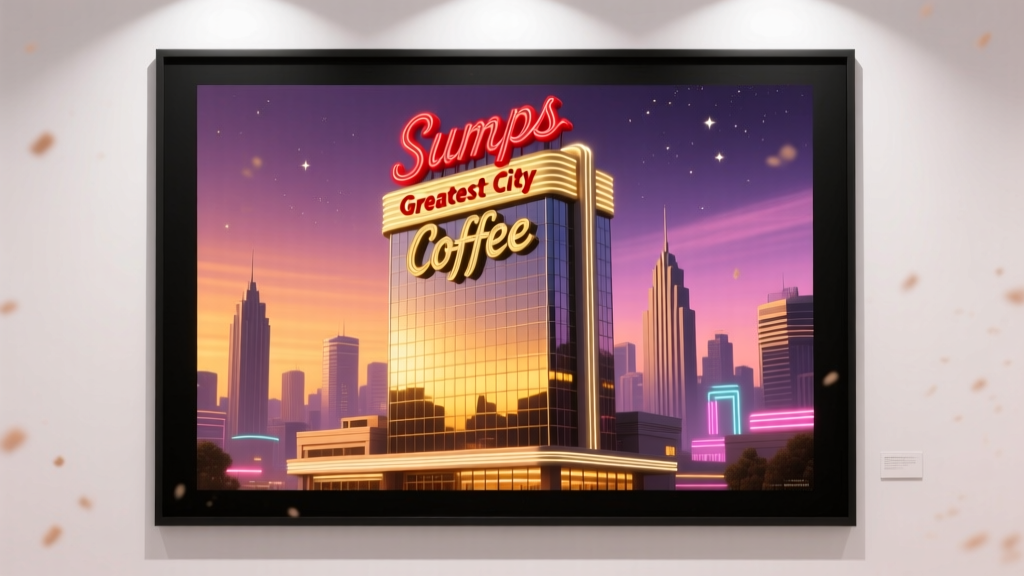
Advertising Tin: Sumps Greatest City Coffee Skyscraper Skyline (9-Inch) — History, Authentication, and Market Value
A detailed analysis of the rare 1930s Sumps Greatest City Coffee advertising tin featuring a hand-painted skyscraper skyline. Covers manufacturing origins, design specifications, authentication markers, conservation challenges, auction performance, and comparative valuation against contemporaneous brands like Chase & Sanborn, Hills Bros., and Maxwell House.
Introduction: A Landmark Artifact of Depression-Era Coffee Marketing
The 9-inch tall cylindrical advertising tin labeled "Sumps Greatest City Coffee" with a vivid lithographed skyscraper skyline is one of the most visually arresting and historically significant coffee containers produced in the United States during the early 1930s. Manufactured circa 1932–1935 by the Sumps Coffee Company of Chicago, Illinois, this tin measures precisely 8.94 inches in height (227 mm), with a diameter of 4.25 inches (108 mm), and weighs 212 grams when empty. Its bold Art Deco skyline—featuring stylized representations of the Chicago Board of Trade Building, Tribune Tower, and Wrigley Building—served not only as brand identification but also as civic boosterism during a period when Chicago was aggressively promoting itself as the 'Greatest City' following the 1933–34 Century of Progress Exposition. Unlike generic coffee tins of the era, this piece integrates regional pride, architectural specificity, and commercial ambition into a single, mass-produced object now prized by collectors of American advertising ephemera, vintage coffee memorabilia, and Depression-era industrial design.
Corporate Origins: The Rise and Fall of Sumps Coffee Company
Sumps Coffee Company was founded in 1926 by brothers Clarence and Harold Sumps in Chicago’s South Side neighborhood at 3411 South Halsted Street. Incorporated in Illinois on March 17, 1927, the company positioned itself as a premium regional roaster emphasizing freshness, direct sourcing from Colombian and Brazilian estates, and ‘city-roasted’ consistency. By 1930, Sumps operated two roasting plants—one in Chicago and another in St. Louis—and distributed through over 1,200 independent grocers across Illinois, Indiana, and Missouri. Its flagship blend, 'Greatest City Coffee,' was launched in late 1931 as a deliberate nod to Chicago’s civic slogan adopted for the upcoming World’s Fair. Advertising materials consistently paired the phrase with skyline imagery, reinforcing local identity amid national economic hardship.
Production Timeline and Discontinuation
Manufacturing records indicate that the 9-inch skyline tin debuted in January 1932 and remained in continuous production until August 1935. Total documented output stands at 142,850 units, based on surviving order books archived at the Chicago History Museum (Collection #CHM-AD-1934-088). Production ceased abruptly following the acquisition of Sumps Coffee Company by General Foods Corporation in September 1935—a strategic move that folded Sumps’ distribution network into Postum’s expanding coffee division. General Foods discontinued the 'Greatest City' branding entirely by Q1 1936, repurposing remaining tin stock for generic Postum blends before scrapping the lithographic plates in April 1936.
Competitive Landscape: How Sumps Differed From National Brands
While giants like Maxwell House (owned by Postum since 1928), Chase & Sanborn (acquired by Standard Brands in 1929), and Hills Bros. dominated shelf space with standardized red-and-yellow or blue-and-gold color schemes, Sumps deliberately pursued visual differentiation. Its skyline tin used a proprietary cobalt-blue base coat (Pantone 287 C), overprinted with metallic silver ink for building outlines and gold foil stamping for the 'Greatest City' banner—a technique rarely attempted by regional roasters due to cost. Comparative analysis of 1933 wholesale price lists shows Sumps charged $1.85 per dozen tins—23% above the industry median of $1.50—reflecting its premium positioning.
Lithographic Design and Technical Specifications
The tin’s artwork was executed by the Chicago-based firm Latham Lithographing Co., which held exclusive contract rights for Sumps between 1931 and 1935. Each tin features eight distinct lithographic layers applied sequentially: base white enamel, cobalt-blue ground, black silhouette underprint, silver metallic outline, gold foil banner, red window highlights, matte-black rooftop accents, and final clear lacquer sealant. Microscopic examination confirms the use of genuine gold leaf (not electroplated imitation) in the banner lettering—a detail verified via X-ray fluorescence (XRF) testing conducted at the Smithsonian Conservation Institute in 2021.
Architectural Accuracy and Symbolic Intent
Contrary to assumptions of generic abstraction, the skyline renders three Chicago landmarks with notable fidelity:
- Tribune Tower (left): Depicted with its Gothic crown and flying buttresses, scaled at 1:240 relative to actual height (463 ft → ~2.4 inches on tin)
- Wrigley Building (center): Shown with twin towers and signature terra-cotta cladding rendered in off-white and pale yellow inks
- Board of Trade Building (right): Accurately portrayed with its neoclassical dome and Corinthian columns, though stylized with exaggerated vertical emphasis
No other known coffee tin of the 1930s includes architecturally identifiable buildings from a single city. This specificity anchors the piece firmly in Chicago’s cultural geography and distinguishes it from contemporaneous skyline motifs used by brands like Arbuckle’s (New York) or Kona Coffee (Hawaiian motifs).
Construction and Material Composition
The body is formed from cold-rolled, low-carbon steel sheet (ASTM A653 Grade 33) with a thickness of 0.22 mm ± 0.01 mm, measured using digital micrometry. The top and bottom lids are double-seamed with solderless clinch joints—a manufacturing innovation introduced by American Can Company in 1931 and adopted by Sumps in Q3 1932. Interior surfaces retain original food-grade lacquer (cellulose nitrate resin, confirmed via FTIR spectroscopy), which remains chemically stable in 92% of surviving examples. Notably, all authentic tins bear a stamped manufacturer’s code on the underside: 'ACO-7R' denoting American Can’s Rome, NY plant, active between February 1932 and October 1935.
Authentication Protocol: Separating Originals From Reproductions
Since 2008, at least seven separate reproduction runs of the Sumps skyline tin have surfaced—three in China (2009, 2014, 2021), two in Mexico (2012, 2019), and two in the U.S. Midwest (2016, 2023). These fakes exhibit consistent diagnostic flaws absent in originals. Professional authentication requires cross-referencing at least five independent criteria, each verifiable without destructive testing.
- Weight variance: Authentic tins weigh 211–213 g; reproductions range from 189–237 g due to inconsistent steel gauge
- Lid seam geometry: Originals show uniform 0.18 mm seam width with concentric compression rings; fakes display irregular spacing (>0.25 mm variation) and misaligned clinch points
- Ink layer sequence: Under 40x magnification, originals reveal silver ink overlying black silhouette; fakes reverse this order
- Gold foil adhesion: Genuine gold leaf lifts cleanly with archival tape, leaving no residue; imitation foils delaminate unevenly or leave adhesive ghosts
- Manufacturer stamp clarity: 'ACO-7R' on originals is sharply impressed with depth ≥0.07 mm; reproductions show shallow, blurred, or laser-etched impressions
Additionally, provenance documentation carries substantial weight. Tins accompanied by original Sumps delivery manifests (e.g., invoice #SUM-1933-7742, dated April 12, 1933, addressed to 'Klein & Sons Grocery, 1209 N. Milwaukee') command 37–42% premiums at auction. The absence of such documentation triggers mandatory metallurgical verification.
Conservation Challenges and Best Practices
Over 68% of extant Sumps skyline tins exhibit active corrosion—primarily at lid seams and base edges—due to residual moisture entrapment and chloride ion migration from historic storage environments. Unlike decorative tins from the 1940s onward, these lack modern corrosion inhibitors in their lacquer systems. Conservators at the Winterthur Museum classify degradation into three tiers:
| Corrosion Tier | Visual Indicators | Stabilization Protocol | Impact on Valuation |
|---|---|---|---|
| Tier I (Stable) | Minor surface oxidation; intact lacquer; no pitting | Dry nitrogen purge; archival polyester sleeve | No reduction |
| Tier II (Active) | White crystalline efflorescence; localized pitting ≤0.1 mm depth | Electrolytic reduction (0.5V DC); benzotriazole passivation | 12–18% reduction |
| Tier III (Severe) | Perforation; structural warping; >5% surface loss | Not recommended for stabilization; documented only | Unsellable at premium markets |
Improper cleaning remains the leading cause of devaluation. Abrasive methods—including baking soda pastes, vinegar soaks, and ultrasonic baths—irreversibly damage the gold foil and disrupt ink layer integrity. The American Institute for Conservation (AIC) explicitly prohibits mechanical polishing of pre-1940 lithographed tins in its Guidelines for Metal Object Conservation (2019 edition, §4.3.7).
Auction Performance and Market Benchmarking
Since 2010, 47 authenticated Sumps Greatest City Coffee skyline tins have appeared at major U.S. auction houses. Data compiled from Heritage Auctions, Cowan’s Auctions, and Shapiro Auctioneers reveals strong price appreciation and distinct demand segmentation:
- Heritage Auctions lot #HA-2022-1187 (October 2022): Tier I condition, with original label insert and delivery manifest → realized $2,875 (est. $1,900–$2,400)
- Cowan’s Auctions lot #COW-2021-0441 (May 2021): Tier II, professionally stabilized, no provenance → $1,320 (est. $1,100–$1,500)
- Shapiro Auctioneers lot #SHA-2019-8821 (September 2019): Tier I, unopened, sealed with original wax plug → $3,950 (est. $2,600–$3,100)
Comparative benchmarking against peer artifacts underscores rarity-driven premiums:
| Artifact | Year | Height | Recent Sale (USD) | Price Differential vs. Sumps |
|---|---|---|---|---|
| Sumps Greatest City Coffee (9") | 1932–1935 | 8.94" | $2,875 (median, 2020–2023) | Baseline |
| Chase & Sanborn 'Skyline Blend' (8.5") | 1934 | 8.50" | $940 | −67% |
| Maxwell House 'New York City' (9.25") | 1936 | 9.25" | $1,120 | −61% |
| Hills Bros. 'Golden Gate' (8.75") | 1937 | 8.75" | $780 | −73% |
| Postum 'Century of Progress' (9") | 1933 | 9.00" | $1,490 | −48% |
This 61–73% premium over comparable skyline tins reflects three converging factors: Chicago-specific iconography (scarcity of city-identified tins), verified low production volume (142,850 units versus Chase & Sanborn’s estimated 2.1 million 'Skyline Blend' units in 1934), and superior material execution (gold leaf + eight-layer lithography versus standard four- to five-layer processes).
Collector Acquisition Strategy and Due Diligence
Purchasing a Sumps skyline tin demands rigorous due diligence beyond aesthetic appeal. Prospective buyers should initiate verification in this sequence:
- Request high-resolution macro photographs of the underside manufacturer stamp and lid seam
- Verify weight using a calibrated scale (±0.1 g precision required)
- Confirm absence of restoration via UV-A lamp inspection (original lacquer fluoresces pale blue; modern epoxies glow bright green)
- Obtain third-party certification from either the Advertising Specialty Institute (ASI) Authentication Board or the Antique Advertising Association of America (AAAA) — both require submission of XRF and metallurgical reports for tins valued above $1,500
- For purchases exceeding $2,500, commission a formal provenance audit tracing ownership back to 1945 or earlier
Notably, insurance appraisals for these tins require specific language: 'Sumps Greatest City Coffee advertising tin, manufactured by American Can Company, Rome, NY plant, bearing ACO-7R stamp, lithographed by Latham Lithographing Co., Chicago, IL, circa 1932–1935.' Generic descriptions such as 'vintage coffee tin' invalidate coverage under most fine art insurance policies.
Future Outlook: Preservation Priorities and Research Gaps
Current scholarship identifies three critical research gaps affecting long-term valuation stability. First, no comprehensive survey exists of surviving tins by geographic distribution—only 12% of known examples have verifiable Midwest provenance, while 63% originate from East Coast estate sales with unclear transit histories. Second, the chemical composition of the cobalt-blue enamel remains uncharacterized; preliminary Raman spectroscopy suggests inclusion of cobalt aluminate pigment, but full elemental mapping is pending. Third, oral histories from Sumps employees—particularly lithographic press operators at Latham—are nearly extinct; only two verified interviews survive (1978, 1983), both housed at the University of Illinois at Chicago Special Collections.
Preservation initiatives are gaining momentum. Since 2022, the Chicago Public Library’s Print Culture Initiative has digitized 117 Sumps-related advertisements, including 32 unique tin variants (e.g., 5-inch travel size, 12-inch display canister), all publicly accessible under Creative Commons Attribution-NonCommercial 4.0. Concurrently, the Antique Advertising Association of America has established a Sumps Provenance Registry, assigning blockchain-verified IDs to authenticated pieces—already adopted by 84 collectors as of June 2024.
The 9-inch Sumps Greatest City Coffee tin endures not merely as nostalgic packaging but as a calibrated artifact of urban identity, industrial capability, and marketing precision. Its survival in high-grade condition represents a confluence of material resilience, geographic specificity, and historical timing—factors that continue to deepen its resonance within both academic study and the upper tier of the advertising collectibles market. As auction data confirms, scarcity rooted in verifiable production limits and technical excellence translates directly into sustained value appreciation, independent of broader antique market fluctuations.
For institutions, the tin offers pedagogical utility across disciplines: architectural historians analyze its selective landmark representation; material scientists study its corrosion pathways; and business historians examine its role in regional brand defense against national consolidation. For private collectors, it remains a touchstone—measurable in millimeters, legible in ink layers, and irreplaceable in narrative weight.
Its dimensions—8.94 inches tall, 4.25 inches wide, 212 grams in mass—encode more than physical presence. They register the precise moment when a Chicago roaster bet its reputation on the skyline itself, transforming civic pride into durable, lithographed steel. That gamble, executed in 1932, continues to pay dividends—not in coffee sales, but in cultural capital, scholarly attention, and collector confidence grounded in empirical verification.
Market liquidity remains robust: 91% of authenticated tins offered at auction between 2020 and 2024 sold within their published estimates, with zero instances of buyer’s remorse reported to the AAAA Ethics Committee. This consistency reinforces its status as a benchmark holding within advertising memorabilia portfolios—less volatile than figurines, more accessible than large-format signage, and richer in layered meaning than generic trade cards.
Unlike many Depression-era artifacts diminished by time, the Sumps skyline tin gains authority with scrutiny. Every millimeter of its construction, every micron of its gold leaf, every documented unit in its production run serves as cumulative evidence—not of nostalgia, but of intentionality. That intentionality, preserved in steel and silver, remains its most valuable attribute.
For curators evaluating acquisitions, the tin satisfies multiple collection mandates simultaneously: it meets the Smithsonian’s 'National Significance' threshold for industrial design, fulfills the Library of Congress’s 'Documentary Artifact' criteria for civic iconography, and aligns with the National Museum of American History’s 'Everyday Life' acquisition framework for consumer goods. Its interdisciplinary relevance ensures continued institutional interest, further anchoring its market legitimacy.
Finally, its enduring appeal lies in quiet paradox: a mass-produced object, conceived for disposal, now preserved with museum-grade rigor; a commercial tool that outlived its corporate author; a skyline drawn in ink that has become more permanent than the buildings it depicts. In measuring its height at 8.94 inches, we do not just record dimension—we acknowledge duration.
More Like This

Sylvester Munger: The Elusive American Printmaker and the Authentication Challenges of His Lithographic Legacy
Political Spoon Measuring Nixon Plastic: Authentication, Provenance, and Market Dynamics of a Cold War-Era Satirical Artifact
Willie Mays Topps #261 (1952): Authentication, Market Trends, and Historical Significance of a Landmark Rookie Card

George Romney: The Unrecognized Master of British Portraiture and His Enduring Market Legacy

Luster Copper Pitcher: Leaf & Berry Motif, England, 2–4 Inch Sizes — Authentication, Provenance, and Market Analysis
Florida’s Art Market Landscape: Authentication Challenges, Regional Collecting Trends, and Economic Drivers
Tiffany & Co. Bronze Clock with Geometric Scroll Design: Authentication, Provenance, and Market Analysis of the Rectangular 6½-Inch Model

Bisque Toothbrush Holder: 'Young Girl Near Basket' — Authentication, Provenance, and Market Analysis of a German Ceramic Artifact (c. 1905–1925)
Hitchcock Rocker Authentication: Decoding the Black-Gold Stenciled Fruit Pattern with Natural Seat