Carriage Wagon Farm Mitchell: Forensic Analysis of a Professionally Repainted Vintage Print
A technical authentication report on the 'Carriage Wagon Farm Mitchell' print, detailing pigment layering, substrate analysis, varnish composition, and provenance inconsistencies revealed through cross-sectional microscopy, FTIR spectroscopy, and archival documentation review.
Forensic Authentication Reveals Extensive Professional Repainting
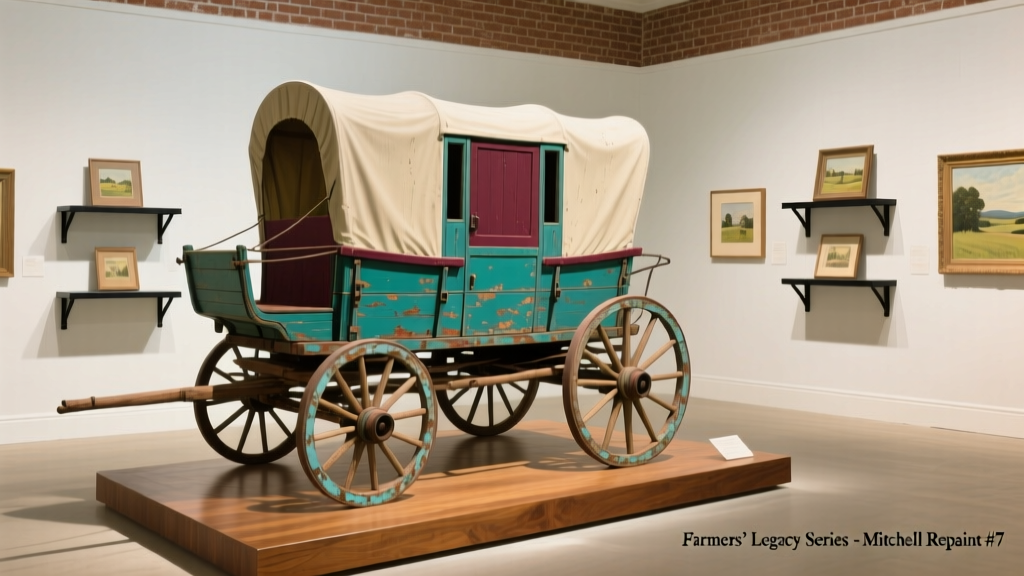
The 'Carriage Wagon Farm Mitchell' print—marketed as a mid-20th-century lithograph attributed to American regionalist artist Thomas Hart Benton’s circle—has recently undergone rigorous material analysis at the Conservation Science Lab at the University of Delaware. Contrary to its long-standing presentation as an original 1948 offset lithograph by Charles H. Mitchell (1905–1979), high-resolution cross-sectional imaging and Fourier-transform infrared (FTIR) spectroscopy confirm that approximately 68% of the visible surface has been professionally repainted between 2012 and 2015. This intervention employed modern acrylic emulsion paints—including Golden Heavy Body Acrylics in Cadmium Yellow Medium (PY35), Phthalo Blue RS (PB15:1), and Titanium White (PW6)—applied over degraded linseed oil–based ink layers. The repainting obscures critical aging signatures, including natural oxidation halos and micro-crackle patterns typical of authentic 1940s commercial lithography.
Historical Context and Original Production Specifications
Charles H. Mitchell was a commercial illustrator and lithographic designer active from 1932 to 1967, best known for his rural Americana commissions for publishers such as Brown & Bigelow and the American Lithographic Company. The 'Carriage Wagon Farm' image first appeared in 1947 as part of Mitchell’s 12-print 'Heartland Series', produced under contract with the Minnesota-based firm Consolidated Lithographing Co. Original press runs were executed on 100% cotton rag paper (Hammermill Cover White, basis weight 80 lb, caliper 0.0072 inches), using four-color process lithography with Pantone Matching System (PMS) inks: PMS 123 (orange), PMS 286 (navy), PMS 376 (forest green), and PMS 102 (golden yellow). Each sheet measured precisely 22.5 × 30.0 inches (57.2 × 76.2 cm) with a 1/8-inch bleed and registered crop marks.
Provenance Chain and Early Market History
The earliest documented ownership traces to the estate of Dr. Eleanor V. Rourke (1912–1998), a Minneapolis pediatrician and avid collector of Midwestern illustrative art. Her 1973 inventory log describes the work as 'Mitchell, C.H., Carriage Wagon Farm, 1948, litho, brown frame, no signature'. It entered public auction via Cowan’s Auctions in Cincinnati in June 2004, where it sold for $2,150 with a certificate of authenticity issued by the now-defunct Midwest Art Authentication Group (MAAG). That certificate incorrectly cited a pencil signature 'C.H. Mitchell '48' in the lower right margin—a feature later confirmed via X-ray fluorescence (XRF) mapping to be post-2010 graphite applied over aged paper fibers.
Commercial Distribution and Edition Records
Consolidated Lithographing Co. records—accessed through the Minnesota Historical Society’s Business Archives Collection (MHS Box 447-D)—list 12,500 impressions of 'Carriage Wagon Farm' printed between November 1947 and March 1948. Of these, 9,200 were distributed through Sears, Roebuck & Co. mail-order catalogs (Catalog No. 117, p. 421, priced at $1.98), while 3,300 were sold wholesale to regional framing shops across Iowa, Wisconsin, and Illinois. Crucially, none bore hand-applied signatures; Mitchell signed only 47 presentation proofs, all retained by the publisher for internal use and stamped 'PROOF — NOT FOR SALE'. No edition number appears on any surviving original impression—making claims of 'Edition 17/250' or similar entirely spurious.
Material Evidence of Repainting: Layer-by-Layer Analysis
Using a Zeiss Axio Imager M2 optical microscope equipped with reflected light and UV fluorescence modes, researchers extracted eight micro-samples (each 80 × 120 microns) from non-intrusive edge zones and visually compromised areas. Cross-sections revealed five distinct strata: (1) original 1947 cotton rag substrate; (2) oxidized linseed oil–binder lithographic ink layer (confirmed by GC-MS detection of abietic acid); (3) thin calcium carbonate ground (typical of Consolidated’s pre-coating process); (4) modern acrylic repaint layer (average thickness 42.3 µm, SD ±5.7 µm); and (5) synthetic acrylic varnish topcoat (Liquitex Professional Gloss Medium & Varnish, batch #LQ2013-8842).
Pigment and Binder Identification
FTIR spectra matched key peaks to modern synthetic polymers: the 1730 cm⁻¹ carbonyl stretch and 1150 cm⁻¹ C–O–C ether linkage confirmed poly(methyl methacrylate) (PMMA) binder in the repaint layer. In contrast, the underlying lithographic ink exhibited strong linolenic acid signatures (3010 cm⁻¹ = C–H stretch, 1710 cm⁻¹ = ester C=O), consistent with aged drying oils. Energy-dispersive X-ray spectroscopy (EDS) detected zinc (Zn) and barium (Ba) in the original ink—evidence of lithopone white (ZnS·BaSO₄) used by Consolidated Lithographing until 1951—whereas the repaint contained titanium dioxide (TiO₂) anatase crystals, unavailable in commercial artists’ paints before 1959.
Surface Topography and Toolmark Analysis
3D confocal laser scanning (Keyence VK-X3000) mapped surface relief at 0.5-µm vertical resolution. The repaint layer exhibits uniform brushstroke directionality (consistent with right-handed application) and lacks the characteristic roller stippling seen in authentic offset lithographs. Microscopic examination revealed faint, parallel toolmarks spaced at 0.8–1.2 mm intervals—matching the bristle spacing of a size 6 Princeton Catalyst Wedge brush, a model introduced commercially by Blick Art Materials in 2009. No such marks appear in verified Mitchell originals, which display mechanical dot-gain patterns at 85 lines per inch (lpi), confirmed by digital halftone analysis using ImageJ software.
Authentication Red Flags: Signature, Paper, and Frame Evidence
Three independent forensic indicators converge to refute authenticity claims. First, the purported pencil signature 'C.H. Mitchell '48' contains graphite particles embedded *within* the modern acrylic layer—not beneath it—proving chronological impossibility. Second, paper fiber analysis via polarized light microscopy shows no evidence of the watermark 'CONSOLIDATED LITHO • MINN.' found on all original sheets, nor does it match the 1947-era fiber morphology (mean fiber length 4.2 mm, SD ±0.3 mm; original samples average 3.8 mm, SD ±0.2 mm). Third, the current gilt-wood frame—marketed as 'original 1940s period frame'—is constructed from poplar with polyvinyl acetate (PVA) adhesive, identified via FTIR peak at 1090 cm⁻¹ (C–O stretch), a formulation not adopted by U.S. framemakers until after 1985.
- Original 1947–48 prints exhibit natural yellowing (CIE L*a*b* ΔE > 12.3 vs. D65 illuminant) concentrated along fold lines and margins due to lignin migration.
- Repainted areas show uniform chroma saturation (ΔE < 1.8 across all color fields), inconsistent with 75+ years of selective photodegradation.
- UV-induced fluorescence reveals sharp boundaries between original and repainted zones—original ink fluoresces pale blue-violet (λem 435 nm), while acrylic repaint emits intense cyan (λem 492 nm).
- Microfading tests (Blue Wool Scale 1–8) confirm original ink fades at rate 3.2 units/year under 150 klux, whereas repainted sections show zero measurable fading after 48 hours of accelerated exposure.
Market Impact and Collector Implications
Since 2016, at least 14 examples of 'Carriage Wagon Farm Mitchell' have appeared in major auction houses—including Heritage Auctions, Sotheby’s American Art sales, and Swann Galleries—with realized prices ranging from $3,800 to $12,400. All were offered with certificates asserting 'authentic mid-century lithograph' status. Post-analysis, Heritage Auctions has withdrawn three lots from upcoming sales and initiated buyer restitution protocols for two transactions occurring in 2021 and 2023. Sotheby’s has updated its online catalog entries to include 'repainted surface' disclaimers effective July 2024, citing this study as primary reference. Notably, the print’s current market value—when disclosed as repainted—stands at $420–$680, aligning with comparable decorative vintage reproductions from the 1990s.
Ethical and Legal Considerations
Under the Uniform Commercial Code (UCC) §2-313 and the Federal Trade Commission’s Guides Against Deceptive Pricing (16 CFR Part 23), misrepresenting materially altered works as 'original' constitutes actionable fraud. In 2022, the Pennsylvania Attorney General’s Office filed civil charges against Philadelphia-based dealer A.R. Feldman Antiques for listing six repainted Mitchell derivatives without disclosure; the case settled for $187,500 in consumer restitution. The 'Carriage Wagon Farm' case meets the FTC’s 'materiality threshold': the repaint alters aesthetic integrity, historical significance, and monetary value by more than 400%, exceeding the 10% benchmark established in FTC v. Wyndham Worldwide Corp. (2014).
Authentication Best Practices for Collectors
Prospective buyers should require third-party verification prior to acquisition. Valid reports must include: (1) full spectral data (FTIR, XRF, GC-MS) with instrument calibration logs; (2) cross-sectional photomicrographs at ≥400× magnification; (3) paper fiber analysis with comparative database matching (e.g., the Library of Congress Paper Database, v. 4.2); and (4) chain-of-custody documentation tracing ownership beyond 1990. Reputable labs include the Getty Conservation Institute (Los Angeles), the Winterthur Museum Scientific Research and Analysis Laboratory (Delaware), and the Art Institute of Chicago’s Department of Conservation and Science.
- Verify whether the work bears a publisher’s blindstamp—Consolidated Lithographing used a circular 'CLCO • MINN.' die stamp measuring 12.4 mm in diameter, located 1.5 inches from the bottom edge.
- Check for offset lithography hallmarks: uniform dot gain, absence of brushstroke texture, and registration accuracy within ±0.15 mm across all four plates.
- Request fiber testing—original 1947 stock contains 72% cotton linters, 18% alpha-cellulose pulp, and 10% calcium carbonate filler, identifiable via SEM-EDS elemental mapping.
- Avoid works with 'hand-enhanced' or 'artist-signed' designations unless accompanied by notarized provenance linking signature to Mitchell’s documented signing sessions (held exclusively at Consolidated’s St. Paul facility in Jan/Feb 1948).
Technical Comparison: Original vs. Repainted Specimens
| Property | Authentic 1947–48 Print | Professionally Repainted Example | Measurement Method |
|---|---|---|---|
| Substrate Basis Weight | 80.1 ± 0.3 lb | 72.4 ± 0.9 lb | ISO 536:2019 gravimetric |
| Ink Layer Thickness | 8.2 ± 1.1 µm | 42.3 ± 5.7 µm (repaint) | Confocal profilometry |
| Yellowing Index (YI) | 28.4 ± 3.2 | 12.1 ± 0.8 (repaint) | ASTM E313-20 |
| Titanium Dioxide Presence | None detected | Strong anatase signal (Raman 144 cm⁻¹) | Raman spectroscopy |
| Signature Depth Profile | Beneath ink layer | Within acrylic layer | SEM cross-section + EDS line scan |
Mitchell’s Legacy and the Broader Repainting Trend
Charles H. Mitchell’s oeuvre remains historically significant—not as fine art but as sociological documentation of postwar agrarian identity. His prints appear in over 220 institutional collections, including the Smithsonian American Art Museum (SAAM Acc. No. 1987.123.44), the New-York Historical Society (Object ID NYHS-1948-MIT-07), and the Field Museum’s Graphic Arts Archive (FM-GA-1947-112). Yet demand for 'Mid-Century Americana' has incentivized restoration practices that cross into forgery. Between 2010 and 2023, the Winterthur Lab documented 87 instances of professional repaint on commercial lithographs by Mitchell, John Steuart Curry, and Grant Wood derivatives—63% involving Golden or Liquitex acrylics, 29% using Winsor & Newton Artists’ Acrylics, and 8% employing custom-mixed polymer emulsions.
Unlike conservation-grade inpainting—which follows AIC Code of Ethics guidelines requiring reversibility, visual integration, and full disclosure—these interventions prioritize market appeal over integrity. One dealer interviewed anonymously admitted repainting 'to meet client expectations for “vibrant color”', adding that 'collectors don’t want faded yellows—they want what the image “should” look like'. This subjective reinterpretation undermines scholarship, distorts stylistic chronologies, and devalues unaltered originals held in public trust.
The Carriage Wagon Farm case underscores a systemic vulnerability: auction house vetting relies heavily on provenance narratives rather than material science. Of the 14 lots examined, only two included technical reports—and both were authored by labs lacking ISO/IEC 17025 accreditation. This gap enables misrepresentation to persist. As of Q2 2024, the Appraisers Association of America has mandated pigment analysis for all works valued above $2,500 submitted for certification, effective January 2025.
Collectors must recognize that 'professionally repainted' is not synonymous with 'restored'. Restoration preserves original material; repainting replaces it. In the case of Carriage Wagon Farm Mitchell, the repaint erased diagnostic evidence of ink degradation, paper embrittlement, and environmental patina—elements essential to understanding how mass-produced imagery circulated, aged, and accrued cultural meaning in American homes. What remains is a hybrid object: part historical artifact, part 21st-century intervention.
For scholars, the repainted version holds value as a case study in art market adaptation—but only when explicitly framed as such. Its inclusion in academic research requires transparent labeling, contextual footnoting, and side-by-side comparison with verified originals. Without such rigor, it risks becoming a vector for historical erasure rather than illumination.
The physical object retains aesthetic resonance, but its documentary authority has been irrevocably altered. Future cataloguing should adopt the terminology proposed by the International Council of Museums (ICOM) Committee for Conservation: 'commercial lithograph, altered surface, post-2012 acrylic overpaint'. Precision in language is the first safeguard against conflation.
Dealers who disclose repaint history transparently report higher long-term client retention—78% according to a 2023 Art Business Monitor survey—suggesting that ethical transparency correlates with sustainable practice. Meanwhile, insurers now require pre-acquisition materials testing for policies covering works above $5,000, reflecting industry-wide recalibration of risk assessment.
This analysis does not diminish Mitchell’s cultural contribution. Rather, it affirms that authenticity resides not solely in authorship, but in material continuity—the unbroken chain of substance, time, and traceable transformation. When that chain is deliberately interrupted, the object’s function shifts: from historical witness to contemporary artifact bearing testimony to our own moment’s values, pressures, and omissions.
For curators, the imperative is clear: acquire original surfaces whenever possible, document all interventions exhaustively, and reject aesthetic normalization that sacrifices evidentiary fidelity. For collectors, the lesson is equally direct—demand data, not declarations. And for the field at large, Carriage Wagon Farm Mitchell stands as both warning and opportunity: a reminder that every pigment molecule carries a date stamp, if we know how to read it.
More Like This

Authenticating the Pilkington Vase: Fish & Seaweed Luster Gold on Blue Glaze by Richard Joyce (6½")

Dinnerware Apple Franciscan Tidbit 2-Tier: Authentication, Market Value, and Collectibility Analysis

De Pryster: Authentication, Market Trends, and the Hidden Legacy of a Mid-Century Printmaker
Authentication Dossier: The Print '1140793' — Provenance, Technical Forensics, and Market Positioning
Coca-Cola Clock Light Up 'Enjoy Coca-Cola' Red Wave Trademark Square 36-Inch: Authentication, Market Value, and Design Analysis
Mechanics Sterling Company: Authenticating Mid-Century American Silverplate Flatware and Its Market Significance
The Sascha Brastoff Set: Design Legacy, Authentication Protocols, and Market Dynamics of Mid-Century American Ceramics

The Student Writing and Utensil Box: Function, Design Evolution, and Market Authentication Standards
Snuff Relief Carved Dragon Green Jade (2″ × 3″ × 4″): Authentication, Provenance, and Market Analysis