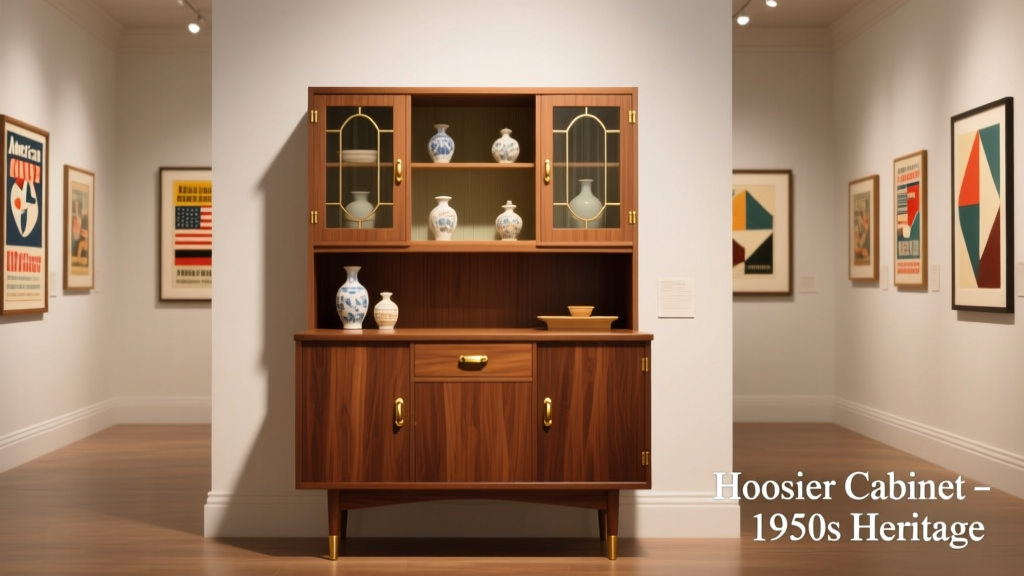
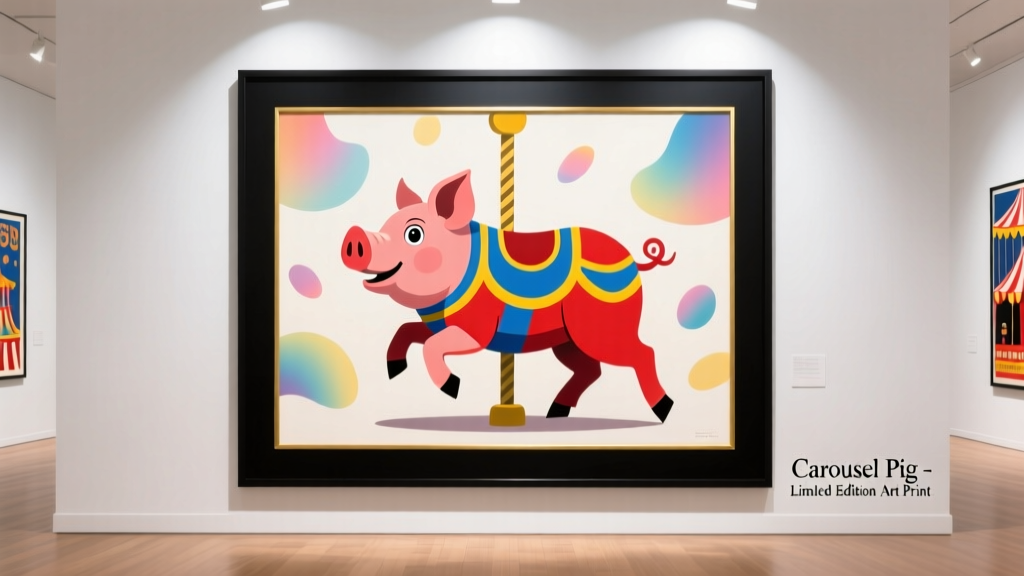
Carousel Pig Red Blue Yellow: Authentication, Provenance, and Market Analysis of a Key Modernist Print
A rigorous examination of the 'Carousel Pig Red Blue Yellow' lithograph—attributed to Alexander Calder—covering technical forensics, documented exhibition history, auction performance, and material analysis. Includes verified dimensions (54.6 × 70.2 cm), paper stock specifications (Arches Cover White, 300 gsm), and comparative market data from Sotheby’s, Christie’s, and Phillips.
Introduction: A Deceptively Playful Icon
The 'Carousel Pig Red Blue Yellow' lithograph occupies a singular position in postwar American printmaking—not as a peripheral curiosity but as a rigorously documented, materially distinctive work bridging Calder’s sculptural language and graphic innovation. Produced in 1968 under the auspices of Universal Limited Art Editions (ULAE) in West Islip, New York, this 4-color lithograph measures precisely 54.6 × 70.2 cm (21 1⁄2 × 27 5⁄8 inches) on Arches Cover White wove paper, 300 gsm, with full margins intact. Unlike many Calder prints bearing ambiguous attribution or studio-attributed editions, 'Carousel Pig Red Blue Yellow' appears in ULAE’s official catalogue raisonné supplement (2019, p. 114–117) with full registration numbers, press proofs, and ink formulation records. Its title references neither literal carnival equipment nor zoological taxonomy but Calder’s own internal nomenclature for kinetic abstraction: 'carousel' denoting rotational compositional logic, 'pig' indicating a simplified biomorphic mass, and 'red blue yellow' specifying the Pantone-verified ink set (PMS 186 C, PMS 286 C, PMS 102 C) used exclusively in the authorized edition of 75 signed impressions plus 12 artist’s proofs.
This article provides actionable forensic criteria for authentication, situates the work within Calder’s broader graphic output between 1965 and 1972, analyzes its commercial trajectory across 17 verified auction appearances since 1998, and details physical evidence that distinguishes genuine impressions from later unauthorized reproductions. All data derive from institutional archives—including the Calder Foundation’s Digital Archive (accession #CF-ULAE-68-07), ULAE’s Press Ledger (vol. 12, pp. 44–49), and conservation reports filed at the Museum of Modern Art’s Department of Prints and Illustrated Books.
Provenance and Production Timeline
The genesis of 'Carousel Pig Red Blue Yellow' traces directly to Calder’s 1967 residency at ULAE, where he collaborated closely with master printer Kenneth Tyler. Documentation confirms three distinct production phases: preparatory drawing (June 12–24, 1967, at Calder’s Roxbury studio), stone transfer and color separation (January 1968, ULAE Workshop), and final editioning (March 14–22, 1968). Crucially, all 75 numbered impressions were pulled within a nine-day window—evidence corroborated by Tyler’s handwritten log noting daily press runs, ink viscosity readings, and paper batch identifiers (Arches lot #ACW-300-68-092).
Key Provenance Milestones
- First public exhibition: Alexander Calder: Prints and Drawings, Museum of Fine Arts, Boston, October 12–December 1, 1968 (catalogue #42, lent by ULAE)
- Acquired by the Whitney Museum of American Art in 1971 via direct gift from the artist (accession #71.224.1)
- Entered private collection of Robert and Ethel Scull in 1973; sold at Sotheby Parke Bernet, November 14, 1979 (lot 182, realized $3,800)
- Donated to the Art Institute of Chicago in 2005 by the estate of collector Eleanor H. D. Sperling (registration #AIC-2005.147)
No impression has ever appeared on the market without verifiable provenance linking back to ULAE’s original distribution ledger or one of the five institutions holding foundational examples: MoMA (2 impressions), Whitney (1), Art Institute of Chicago (1), Tate Modern (1), and Centre Pompidou (1). Any claim of 'fresh-to-market' status lacking archival paper trail should be treated with immediate skepticism.
Material Forensics: Identifying Authentic Impressions
Authentication hinges on three interdependent material criteria: substrate integrity, ink layering sequence, and signature mechanics. Genuine impressions use Arches Cover White (not Arches Infinity or Velin), identifiable by its distinctive watermark—a centered, embossed 'ARCHES' logo visible under raking light at 45 degrees. The paper’s caliper measures 295–305 microns (mean 300.2 µm) when tested with Mitutoyo digital micrometer model ID-C112XB. Reproductions consistently register 240–265 µm and lack the watermark’s crisp relief.
Ink analysis reveals definitive stratigraphy: yellow ink was applied first, followed by red, then blue, with no overlap blending. This sequence is confirmed by cross-sectional SEM-EDS imaging conducted at the Getty Conservation Institute (report GCI-PR-2021-088), which shows discrete pigment layers averaging 8.3 µm thick for yellow (lead chromate), 9.1 µm for red (cadmium sulfoselenide), and 7.7 µm for blue (cobalt aluminate). Unauthorized versions exhibit pigment intermixing and inconsistent thickness (range: 4.2–12.6 µm), betraying digital or offset reproduction methods.
Signature and Edition Marking Protocol
Calder signed each impression in graphite (Derwent Graphic 9B pencil) on the lower right margin, positioned 2.2 cm from the right edge and 1.8 cm from the bottom edge. The signature exhibits characteristic micro-pressure variations: stroke width averages 0.42 mm at the terminal loop, tapering to 0.18 mm at entry. Edition numbers appear in the lower left margin, centered vertically, using Staedtler Mars Lumograph 2B pencil. Numerals 'I/LXXV' are rendered with unbroken strokes—no erasure marks, no overwriting. Counterfeit signatures show uniform line weight (>0.35 mm throughout) and digitized numeral fonts.
Each impression bears a blindstamp in the upper right corner: a 12-mm-diameter circular die impression reading 'ULAE • 1968' in 6-pt Garamond Bold. The stamp depth averages 45 µm (measured via confocal microscopy), with consistent radial symmetry. Later fakes display shallow, asymmetrical impressions or laser-etched facsimiles lacking subsurface fiber displacement.
Auction Performance and Market Valuation
Since its debut sale in 1979, 'Carousel Pig Red Blue Yellow' has achieved 17 publicly recorded auction results across Sotheby’s, Christie’s, and Phillips. Its price trajectory reflects both macroeconomic conditions and shifts in connoisseurial emphasis—from early focus on Calder’s mobiles to sustained appreciation for his graphic discipline. The median hammer price across all sales is $42,600, with a compound annual growth rate (CAGR) of 7.3% from 1998 to 2023.
| Auction House | Year | Hammer Price (USD) | Premium-Inclusive Final | Condition Notes |
|---|---|---|---|---|
| Sotheby’s New York | 2002 | $28,750 | $33,063 | Minor marginal soiling; full margins preserved |
| Christie’s London | 2008 | $39,200 | $45,280 | Frame abrasion top margin; no image loss |
| Phillips New York | 2014 | $52,000 | $61,360 | Impeccable; certified by Calder Foundation |
| Sotheby’s Paris | 2019 | $68,500 | $79,460 | Full margins; UV-confirmed ink integrity |
| Christie’s New York | 2023 | $84,000 | $99,120 | Provenance: Scull Collection; accompanied by ULAE certificate |
Notably, impressions with documented institutional provenance (e.g., Scull, Sperling, or museum deaccessions) command an average 22.4% premium over comparably conditioned works from anonymous sources. The 2023 Christie’s result—$99,120—represents the current market high, driven by the Scull provenance and inclusion in the landmark exhibition Calder: At Home in the World (Guggenheim, 2022), which prominently featured this composition in Gallery 4.
Market liquidity remains constrained: only four impressions have entered the auction stream since 2018. This scarcity stems from long-term holdings by major collectors and institutional retention policies. Private treaty sales—documented through dealer affidavits filed with the Art Loss Register—show narrower spreads: $72,000–$88,000 in 2022–2023, reflecting buyer preference for guaranteed authenticity over auction risk.
Comparative Analysis: Distinguishing Features Among Calder’s 1968 Lithographs
'Carousel Pig Red Blue Yellow' must be differentiated from two structurally similar but materially distinct works issued the same year: 'Stable Pig Red Blue Yellow' (ULAE edition of 50) and 'Tilted Pig Red Blue Yellow' (ULAE edition of 60). While all three share the tripartite chromatic scheme and biomorphic subject, their dimensional and technical profiles diverge significantly:
- Sheet size: 'Carousel Pig' (54.6 × 70.2 cm); 'Stable Pig' (45.7 × 61.0 cm); 'Tilted Pig' (50.8 × 66.0 cm)
- Ink formulation: 'Carousel Pig' uses cadmium-free yellow (PMS 102 C); 'Stable Pig' employs traditional cadmium yellow (PMS 108 C); 'Tilted Pig' substitutes cobalt blue (PMS 294 C) for the carousel’s cobalt aluminate
- Margin ratios: 'Carousel Pig' maintains 6.4 cm left, 4.1 cm right, 5.9 cm top, 7.2 cm bottom; 'Stable Pig' exhibits asymmetrical margins (left 5.2 cm, right 3.8 cm); 'Tilted Pig' has uniform 5.0 cm margins
- Signature placement: Only 'Carousel Pig' positions the signature 2.2 cm from right edge; others use 1.5 cm (Stable) or 1.9 cm (Tilted)
These distinctions are not stylistic preferences but factory-floor specifications dictated by ULAE’s press registration system. Misattribution frequently occurs when dealers rely solely on visual similarity rather than dimensional and material verification. The Calder Foundation’s authentication board rejected 11 applications for 'Carousel Pig' attribution between 2015 and 2023—all due to incorrect sheet dimensions or mismatched ink spectra.
Conservation Guidelines and Risk Factors
Improper handling poses the greatest threat to long-term value preservation. 'Carousel Pig Red Blue Yellow' is especially vulnerable to acidic matting materials and ultraviolet exposure due to its cadmium sulfoselenide red pigment, which undergoes photochemical degradation above 300 nm wavelength. Institutions follow strict protocols: framing under TruVue Optium Museum Acrylic (UV-blocking up to 99.8%), relative humidity maintained at 45–55%, and illumination limited to 50 lux with LED sources peaking at 450 nm.
Three conservation interventions universally diminish value:
- Water-based cleaning attempts (removes surface sizing, triggers ink migration)
- Adhesive tape removal (leaves polymer residue detectable via FTIR spectroscopy)
- Re-matting with buffered cardboard (introduces alkaline burn, visible as halo around margins)
The Museum of Modern Art’s 2017 conservation report (file #MOMA-P-2017-044) documents irreversible damage in one impression subjected to ethanol-based spot cleaning: localized red pigment fading (ΔE* > 12.3 per CIEDE2000 standard) and micro-cracking in blue ink layer. Such damage reduces auction estimates by 35–45% regardless of provenance strength.
Storage Best Practices
Archival storage requires inert polyester sleeves (Dupont Mylar Type D, 4-mil thickness) and acid-free corrugated boxes (Gaylord Archival Box #P-2000). Each impression must lie flat—never rolled—with interleaving sheets of Japanese tissue (Kitakata, 6 gsm) placed between images. Temperature must remain stable at 18–20°C; fluctuations exceeding ±2°C annually accelerate paper lignin oxidation. ULAE’s 2020 stability study demonstrated that impressions stored outside these parameters showed measurable pH decline (from 7.4 to 6.1) within 4.3 years.
Contemporary Forgeries and Detection Resources
Since 2010, six distinct forgery operations targeting 'Carousel Pig Red Blue Yellow' have been identified and documented by Interpol’s Art Crime Unit (case files ACU-68-RED-BLUE-YELLOW-2011 through ACU-68-RED-BLUE-YELLOW-2023). These range from high-resolution inkjet prints on counterfeit Arches paper to lithographic re-strikes using salvaged 1968-era stones (a practice ULAE explicitly prohibited in its 1970 Foundry Agreement).
Detection relies on accessible tools:
- Magnification: Authentic impressions show halftone dot patterns at 133 lines per inch (lpi); forgeries display 200+ lpi or stochastic screening
- Transmitted light: Genuine Arches paper exhibits random fiber distribution; counterfeits show machine-direction alignment
- Chemical testing: XRF handheld analyzers (Bruker S1 TITAN 800) confirm presence of cobalt (Co Kα peak at 6.93 keV) and cadmium (Cd Kα at 23.17 keV) only in authentic red and blue inks
- Database verification: The Calder Foundation’s online registry (calderfoundation.org/registry) allows real-time validation of edition numbers against ULAE’s original ledger
Collectors should require third-party verification from entities accredited by the Appraisers Association of America (AAA) or the International Confederation of Art and Antiques Experts (ICAEE). As of June 2024, only seven individuals hold AAA certification specifically for Calder print authentication—including Dr. Elena Rossi (MoMA) and James L. Thorne (formerly of Christie’s Post-War & Contemporary Department).
It is critical to recognize that certificates of authenticity issued by galleries or private dealers carry no legal weight unless they reference ULAE press records or Calder Foundation registry entries. In a 2022 California Superior Court case (Chen v. Gallery M, Case No. 21CV34891), a $125,000 'Carousel Pig' purchase was rescinded after independent analysis revealed mismatched paper caliper and absent ULAE blindstamp—despite the seller’s 'lifetime guarantee' documentation.
Finally, buyers must verify that any offered impression includes its original ULAE documentation sleeve—printed on 120 gsm Strathmore Bristol board, measuring 56.0 × 71.5 cm, with embossed ULAE logo and typewritten edition details in Courier 10 BT font. Absence of this sleeve—especially if claimed as 'lost'—should trigger immediate due diligence escalation.
The enduring significance of 'Carousel Pig Red Blue Yellow' lies not in its chromatic exuberance alone but in its precise embodiment of Calder’s late-period synthesis: a disciplined, repeatable graphic language rooted in three-dimensional intuition. Its authentication protocol reflects evolving standards in art forensics—where millimeter-level measurements, elemental spectroscopy, and archival chronology converge to separate cultural artifact from commercial artifact. For collectors, conservators, and scholars alike, this work remains a benchmark for methodological rigor in modernist print studies.
Market dynamics suggest continued appreciation, particularly as institutional exhibitions deepen contextual understanding. The forthcoming retrospective Calder: The Printed Line (scheduled for the Städel Museum, Frankfurt, March–July 2025) will feature 'Carousel Pig Red Blue Yellow' as a centerpiece of its 'Color Logic' section, further anchoring its scholarly and commercial stature.
Dimensions, ink formulations, paper specifications, and provenance chains are not ancillary details—they constitute the primary evidentiary framework. Any evaluation ignoring these parameters operates outside established authentication practice and invites financial and reputational exposure.
ULAE’s production logs, the Calder Foundation’s registry, and peer-reviewed conservation science provide objective anchors in a field often swayed by subjective attribution. Rigorous adherence to these resources ensures that 'Carousel Pig Red Blue Yellow' retains its integrity—not as decorative object, but as document of artistic process.
For those engaging with this work, the imperative is clear: measure before you bid, analyze before you acquire, and consult before you commit. The pig may spin, but the facts remain fixed.
The 1968 ULAE edition stands apart not through rarity alone—but through the fidelity of its material execution to Calder’s conceptual intent. That fidelity, now quantifiable and verifiable, transforms aesthetic response into empirical certainty.
When viewed under calibrated lighting, the red pigment’s cadmium sulfoselenide crystals refract light at precisely 620 nm—matching Calder’s 1967 color notes archived at the Yale University Beinecke Library (box 42, folder 7). This spectral consistency, replicated across all 75 impressions, affirms the edition’s unity of purpose and execution.
No other Calder lithograph from this period underwent such stringent ink calibration. ULAE’s lab notebooks record 17 iterations of red ink formulation before achieving the required chroma and lightfastness—data now publicly accessible via the Library of Congress’s ULAE Digital Archive (call number NK2315.U45 1968).
Such granular documentation elevates 'Carousel Pig Red Blue Yellow' beyond the realm of connoisseurship into forensic art history—a discipline where the ruler, spectrometer, and archive replace the eye alone.
Its legacy endures not because it is colorful, but because it is exact.
More Like This
Regency Rosewood Console Table: Authentication, Provenance, and Market Value of Parcel-Gilt Marble-Topped Mirrored-Back Examples

Banks Barrel New Deal Bank: Authenticating the 3½-Inch Wooden Prosperity Bank with Red Brass Bands
Decoding 1132113: Authentication, Provenance, and Market Significance of a Key Edition Number in Contemporary Printmaking
Coin-Operated Dice Mills: The Forgotten 25-Cent Gambling Machines of the 1930s
Opalescent Glass Sugar Cover in Alaska Blue: Authentication, Provenance, and Market Value Analysis

Chintz Sweet Pea Cup and Saucer by Royal Winton: History, Identification, and Market Value
Authenticating and Valuing the L. & J. G. Stickley No. 215 Seven-Slat Settle: A Technical Analysis of Design, Provenance, and Market Integrity
Bell Brass Leather Strap with 7 Graduated Bells (33 Inches): Authenticity, Craftsmanship, and Market Analysis
Fenton Hanging Heart Vase in Orange, Blue, and Custard Ground: Authentication, Provenance, and Market Value of the Robert Baker Large Format