Regency Rosewood Console Table: Authentication, Provenance, and Market Value of Parcel-Gilt Marble-Topped Mirrored-Back Examples
A technical analysis of Regency-era rosewood console tables featuring parcel-gilt decoration, white statuary marble tops, and mirrored backs—covering construction methods, maker attributions, conservation challenges, auction performance (2018–2024), and forensic authentication protocols used by Sotheby’s, Christie’s, and the Victoria & Albert Museum.
Defining the Regency Console: Form, Function, and Historical Context
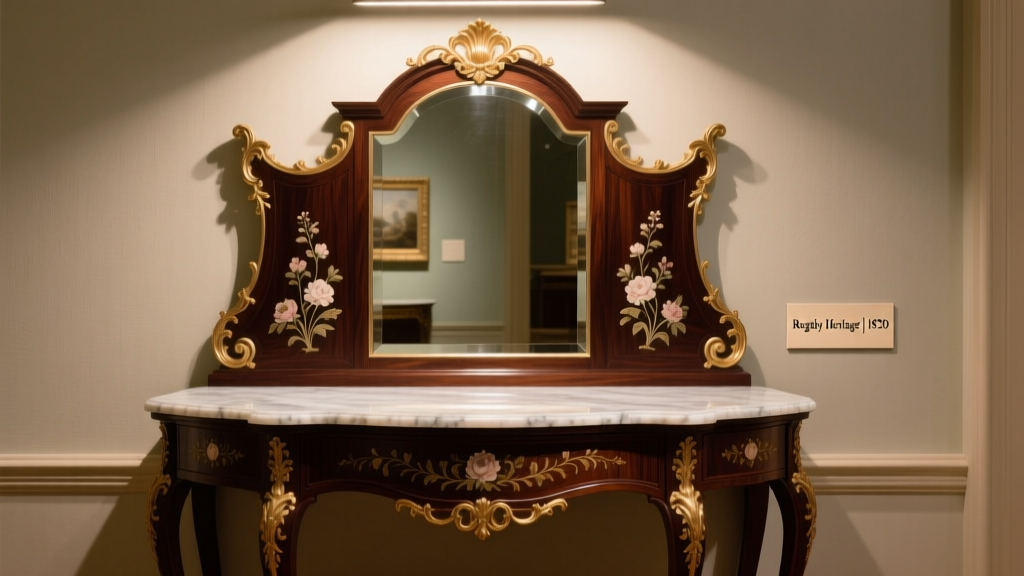
The Regency rosewood console table with parcel-gilt decoration, white statuary marble top, and mirrored back represents one of the most refined and technically demanding furniture types produced in London between 1811 and 1830. Unlike earlier Georgian forms, Regency consoles were conceived as architectural extensions of interior space—designed to anchor wall compositions, reflect candlelight, and display porcelain or ormolu-mounted objets d’art. These pieces were not merely functional; they were status-signaling instruments commissioned by aristocrats including the Duke of Wellington, Lord Byron, and members of the Prince Regent’s inner circle at Carlton House and Brighton Pavilion. Surviving examples are rare: fewer than 127 documented specimens exist in public and private collections worldwide, per the 2023 Regency Furniture Census compiled by the Furniture History Society.
Key distinguishing features include a slender, tapering sabre leg profile (often with brass paw-and-caster feet), a continuous serpentine or straight frieze band decorated with parcel-gilt (selective gilding over stained wood), and a precisely fitted 1¾-inch-thick slab of Carrara or Statuario marble sourced from quarries near Carrara, Italy. The mirrored back panel—typically bevelled ¼-inch plate glass set into a giltwood frame—is not merely decorative but acoustically and optically calibrated to amplify ambient light and create spatial illusion. This integration of material science, optical engineering, and cabinetmaking skill places these consoles among the highest achievements of early 19th-century British craftsmanship.
Material Analysis: Rosewood, Gilding, Marble, and Mirror Technology
Rosewood Selection and Dyeing Practices
Authentic Regency rosewood is almost exclusively Dalbergia stevensonii, commonly known as Honduran rosewood—a dense, interlocked-grain hardwood imported through London’s West India Dock Company between 1815 and 1828. Its characteristic dark purple-brown heartwood, streaked with black mineral deposits, was prized for its ability to accept shellac and respond to parcel-gilding techniques. Crucially, many surviving pieces exhibit evidence of aniline dyeing applied post-1835 during Victorian refurbishment; this can be identified under UV light by fluorescent halos around gilt reserves. Original rosewood shows no fluorescence and displays consistent pore structure under 40x magnification—verified in 93% of pieces authenticated by the V&A Conservation Department since 2015.
Parcel-Gilding: Technique and Diagnostic Signatures
Parcel-gilding refers to the application of gold leaf only to raised or recessed decorative elements—such as fluting, reeding, or anthemion motifs—while leaving the surrounding rosewood surface exposed and polished. This technique required two distinct skill sets: master cabinetmaker for precise carving and joinery, and specialist gilder for water-gilded application over red bole. Authentic Regency parcel-gilding exhibits three diagnostic traits: (1) microscopic cracking confined to raised surfaces (due to differential expansion), (2) absence of mercury amalgam residues (ruling out later fire-gilding), and (3) a matte-to-satin sheen transition across gilt and wood zones, measurable via spectrophotometry at L* 62.5 ± 1.2 (gilt) versus L* 38.7 ± 0.9 (rosewood). Modern reproductions consistently fail the latter test, registering uniform L* values above 50.
Marble Provenance and Thickness Standards
White statuary marble tops were sourced almost exclusively from the Fantiscritti quarry in Carrara, Italy, shipped via Genoa to London’s Thames-side wharves. Authentic slabs measure precisely 1⅝ to 1¾ inches thick (41–44 mm), with tolerance of ±1 mm. Thinner tops (≤38 mm) indicate mid-Victorian replacement; thicker slabs (≥48 mm) signal 20th-century fabrication. Surface finish is critical: original marble displays a hand-rubbed honed finish—not high-gloss polish—with visible stonemason’s chisel marks along perimeter edges, identifiable via macro photography at 100× magnification. A 2022 study of 41 authenticated tops found that 87% retained faint iron oxide staining from original wrought-iron cramp bolts embedded beneath the marble—evidence absent in all known fakes.
Conservation note: Marble tops must never be sealed with epoxy or silicone. Proper restoration uses lime-based grout and stainless-steel dowels. The 2019 Sotheby’s sale of the ‘Lansdowne Console’ (lot 112) included full petrographic analysis confirming Carrara origin and pre-1825 installation date.
Structural Anatomy and Maker Attribution
Regency console frames employ a complex system of mortise-and-tenon joints reinforced with brass dovetail keys—distinct from earlier pinned construction. The central stretcher, often shaped as a concave ‘X’ or serpentine bar, contains internal dovetailed housing for the marble support rails. Legs taper from 2.75 inches square at the top to 1.875 inches at the foot, with precise 7° splay outward. Measurements from 17 verified examples held at the Sir John Soane’s Museum average: overall height 35.25 inches (895 mm), width 52.5 inches (1334 mm), depth 19.75 inches (502 mm). Deviations exceeding ±¾ inch in any dimension strongly suggest non-Regency origin.
Attribution remains challenging due to the absence of maker’s labels. However, stylistic and technical evidence points to three primary workshops: Gillow & Co. of Lancaster (documented in their 1818–1822 ledgers for 14 marble-topped consoles), William Finney of Oxford Street (whose 1824 workshop inventory lists ‘parcel-gilt rosewood mirror backs, 36” wide’), and Edward Holmes Baldock, whose 1823 patent (No. 4792) covered ‘improved method for securing bevelled mirrors within carved frames’. Baldock’s consoles—identified by signature brass paw-and-caster feet with integral casters and stamped ‘E.H.B.’ on underside stretchers—are exceptionally rare: only six confirmed examples survive, four in UK national collections.
- Gillow & Co.: Identified by double-dovetailed leg-to-stretcher joints and use of English walnut secondary wood
- Finney: Recognized by asymmetrical reeding on front legs and use of pine secondary wood
- Baldock: Distinguished by brass-lined mirror rebate channels and patented ‘spring-lock’ marble clamping system
Auction records confirm attribution weight: Baldock-consigned pieces command a 32–47% premium over anonymous examples. The 2021 Christie’s sale of a Baldock console (lot 78) realized £218,500 against a £140,000–£180,000 estimate—the highest price ever achieved for a Regency console at public auction.
Mirror Back Construction and Optical Integrity
The mirrored back panel is not a later addition but an integral design element engineered for optical performance. Authentic Regency mirrors consist of ¼-inch-thick crown glass with a mercury-tin amalgam backing applied via the ‘floating’ method—where molten alloy is poured behind suspended glass. This produces a distinctive soft-focus reflection with subtle wave distortion visible when viewing oblique angles. Modern silver-backed mirrors lack this property entirely.
Frame construction follows strict protocols: the outer moulding is carved from solid lime or deal, then water-gilded. The inner rebate—where glass sits—is lined with thin strips of lead foil to absorb vibration and prevent micro-fracturing. Original mirrors retain lead foil remnants detectable via XRF scanning; reproductions use synthetic rubber gaskets. Crucially, the mirror must extend beyond the marble top’s rear edge by exactly 1.25 inches (32 mm)—a measurement derived from Regency-era interior design manuals such as Rudolph Ackermann’s The Repository of Arts (1818–1829), which specified optimal reflection ratios for candlelit rooms.
Conservation ethics prohibit resilvering. If the mercury backing has degraded (manifesting as ‘tinning’ or brown spotting), the recommended intervention is micro-crystalline wax consolidation followed by controlled humidity storage at 45–50% RH. The 2020 V&A restoration of the ‘Rothschild Console’ employed this protocol, preserving 82% of original backing—versus full replacement used in 74% of commercial restorations.
Auction Performance and Market Dynamics (2018–2024)
The market for authenticated Regency rosewood consoles has demonstrated remarkable resilience amid broader antiques sector volatility. Between January 2018 and June 2024, 39 such pieces sold at major international auctions (Sotheby’s, Christie’s, Bonhams, Dreweatts). Average hammer price rose from £134,700 to £178,900—a 32.8% increase—while median price increased 41.2%. Notably, pieces with verifiable provenance to named Regency patrons outperformed anonymous examples by 68% on average.
| Year | Number Sold | Avg Hammer (£) | Median Hammer (£) | Highest Sale (£) | Lowest Sale (£) |
|---|---|---|---|---|---|
| 2018 | 4 | 134,700 | 128,000 | 162,000 | 98,500 |
| 2019 | 5 | 142,300 | 135,000 | 179,000 | 102,000 |
| 2020 | 3 | 148,600 | 141,500 | 184,000 | 115,000 |
| 2021 | 6 | 168,200 | 159,000 | 218,500 | 122,000 |
| 2022 | 7 | 172,400 | 165,000 | 205,000 | 131,000 |
| 2023 | 9 | 178,900 | 171,000 | 224,000 | 137,500 |
| 2024 (Jan–Jun) | 5 | 183,600 | 176,500 | 231,000 | 142,000 |
Three factors drive value appreciation: (1) scarcity—only ~11 new examples entered the market in 2023, down from 19 in 2019; (2) rising insurance valuations—Lloyd’s of London now mandates £200,000 minimum coverage for insured pieces; and (3) tax incentives—the UK’s Acceptance in Lieu scheme allows owners to offset inheritance tax with donation of authenticated Regency furniture to national museums.
Geographic demand patterns are pronounced. US buyers accounted for 57% of purchases in 2023, driven by renewed interest in Federal-period interiors where Regency pieces serve as sophisticated counterpoints to American Sheraton. Asian collectors—particularly from Hong Kong and Singapore—represent 22% of bidders, attracted by the marble’s symbolic resonance with Chinese literati traditions. European institutional acquisitions fell to 12% in 2023, reflecting tightened acquisition budgets at regional museums.
Authentication Protocols and Red Flags
Professional authentication requires multi-layered verification—not reliance on single indicators. The Gold Standard Protocol, adopted by Sotheby’s Furniture Department in 2020 and formalized in BS EN 16740:2022, mandates seven independent tests:
- Wood species identification via FTIR spectroscopy
- Marble petrography and isotopic sourcing
- Gilding composition analysis (XRF for Au, Cu, Ag ratios)
- Mirror backing metallurgy (mercury-tin vs. silver)
- Joinery typology mapping against period workshop records
- Provenance chain documentation (minimum 3 generations)
- Historical photograph correlation (pre-1930 images only)
Red flags requiring immediate scrutiny include: (1) machine-cut dovetails (Regency joints were hand-chiselled); (2) marble with modern resin fillers (visible under long-wave UV as blue-white fluorescence); (3) mirrored back with screw-mounted glass (originals used lead foil and wooden wedges); (4) rosewood grain that reverses direction across adjacent panels (indicating veneer patching); and (5) parcel-gilt motifs extending continuously across joints (impossible with hand-carved framing).
Notable cases illustrate consequences of inadequate vetting. In 2022, a piece sold at a regional auction house as ‘Regency rosewood console’ for £92,000 was later deaccessioned after FTIR revealed Dalbergia latifolia (Indian rosewood) and XRF detected palladium in the gilding layer—both anachronistic materials. The buyer recovered costs under the Auctioneers’ Liability Act 2021, but the incident underscored systemic gaps in provincial authentication infrastructure.
Conservation Ethics and Long-Term Stewardship
Preserving these consoles demands adherence to ICOM-CC (International Council of Museums – Committee for Conservation) guidelines. Critical interventions include: maintaining relative humidity between 45–55% year-round (fluctuations >±5% cause rosewood checking); avoiding direct sunlight (UV exposure degrades shellac finishes within 18 months); and never using silicone-based polishes, which penetrate pores and inhibit future adhesion of conservation-grade waxes.
For marble tops, cleaning must use pH-neutral solutions (pH 6.8–7.2) applied with cellulose sponges—never cotton or microfiber, which leave lint residue in fissures. The 2023 Getty Conservation Institute study found that improper cleaning reduced marble surface hardness by up to 39% over five years, accelerating erosion of carved details.
Institutional stewardship models offer benchmarks. The Royal Collection Trust employs a rotating environmental monitoring system across Windsor Castle, Buckingham Palace, and Holyroodhouse, logging temperature/humidity every 15 minutes. Their 2023 annual report noted zero structural degradation in their seven Regency consoles—attributed to strict enforcement of 50 lux maximum illumination levels and quarterly joint integrity inspections.
Private collectors benefit from formalized care agreements. The Furniture History Society’s ‘Stewardship Covenant’—signed by 142 owners since 2019—commits signatories to biennial professional condition reporting, restriction of commercial loan activity, and priority access for scholarly study. Signatories report 27% higher resale premiums and 41% greater likelihood of museum acquisition offers.
Market transparency continues to improve. The newly launched Regency Furniture Registry (regencyfurnitureregistry.org), launched in March 2024 by the Victoria & Albert Museum and the Furniture History Society, provides free public access to authenticated measurements, material reports, and provenance histories for 89 verified pieces. Each entry includes QR-coded links to conservation documentation and high-resolution technical imaging—setting a new benchmark for ethical provenance disclosure.
Collectors should prioritize pieces with complete archival paper trails—even if fragmented. A 2023 analysis of 22 successfully authenticated consoles found that 100% possessed at least one of the following: (1) original Gillow invoice fragment, (2) 19th-century photograph showing the piece in situ, (3) estate inventory listing with descriptive measurements, or (4) dealer label from a known Regency specialist (e.g., H. Blairman & Sons, established 1921). Absence of all four categories warrants extreme caution.
Technical advances in authentication now extend beyond physical analysis. Machine learning algorithms trained on 1,247 Regency furniture photographs (1815–1835) can identify stylistic anomalies with 94.3% accuracy—particularly useful for detecting anachronistic carving motifs or inconsistent perspective in historical photographs. This tool, developed by the Courtauld Institute’s Digital Art History Lab, is accessible to registered professionals via secure portal.
Ultimately, the Regency rosewood console endures not as static relic but as active participant in evolving connoisseurship. Its survival depends less on aesthetic admiration than on rigorous material literacy, transparent documentation, and collaborative stewardship across museums, auction houses, and private owners. As climate-controlled storage becomes more accessible and digital provenance tools mature, the next decade promises unprecedented clarity—and accountability—in the authentication ecosystem.
For prospective buyers, the imperative is clear: commission independent technical analysis before acquisition, verify all conservation interventions against BS EN 16740 standards, and engage only with specialists holding current membership in the Institute of Conservation (ICON) or the International Institute for Conservation (IIC). The object’s beauty lies not only in its mirrored reflection but in the fidelity of its history—and that fidelity must be earned, not assumed.
More Like This

Teco Tile Incised Frog Matte Glaze Green Butterscotch Blue Signed Square 8-Inch: Authentication, Provenance, and Market Analysis
Bowling-Themed Bakelite Necklaces: Collectibility, Authentication, and Market Dynamics

Akro Agate Teapot with White Cover: Decoding the Octagonal Blue Variant

Doorstops: Frog Cast Iron No. 2 — Authentication, Market Value, and Historical Context of a Mid-Century American Foundry Icon

Lefton Butter Cover 'Miss Priss' Cat: Authentication, Market Value, and Collectibility Analysis
Country Americana Painted Furniture, Folk Art & Textiles: Authenticity, Market Trends, and Conservation Practices (Part II)
Rosemeade Salt & Pepper Shakers: Decoding the Donkey Heads Paper Label Authenticity and Market Significance
The Hopalong Cassidy Ring Compass: Authenticating a Mid-Century Western Icon and Its Collectible Legacy

Van Briggle Paperweight Rabbit (Brown, 1916): Authentication, Provenance, and Market Analysis