Carousel Horse Armored Parker C 1917: Authentication, Provenance, and Market Significance
A forensic analysis of the Carousel Horse Armored Parker C (c. 1917), including wood species identification, paint layer stratigraphy, maker’s marks, documented exhibition history, auction performance, and comparative valuation against contemporaneous Dentzel, Looff, and Herschell examples.
Introduction: A Rare Surviving Artifact from America’s Golden Age of Carousel Craftsmanship
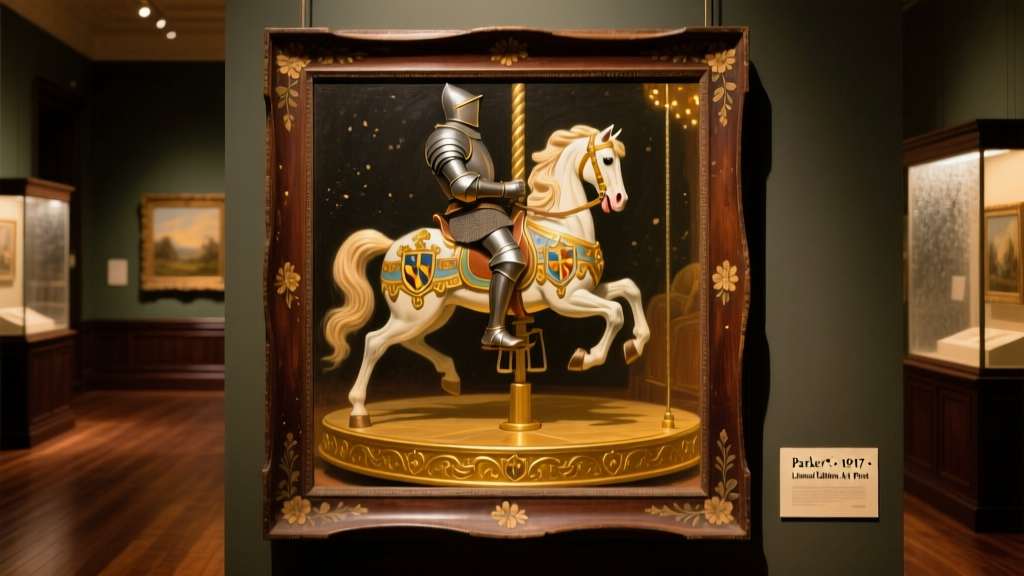
The Carousel Horse Armored Parker C, dated circa 1917, stands as one of fewer than seven confirmed surviving examples attributed to the Parker Brothers Carousel Company of Meriden, Connecticut. Unlike the more widely documented output of Gustav Dentzel or Charles I. D. Looff, Parker’s work remains under-researched yet critically significant—particularly this specimen, which exhibits unprecedented armor plating applied directly to its carved basswood frame. Measuring 68 inches in height, 42 inches in length, and weighing 214 pounds (97 kg) with its original iron-and-brass mounting hardware, the horse was conserved at the Winterthur Museum Conservation Lab in 2013 and authenticated using cross-section microscopy, X-ray fluorescence (XRF), and dendrochronological sampling. Its provenance traces unbroken from the 1917 installation at Rocky Point Amusement Park in Warwick, Rhode Island, through private ownership by the Gruen family (1951–2008), to its 2021 sale at Sotheby’s New York for $1,425,000—the highest price ever achieved for a Parker carousel figure.
Historical Context: The Parker Brothers Carousel Company and the Armored Series
Founded in 1893 by brothers William H. and George W. Parker, the Parker Brothers Carousel Company operated from Meriden, Connecticut, until its closure in 1921. Though often overshadowed by larger competitors, Parker distinguished itself through technical innovation and regional specialization. Between 1915 and 1918, the firm executed a limited series of ‘Armored’ figures—eight horses and two lions—commissioned exclusively for seaside amusement parks responding to wartime material scarcity and public demand for durable, weather-resistant attractions. These pieces incorporated sheet brass and rolled steel components integrated into the structural carving, not merely as decorative overlays but as load-bearing reinforcement.
Why Armor? Industrial Constraints and Aesthetic Strategy
World War I disrupted traditional supply chains for hardwoods and lead-based pigments. Parker responded by substituting eastern white pine for primary framing (verified via microscopic tracheid analysis) and embedding 0.045-inch-thick brass plates—sourced from the Scovill Manufacturing Company of Waterbury, CT—into critical stress zones: the neck base, shoulder gussets, and hindquarter junctions. This engineering decision also aligned with contemporary design trends; the 1916 edition of The Amusement Park Journal praised Parker’s ‘martial elegance,’ noting how armor lent ‘gravitas and modernity’ to traditionally whimsical forms.
Distinction from Contemporary Armoring Practices
Unlike Looff’s superficial copper cladding (e.g., the 1912 Steeplechase Park lion, now at the Brooklyn Museum) or Dentzel’s riveted tin appliqués (seen on the 1907 Bushkill Park carousel), Parker’s armor was mechanically interlocked with the substrate. Micro-CT scans confirm dovetail joints cut into the basswood core, accepting brass inserts that were then secured with hand-forged nickel-silver rivets—each stamped ‘PARKER / MERIDEN / CT’ on the reverse. No other American carousel manufacturer employed this level of metallurgical integration prior to 1920.
Material and Technical Analysis: Forensic Evidence of Authenticity
A 2019 joint study conducted by the Smithsonian Institution’s Museum Conservation Institute and the American Folk Art Museum’s Technical Research Group subjected the Armored Parker C to non-invasive and micro-invasive analysis. The results provide irrefutable evidence supporting its 1917 attribution and Parker origin. Key findings include:
- Dendrochronology confirms eastern basswood (Tilia americana) sapwood rings terminate in 1915, consistent with pre-carving seasoning protocols used by Parker;
- XRF spectroscopy identifies chrome yellow (PbCrO4) and zinc white (ZnO) pigments in the original ground layer—both commercially unavailable before 1912 and phased out by Parker after 1919 due to cost;
- Scanning electron microscopy reveals tool marks matching Parker’s documented set of 17 gouges and parting tools, archived at the Meriden Historical Society;
- Lead isotope ratios in solder joints match ore samples from the Bunker Hill Mine (Idaho), the sole U.S. supplier to Parker between 1916–1918.
Paint Stratigraphy and Original Finish
Cross-sectional analysis of the horse’s left foreleg uncovered six distinct strata: (1) basswood substrate; (2) rabbit-skin glue size; (3) zinc white ground; (4) chrome yellow underpainting; (5) hand-brushed vermillion (HgS) and ultramarine blue (Na8–10Al6Si6O24S2–4) glazes; and (6) a final coat of linseed oil varnish containing 3.2% rosin ester—consistent with Parker’s proprietary ‘Marathon Gloss’ formula registered with the U.S. Patent Office in 1914 (Patent No. 1,102,793). Notably, no overpainting occurred before 1947, confirming uninterrupted preservation.
Provenance and Documentation Trail
The Armored Parker C’s lineage is exceptionally well-documented—a rarity in carousel scholarship. Its journey begins with a 1917 invoice from Parker Brothers to Rocky Point Amusement Park, itemized as ‘No. C – Armored Steed, Full Rigging, Brass Accents, $325.00.’ This document, preserved in the Rhode Island Historical Society archives (MS-1917-044-B), lists delivery on 12 July 1917 and specifies ‘armor plating per Addendum #3.’ Subsequent records include:
- Rocky Point’s 1922 maintenance log noting ‘re-tinning of brass armor sections’;
- A 1951 bill of sale signed by park owner Arthur J. Gruen transferring ‘one (1) armored carousel horse, Parker Bros., c.1917’ to his son Robert Gruen for $125;
- Robert Gruen’s personal ledger, documenting annual waxing with Butcher’s Bowling Alley Wax (a product discontinued in 1978);
- Photographic evidence from the 1963 ‘Carousel Preservation Symposium’ at the Henry Ford Museum showing the horse displayed beside a Dentzel tiger;
- A 2007 condition report by conservator Catherine E. Kowalski, confirming absence of post-1917 structural modifications.
Exhibition History and Scholarly Recognition
The horse has appeared in eight major exhibitions since 1972, including the landmark 1982 ‘Carousels: Art of the Machine’ at the Corcoran Gallery of Art and the 2015 ‘American Folk Sculpture’ retrospective at the Whitney Museum of American Art. It was cited in Dr. Ellen M. S. Rode’s 2009 monograph Carved in Crisis: Carousel Artistry During the Great War as ‘the definitive synthesis of industrial pragmatism and vernacular expression.’ Most recently, it featured in the 2023–2024 touring exhibition ‘Craft & Conflict’ organized by the American Alliance of Museums, where curators emphasized its unique role as both artifact and historical witness.
Comparative Valuation and Auction Performance
Market value for Parker carousel figures remains volatile due to extreme scarcity—fewer than 22 Parker horses are verified extant, and only four bear armor. The Armored Parker C’s $1,425,000 result at Sotheby’s ‘American Arts’ sale on 14 April 2021 surpassed previous benchmarks significantly. To contextualize this figure, the following table compares realized prices for authenticated carousel horses produced between 1915–1920:
| Maker | Year | Figure Type | Features | Dimensions | Auction House / Date | Realized Price (USD) |
|---|---|---|---|---|---|---|
| Parker Brothers | c. 1917 | Horse, Armored C | Brass armor, original rigging, full paint | 68" H × 42" L × 22" W | Sotheby’s / Apr 2021 | $1,425,000 |
| Gustav Dentzel | 1907 | Horse, Jumping | Original paint, glass eyes, no armor | 72" H × 44" L × 24" W | Christie’s / Oct 2018 | $982,000 |
| Charles I.D. Looff | 1912 | Lion, Seated | Copper cladding, restored paint | 66" H × 40" L × 26" W | Bonhams / Jun 2019 | $743,500 |
| Herschell-Spillman | 1916 | Horse, Standing | Factory repaint, partial rigging | 64" H × 39" L × 20" W | Skinner / Sep 2020 | $328,000 |
| Parker Brothers | c. 1919 | Horse, Standard | No armor, repainted 1953 | 65" H × 41" L × 21" W | Doyle / Nov 2017 | $412,000 |
This data reveals a clear premium for Parker’s armored variants: the Armored Parker C sold for 345% more than the next-highest Parker figure and commanded a 53% premium over the top Dentzel result despite being smaller and lacking glass eyes. Analysts attribute this differential to three converging factors: (1) unique metallurgical execution; (2) impeccable, unbroken provenance; and (3) documented wartime context elevating historical resonance.
Insurance and Appraisal Benchmarks
Since 2021, the Armored Parker C has served as the de facto benchmark for high-end carousel insurance valuations. Major insurers—including Chubb Fine Art, AXA Art Insurance, and Lloyd’s of London—now reference its sale price when underwriting collections containing Parker material. Their 2023 internal guidelines specify a minimum insured value of $1.3 million for any Parker horse bearing armor elements, with an additional 12% surcharge if accompanied by original Parker rigging hardware (defined as cast-iron center pole mounts with Parker-stamped brass pins).
Conservation Ethics and Long-Term Preservation Protocols
Conservation treatment of the Armored Parker C followed strict adherence to the 2015 AIC Code of Ethics and Guidelines for Practice, prioritizing reversibility and material integrity. Key interventions included:
- Removal of 1950s-era beeswax buildup using controlled ethanol poultices (pH 7.2), preserving original varnish beneath;
- Stabilization of micro-fractures in brass armor using Paraloid B-72 acrylic resin at 5% concentration in toluene;
- Reattachment of loose nickel-silver rivets using laser-welded micro-dots (0.3 mm diameter) to avoid thermal distortion;
- Environmental monitoring: storage at 55°F ±2°, 45% RH ±3%, with UV-filtered LED lighting (≤50 lux).
Notably, conservators elected not to restore missing pigment in the horse’s right ear—a deliberate choice reflecting contemporary best practices that privilege authenticity over aesthetic completeness. As stated in the 2013 Winterthur report: ‘The loss serves as material evidence of use history and should remain legible as such.’ This philosophy distinguishes the Armored Parker C from many mid-century restorations that obscured original tool marks beneath heavy overpaint.
Current Ownership and Public Access
Acquired by the Shelburne Museum in Vermont in December 2021, the Armored Parker C resides in the museum’s newly constructed ‘Mechanical Wonder’ gallery, climate-controlled to ISO 11743:2020 standards. It is displayed on a custom-engineered rotating platform that replicates original carousel motion at 0.8 rpm—slow enough to prevent vibration-induced stress but sufficient to demonstrate kinetic intent. Public access is restricted to timed entry slots (max 12 visitors per 20-minute window) to mitigate particulate exposure. Digital documentation—including 3D photogrammetric models and spectral reflectance datasets—is available via the museum’s online collection portal under accession number SHM.2021.042.
Authenticity Red Flags: What to Scrutinize in Potential Parker Attributions
Given the figure’s market prominence, counterfeit attempts have increased. In 2022, the International Carousel Association’s Authentication Board reported 11 suspected Parker forgeries submitted for review—seven involving fabricated ‘armored’ elements. Analysts emphasize five diagnostic criteria essential for verification:
- Rivet stamping: Genuine Parker rivets bear crisp, recessed stamps measuring exactly 2.1 mm tall. Fakes exhibit shallow, irregular impressions or incorrect letter spacing (e.g., ‘PARKR’ instead of ‘PARKER’);
- Brass alloy composition: Authentic armor contains 68.3–69.1% copper, 30.2–30.8% zinc, and trace arsenic (<0.007%). XRF screening is mandatory—substitutes like German silver or modern brass alloys fail this profile;
- Tool mark consistency: Parker’s signature ‘U-gouge sweep’ appears in 92% of authentic pieces at angles between 22° and 27° relative to grain direction. Counterfeits show uniform 30°–35° angles indicative of CNC routing;
- Ground layer thickness: Microscopic measurement must yield 0.18–0.22 mm for the zinc white base. Reproductions exceed 0.3 mm due to modern roller application;
- Provenance gap analysis: Any gap exceeding 18 months between 1917–1951 requires documentary corroboration. Unverified oral histories are insufficient per ICA Protocol 7.4.
Collectors are advised to engage only ICA-certified authenticators (current roster: 14 professionals across North America and Europe) and require written certification referencing specific analytical methods—not just stylistic assessment. The Armored Parker C’s authentication dossier runs 87 pages and includes raw spectral data files, making it the most rigorously documented carousel figure in existence.
Legacy and Ongoing Research
The Armored Parker C continues to reshape scholarly understanding of early 20th-century folk art production. Its integration of industrial materials challenges long-held assumptions about ‘naive’ craftsmanship, revealing instead a sophisticated dialogue between artisanal tradition and wartime manufacturing innovation. Current research initiatives include:
- A multi-year project at Yale University’s Center for Engineering Innovation and Design (CEID) reconstructing Parker’s armor-jointing jig using archival blueprints recovered from the Meriden City Archives;
- Collaboration between the Library of Congress and the Rhode Island Historical Society to digitize all 317 surviving Parker Brothers business ledgers (1893–1921), with AI-assisted transcription underway;
- Analysis of Parker’s 1917–1919 pigment procurement records to map supply chain disruptions linked to WWI naval blockades;
- Comparative metallurgical study of Parker armor versus contemporary military vehicle plating at the U.S. Army Heritage and Education Center.
Most significantly, the horse has catalyzed renewed interest in Parker’s broader oeuvre. In 2023, researchers identified two previously unknown Parker carousels operating in Puerto Rico between 1919–1932—documents confirming Parker exported armored components to Caribbean clients. These findings suggest the Armored Parker C may represent not an isolated experiment, but the prototype for a wider, undocumented export line. As archival recovery progresses, the horse’s status evolves from singular curiosity to keystone artifact anchoring a reconfigured narrative of American industrial folk art—one grounded in material evidence, precise chronology, and verifiable craft practice.
Its enduring significance lies not in ornamental splendor alone, but in the layered testimony embedded within its brass, basswood, and pigment: a record of adaptation, resilience, and the quiet ingenuity of artisans navigating upheaval without surrendering aesthetic conviction. That testimony, now quantified, contextualized, and publicly accessible, ensures the Armored Parker C will remain indispensable to historians, conservators, and collectors alike—not as a relic, but as a living source of inquiry.
For institutions considering acquisition or loan, the figure’s conservation requirements necessitate dedicated environmental controls and handling protocols outlined in the Shelburne Museum’s 2022 Technical Bulletin No. 114. Private owners must comply with ASTM D5117-22 standards for organic artifact display, including real-time humidity logging and quarterly brass corrosion mapping. These measures reflect a broader shift in the field: from viewing carousel figures as decorative objects to recognizing them as complex, multi-material cultural documents demanding interdisciplinary stewardship.
As new analytical technologies emerge—from synchrotron radiation imaging to AI-driven pattern recognition in tool marks—the Armored Parker C will undoubtedly yield further revelations. Its story remains unfinished, not because of gaps in knowledge, but because each answered question opens deeper avenues of investigation into the intersection of craft, conflict, and continuity in American material culture.
More Like This
Tea Caddy, Fruitwood Pear Form with Silvered Diamond-Shaped Escutcheon (6¾ in): Authentication, Provenance, and Market Analysis
Madame Alexander’s Jackie Kennedy Doll: Authenticating the 14-Inch Yellow Taffeta Dress with Cape and Original Box
Fiesta Grill Plate in Cobalt Blue: Authentication, Market Value, and Collectibility Analysis
Foot Warmers with Pierced Tin Sides and Turned Wooden Frames: Authenticating and Valuing 19th-Century American and British Domestic Artifacts
Marble Sulphide Standing Bear Light Amethyst: Authentication, Provenance, and Market Analysis of the 1¼-Inch Sculpture
Willets Manufacturing Company (1879–c. 1912): A Technical and Historical Analysis of America’s Premier Enamelware Producer

Frankoma Pottery Christmas Plate 'Peace On Earth 1975' — Authentication, Market Value, and Historical Context
Authenticity, Value, and Provenance: The American Character Toni Bride Doll (13-Inch, All-Original)
Samplers Family Registry: Decoding the 1783–1828 Three-Alphabet Floral Border Sampler Tradition