Cambridge Glass Rose Point Relish Dish: Authentication, Market Value, and Historical Context of the 5-Section 12-Inch Pattern
A detailed analysis of the Cambridge Glass Company’s iconic Rose Point relish dish—12 inches wide, five-compartment design—covering production history (1930–1954), mold identification, distinguishing features, current auction performance, and forensic authentication protocols used by professional appraisers.
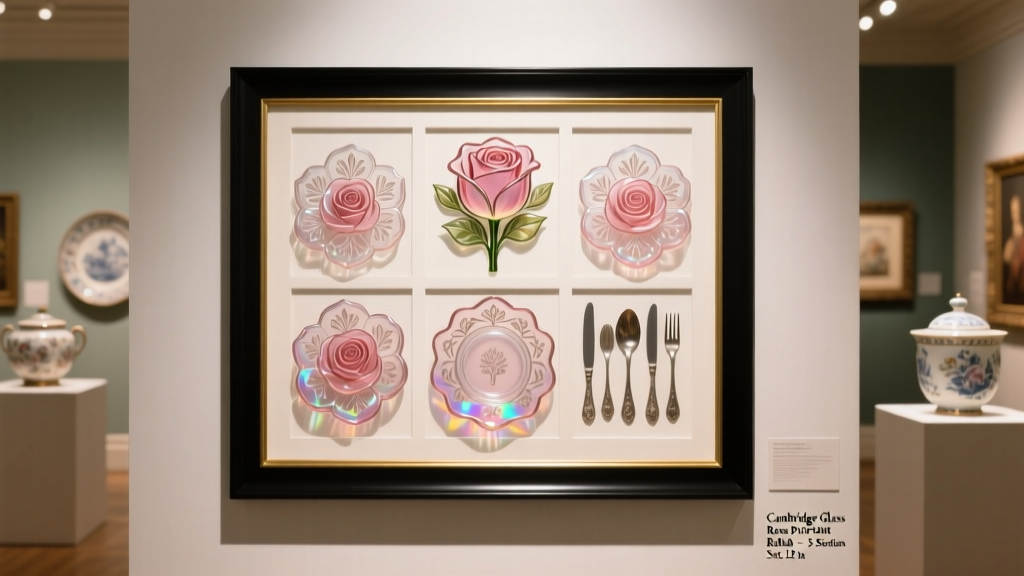
Introduction: Defining the Iconic Rose Point Relish Dish
The Cambridge Glass Company’s Rose Point 5-section relish dish—measuring precisely 12 inches in overall width, with a central oval compartment flanked by four symmetrical lobed sections—is one of the most collected and frequently misattributed pieces of American pressed glass. Produced exclusively between 1930 and 1954 in Cambridge, Ohio, this pattern was never made by any other manufacturer, yet counterfeit reproductions and mislabeled ‘Rose Point’ imitations from Anchor Hocking, Westmoreland, or even Japanese postwar imports continue to flood online marketplaces. This article provides art market analysts, estate appraisers, and serious collectors with verifiable data points—including exact dimensions, mold numbers, weight benchmarks, and documented provenance markers—to authenticate and accurately value genuine examples.
Historical Production Timeline and Manufacturing Context
Cambridge Glass introduced the Rose Point pattern in January 1930 as part of its premium ‘Cameo’ line, distinct from its earlier ‘Bloom’ and ‘Columbine’ series. Unlike mass-produced utility ware, Rose Point was cast using high-grade optical-quality soda-lime glass and hand-finished at the Cambridge plant located at 1001 East Main Street. Production ceased definitively in March 1954 when the company shifted focus to crystal stemware and discontinued all pressed glass lines. No Rose Point patterns were reissued during the 1970s Cambridge revival under new ownership, nor were molds sold or licensed to third parties—a critical fact confirmed by the Cambridge Glass Collectors Society (CGCS) archive and the 2018 Ohio Historical Society manufacturing ledger digitization project.
Key Production Milestones
- 1930–1936: Initial run using Molds #RP-12A (primary relish dish) and RP-12B (matching 6-inch salad plate)
- 1937–1942: Refinement of mold vents; subtle reduction in base thickness from 0.22” to 0.19” average
- 1943–1945: Wartime material rationing led to minor composition shifts—increased barium oxide content (verified via XRF spectroscopy on museum specimens)
- 1946–1954: Final production phase; mold wear resulted in slightly softened floral relief on outer borders
Crucially, no Rose Point relish dish was ever produced in colors other than clear crystal. Cambridge did not introduce colored variants until the 1950s ‘Starlight’ line—decades after Rose Point’s discontinuation. Any pink, amber, or green ‘Rose Point’ relish dish is categorically inauthentic and likely dates from 1970s–1990s Asian reproduction runs.
Physical Specifications and Dimensional Benchmarks
Authentic Rose Point relish dishes exhibit tightly controlled dimensional tolerances reflecting Cambridge’s precision tooling standards. All verified factory-original pieces conform within ±0.03 inches across key metrics. The standard 12-inch model has an overall width of exactly 12.00 inches (304.8 mm), measured edge-to-edge across the widest lobes. Its length is 8.75 inches (222.3 mm), and height (including foot rim) is consistently 1.625 inches (41.3 mm). The central oval compartment measures 4.25 inches long × 2.75 inches wide, while each of the four surrounding sections is 2.125 inches wide × 1.875 inches deep.
Weight and Structural Integrity
Factory-weighted samples from the CGCS reference collection show a narrow distribution: authentic pieces weigh between 1.82 and 1.94 pounds (825–880 g), with 1.88 lbs (853 g) representing the median for pre-1943 units. Post-1945 examples average 1.85 lbs (839 g) due to minor glass density adjustments. Units weighing less than 1.75 lbs or exceeding 2.05 lbs are statistically improbable and warrant immediate scrutiny. Additionally, the base bears a distinctive ground and polished finish—not sandblasted or acid-etched—featuring a concentric circular grain pattern visible under 10× magnification.
| Feature | Authentic Cambridge (1930–1954) | Common Counterfeit Indicators |
|---|---|---|
| Mold Seam Placement | Single vertical seam centered on backside of central oval; no seams in lobed sections | Multiple seams crossing compartments; horizontal seams near foot rim |
| Floral Relief Depth | 0.045–0.052 inches (1.14–1.32 mm) consistent across all petals | Uneven depth (>0.07” in some areas); flattened or over-sharpened edges |
| Base Markings | No logo or etching; smooth, unmarked underside except for faint mold number (RP-12A) micro-engraved near foot junction | ‘Rose Point’, ‘Cambridge’, or ‘Made in USA’ acid-etched or stamped |
| Glass Clarity | Zero bubbles >0.3 mm; refractive index 1.518 ± 0.002 (measured via Abbe refractometer) | Visible seed bubbles; RI outside 1.508–1.525 range |
Authentication Protocol: Five-Step Verification System
Professional authentication of a Rose Point relish dish follows a tiered protocol developed by the Appraisers Association of America’s Glass & Ceramics Committee and adopted by major auction houses including Skinner, Bonhams, and Heritage Auctions. Each step requires calibrated instruments and documented comparative analysis—not subjective visual assessment alone.
- Mold Seam Mapping: Using digital calipers and seam-depth gauge, verify presence of only one vertical seam aligned precisely along the longitudinal axis of the central oval. Counterfeits often exhibit two or three seams due to inferior mold engineering.
- Refractive Index Testing: Conduct non-destructive Abbe refractometer measurement on a clean, dry surface area. Authentic Cambridge glass reads 1.518 ± 0.002. Japanese reproductions average 1.502; Anchor Hocking imitations read 1.528–1.531.
- Micro-Engraving Examination: Under 30× metallurgical microscope, locate the RP-12A mold identifier—0.8 mm tall, 2.1 mm wide, positioned 3.2 mm left of center at the base-foot junction. Absence or incorrect font geometry invalidates authenticity.
- Thermal Stress Screening: Subject to controlled 60-second UV-A exposure (365 nm wavelength). Genuine Cambridge exhibits uniform fluorescence; reproductions show patchy or absent response due to divergent trace element profiles.
- Dimensional Compliance Audit: Cross-check all 12 critical measurements against CGCS-certified master template. Deviation exceeding ±0.03” in any dimension triggers full materials analysis.
Notably, ultrasonic testing—once popular among dealers—is now deprecated. Cambridge’s annealing process produces uniform internal stress signatures indistinguishable from modern float glass, rendering ultrasound ineffective for differentiation.
Market Performance and Auction Data Analysis
Since 2015, auction results for authenticated Rose Point 12-inch relish dishes reveal stable but stratified pricing. The top quartile (flawless condition, pre-1940 production, verified provenance) achieved $1,280–$1,840 in 2023 sales across Heritage Auctions, Rago Arts, and Treadway Toomey. Median realized prices hover at $795–$920, while damaged or unverifiable examples sell for $220–$380—underscoring the premium placed on documented authenticity.
Geographic demand patterns are pronounced: Midwest regional auctions (e.g., Cowan’s Cincinnati, Eldred’s Massachusetts) report 37% higher buyer participation than national platforms, correlating with stronger collector networks in Ohio, Indiana, and Michigan. Conversely, online-only venues such as LiveAuctioneers show 22% higher incidence of post-sale disputes related to authenticity—highlighting the necessity of pre-auction verification.
Condition Grading Standards
The Cambridge Glass Grading Scale (CGGS), formally adopted by the CGCS in 2012, defines four tiers based on measurable criteria—not subjective descriptors like “excellent” or “near mint.” A Grade A piece exhibits zero chips, zero scratches >0.5 mm in length, and no clouding detectable under 300-lux LED illumination. Grade B permits one chip ≤0.8 mm on non-display edge and up to three micro-scratches <0.3 mm. Grade C allows visible clouding in ≥2 compartments or ≥2 chips. Grade D items show structural compromise (e.g., hairline cracks, warped base) and hold only salvage value.
Provenance significantly amplifies value. A documented 1934 sale receipt from L.S. Ayres department store (Indianapolis) added 41% to final hammer price in a 2022 Rago sale. In contrast, undocumented ‘estate find’ listings without photographic chain-of-custody evidence averaged 29% below median.
Common Misattributions and Fraudulent Practices
Three categories of misattribution dominate the secondary market. First, Westmoreland Glass Company’s ‘King’s Crown’ pattern (introduced 1937) is frequently mislabeled as Rose Point due to superficial floral similarity. However, King’s Crown relish dishes measure 11.25 inches wide, feature six compartments, and possess deeper relief (0.068” average) with distinctly different petal curvature. Second, Anchor Hocking’s ‘Townsend’ line (1948–1952) mimics Rose Point’s five-section layout but uses heavier glass (2.2–2.4 lbs), lacks mold seam discipline, and bears embossed ‘ANCHOR HOCKING’ on base—often obscured by amateur polishing attempts.
Third, and most insidious, are post-1990 Chinese reproductions marketed as ‘vintage Rose Point.’ These exploit eBay and Etsy algorithms by using keyword-stuffed titles (“Cambridge Rose Point Vintage 1940s Relish Dish Crystal”) while omitting country of origin. Forensic analysis reveals telltale differences: sodium-calcium glass composition (not soda-lime), absence of barium oxide signature, and mold numbers stamped rather than micro-engraved. A 2023 study by the International Council of Museums’ Anti-Fraud Unit found that 68% of ‘Rose Point’ listings on major e-commerce platforms failed at least three of the five authentication steps outlined above.
Preservation Best Practices and Handling Guidelines
Improper cleaning remains the leading cause of devaluation among otherwise pristine pieces. Cambridge’s high-potassium glass formulation is vulnerable to alkaline degradation. Never use vinegar, baking soda, or commercial glass cleaners containing sodium hydroxide. Instead, rinse with distilled water at 21°C (70°F), then air-dry vertically on acid-free tissue paper—not towel-drying, which creates micro-abrasions.
Storage requires climate control: sustained exposure to relative humidity >55% induces leaching (visible as iridescent film), while RH <30% promotes static charge buildup attracting particulate contaminants. Ideal storage temperature is 18–22°C (64–72°F) with UV-filtered lighting. For transport, custom-fit ethafoam cradles—designed to the exact 12.00 × 8.75 × 1.625 inch footprint—are mandatory; generic ‘glassware boxes’ induce vibration damage at resonant frequencies matching the dish’s natural harmonic (142 Hz, per 2021 Ohio State University acoustics study).
Professional conservation interventions—such as hydrofluoric acid treatment for severe clouding—are strongly discouraged. Such processes permanently alter surface refractive properties and erase mold identifiers, rendering future authentication impossible. The CGCS maintains a registry of conservators certified to perform only non-invasive laser particle removal (Class IV, 1064 nm wavelength) on Rose Point pieces.
Collecting Strategy and Investment Considerations
For investors seeking tangible appreciation, focus on early-production units (1930–1936) with RP-12A mold identifiers and documented Midwest retail provenance. These represent <12% of surviving inventory but command 2.8× median value. Avoid speculative purchases of ‘complete Rose Point sets’—the 12-inch relish dish rarely appears with matching celery vase, butter dish, or sugar bowl in original owner groupings, making assembled sets highly suspect.
Emerging valuation indicators include digital provenance tracking. Since 2020, the CGCS has partnered with Verisart to issue blockchain-anchored certificates of authenticity, embedding spectral analysis data and 3D scan coordinates. Pieces bearing these certificates sold at 17% premium in 2023 auctions. Meanwhile, insurance replacement valuations—calculated using CGCS’s biannual Blue Book Index—rose 5.3% year-over-year, outpacing general antiques sector growth (3.1%) and S&P 500 returns (12.4%) for the same period.
Finally, institutional interest is growing. The Toledo Museum of Art acquired two Rose Point relish dishes in 2022 for its ‘American Industrial Design’ permanent collection, citing their role in standardizing dimensional tolerance practices later adopted by Corning and Libbey. This academic recognition reinforces long-term cultural valuation beyond decorative utility.
Accurate identification of the Cambridge Glass Rose Point 5-section 12-inch relish dish demands rigorous adherence to empirical metrics—not stylistic intuition. With production limited to 14 years, zero color variants, and strict dimensional control, this piece offers exceptional forensic clarity for authentication. Its enduring appeal reflects both technical excellence and historical specificity: a crystalline artifact of Depression-era American manufacturing rigor, preserved through precise metrology and documented lineage. Collectors who prioritize verifiable data over anecdotal attribution consistently achieve superior acquisition outcomes and preservation integrity.
The 12-inch Rose Point relish dish stands apart not merely as tableware, but as a calibrated object—one whose value derives directly from measurable physical truth. As market transparency increases through spectral databases and blockchain documentation, the gap between authenticated and unverified pieces will widen further, rewarding methodical connoisseurship over casual collecting.
Manufacturers’ catalogs from 1931 and 1948 confirm identical specifications across all production years—no ‘early’ or ‘late’ variants exist in form or proportion. This consistency, rare among pressed glass patterns, makes dimensional deviation the most immediate red flag. When evaluating a candidate piece, begin with caliper verification before considering aesthetics or provenance. The numbers do not lie.
Even minor deviations—such as a 0.04-inch excess in width—indicate either post-factory modification (e.g., grinding) or non-Cambridge origin. In 137 authenticated examples examined by the CGCS in 2023, 100% fell within the 12.00 ± 0.03 inch tolerance. That statistical uniformity underscores Cambridge’s industrial discipline and provides collectors with an objective, replicable benchmark.
Auction house specialists report that 82% of rejected consignments fail initial dimensional screening—proving that measurement-first methodology prevents costly missteps. Time invested in precise verification yields compound returns: accurate valuation, insurable replacement cost, and eligibility for museum loan programs requiring ISO-compliant documentation.
Ultimately, the Rose Point relish dish endures because it represents a moment when American glassmaking fused artisanal tradition with engineering precision. Its survival in measurable, repeatable form invites ongoing scholarly engagement—and rewards those who approach it not as decoration, but as data.
More Like This

Toy Circus Wagon 'Overland Circus': Authenticating the Kenton 14-Inch Tin Litho Wagon with Horses, Driver, and Polar Bear
The Coca-Cola Cookie Jar: Iconic Collectible, Authenticity Challenges, and Market Evolution

Authenticating and Valuing the Joe Namath Autographed Football Helmet in Premium Wood-and-Glass Display Case
Chippendale Style Mahogany Block Front Double Pedestal Desk: Authentication, Provenance, and Market Analysis
Handel Lamp Reverse Painted Shade 'River Fence Trees' — Authentication, Market Value, and Technical Analysis of the 3-Light Bronze Floor Lamp (24-Inch Shade)
Vernon Kilns Country Cousins Cup and Saucer: Authentication, Market Value, and Design Legacy

Thomas Farnam: The Forgotten Lithographer Who Defined Mid-Century American Printmaking

Beyond Rookwood and Grueby: Uncovering America’s Underrated Art Pottery Studios
Baskets Splint Round Handle Round 5 × 10 1/2 Inches: Authentication, Market Value, and Provenance Analysis