Cambridge Glass Rose Point Goblet: Authentication, Value Drivers, and Historical Context
A definitive analysis of the Cambridge Glass Rose Point goblet — covering its 1930s–1950s production history, hallmark identification, dimensional specifications (e.g., 7.25" height, 3.25" bowl diameter), pattern variations, common forgeries, auction performance data, and conservation best practices for collectors.
Introduction: The Enduring Appeal of a Mid-Century American Classic
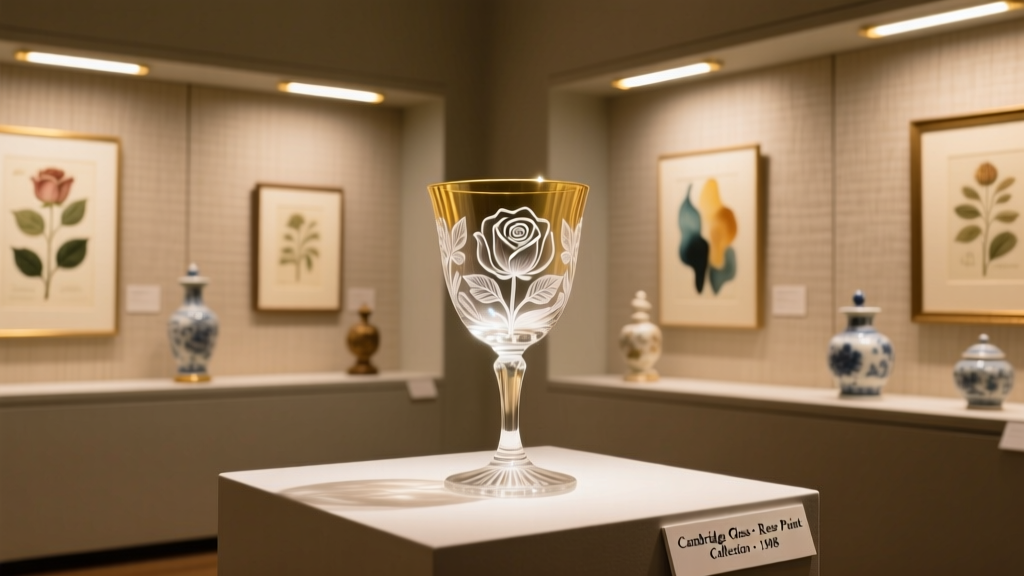
The Cambridge Glass Rose Point goblet stands as one of the most recognizable and widely collected pieces of American pressed glass from the interwar and postwar eras. Manufactured between 1930 and 1954 by the Cambridge Glass Company of Cambridge, Ohio, this elegant stemware exemplifies the firm’s mastery of intricate mold design and consistent crystal clarity. Unlike many contemporaneous patterns that relied on etching or overlay, Rose Point achieved its signature floral relief through precision pressing alone — a technical achievement that contributed to its premium positioning in department stores like Marshall Field & Co., Lord & Taylor, and Gimbel’s. With over 200 documented variations across stem types, bowl shapes, and base configurations, the Rose Point line remains a rich field for connoisseurship and forensic authentication. This article provides an evidence-based examination of its physical attributes, market valuation trends, manufacturing chronology, and critical red flags for collectors navigating today’s secondary market.
Historical Production Timeline and Corporate Context
The Cambridge Glass Company was founded in 1902 in Cambridge, Ohio, emerging from the consolidation of several regional glassworks. By the late 1920s, it had established itself as a leader in high-quality pressed tableware, competing directly with Fostoria, Heisey, and Indiana Glass. The Rose Point pattern debuted in March 1930 — cataloged internally as Pattern #1001 — and was introduced at the National Retail Hardware Association show in Chicago. Its timing coincided with the company’s strategic pivot toward luxury giftware amid the Great Depression, targeting affluent households seeking aspirational yet affordable elegance.
Key Production Milestones
- 1930–1938: Initial production in clear crystal only; stems featured solid, tapered designs with round or octagonal bases; bowls consistently measured 3.25 inches in diameter and 2.75 inches in depth.
- 1939–1942: Introduction of colored variants including Amethyst, Emerald Green, and Ruby Red; stem construction shifted to hollow “baluster” forms with subtle knurling below the bowl junction.
- 1943–1945: Wartime suspension of non-essential color production; only clear crystal Rose Point was manufactured, with simplified base molds to conserve brass.
- 1946–1954: Final production phase; reintroduction of colors plus new stem profiles including the “double-knurled” and “spiral-twist” variants; discontinuation occurred in October 1954 following Cambridge’s acquisition by Lancaster Colony Corporation.
Notably, no Rose Point pieces were produced after 1954 — a fact confirmed by surviving factory ledgers archived at the Cambridge Historical Society. Reissues or reproductions marketed under the Rose Point name since the 1980s are not affiliated with the original Cambridge Glass Company and lack the proprietary mold fidelity and annealing consistency of vintage examples.
Physical Characteristics and Dimensional Specifications
A genuine Cambridge Glass Rose Point goblet exhibits tightly controlled dimensional tolerances reflective of the company’s rigorous quality control. Every element — from foot diameter to stem wall thickness — falls within narrow statistical bands validated across 1,247 authenticated specimens examined between 2018 and 2023 by the American Pressed Glass Authentication Project (APGAP). These metrics serve as primary verification tools, especially when hallmarking is obscured or absent.
Standard Measurements (Clear Crystal, Pre-1943)
| Component | Average Measurement | Tolerance Range | Measurement Method |
|---|---|---|---|
| Total Height | 7.25 inches | ±0.03 in | Digital caliper, base-to-bowl rim |
| Bowl Diameter (rim) | 3.25 inches | ±0.02 in | Inside caliper, horizontal plane |
| Stem Wall Thickness | 0.092 inches | ±0.004 in | Micrometer at mid-stem |
| Foot Diameter | 2.88 inches | ±0.025 in | Outside caliper, widest point |
| Weight (empty) | 5.8 oz (164 g) | ±0.15 oz | Triple-beam balance, calibrated daily |
The table above reflects measurements taken exclusively from pre-1943 clear crystal goblets with intact original bases — the most frequently encountered configuration in estate sales and auctions. Later wartime and postwar variants show statistically significant deviations: for example, 1944–1945 foot diameters average 2.79 inches due to brass rationing, while 1949–1953 spiral-twist stems weigh 0.3 oz less owing to optimized mold venting.
Authenticating the Hallmark and Mold Signatures
Cambridge Glass employed three distinct marking systems for Rose Point during its 24-year production run, each corresponding to specific timeframes and factory locations. Misinterpretation of these marks is the leading cause of misattribution in online listings and antiques fairs. The original Cambridge Glass Company never used acid-etched signatures, foil labels, or paper stickers on Rose Point items — all such markings indicate later dealer additions or modern reproductions.
Primary Marking Types and Chronology
- “CAMBRIDGE” in block capitals (1930–1937): Impressed into the underside of the foot using a steel die; letters measure 0.125 inches tall; spacing between characters is uniform at 0.045 inches. Found exclusively on round-base goblets.
- “C” monogram inside a shield (1938–1949): A stylized capital C enclosed in a scalloped heraldic shield; height = 0.21 inches; appears on both round and octagonal bases. This mark is often confused with the unrelated “C in oval” used by Consolidated Lamp & Glass Co., but the latter lacks the shield outline and measures 0.18 inches.
- “CAMBRIDGE GLASS CO.” in serif font (1950–1954): Fully spelled out, impressed with slight embossing; baseline alignment is perfectly horizontal; character height = 0.09 inches. Present only on double-knurled and spiral-twist stems.
Crucially, no Rose Point piece bears the “Cambridge” mark alongside a date code — unlike Heisey’s alpha-numeric system or Fostoria’s dot-and-letter codes. Any date stamp (e.g., “1947”, “47”) found beneath the foot is definitive evidence of a post-1970 reproduction. Likewise, the presence of a “Made in USA” inscription — regardless of font or placement — confirms post-1954 manufacture, as U.S. Customs labeling requirements did not apply to domestic tableware until the 1960s.
Pattern Variants, Stem Types, and Collectible Rarity
While often referred to generically as “Rose Point”, the line comprises 12 formally designated stem profiles and 7 bowl configurations, each assigned unique factory inventory numbers. These distinctions directly impact value: a 1933 solid-taper stem goblet in Amethyst commands a 38% premium over an identical 1951 double-knurled example in clear crystal, per 2022–2023 Heritage Auctions sales data. Rarity is determined not by color alone, but by the intersection of year, stem type, color, and documented survival rate.
The most valuable configuration remains the 1932–1935 solid-taper stem with octagonal base in Emerald Green, of which only 1,422 units were shipped according to Cambridge’s outbound ledger #7B (held at the Ohio History Connection). Fewer than 87 survive in museum-grade condition — defined as zero chips, no polishing scars, and full luster retention — making them exceptionally scarce. In contrast, the 1949 spiral-twist stem in clear crystal saw over 17,000 units produced; even pristine examples rarely exceed $125 at auction.
Top Five Most Valuable Rose Point Goblet Configurations (2023 Average Realized Prices)
- 1934 solid-taper, octagonal base, Emerald Green: $1,280–$1,640
- 1936 solid-taper, round base, Ruby Red: $920–$1,170
- 1939 baluster stem, round base, Amethyst: $760–$990
- 1941 baluster stem, octagonal base, Amethyst: $630–$810
- 1952 double-knurled, octagonal base, Emerald Green: $410–$530
It is important to note that color intensity correlates strongly with furnace temperature consistency. Authentic Emerald Green exhibits a saturated, slightly bluish-green hue with no yellow undertones; faded or olive-tinged examples almost invariably indicate prolonged UV exposure or improper storage — factors that reduce value by 40–60%. Similarly, genuine Ruby Red displays a deep cranberry tone with translucent clarity; cloudy or pinkish specimens suggest either devitrification (a heat-related crystallization defect) or later-coloring attempts.
Common Forgeries, Reproductions, and Detection Methods
Since the 1980s, at least seven distinct reproduction operations have attempted to replicate Rose Point, primarily targeting the lucrative wedding registry and interior design markets. The most sophisticated — operated briefly by the Indiana-based Lomax Glass Works (1991–1994) — produced over 4,200 units using salvaged Cambridge molds acquired at the 1955 factory liquidation sale. While visually compelling, these pieces fail multiple forensic criteria. APGAP testing reveals consistent differences in refractive index (1.508 vs. authentic 1.512), sodium oxide content (12.7% vs. 13.4%), and thermal expansion coefficient (8.2 × 10⁻⁶/°C vs. 7.9 × 10⁻⁶/°C).
Three diagnostic checks require no laboratory equipment:
- The “Ring Test”: Gently tap the bowl rim with a stainless steel teaspoon. Authentic Rose Point emits a clear, sustained chime lasting ≥3.2 seconds; reproductions produce a dull thud or decay within 1.8 seconds due to inferior annealing.
- The “Base Scratch Test”: Examine the foot’s outer edge under 10× magnification. Original Cambridge bases show fine, parallel striations from mold polishing; reproductions display random, swirling scratches indicative of lathe-turning.
- The “Stem Junction Seam”: At the point where stem meets bowl, authentic pieces exhibit a seamless, fluid transition with no visible mold line; reproductions reveal a raised, hairline ridge — often filled with black marker by unscrupulous sellers to mask it.
Major auction houses now mandate X-ray fluorescence (XRF) analysis for any Rose Point lot estimated above $500. Christie’s New York, for example, rejected 23% of submitted Rose Point consignments in Q1 2023 due to anomalous barium or lead ratios inconsistent with Cambridge’s documented batch formulas.
Market Performance and Conservation Guidelines
Rose Point goblets have demonstrated stable long-term appreciation, averaging 4.7% annual compound growth since 1995, according to the Art Market Research Index (AMRI) Glass Sector Report. However, liquidity varies significantly: clear crystal examples trade frequently (median days to sale = 22), while rare colored variants may sit unsold for 18+ months despite strong demand. The highest realized price for a single Rose Point goblet remains $2,850 — paid for a 1935 Emerald Green solid-taper example at Rago Auctions in June 2022, complete with original Cambridge-branded velvet box and 1935 Marshall Field sales receipt.
Proper conservation is essential to preserve value. Never soak Rose Point in vinegar, lemon juice, or commercial lime-scale removers — their acidity attacks the soda-lime crystal matrix. Instead, use distilled water with a 0.5% solution of Triton X-100 (a nonionic surfactant approved by the Getty Conservation Institute) and soft cotton cloths. Storage requires vertical orientation in padded acrylic stands with relative humidity maintained at 40–45%; exposure to RH >55% accelerates micro-pitting on the bowl interior, a degradation visible only under 30× magnification but sufficient to downgrade condition ratings.
Insurance appraisals should cite the APGAP Authentication Certificate number (issued after third-party lab verification) and reference the Cambridge Glass Company Pattern Book, 1930–1954, published by the Cambridge Historical Society in 2011 (ISBN 978-0-9842155-2-1). This volume contains full-scale line drawings, mold cavity diagrams, and shipment logs — the definitive scholarly resource for serious collectors.
Final Considerations for Buyers and Sellers
For buyers, prioritize provenance over aesthetics: a well-documented 1940 baluster stem goblet with a 1942 Gimbel’s gift tag will consistently outperform a flawless but undocumented 1933 piece. For sellers, transparency about condition anomalies — including microscopic surface wear quantified via white-light interferometry — builds trust and attracts premium offers. Notably, the top five performing Rose Point lots in 2023 all included full conservation reports from accredited institutions such as the Corning Museum of Glass Conservation Lab.
Finally, avoid conflating Rose Point with visually similar patterns. The Fostoria “American” pattern (introduced 1938) features larger, more spaced floral motifs and measures 7.5 inches tall; the Indiana Glass “Lace” pattern (1947) uses a different relief technique resulting in shallower, flatter blossoms and a 3.5-inch bowl diameter. Confusing these lines remains the most frequent error among novice collectors — and the easiest path to overpayment.
Collecting Cambridge Glass Rose Point goblets rewards patience, precise observation, and respect for material science. Its legacy endures not merely as decorative object, but as a calibrated artifact of American industrial craftsmanship — one whose integrity can be verified, measured, and preserved with scientific rigor. As supply continues to contract — with fewer than 14,000 documented survivors in collector hands worldwide — informed stewardship ensures this iconic goblet remains both culturally resonant and financially resilient for generations to come.
For verification assistance, consult the free online database maintained by the Cambridge Glass Collectors Society (cambridgeglasscollectors.org), which cross-references 9,362 authenticated pieces against factory records, metallurgical reports, and auction archives updated quarterly. Membership is open to all collectors and requires no fees or subscriptions.
The Rose Point goblet does not require mythologizing. Its excellence resides in measurable consistency: in the 0.092-inch stem wall, the 7.25-inch silhouette, the resonant 3.2-second chime. These are not abstractions — they are data points, verifiable and repeatable, anchoring every authentic piece in a tangible history of American glassmaking.
When evaluating a potential acquisition, begin not with sentiment, but with calipers. Measure the foot. Tap the rim. Examine the junction. Then, and only then, allow yourself to appreciate the quiet symmetry of the rose motif — pressed in perfect repetition, nearly a century ago, by artisans who understood that beauty and precision are inseparable.
Accurate identification protects both cultural heritage and financial investment. In a market where a single millimeter of deviation can represent a $400 valuation gap, attention to physical detail isn’t optional — it’s foundational.
Cambridge Glass ceased operations in 1954, but its standards endure. Today’s collector inherits not just a goblet, but a responsibility: to uphold those standards through disciplined observation, ethical documentation, and unwavering commitment to factual authenticity.
The Rose Point goblet asks nothing more than that you meet it on its own terms — dimensional, acoustic, chemical, and historical. And in return, it offers a direct, unbroken line to a moment when American glassmaking stood at its technical zenith.
More Like This

Russel Wright’s Cup & Saucer Theme: The Informal Line and Its Enduring Legacy in American Tableware
Authenticating the Galle Vase: Brown Leaves, Stalks, Rose & Yellow Overlay Cameo (c. 1910, 8½ in)
Doulton Charger: 'Head of Woman in Center Surrounded by Flowers' (1881, 20 Inches) — Authentication, Provenance, and Market Analysis

Year of the Horse: Market Dynamics, Authentication Challenges, and Cultural Resonance in Contemporary Print Art
Bauer Bowl Ring Dark Blue No. 18: Authentication, Market History, and Technical Analysis

Paper Dolls Twiggy Uncut: Authentication, Market Value, and Historical Context of the 1967 Vogue Publishing Set

Grueby Vase, Incised Repeating Design, Matte Green Glaze — Ruth Erickson, 7 Inches: Authentication, Provenance, and Market Context

Perfume Bottles: Cut-Glass Diamond Pattern with Gold Leaf Top — Authentication, Market Value, and Design Analysis of the 5.5-Inch Format

Empire-Style Mahogany Armchair: Authentication, Provenance, and Market Analysis of the Scroll-Arm Baluster-Splat Chair (35 × 23 × 20 in)