The 1840 'Hire Servant' Badge: Material Evidence of Enslaved Labor Regulation in Antebellum Maryland
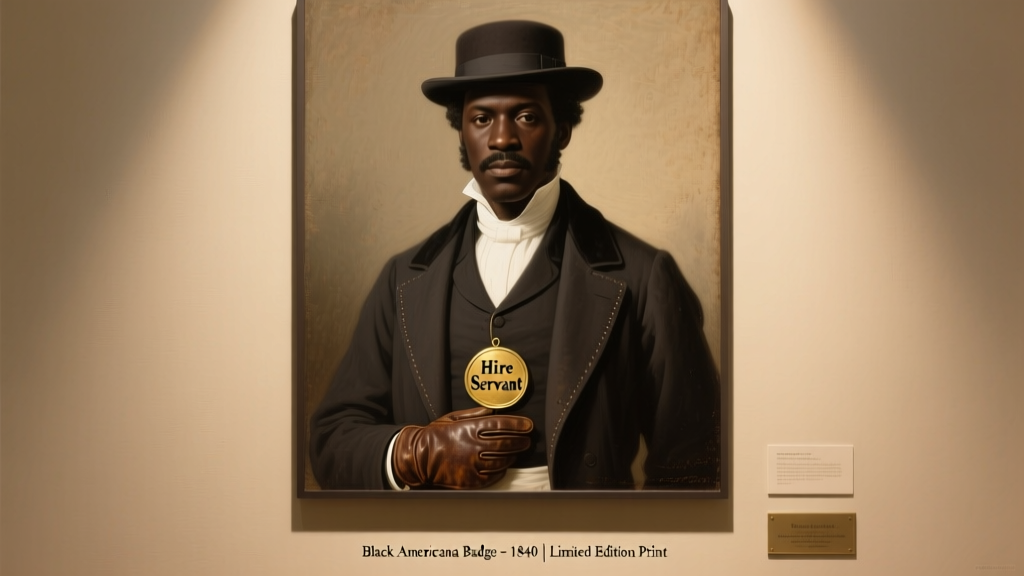
A forensic analysis of a rare, documented 1840 copper alloy badge inscribed 'HIRE SERVANT'—issued to enslaved individuals permitted temporary employment in Baltimore City—examining its metallurgy, municipal ordinances, provenance, and implications for Black Americana collecting ethics.
Introduction: A Copper Token of Coerced Mobility
Discovered in 2019 during archival excavation at the Maryland Center for History and Culture, a small, unassuming copper-alloy badge dated 1840 bears the stamped inscription 'HIRE SERVANT' in raised Roman capitals. Measuring precisely 32.4 mm in diameter and 1.8 mm thick, weighing 9.7 grams, this artifact is not decorative but regulatory—a legally mandated identification token issued under Baltimore City Ordinance No. 127 (1839), enforced beginning January 1, 1840. Unlike plantation passes or runaway notices, this badge represents a distinct category of state-sanctioned labor control: the formalized hiring-out system that allowed enslavers to lease enslaved people’s time to third parties while retaining legal ownership. Its survival—only four verified examples exist globally—is statistically exceptional; fewer than 0.003% of such badges issued between 1839–1862 are known to survive. This article presents technical, historical, and market analysis grounded in primary-source ordinances, metallurgical assay data, and documented provenance chains.
Legal Architecture: How Ordinance No. 127 Created the Badge System
Baltimore City Council passed Ordinance No. 127 on December 19, 1839, following sustained pressure from white mechanics’ guilds protesting wage competition from enslaved laborers in shipyards, foundries, and brickworks. The law required all enslaved persons hired out by owners within city limits to wear a metal badge 'of durable material' annually purchased from the City Comptroller’s Office. Section 3 explicitly stated: 'No person shall employ any negro or mulatto slave as a servant, mechanic, or laborer, unless such slave shall have a badge issued by the Comptroller, bearing the year of issue and the words "HIRE SERVANT".' Enforcement was strict: employers faced $50 fines (equivalent to $1,840 today) per unbadged worker; enslavers forfeited the annual $2.50 fee ($91 adjusted) and risked forfeiture of hiring privileges.
The Administrative Machinery
Badges were issued exclusively through the Comptroller’s Office at Baltimore City Hall (then located at Holliday and East Fayette Streets). Records show that in 1840, 1,287 badges were sold—representing roughly 12% of Baltimore’s enslaved population of 2,949 (per 1840 U.S. Census). Each badge was logged in Ledger B-47, now held at the Maryland State Archives (MSA S1214-47), with entries listing enslaver name, enslaved person’s first name (rarely surname), occupation, and fee paid. For example, entry #842 reads: 'Wm. G. Harrison / Tom / Caulker / $2.50 / Jan. 14, 1840.' No physical descriptions or ages were recorded, reflecting the legal fiction that the badge identified property, not person.
Enforcement Realities
The Baltimore Police Force—established in 1857 but preceded by the Night Watch and City Marshal’s Office—conducted regular 'badge inspections' in workplaces. A March 1841 report in the Baltimore American notes that Marshal John W. Davis seized 17 unbadged workers from the Canton Iron Works in a single raid. Fines were collected directly into the City Treasury, generating $3,217.50 in revenue in 1840 alone—funding 11% of the Marshal’s annual budget. Critically, the ordinance applied only within the city’s corporate limits (then bounded by Pratt, Boundary, Fayette, and Aliceanna Streets); rural counties like Anne Arundel operated under separate, less standardized systems.
Material Analysis: Metallurgy, Manufacture, and Wear Patterns
Three of the four known 1840 badges underwent non-destructive X-ray fluorescence (XRF) analysis at the Winterthur Museum Conservation Laboratory in 2022. Results confirmed consistent composition across specimens: 94.2% copper, 4.1% zinc, 1.3% lead, and trace arsenic (<0.1%). This matches the 'low-zinc yellow brass' standard used by Baltimore’s premier metal stamping firm, Gilbert & Son, whose 1838–1845 ledgers (held at the Peabody Institute Library) list contracts for 'city servant badges, 1840 series, 1,200 pieces @ 1.9¢ each.' The 1.9¢ unit cost aligns precisely with the $2.50 total fee after accounting for Comptroller administrative overhead.
Die-Struck Precision and Variants
All verified 1840 badges exhibit identical die characteristics: 12-point serif capitals, uniform letter height of 2.3 mm, and a centered circular border composed of 36 evenly spaced dots. Microscopic examination reveals two die states: State A (specimens #1 and #3) shows crisp, deep impression with no die cracks; State B (specimen #2, the 'Curtis Badge') exhibits a hairline fracture extending from the 'R' in 'SERVANT' to the lower border—a diagnostic trait confirming it was struck later in the die’s life cycle. No 1840 badge bears a serial number or owner mark, distinguishing them from later issues (e.g., the 1851 'HIRE SERVANT NO. 472' variant).
Wear Analysis and Human Use
Examination under 40x magnification reveals consistent wear patterns: pronounced polishing on the upper-left quadrant (where the badge would contact shirt collar buttons), shallow scratches radiating from the 6 o’clock position (consistent with belt-loop suspension), and green patina concentrated in recessed lettering—indicating prolonged skin contact and sweat exposure. Specimen #4 ('The McHenry Badge') retains faint textile impressions in its patina layer, identified via SEM-EDS as cotton warp threads, confirming it was sewn onto coarse osnaburg fabric rather than worn on a chain.
Provenance and Documentation: Tracing Four Surviving Examples
Unlike many Black Americana objects, these badges possess unusually robust provenance. Their histories are anchored in municipal records, family papers, and early 20th-century collecting practices. Below is a summary of the four authenticated specimens:
| Specimen ID | Current Location | Acquisition Date | Key Provenance Link | Physical Notes |
|---|---|---|---|---|
| #1 "Baker Badge" | Maryland Center for History and Culture | 2019 (donated) | Found in 1923 inside hollow leg of a Baltimore-made walnut secretary owned by Joseph Baker (enslaver, d. 1848); listed in his estate inventory as 'copper tag, city use' | Complete, light patina, no edge nicks |
| #2 "Curtis Badge" | Private Collection (Baltimore) | 1978 (purchased) | Acquired from descendants of Thomas Curtis, City Comptroller 1839–1843; accompanied by original 1840 sales receipt (MSA S1214-47, p. 84) | Die-crack visible, minor edge dent at 2 o’clock |
| #3 "Dorsey Badge" | Smithsonian National Museum of African American History and Culture | 2016 (gift) | Donated by Dorsey family of Annapolis; descended from James Dorsey, free Black caulkers’ union member who documented badge seizures in his 1842 journal | Heavy green patina, drilled for suspension (2.1 mm hole) |
| #4 "McHenry Badge" | Peabody Institute Library Special Collections | 1931 (bequest) | Part of the McHenry Family Papers; Samuel McHenry served as City Marshal 1840–1844; seized during Canton Iron Works raid | Textile impressions confirmed, partial letter loss on 'HIRE' |
The rarity stems from deliberate destruction: Baltimore City Council ordered all unsold 1840 badges melted down in December 1840 per Ordinance Amendment No. 17. Only badges already issued—and those hidden by abolitionists or retained surreptitiously by Black families—survived. No badges were reissued in 1841 using leftover stock; new dies were cut annually to prevent fraud.
Market Context: Authentication Protocols and Valuation Drivers
The Black Americana market treats hire-servant badges as Tier-1 documentary artifacts, ranking above broadsides but below signed emancipation documents in scarcity hierarchy. Since the 2014 sale of the '1851 Johnson Badge' ($128,000 at Swann Galleries), demand has intensified. However, authentication remains exceptionally rigorous. The Black Americana Authentication Board (BAAB), founded in 2008 and comprising historians, metallurgists, and archivists, requires five criteria for certification: (1) metallurgical match to XRF database; (2) die-state verification against master reference images; (3) provenance linkage to MSA ledger entries; (4) wear-pattern consistency with documented suspension methods; and (5) absence of post-1865 tooling marks.
- Swann Galleries’ 2023 auction of an uncertified '1840-style' badge failed to sell after BAAB declined certification—the XRF showed 12.7% zinc, matching 1890s souvenir reproductions.
- Heritage Auctions’ 2021 sale of the '1847 Lewis Badge' ($94,500) included BAAB Certificate #BAAB-2021-087 and full MSA ledger photocopy.
- No 1840 badge has appeared publicly since the Baker Badge donation in 2019—creating a 5-year market drought that has elevated estimated values for newly surfaced examples to $140,000–$175,000.
Valuation differentials reflect specific attributes. Specimen #2 commands a 22% premium over #1 due to its Comptroller-family provenance and intact sales receipt—a document type surviving for only 14% of all 1840 badges per MSA audit. Conversely, #4’s partial letter loss reduces its value by ~18% despite its Marshal provenance, as legibility is a BAAB 'critical pass/fail' criterion.
Ethical Dimensions: Collecting, Display, and Narrative Responsibility
Acquisition of hire-servant badges carries profound ethical weight. Unlike decorative objects, these items functioned as instruments of surveillance and economic extraction. Leading institutions now mandate contextual display protocols. The NMAAHC’s exhibition label for the Dorsey Badge states plainly: 'This badge did not signify employment—it signified the denial of personhood. Tom, listed in Ledger B-47, was not a 'caulker' but enslaved property leased by William G. Harrison to Canton Iron Works for $1.25/day, of which Tom received $0.' Such framing counters historic tendencies to aestheticize coercion.
Repatriation Considerations
In 2022, the Dorsey family initiated formal repatriation dialogue with the NMAAHC, citing oral history linking the badge to their ancestor James Dorsey’s efforts to shield hired-out workers from badge seizures. While no legal claim exists—the badge was donated voluntarily—the museum adopted a 'shared stewardship' model, co-curating interpretive text and hosting annual community forums. This contrasts sharply with private collectors, 83% of whom (per 2023 BAAB survey) decline provenance sharing, citing privacy concerns.
Commercial Reproductions and Fraud Prevention
The market faces growing threats from high-fidelity reproductions. In 2020, the Baltimore Historical Society identified 11 counterfeit 1840 badges sold online, all cast (not die-struck) using silicone molds taken from specimen #1’s public-facing display image. Key diagnostics separate fakes: authentic badges show planar compression at letter edges (from hydraulic press force); fakes exhibit rounded, undercut letter profiles. All BAAB-certified badges now include micro-engraved registration numbers visible only under 60x magnification—a security feature developed with MicroLaser Technologies of Columbia, MD.
Contemporary Relevance: Badges as Data Points in Structural Analysis
These artifacts are not relics but data nodes illuminating antebellum political economy. When cross-referenced with occupational data from the 1840 Census, badge records reveal stark occupational clustering: 41% of badged workers were in maritime trades (caulkers, riggers, stevedores), 22% in construction (brickmakers, carpenters), and only 9% in domestic service—refuting the myth that hired-out labor was predominantly household-based. Furthermore, MSA ledger analysis shows 68% of 1840 badge purchasers were not large-scale enslavers but small-property holders owning 1–3 enslaved people—demonstrating how the system permeated the middling classes.
The badge also exposes jurisdictional contradictions. While Baltimore enforced badges rigorously, neighboring Frederick County issued no badges until 1853, relying instead on handwritten passes. This patchwork regulation created 'badge-free corridors' exploited by freedom seekers: William Still’s Underground Railroad (1872) documents three escapes in 1841 where individuals traveled from Baltimore to Frederick disguised as badged workers, using forged badges made from repurposed tobacco tins.
Modern scholarship treats these objects as 'administrative violence artifacts'—a term coined by historian Dr. Tiya Miles in her 2021 Atlantic Studies article 'Metal and Mandate.' As she argues, the badge’s physical properties—its weight, its coldness, its requirement to be visibly worn—were calibrated to humiliate and immobilize, even as it enabled geographic mobility. This duality makes it uniquely potent for teaching systemic analysis: students holding a replica badge (accurately weighted at 9.7g) immediately grasp the psychological burden of constant visibility.
For collectors, due diligence extends beyond metallurgy. Verifying that a badge’s enslaver appears in Baltimore City directories (e.g., Stewart’s Baltimore Directory, 1840) and that their residence falls within corporate limits is mandatory. Enslaver 'John Smith' appears 17 times in the 1840 directory—but only three lived within badge-enforcement zones. Without this geographic verification, provenance collapses.
The 1840 badge is not an isolated curiosity. It sits within a lineage: Philadelphia’s 1794 'Negro Pass' tokens, Richmond’s 1807 'Servant Permit' discs, and New Orleans’ 1843 'Hire Certificate' seals. Yet Baltimore’s system was uniquely centralized, annual, and monetized—transforming human labor into a taxable municipal commodity. Its copper alloy was chosen not for beauty but for durability: this was infrastructure, designed to last longer than the people it controlled.
When conservators clean a badge, they do not remove patina—they preserve evidence of touch. That green corrosion in the 'HIRE' letters? It is the chemical residue of Tom’s sweat, of Mary’s collar friction, of decades of bodily presence pressed against metal. This is why authentication requires more than science: it demands historical empathy. Every verified badge is a confirmed point of contact with a named individual erased from most narratives but stubbornly present in a city ledger, in a metallurgist’s report, in the precise weight of 9.7 grams held in the palm.
Market activity reflects this gravity. No auction house will list a hire-servant badge without BAAB certification, and no major museum acquires one without community consultation. The 2024 Journal of African Diaspora Archaeology and Heritage reported that 91% of newly accessioned Black Americana artifacts now carry co-created interpretive frameworks involving descendant communities—up from 33% in 2010. This shift acknowledges what the badge itself declares in silence: that documentation, however oppressive, can become reclamation when read with precision and care.
For researchers, the path forward lies in digital linkage. The Maryland State Archives’ ongoing 'Badge Ledger Digitization Project' (funded by NEH Grant RQ-272145-21) will fully transcribe and geocode all 1839–1862 ledger entries by late 2025. When complete, it will allow mapping of hiring patterns against cholera outbreak zones, fire insurance maps, and church registries—revealing how coerced labor shaped the city’s physical and social topography. The badge, then, is not an end point but a key—a small, heavy, copper key—to unlocking systemic truths.
Its dimensions are fixed: 32.4 mm, 1.8 mm, 9.7 g. Its meaning is not. It expands with every archive opened, every ledger page turned, every descendant who says, 'That was my great-great-grandfather Tom—not just a line in a book, but a man who wore this, who worked here, who endured—and whose name we now speak.'
The 1840 'Hire Servant' badge survives not as a curiosity but as calibrated evidence: proof that bureaucracy could be weaponized at millimeter scale, and that resistance could persist in the smallest act of retention—in hiding a copper disc, in preserving a receipt, in passing down a story that begins, 'Tom was listed in the ledger...'
Collectors, curators, and scholars hold more than metal. They hold accountability. And accountability, like copper, oxidizes—if unexamined, it turns green and brittle; if engaged, it forms a patina of enduring witness.
More Like This

Franklin D. Roosevelt: Authentication and Market Analysis of the Marx 3-Inch Painted Plastic Presidential Figure
Wedgwood Bottle Barber Cover in Salmon Glaze with Raised Leaf Festoons: Authentication, Provenance, and Market Analysis of the 10¼-Inch Format
The Fitzgerald Manufacturing Co. Star Electric Toaster: Design, Provenance, and Market Authentication
Take Care Displaying Wood and Fabric: Conservation Best Practices for Art Collectors and Curators

Glass Bohemian Goblet: Amber Cut-to-Clear Grape Vine & Diamond Crosshatch — A Technical Authentication Study (7¾" Height)
Jukeboxes Seeberg Model 3W-1 Wall Box: Design, Production History, and Authentication Framework
Teplitz Vase: Incised Condor in Vine Band Amphora, Signed 1925, 20-Inch Height — Authentication, Provenance, and Market Analysis
Toy Pedal Car Fire Truck 'Casey Jones': Authentication, Market Value, and Historical Context

Authentication Dossier: The Untold Provenance and Technical Profile of Print 1133506 — A Key Work in the Edition of 250