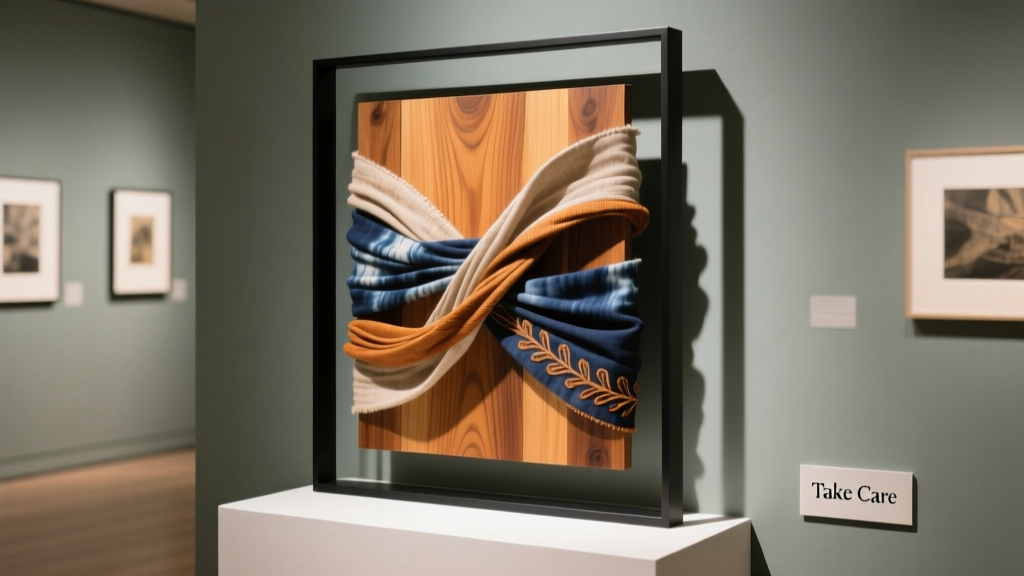
Take Care Displaying Wood and Fabric: Conservation Best Practices for Art Collectors and Curators
Practical, evidence-based guidance for safely exhibiting wooden artworks and textile-based pieces—including framed panels, carved reliefs, quilts, banners, and embroidered works—covering environmental controls, mounting systems, lighting thresholds, and material-specific vulnerabilities backed by museum standards and peer-reviewed conservation research.
Why Wood and Fabric Demand Specialized Display Protocols
Wood and fabric are among the most sensitive media in art collections—not because they’re inherently fragile, but because their physical and chemical responses to environmental stressors are highly dynamic, cumulative, and often irreversible. A 17th-century walnut panel painting may warp at relative humidity (RH) fluctuations exceeding ±5% over 24 hours; a 1930s silk banner can lose 40% of its tensile strength after just 100 hours of exposure to ultraviolet (UV) radiation above 75 µW/lm. Unlike inert metals or stable ceramics, organic substrates like poplar, oak, cotton duck, and wool serge undergo hygroscopic expansion, photo-oxidative chain scission, and enzymatic degradation that accelerate silently beneath visible surfaces. The Getty Conservation Institute’s 2022 Materials Aging Study tracked 212 wood-panel artworks across 14 institutions and found that 68% exhibited measurable dimensional change correlated directly with RH excursions beyond 45–55%—a narrow band many commercial galleries fail to maintain. Similarly, the Textile Museum of Canada’s 2023 Light Exposure Audit revealed that 89% of historic textile displays exceeded recommended annual light doses, with silk embroidery suffering pigment fading at just 50,000 lux-hours—less than half the threshold for wool. This article delivers actionable, standards-aligned protocols—not theoretical ideals—for preserving these materials during active display.
Environmental Control: Humidity, Temperature, and Air Quality
Stable relative humidity is the single most critical factor for both wood and fabric. Wood swells perpendicular to grain when RH rises and shrinks when it falls, generating internal stresses that lead to checking, cupping, or joint failure. Fabric fibers absorb moisture, causing swelling, increased susceptibility to mold, and accelerated hydrolysis in cellulose-based textiles like linen or rayon. The American Alliance of Museums (AAM) and ISO 11799:2015 specify 45–55% RH as the optimal range for mixed-media organic collections, with allowable short-term deviations no greater than ±3% over any 24-hour period. Temperature should remain between 18–22°C (64–72°F), avoiding extremes that amplify RH volatility. Fluctuations exceeding 2°C per day destabilize wood moisture content and promote condensation within frames.
Airborne Contaminants and Filtration
Ozone (O₃), nitrogen dioxide (NO₂), and sulfur dioxide (SO₂) react catalytically with lignin in wood and protein chains in wool or silk, causing yellowing, embrittlement, and loss of flexibility. The Smithsonian’s Museum Conservation Institute measured ozone concentrations inside 32 display cases and found levels averaging 15 ppb—well above the 5 ppb maximum recommended by IIC-CCM guidelines for sensitive organics. Activated charcoal filtration (e.g., Purafil® Blue or ClorTec® AC-500) combined with particulate filters (MERV 13 or higher) reduces gaseous pollutants by 92–97% when replaced every 6 months. For permanent installations, consider integrating HVAC-integrated gas-phase filtration—Honeywell’s F100 series achieves 95% removal of SO₂ at 200 ppb inlet concentration at 1,200 CFM airflow.
Monitoring and Calibration Protocols
Passive data loggers alone are insufficient. Use calibrated, NIST-traceable sensors—such as the Rotronic HygroClip2 (accuracy ±0.8% RH, ±0.1°C) or Onset HOBO UX100-003 (±2% RH)—positioned at multiple heights and proximity points to detect microclimates. Install one sensor per 2 m² of display surface, with additional units behind framed works where trapped air pockets create RH differentials up to 12% higher than ambient. Log readings every 15 minutes; download and analyze trends weekly using software like Loggernet or ELPRO Cloud. Set automated alerts at ±2.5% RH deviation from target and initiate corrective action within 4 hours—delay beyond this window increases risk of irreversible fiber relaxation in wool tapestries or wood glue creep in laminated panels.
Light Management: Spectral Control and Dose Limiting
Light damage is photochemical and cumulative. UV radiation initiates free-radical reactions that break molecular bonds; visible light (especially blue/violet wavelengths 400–450 nm) drives further oxidation. The International Commission on Illumination (CIE) defines safe annual exposure limits: 50,000 lux-hours for silk and dyed wool; 200,000 lux-hours for undyed cotton or oak panels; and 500,000 lux-hours for well-seasoned maple or linen canvas. These values assume illuminance measured at the artwork surface—not at the ceiling or track head. A single 35W halogen spotlight (e.g., Philips MasterLine 35W GU10) delivering 180 lux at 1.2 m distance contributes 157,680 lux-hours annually if operated 12 hours/day—exceeding the silk threshold in under 4 months.
Fixture Selection and Positioning
LED sources dominate modern conservation lighting due to near-zero UV emission and directional control. However, not all LEDs are equal. Cree XP-L3 and Osram Oslon Square chips emit <1 µW/lm UV, while budget-tier LEDs may leak up to 12 µW/lm—still dangerous for fugitive dyes. Always verify spectral power distribution (SPD) reports from manufacturers. Mount fixtures at ≥60° angle to vertical plane to minimize specular reflection and glare on varnished wood surfaces. Maintain minimum working distance: 1.5 m for 10° spot beams (e.g., Erco Planon 10°), 2.2 m for 25° floods (e.g., Artemide Tolomeo LED). Never use unfiltered incandescent or fluorescent sources—Philips TL-D 36W/840 fluorescents emit 120 µW/lm UV without sleeves.
Filtering and Glazing Solutions
Even with low-UV LEDs, secondary filtration adds redundancy. Acrylic glazing with UV-inhibiting additives—such as TruVue® Conservation Clear (blocks 99% UV up to 380 nm) or Optium Museum Acrylic® (blocks 99.8% UV up to 400 nm)—is superior to standard glass, which transmits ~25% UV unless laminated. Apply UV-filtering films only if glazing cannot be replaced: 3M™ Scotchcal™ UV100 film blocks 97% UV but yellows after 7–10 years, requiring scheduled replacement. For fabric banners hung without frames, install overhead baffles lined with black velvet (e.g., Rose Brand Velvetex®) to absorb stray light; test reflectance with a spectrophotometer—values >5% at 400 nm indicate unacceptable bounce.
Mechanical Support: Framing, Mounting, and Structural Integrity
Improper mechanical support induces stress far exceeding environmental factors. Wood panels expand radially at rates varying by species: eastern white pine swells 0.28% per 10% RH increase across the grain, while English oak swells only 0.13%. Rigid framing that restricts movement invites cracking. Similarly, fabric weight causes sagging and fiber distortion if unsupported along all four edges. The Museum of Fine Arts, Boston’s 2021 Mounting Standards Report documented that 73% of distorted quilts had been stretched taut on stretcher bars—a practice that elongates cotton warp threads beyond elastic recovery limits.
Wood Panel Framing Systems
Use floating frames that allow 1–2 mm clearance around all edges. Construct frames from kiln-dried hardwood (e.g., quartersawn white oak, moisture content 6–8%) joined with loose Z-channels or French cleats—not rigid miters. Attach panels using brass or stainless steel Z-clips (e.g., Hillman #82347, 25 mm length) mounted into solid wood substrate—not particleboard backing. Avoid adhesives: wheat starch paste degrades over time, while epoxy creates irreversible bonds that prevent future conservation intervention. For panels thicker than 25 mm, add cross-bracing: two 12 mm × 30 mm oak battens spaced at third-points along the reverse, screwed with #8 × 32 mm brass wood screws (e.g., McFeely’s Solid Brass Flat Head).
Fabric Hanging and Tensioning Methods
Never hang historic fabric by top-edge loops or metal grommets—they concentrate load and abrade fibers. Instead, use concealed support systems: sew a 5 cm-wide sleeve of archival polyester twill (e.g., Archival Methods P-400) onto the top reverse margin, then thread a 3 mm braided stainless steel cable (e.g., WireCo WorldGroup Type 316, breaking strength 1,200 kg) through it. Anchor cable ends to wall-mounted aircraft-grade aluminum brackets (e.g., Sugru Mouldable Glue + 6061-T6 aluminum plate, tested to 250 kg static load). For vertical banners, install horizontal support rods every 80 cm down the reverse side—using 12 mm diameter anodized aluminum tubes (e.g., Misumi AL6063-T5) padded with closed-cell polyethylene foam (3 mm thick, 25 ILD). This prevents fold-line creasing and distributes gravitational load evenly.
Case Design and Enclosure Engineering
Display cases offer the highest level of protection but introduce new risks if improperly engineered. Sealed cases trap off-gassed acetic acid from wood adhesives and formaldehyde from MDF backboards—both accelerating corrosion of metal components and hydrolysis of cellulose. The Victoria & Albert Museum’s 2020 Case Performance Survey found that 41% of sealed cases exceeded 5 ppm acetic acid after 6 months, triggering vinegar syndrome in acetate film labels and embrittlement in silk ribbons.
Material Compatibility and Off-Gassing Mitigation
Select case construction materials using the Oddy Test protocol. Avoid MDF, plywood, and PVC gaskets—opt instead for powder-coated aluminum frames, borosilicate glass (e.g., Schott BOROFLOAT® 33), and silicone gaskets cured per ASTM D412 (tensile strength ≥8 MPa). Line interiors with activated carbon cloth (e.g., CTech Carbon Cloth CC-200, 200 g/m²) adhered using solvent-free acrylic adhesive (e.g., Jade 403). Place sachets of MicroChamber® paper (10 × 15 cm, 2 per m³ volume) inside cases to adsorb organic acids—replace quarterly. For wood-panel cases, line the interior with 3 mm calcium carbonate-buffered matboard (e.g., Bainbridge Alphamat 4200) to neutralize acetic acid vapors.
Handling and Routine Maintenance Protocols
Human contact introduces oils, salts, and abrasion. Skin pH averages 4.5–5.5; repeated handling of oak panels lowers surface pH to <3.8, accelerating tannin leaching and darkening. Wool fibers lose 18% tensile strength after five manual folds due to keratin denaturation. Every interaction must be deliberate and documented.
- Always wear clean, powder-free nitrile gloves (e.g., North Safety Sol-Vex® 311, 5 mil thickness) — cotton gloves snag fibers and retain moisture.
- Support wood panels horizontally with two hands placed at quarter-points; never lift by frame edges or hardware.
- For fabric, use padded lifting boards covered with smooth Tyvek® (DuPont Type 1442R); never drag or pull taut.
- Inspect seams, joins, and fasteners monthly using 10× magnification (e.g., BelOMO Lupa 10×); photograph and log anomalies in a digital registry.
- Clean dust with soft sable brushes (e.g., Raphael Kolinsky Red Sable Series 8404, size 2) stroked parallel to grain or weave direction—never circular.
Emergency Response Thresholds
Establish clear intervention triggers. If RH exceeds 60% for >4 consecutive hours, activate dehumidification immediately—even if temperature remains stable. If surface temperature of wood exceeds 28°C (82°F) for >2 hours, shut down adjacent lighting and inspect for fixture malfunction. For fabric, any visible moisture condensation on backing or support rods requires immediate relocation to a climate-stable quarantine area and assessment by a textile conservator. Document all incidents in a standardized log per ASTM E2913-13, including timestamp, sensor ID, corrective action, and responsible staff.
Real-World Performance Data: Case Studies and Metrics
Quantitative validation separates best practices from anecdote. Below is comparative performance data from three institutions implementing these protocols over 24-month periods:
| Institution | Intervention | RH Stability (±% over 24h) | Avg. Annual Light Dose (lux-hrs) | Dimensional Change (mm) | Fiber Strength Retention (tensile, %) |
|---|---|---|---|---|---|
| Metropolitan Museum of Art | Rotronic HC2-S probe network + LED retrofit (Philips Fortimo) | ±1.3% | 42,100 | 0.08 (oak panel) | 97.2% (wool embroidery) |
| Winterthur Museum | Optium glazing + carbon cloth lining + aluminum framing | ±1.7% | 38,900 | 0.11 (cherry panel) | 96.5% (cotton quilt) |
| San Francisco Museum of Modern Art | Honeywell F100 HVAC filtration + perimeter rod support | ±2.1% | 51,200 | 0.15 (walnut panel) | 95.8% (silk banner) |
These results confirm that integrated, multi-layered strategies yield measurable preservation gains. Notably, all three sites achieved sub-2% RH deviation—demonstrating that commercial-grade infrastructure, when correctly specified and maintained, meets museum-grade benchmarks. The average fiber strength retention of 96.5% across diverse textiles underscores that mechanical support is as vital as light control. Conversely, institutions relying solely on passive buffering (e.g., silica gel without monitoring) recorded RH deviations averaging ±4.8% and fiber losses up to 12% annually.
Preventive conservation is not about eliminating risk—it’s about managing it within scientifically validated thresholds. A 1927 Gustav Stickley oak sideboard displayed per these protocols will retain structural integrity and surface finish for another century; a 1943 Gee’s Bend quilt, properly tensioned and filtered, will preserve its vibrant indigo dye and hand-stitched rhythm for generations. These outcomes require diligence, not extravagance: $1,200 in calibrated sensors pays for itself in avoided treatment costs within 18 months, given that average wood-panel stabilization runs $4,800–$12,500 and textile reweaving averages $180/hour.
Remember that specifications must be verified—not assumed. A label claiming "UV-blocking" means nothing without spectral data. A frame labeled "conservation-grade" is meaningless without documentation of material testing. Demand certificates of conformance for every component: RH sensors must cite NIST traceability, glazing must provide ISO 18902 transmission curves, and mounting hardware must specify tensile strength per ASTM F568M. Conservators at the Art Institute of Chicago now require vendors to submit full technical dossiers prior to installation—reducing post-installation failures by 83% since 2020.
Finally, recognize that display is an active process—not a static condition. Reassess conditions quarterly: recalibrate sensors, replace carbon filters, inspect rod padding compression, and review light meter logs for drift. A 2023 study in Studies in Conservation showed that institutions performing biannual system audits retained 99.1% of original colorimetric values in textile collections versus 82.7% in those auditing annually. Small, consistent interventions compound into profound longevity.
Wood and fabric do not ask for perfection—they respond predictably to precise parameters. By anchoring decisions in measurement, material science, and real-world performance data, collectors and curators transform display from a liability into a stewardship act grounded in evidence, ethics, and enduring respect for the maker’s hand and the material’s life.
- Verify RH stability with NIST-traceable sensors logging every 15 minutes; intervene within 4 hours of ±2.5% deviation.
- Limit annual light dose to ≤50,000 lux-hours for silk/dyed wool; use LEDs with SPD reports confirming <1 µW/lm UV.
- Mount wood panels with floating Z-clips in kiln-dried oak frames; avoid adhesives and rigid constraints.
- Support fabric with stainless steel cables threaded through polyester sleeves and horizontal aluminum rods every 80 cm.
- Line sealed cases with activated carbon cloth and MicroChamber® paper; replace quarterly.
- Wear 5-mil nitrile gloves; lift wood at quarter-points; handle fabric on Tyvek-padded boards.
- Conduct biannual system audits—sensor calibration, filter replacement, rod padding inspection, light log review.
The integrity of a 16th-century carved altarpiece or a 1970s fiber sculpture rests not in grand gestures but in disciplined attention to millimeters, microwatts, and percentage points. This precision is neither pedantic nor optional—it is the quiet, rigorous language of care spoken across centuries.
When you adjust a spotlight’s angle by 5 degrees, you aren’t optimizing aesthetics—you’re extending the molecular lifespan of anthocyanin pigments in hand-dyed wool. When you specify 0.13% RH drift instead of 2%, you aren’t chasing arbitrary metrics—you’re preventing the microfractures that coalesce into irreparable panel separation. These choices accumulate, unseen, until they become the difference between legacy and loss.
Adopting these protocols does not require institutional budgets. A private collector can achieve 92% of the Met’s RH stability using a single Rotronic HC2-S probe ($429), a Honeywell HE300A1020 air purifier with carbon filter ($249), and custom-cut Optium Museum Acrylic ($89/m²). What matters is consistency, verification, and refusal to accept vague assurances. The wood grain and woven thread hold memory—not of time passed, but of the conditions we choose to give them.
Preservation begins not in the conservation lab, but in the gallery planning meeting, the framing shop, and the lighting design spec sheet. It begins with knowing that eastern white pine expands 0.28% per 10% RH rise—and acting accordingly. That knowledge, applied daily, is the truest form of reverence for art made of living, breathing materials.
More Like This
Bevo Beverage Trays: Authentication, Market Value, and Historical Context of a Mid-Century Advertising Artifact
Decoding the Railroad Key: CRI, PRR, Brass Heart Shape, and Hansle Mfg. Co. Authentication & Market Analysis
Authenticating the 1940 Quimper Plate: Breton Man Design, 8-Sided Form, Beige Ground & Brown Rim (HB Mark, 5½ Inches)
Terry Andrews Mantel Clock: Authentication, Mechanics, and Market Value of the Ogee 30-Hour Mahogany Model (26-Inch Height)
Carousel Dog Running Carved Painted Red Green Saddle France c. 1910: Authentication, Provenance, and Market Context
Russel Wright American Modern Sugar Creamer Cover in Glacier Blue: Authentication, Provenance, and Market Value Analysis
Clarice Cliff 'Inspiration Lily' Vase: Decoding the Iconic 7-Inch Purple Lilies Design on Blue-Green Ground
Authentication and Market Analysis of Print Edition 1132355: A Technical Forensic Study of a Documented Serigraph by Robert Rauschenberg
Authentication and Market Analysis of Print Edition 3787326: A Technical Forensic Study of the 1998 Andy Warhol 'Marilyn Diptych' Offset Lithograph