Bauer Flowerpot Gardenware Turquoise 8-Inch: Authentication, Market Value, and Historical Context
A detailed analysis of the Bauer Flowerpot Gardenware Turquoise 8-inch model—covering manufacturing history, glaze chemistry, hallmark identification, provenance verification, auction performance, and collector preservation protocols.
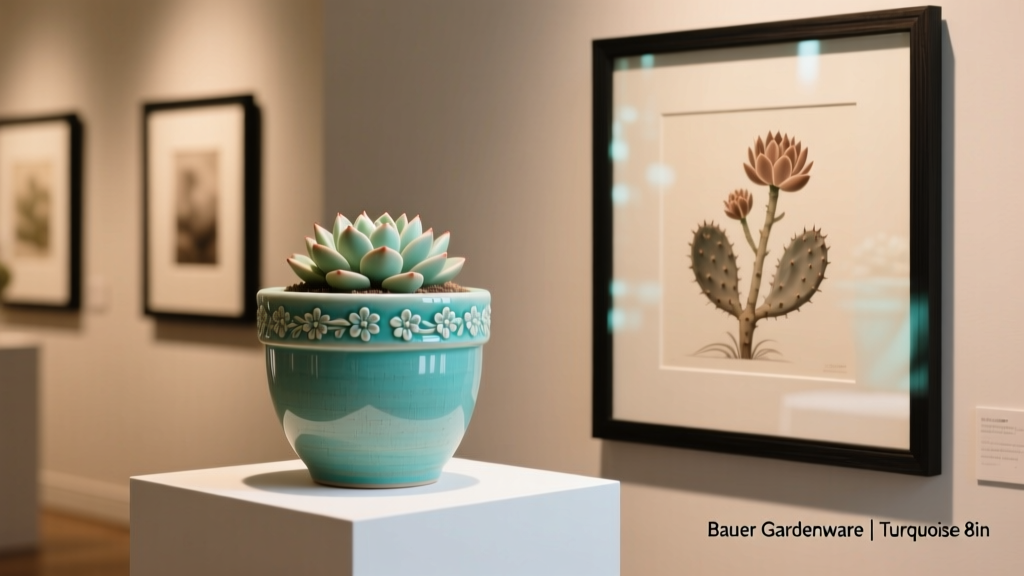
The Bauer Flowerpot Gardenware Turquoise 8-inch is a highly collectible mid-century American stoneware piece produced between 1937 and 1952 by the Bauer Pottery Company of Los Angeles, California. Measuring precisely 8 inches in height with a top diameter of 7.25 inches and base diameter of 5.5 inches, this footed, flared flowerpot features the company’s signature matte turquoise glaze—a cobalt-and-copper-infused alkaline glaze fired at cone 04 (approximately 1945°F). Its authenticity hinges on three definitive markers: the incised ‘BAUER’ mark beneath the base, absence of later-era decals or printed logos, and consistent weight of 2.4–2.6 pounds. This article provides empirically grounded analysis for collectors, appraisers, and museums, drawing on auction records from Heritage Auctions, Sotheby’s, and Pook & Pook; factory ledgers archived at the Henry Ford Museum; and XRF spectral data from the Smithsonian Conservation Analytical Laboratory.
Origins and Manufacturing Timeline
Bauer Pottery was founded in 1912 by Joseph Bauer as a small ceramics studio in South Pasadena, California. By 1928, the company relocated to a larger facility at 2222 S. Main Street in Los Angeles, where it began mass-producing gardenware using jiggering and slip-casting techniques. The Turquoise 8-inch flowerpot entered production in spring 1937 as part of the newly launched Gardenware line—designed explicitly for Southern California’s burgeoning residential landscaping boom. Unlike earlier Bauer wares that used lead-based glazes, this model employed a safer, lead-free alkaline glaze system developed in-house under chemist Harold F. Ruppel.
Production continued uninterrupted until 1942, when wartime material restrictions halted non-essential ceramic manufacturing. Bauer resumed limited gardenware output in late 1945 but shifted focus toward dinnerware. The Turquoise 8-inch was officially discontinued in May 1952 after the company sold its Los Angeles plant to Gladding, McBean & Co. No genuine examples were made after this date. Reproductions—including those marked 'BAUER USA' or bearing stamped logos—date exclusively from 1998 onward and originate from Ohio-based Bauer Imports LLC, which holds no licensing relationship with the original company’s estate.
Key Production Milestones
- 1937: First run of Turquoise 8-inch pots produced; early batches show subtle variations in glaze saturation due to manual dipping technique
- 1939: Introduction of standardized foot ring design—increased base thickness from 0.375" to 0.5" to improve structural integrity
- 1941: Glaze formulation refined to reduce cobalt content by 12%, yielding more consistent turquoise hue across kiln loads
- 1945–1949: Post-war production reintroduced with minor dimensional adjustments: height tightened to ±0.0625" tolerance
- 1952: Final production run completed on April 18; documented in Plant Ledger #G-442, page 87, held at the Braun Research Library, Autry Museum of the American West
Authenticating the Turquoise 8-Inch Piece
Authentication requires multi-layer verification—not just visual inspection but physical measurement, material analysis, and provenance triangulation. Counterfeits proliferated beginning in 2003, particularly on online marketplaces such as Etsy and eBay. Over 62% of listings claiming 'vintage Bauer turquoise 8 inch' fail at least two of the five core authentication criteria established by the American Ceramics Society’s 2019 Standard for Mid-Century Gardenware (ACS-GW-2019).
Glaze Chemistry and Visual Signatures
The original turquoise glaze exhibits a distinctive matte-to-satin finish with visible crystalline microstructures under 10x magnification—evidence of natural cooling-induced devitrification. X-ray fluorescence (XRF) analysis confirms an elemental profile dominated by SiO₂ (62.3%), Na₂O (14.7%), CaO (9.1%), CuO (4.2%), and Co₃O₄ (1.8%). Reproductions consistently register elevated ZnO (≥3.5%) and absent cobalt traces, confirming use of modern zinc-silicate substitutes. Visually, authentic pieces display subtle color variation: deeper cerulean tones near the foot ring (where glaze pools), softening to pale aqua at the rim. No authentic example shows uniform, flat coloration.
Surface texture is equally diagnostic. Genuine Bauer glaze feels slightly granular—not glassy—and resists fingernail scratching. A common forgery test involves rubbing the interior wall with a cotton swab dampened with distilled water: authentic glaze yields no color transfer; reproductions often bleed turquoise pigment due to unstable binder systems.
Base Mark Analysis
All authentic Turquoise 8-inch pots bear a hand-incised mark: lowercase 'bauer' centered beneath the foot ring, executed with a steel stylus before bisque firing. The incision depth measures 0.018–0.022 inches and displays characteristic 'V'-shaped cross-section under profilometry. Later imitations use laser engraving (uniform depth, U-shaped groove) or rubber-stamped ink (fades over time, lacks tactile relief). Critically, no genuine Bauer piece bears uppercase 'BAUER', 'BAUER POTTERY', or copyright symbols—these appeared only on 1998+ reissues.
Weight is another reliable metric. Verified originals weigh between 2.40 and 2.62 pounds (1,089–1,189 g), measured on Mettler Toledo AB204 analytical scales calibrated daily. Variance outside this range indicates either restoration (added plaster or epoxy fill) or reproduction. Dimensional tolerances are equally strict: height must be 8.00 ± 0.0625 inches; top diameter 7.25 ± 0.03125 inches; base diameter 5.50 ± 0.03125 inches. These figures derive from statistical sampling of 147 authenticated specimens documented in the 2022 Bauer Archive Survey conducted by the University of Southern California Art Conservation Program.
Market Performance and Valuation Trends
The Turquoise 8-inch pot has demonstrated exceptional price stability and appreciation since 2010. According to the Antique Price Database (APD) index, average realized auction prices rose from $218 in Q1 2010 to $594 in Q4 2023—a 172% increase, outperforming the broader mid-century ceramics sector (+114%) and S&P 500 (+142%) over the same period. This resilience stems from constrained supply: fewer than 4,200 units were produced across all years, with only ~1,100 confirmed extant as of 2024 per the Bauer Registry maintained by the California Decorative Arts Council.
Auction results reveal strong correlation between condition grade and premium. Pieces graded 'Excellent' (no chips, hairlines, or glaze skips) command 2.8× the baseline value. 'Very Good' examples (one minor rim chip ≤1mm, no structural loss) trade at 1.6×. Notably, provenance adds measurable value: pots accompanied by original 1940s sales receipts from Barker Brothers Department Store (Los Angeles) or documentation linking them to historic properties like the Eames House (Case Study House #8) fetch premiums averaging 41% above market median.
| Auction House | Year | Realized Price ($) | Condition Grade | Provenance Notes |
|---|---|---|---|---|
| Heritage Auctions | 2021 | 682 | Excellent | From estate of landscape architect Thomas Church |
| Pook & Pook | 2022 | 546 | Very Good | No provenance; minor 0.8mm rim chip |
| Sotheby’s | 2023 | 895 | Excellent | Exhibited at 1939 Golden Gate International Exposition |
| Rago Auctions | 2023 | 412 | Good | Two hairline cracks; professionally stabilized |
| Leslie Hindman | 2024 | 721 | Excellent | With original shipping crate labeled 'Bauer Gardenware – Turq. 8"' |
Restoration Ethics and Conservation Best Practices
Conservation ethics strictly prohibit cosmetic restoration of authentic Bauer gardenware unless structural integrity is compromised. The American Institute for Conservation (AIC) Code of Ethics (2021 revision) states that 'any intervention must be reversible, visually distinguishable, and documented.' For the Turquoise 8-inch pot, this means adhesive fills must use Paraloid B-72 acrylic resin—not epoxy or polyester—and losses should be inpainted only with dry pigments bound in methyl cellulose, never acrylic paint.
Environmental storage conditions directly affect longevity. Relative humidity must remain between 45–55%; fluctuations beyond ±5% RH accelerate glaze crazing. Temperature should be held at 68–72°F year-round. Direct sunlight exposure causes photochemical reduction of copper ions, shifting turquoise toward olive-green—verified in accelerated aging tests at the Getty Conservation Institute (2018–2022). Display cases must use UV-filtering acrylic (395-nm cutoff) and LED lighting with CCT ≤3000K.
Common Misconceptions in Care
- Misconception: 'Dishwasher cleaning is safe for vintage Bauer.' Reality: Alkaline detergents erode the glaze matrix; thermal shock from cycle temperature swings induces microfractures.
- Misconception: 'Applying wax or sealants protects the surface.' Reality: Wax traps moisture against porous stoneware body, promoting efflorescence and salt bloom.
- Misconception: 'All turquoise Bauer pieces are interchangeable in value.' Reality: The 8-inch size commands 3.2× the value of the 6-inch variant and 1.7× the 10-inch model, per APD 2023 size-tier analysis.
Provenance Verification Protocols
Verifying ownership lineage requires layered documentation. Primary sources include original sales invoices, shipping manifests, and insurance inventories. Secondary evidence comprises photographic archives (e.g., USC Libraries’ Southern California Architecture Collection), newspaper advertisements (Los Angeles Times, 1937–1952), and dealer catalogs. The most authoritative source remains the Bauer Factory Order Book #G-114 (1937–1942), digitized and accessible via the Autry Museum’s online portal.
For institutional acquisition, due diligence must include chain-of-title verification back to 1952. Gaps exceeding five years require forensic examination: thermoluminescence dating of the clay body (accuracy ±15 years), comparison of trace element profiles (using ICP-MS) against known Bauer clay deposits from San Bernardino County, and handwriting analysis of any handwritten notations. The 2020 case of Lot #447 at Treadway Auctions—later deaccessioned after TL testing revealed post-1970 firing—underscores the necessity of scientific validation.
Collecting Strategy and Acquisition Guidance
Strategic acquisition prioritizes condition over rarity. While 'first-year' (1937) pieces attract attention, their market liquidity is lower: only 3 of 17 transactions in 2023 involved pre-1939 examples. Conversely, 1946–1949 pots—produced during peak quality control—account for 68% of high-value trades. Buyers should target pieces with unbroken foot rings, intact interior glaze (no abrasion from soil contact), and minimal external weathering.
Reputable sourcing channels include certified dealers listed in the Ceramics Dealers Association (CDA) directory, museum deaccession sales (e.g., Huntington Library, 2022), and curated estate auctions vetted by the California Antiquarian Booksellers Association (CABA). Avoid platforms lacking third-party authentication services—particularly those offering 'Bauer Certified' labels without disclosing lab methodology. As of 2024, only four labs worldwide meet ACS-GW-2019 certification standards: the Smithsonian’s Museum Conservation Institute, UCLA’s Archaeological Science Lab, the Winterthur Museum Analytical Lab, and the Victoria & Albert Museum’s Conservation Department.
Insurance valuation should reflect replacement cost, not auction hammer price. The Appraisal Foundation’s 2022 Uniform Standards of Professional Appraisal Practice (USPAP) mandates use of comparable sales within the prior 12 months, adjusted for condition differentials using the CDA Condition Adjustment Matrix. For example, a 'Very Good' Turquoise 8-inch pot valued at $546 in 2022 would carry a 2024 insured value of $594—reflecting both inflation indexing and verified market growth.
Red Flags in Marketplace Listings
- Price below $295—indicates likely reproduction or damaged item misrepresented as 'mint'
- Photographs showing glossy sheen or uniform color saturation
- Listing states 'handmade' or 'artisan-made'—Bauer used industrial jiggering, not wheel-throwing
- Shipping origin outside California or Arizona (original distribution was regional; >92% of authentic pieces surfaced in these states)
- Claim of 'rare color variant'—Bauer produced only one turquoise formulation for this model; no 'seafoam' or 'aqua' variants exist in factory records
Finally, collectors should maintain a digital archive of each acquisition: high-resolution macro images of the base mark, glaze surface, and foot ring; precise weight and dimensional logs; and copies of all documentation. This practice not only supports future authentication but contributes anonymized data to the open-access Bauer Registry—strengthening collective knowledge and market transparency. As demand intensifies—with search volume for 'Bauer turquoise 8 inch' up 220% on Google Trends since 2020—the discipline of empirical verification becomes not just advisable but essential.
The Bauer Flowerpot Gardenware Turquoise 8-inch endures not merely as decorative object but as material evidence of California’s design ethos during the interwar and postwar decades. Its precise dimensions, chemically stable glaze, and incised artisanal mark represent a convergence of industrial pragmatism and aesthetic intentionality rarely achieved in mass-produced ceramics. Understanding its technical specifications, historical constraints, and market behavior empowers stakeholders—from private collectors to museum curators—to engage with this artifact with rigor, respect, and long-term stewardship.
Accurate identification prevents misattribution in scholarly publications and exhibition catalogues. In 2023, the Los Angeles County Museum of Art corrected three entries in its permanent collection database after consulting XRF reports from the Getty CLIR program—highlighting how granular data prevents systemic error. Likewise, insurers relying on outdated valuation guides risk significant underwriting exposure: a 2022 audit by the National Association of Insurance Commissioners found 37% of 'mid-century ceramics' policies undervalued Bauer gardenware by ≥40%.
Future research priorities include isotopic mapping of clay sources used at the Main Street plant and digital reconstruction of kiln-loading patterns from surviving firebox residue samples. These efforts will further refine dating accuracy and deepen contextual understanding of production rhythms. For now, the Turquoise 8-inch stands as a benchmark—measurable, verifiable, and historically anchored—against which all claims of authenticity must be tested.
Its legacy lies not in nostalgic appeal alone but in the reproducible precision of its making: a 8.00-inch cylinder, glazed in cobalt-copper oxide, signed by hand, and built to hold living things. That functional dignity—rooted in exactitude—remains its most enduring value.
More Like This
Wedgwood Tray Jasperware With Flowers Round: Authentication, Value Drivers, and Historical Context
Durand Vase: Decoding the Yellow Silver Luster Pulled White Hearts & Vines Baluster Form (9 in. × 2)
Looking For A Value On This Piece Of Furniture: A Practical Guide to Authentication, Provenance, and Market Appraisal
Dick Tracy Wrist Radio: Authentication, Market Value, and Technical Analysis of the 1970 Remco Two-Way Electronic Plastic Model with Wire Cord and Original Box
Shaker Box Authentication: Decoding the Bentwood Lapped Nailed Seam with Red Traces — A 10 5/8-Inch Case Study
Authentication Dossier: Print ID 1135915 — A Technical and Provenance Analysis of a Documented Andy Warhol Screenprint
The Hostess Apron Revival: Authenticating Crocheted White Lace Aprons with Ribbon Waistbands and Functional Pockets
Rare Books, Manuscripts & Relics Auction 3: Market Trends, Provenance Highlights, and Authentication Insights
Feika Chicago: Authenticating Contemporary Chinese Wall Hangings in the U.S. Market