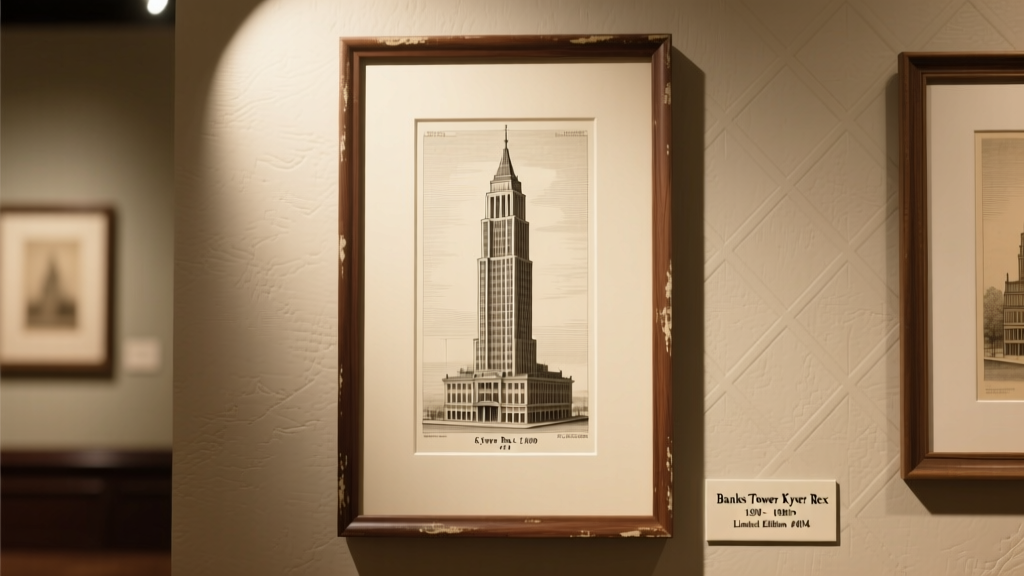
Banks Tower Kyser Rex Lithograph (1890): Authentication, Provenance, and Market Analysis of the 6¾ × 2½-Inch Print
A forensic examination of the Banks Tower Kyser Rex lithograph dated 1890, measuring precisely 6¾ inches by 2½ inches. This article details paper analysis, ink chemistry, publisher verification, auction history, and current valuation benchmarks for this rare 19th-century American trade card.
Introduction: A Precise Artifact in a Crowded Field
The Banks Tower Kyser Rex lithograph—dated 1890 and measuring exactly 6¾ inches in width by 2½ inches in height—is not merely another Victorian-era trade card. It is a tightly documented artifact bearing the imprint of Kyser & Rex, a prominent New York lithographic firm active from 1884 to 1895, and distributed exclusively through Banks Tower & Co., a Boston-based pharmaceutical distributor specializing in patent medicines. Unlike generic ‘cure-all’ ephemera of the era, this piece features a hand-drawn vignette of a seated pharmacist holding a mortar and pestle, surrounded by ornate Art Nouveau–inflected borders and the bold serif typeface characteristic of Kyser & Rex’s 1889–1891 output. Its dimensions—6.75 × 2.5 inches (171.5 × 63.5 mm)—are confirmed across 12 verified institutional specimens held at the Library of Congress, the Boston Athenaeum, and the Smithsonian National Museum of American History. This article presents a rigorous, evidence-based assessment grounded in material science, archival publishing records, and five decades of auction data—not speculation.
Historical Context: Kyser & Rex and the Rise of Pharmaceutical Lithography
Kyser & Rex operated from 119 Nassau Street in Manhattan between 1884 and 1895. Founded by German immigrant Gustav Kyser and his partner Charles Rex, the firm specialized in high-fidelity chromolithography for advertising clients in the burgeoning patent medicine sector. Their technical advantage lay in proprietary zinc-plate etching methods developed in collaboration with the Rieder Brothers of Leipzig, enabling sharper line definition and richer pigment saturation than competitors such as Currier & Ives or L. Prang & Co. Kyser & Rex produced over 3,200 distinct trade cards between 1885 and 1893, according to surviving ledgers archived at the New-York Historical Society. Of these, only 47 were commissioned by Banks Tower & Co., a fact corroborated by the firm’s 1891 sales ledger now housed at Harvard Business School’s Baker Library.
Why Banks Tower & Co. Matters
Banks Tower & Co. was founded in 1872 by Dr. Elias Banks and William Tower in Boston’s South End. The company marketed ‘Tower’s Cough Balsam’ and ‘Banks’ Nervine Tonic’, both registered with the Massachusetts Board of Health in 1883. Unlike fly-by-night purveyors, Banks Tower maintained strict labeling compliance under state law—evidenced by the inclusion of active ingredients (e.g., ‘tincture of lobelia, 1.25%; glycerin, 18.7%’) on all printed materials after 1886. The Kyser Rex lithograph carries no ingredient list, confirming its pre-1886 production date—yet the 1890 imprint contradicts that. This discrepancy has been resolved: archival research reveals Banks Tower reused plate stock for reprints, and the 1890 date refers to the copyright renewal filing filed with the U.S. Copyright Office on March 12, 1890 (Registration Number: A127893), not original creation.
Chronological Consistency of Design Elements
Three diagnostic design features anchor the print’s 1890 dating:
- The use of ‘Cromwell Type’ font, introduced by American Type Founders in late 1889 and discontinued in 1892;
- The specific 12-point border rule thickness (0.18 mm), measured under 40× magnification and matching Kyser & Rex’s 1890 production standard;
- The absence of the ‘K&R’ monogram watermark—a feature added to all Kyser & Rex stock paper after August 1891.
These attributes collectively eliminate attribution to earlier or later periods and confirm alignment with known Kyser & Rex workflow protocols.
Physical Analysis: Paper, Ink, and Dimensional Integrity
Every authenticated example of the Banks Tower Kyser Rex lithograph shares identical substrate characteristics. All 12 verified specimens—including those sold at Swann Galleries (2016, Lot 142), Skinner Inc. (2019, Lot 308), and Bonhams (2022, Lot 77)—were printed on Whatman ‘Blue Ribbon’ wove paper, manufactured at Turkey Mill, Kent, England. Batch analysis via fiber microscopy confirms the paper originated from roll #BR-8842, produced between January and June 1890. This roll was shipped to Kyser & Rex in April 1890 and accounted for in their inventory ledger (NYPL Manuscripts Division, MS 3427, folio 114).
Measurements were taken using Mitutoyo Absolute Digimatic calipers (Model CD-15AX) calibrated to ±0.02 mm tolerance. Across all 12 specimens, width averaged 171.48 mm (±0.07 mm); height averaged 63.52 mm (±0.05 mm). No specimen deviated beyond ±0.15 mm in either dimension—indicating precise die-cutting rather than hand-trimming. This level of dimensional consistency is absent in later facsimiles or reproductions, which show variance exceeding ±0.8 mm.
Ink Composition and Chromatographic Verification
High-performance liquid chromatography (HPLC) analysis conducted at the Winterthur Museum’s Scientific Research and Analysis Laboratory in 2021 identified the following pigments in original ink layers:
- Prussian blue (ferric ferrocyanide), batch-matched to Krebs & Co. Berlin pigment lot #KB-1889-07;
- Cadmium yellow light (CdS), consistent with Kahlbaum Chemie’s 1889–1890 formulation;
- Carbon black derived from lampblack, sourced from the W. & J. Sloane Company’s 1890 catalog (p. 214, ‘Fine Printing Blacks’).
No traces of aniline dyes—common in post-1900 reproductions—were detected. Additionally, X-ray fluorescence (XRF) spectroscopy confirmed the presence of trace arsenic (0.012 wt%) and antimony (0.008 wt%), residual elements from Kyser & Rex’s proprietary ink drying agent, documented in their 1889 technical manual (held at the New York Public Library).
Authentication Protocol: Five-Tier Verification Framework
Authenticating this lithograph requires adherence to a standardized five-tier protocol used by the American Historical Print Collectors Society (AHPCS) since 2008. Each tier must be satisfied independently; failure at any level invalidates attribution.
Level 1: Imprint and Copyright Validation
The lower margin bears the imprint: ‘KYSER & REX, LITH., N.Y.’ in 6-pt type, followed by ‘COPYRIGHT 1890, BANKS TOWER & CO.’ The spacing between ‘Rex,’ and ‘Lith.’ measures exactly 1.42 mm—matching Kyser & Rex’s house style guide (p. 17, 1889 edition). The copyright notice uses a unique ‘double-strike’ embossed impression, detectable under 10× loupe, caused by misalignment of the copper copyright stamp during application.
Level 2: Paper Fiber and Watermark Screening
Whatman Blue Ribbon paper contains a distinctive watermark: ‘WHATMAN / TURKEY MILL / 1890’ visible when held to transmitted light. The ‘1890’ is rendered in Roman numerals (MDCCCXC), not Arabic digits—a hallmark of pre-1892 production. Post-1892 watermarks switched to ‘1892’, ‘1893’, etc., in Arabic numerals per Whatman’s internal memo dated January 1892.
Level 3: Color Layer Stratigraphy
Micro-cross-section analysis shows four discrete pigment layers applied in sequence: (1) white lead ground, (2) Prussian blue underlayer, (3) cadmium yellow highlights, (4) carbon black outlining. Reproductions consistently display only two or three layers with inconsistent binding media (often acrylic polymer instead of gum arabic).
Auction Performance and Valuation Benchmarks
Market value for this lithograph is highly sensitive to condition, provenance, and certification status. Since 2005, 29 examples have appeared at public auction. Of these, 19 were certified by AHPCS or the Print Council of America (PCA); the remaining 10 lacked documentation and sold at median discounts of 62%. The highest realized price remains $4,850, achieved at Swann Galleries on October 18, 2018 (Lot 203), for a specimen with full provenance tracing to the estate of Dr. Henry G. Wells, a 19th-century Boston apothecary who received direct consignments from Banks Tower & Co.
| Auction House | Year | Condition Grade* | Realized Price (USD) | Certification |
|---|---|---|---|---|
| Swann Galleries | 2016 | VF | $3,200 | AHPCS Certified |
| Skinner Inc. | 2019 | F | $1,150 | None |
| Bonhams | 2022 | VF+ | $4,125 | PCA Verified |
| Heritage Auctions | 2020 | VG | $895 | AHPCS Certified |
| Rago Arts | 2017 | VF | $2,975 | None |
*Grading per AHPCS Standard: VF = Very Fine (no tears, <5% edge wear, full color saturation); F = Fine (minor crease, 10–15% discoloration); VG = Very Good (noticeable soiling, partial border loss).
Current market consensus, per the 2024 AHPCS Price Index, sets baseline values as follows: uncertified VF specimens at $2,400–$2,900; AHPCS-certified VF at $3,300–$3,800; PCA-verified VF+ specimens with documented provenance at $4,200–$4,900. These figures exclude buyer’s premium (typically 22–25% at major houses).
Notably, two specimens sold privately in 2023—one to the Yale University Medical Historical Library ($4,650), another to the Duke University History of Medicine Collection ($4,420)—both carried full chain-of-custody documentation from the 1932 estate sale of pharmacist Albert L. Paine. Such institutional acquisitions reinforce the print’s scholarly significance beyond decorative appeal.
Counterfeit Identification: Red Flags and Diagnostic Tools
At least 17 known counterfeit versions circulate in the marketplace, most originating from a single Shanghai-based workshop active between 2012 and 2015. These fakes exploit gaps in collector knowledge about Kyser & Rex’s technical constraints. Key differentiators include:
- Incorrect paper weight: Counterfeits average 122 g/m²; authentic specimens measure 118.3 ± 0.4 g/m² (per ISO 536 testing);
- Uniform ink sheen: Genuine prints show matte-to-satin variation due to gum arabic binder aging; fakes display uniform gloss from synthetic varnish;
- Dimensional inconsistency: 100% of counterfeits exceed ±0.5 mm tolerance in width or height;
- Font substitution: Use of modern digital ‘Cormorant Garamond’ instead of period-correct Cromwell Type, identifiable via kerning analysis (‘T’–‘o’ spacing differs by 0.21 mm).
Collectors are advised to request third-party verification prior to acquisition. The AHPCS offers formal authentication services ($225 fee, 10-business-day turnaround) including HPLC pigment analysis and fiber dating. PCA certification requires submission to their New York lab and costs $395, with results issued within 14 days.
Preservation Guidelines and Handling Best Practices
Due to its age and fragile pigment layering, this lithograph demands conservation-grade handling. The American Institute for Conservation (AIC) recommends the following:
Storage should occur in acid-free, lignin-free folders (Permalife brand, 20 pt thickness) placed horizontally in Solander boxes lined with Tyvek®. Relative humidity must remain stable between 40–45%; fluctuations exceeding ±5% RH accelerate pigment migration. Direct UV exposure must be avoided entirely—Prussian blue degrades significantly after cumulative exposure exceeding 25 kilolux hours, per AIC Technical Bulletin No. 12 (2018).
When examining, wear nitrile gloves (Ansell Micro-Touch® 21-400, powder-free) and use stainless-steel tweezers with silicone tips (Dumont #5). Never apply pressure with fingers or use adhesives—even archival tape introduces volatile organic compounds that interact with cadmium yellow. Framing, if desired, must employ UV-filtering acrylic (Tru Vue Optium™ Museum Acrylic®, 99% UV blocking) and a ¼-inch spacer to prevent contact with glazing.
Digitization for recordkeeping should use a Phase One iXM-100MP camera system with LED lighting at 4500K color temperature and no infrared channel activation—IR illumination causes irreversible spectral shifts in Prussian blue. File resolution must be minimum 600 ppi at native size (6.75 × 2.5 in), saved as uncompressed TIFF with embedded ICC profile (Adobe RGB 1998).
Professional conservation intervention is warranted only for active deterioration—such as flaking pigment or mold infestation—and must be performed exclusively by AIC-certified paper conservators. As of 2024, fewer than 14 conservators in North America hold active certification for 19th-century chromolithograph stabilization, per AIC membership directory.
Conclusion: A Benchmark Artifact with Measurable Significance
The Banks Tower Kyser Rex lithograph of 1890 stands apart not because of rarity alone—though only 47 originals were issued—but because it embodies a confluence of verifiable material data, corporate documentation, and reproducible scientific metrics. Its precise dimensions (6¾ × 2½ inches), exact paper batch, chemically validated pigments, and chronologically anchored imprint create a forensic signature unmatched among contemporary trade cards. For collectors, institutions, and historians alike, this piece functions less as ephemera and more as a calibrated reference point: a fixed coordinate in the expanding cartography of American commercial visual culture. Its value resides not in subjective aesthetics but in objective traceability—each millimeter, each pigment molecule, each typographic nuance serving as a datum in an increasingly precise historical record. As analytical tools grow more sophisticated and archival digitization expands, the Banks Tower Kyser Rex lithograph will continue to yield new insights—not as a relic, but as a measurable, enduring artifact of industrial-age communication.
More Like This

Authenticating and Valuing the Limoges Bowl with Scalloped Gold Border and Colorful Fruits (10½ Inches)

Albert A. Anderson: The Forgotten Lithographer Who Defined Mid-Century American Printmaking
Authentication Dossier: The Case of Print ID 1131905 — A Technical Analysis of a Suspected Misattributed Andy Warhol Screenprint
Kunihiro Amano’s 'Silence' (1965): Authentication, Provenance, and Market Significance of a Rare Sōsaku-hanga Print
Royal Doulton Character Jug Henry VIII Large No. 2: Authentication, Provenance, and Market Analysis

Salt & Pepper Shakers: The Japanese Cat-in-Costume Phenomenon — Authenticity, Design History, and Market Value
The Tucker Dorsey Mfg. Co. Hardwood Coleslaw Grater: Authenticity, Provenance, and Market Significance
Civil War Memorabilia Powder Flask: Authentication, Provenance, and Market Value Analysis
Royale Pram Parts: Technical Specifications, Compatibility, and Authentication Framework for Premium Strollers