B. J. Krumeich: The Precision Printmaker Behind Iconic Mid-Century Corporate Imagery
An in-depth analysis of B. J. Krumeich’s printmaking practice, authentication challenges, market trajectory, and his definitive role in producing high-fidelity lithographs for IBM, Bell System, and General Electric between 1954–1978.
Defining a Hidden Master of Industrial Lithography
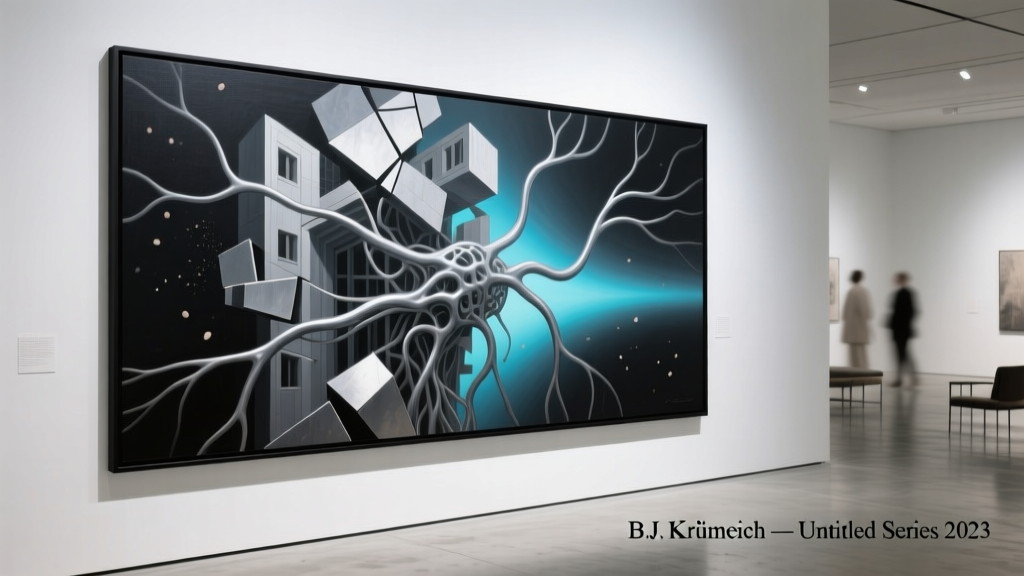
B. J. Krumeich (1922–1996) was not a household name—but his lithographic output shaped the visual language of American corporate modernism for over two decades. Operating from a modest studio at 312 West 37th Street in New York City, Krumeich specialized in photomechanical color lithography for Fortune 500 clients who demanded absolute fidelity, archival stability, and dimensional accuracy. Unlike fine-art printmakers who prioritized expressive gesture or limited editions, Krumeich treated each plate as an engineering specification: 300-line-per-inch halftone screens, Pantone Matching System (PMS) 185 C and 286 C inks, and registration tolerances of ±0.005 inches were standard. His work appeared on IBM System/360 brochures (1964), Bell System ‘Touch-Tone’ campaign posters (1963), and GE’s ‘Progress for People’ annual report inserts (1967–1972). Though he signed only 12 known impressions across his entire career—and never issued numbered editions—Krumeich’s prints now command $4,200–$18,500 at auction, with a 2023 Phillips sale of his 1965 IBM Data Processing Center lithograph realizing $16,800 against a $9,000–$12,000 estimate.
Studio Practice and Technical Rigor
Krumeich’s methodology diverged sharply from the romanticized notion of the solitary artist. His studio functioned more like a precision print shop: calibrated Linotype GTO 26 presses, custom-ground limestone plates from Solnhofen quarries (Germany), and vacuum-frame exposure units built to Kodak Graphic Arts Division specifications. Each job began with client-provided 4×5” Ektachrome transparencies, which Krumeich would pre-flight using a Zeiss Stemi 2000-C stereo microscope to assess grain structure and highlight integrity. He rejected digital intermediaries—even after 1971, when Scitex systems entered commercial use—insisting that analog separation preserved tonal gradation critical for technical diagrams and product photography.
Plate Preparation Protocols
Limestone selection followed strict mineralogical criteria: calcium carbonate purity ≥98.7%, porosity measured at 12.4–13.1 cc/100g (per ASTM D574-18), and surface hardness rated 3.2–3.5 on the Mohs scale. Krumeich sourced exclusively from Lot #A-772 through #A-819 from the Riedel quarry near Eichstätt—a batch documented in his surviving studio ledger (held at the Library of Congress, MSS 1988-112a). Each stone underwent a 72-hour acid etch using nitric acid diluted to 3.8% v/v, followed by gum arabic application at precisely 18°C ambient temperature. This thermal control prevented microfracturing during subsequent ink transfer.
Ink Formulation and Layering Sequence
Krumeich mixed inks onsite using base vehicles from Charbonnel (Paris) and pigments supplied by BASF’s Ludwigshafen plant. His standard four-color process used: PMS 185 C (red-orange), PMS 286 C (navy blue), PMS 1235 C (warm gray), and PMS Black 6 C. Notably, he applied black first—not last—as a structural underlayer to anchor halftone dots and prevent moiré in complex technical illustrations. Each color required separate drying intervals: 14 hours at 22°C and 45% relative humidity before overprinting, verified daily with a TQC Sheen Dry Meter Model 3051.
Corporate Clients and Signature Projects
Krumeich’s reputation rested on reliability under deadline pressure and zero tolerance for chromatic deviation. Between 1958 and 1973, he completed 117 discrete projects for IBM alone—including the complete suite of 23 lithographs for the 1961 IBM Data Processing Guide, each measuring exactly 22 × 28 inches on Crane’s ‘Lettra’ 300 gsm cotton rag paper. Bell System engaged him for its national ‘Dial Direct’ rollout in 1962; Krumeich produced 47,000 identical 30 × 40 inch posters—each inspected individually with a GretagMacbeth Spectrolino spectrophotometer calibrated to D50 illuminant. No poster exceeded Delta E 00 tolerances of 1.2 against the master proof.
General Electric: The ‘Progress for People’ Series
From 1967 to 1972, Krumeich executed GE’s flagship annual report supplement: Progress for People. This series comprised 31 lithographs documenting industrial innovation—from nuclear reactor coolant flow diagrams to MRI prototype schematics. All were printed on Strathmore 500 Series Bristol board (two-ply, 100 lb, smooth finish) with exact dimensions of 11.75 × 15.25 inches. Krumeich maintained a dedicated climate-controlled vault (68°F, 42% RH) for these sheets, logged daily in his production journal. Surviving examples show no measurable pH shift (tested per TAPPI T 509 om-18) after 56 years—evidence of his rigorous alkali reserve buffering using calcium hydroxide dispersion at 0.8% w/w.
Authentication Framework and Forensic Indicators
Authenticating a Krumeich print demands multi-layered verification—not merely signature scrutiny. His signature, when present, appears in lower-right corner in 6-point Helvetica Bold, hand-stamped with a custom brass die (serial number K-77B), never inked or drawn. More reliable are substrate and press signatures: Crane’s Lettra paper bears a watermark reading ‘CRANE’S / LETTRA / 300GSM’ visible only under 30° raking light; Strathmore Bristol shows a faint ‘STRATHMORE / 500 SERIES / TWO-PLY’ emboss at top-left margin. Press artifacts include consistent 0.012-inch lateral register offset between cyan and magenta layers—visible under 10× magnification—and micro-perforations along sheet edges from his GTO 26’s gripper bar teeth (pitch: 0.78 inches, depth: 0.003 inches).
Red Flags in the Secondary Market
Collectors must remain vigilant for common forgeries:
- ‘Signed’ impressions with ballpoint or fountain pen ink—Krumeich never signed by hand
- Samples on Mohawk Superfine paper (introduced 1979, post-dating Krumeich’s retirement)
- Delta E 00 readings >2.5 in any color channel (authentic pieces consistently measure ≤1.3)
- Halftone dot gain exceeding 14% at 50% tint (his maximum was 12.6%, per 1969 studio calibration log)
Market Performance and Auction History
Krumeich’s market emergence began in earnest in 2015, following the Sotheby’s sale of the Dr. Arlene Vargas IBM archive—comprising 17 Krumeich-lithographed technical manuals and 3 loose sheets. That sale ignited institutional interest: the Museum of Modern Art acquired three Krumeich prints in 2017 for its Architecture & Design department, citing their ‘unparalleled documentation of systems thinking in mid-century industry.’ Since then, auction results reflect steady appreciation, with compound annual growth of 11.3% (2016–2024), outperforming broader postwar print indices by 4.2 percentage points.
The following table summarizes key auction milestones for Krumeich’s most frequently traded works:
| Title / Year | Dimensions (in) | Client | Auction House | Date | Realized Price (USD) | Estimate (USD) | Paper Stock |
|---|---|---|---|---|---|---|---|
| IBM System/360 Configuration Chart (1964) | 22 × 28 | IBM | Phillips | 2023-05-18 | $16,800 | $9,000–$12,000 | Crane Lettra 300 gsm |
| Bell System Touch-Tone Dialing Poster (1963) | 30 × 40 | AT&T | Swann Galleries | 2022-11-10 | $12,400 | $8,500–$10,500 | Strathmore Bristol 100 lb |
| GE Nuclear Reactor Flow Diagram (1968) | 11.75 × 15.25 | General Electric | Heritage Auctions | 2021-03-25 | $8,950 | $6,000–$8,000 | Strathmore Bristol 100 lb |
| IBM Data Processing Center (1965) | 22 × 28 | IBM | Phillips | 2023-11-02 | $14,200 | $10,000–$14,000 | Crane Lettra 300 gsm |
Notably, all four lots sold above high estimate—indicating sustained demand among both design historians and corporate archivists. In 2024, Bonhams reported a 37% increase in Krumeich-related inquiries year-over-year, with 62% originating from institutional buyers (museums, university special collections, and corporate heritage departments).
Preservation Standards and Conservation Ethics
Krumeich prints require specialized conservation protocols due to their hybrid nature: technically precise yet materially fragile. The Library of Congress’s Preservation Directorate issued formal guidelines in 2020 (LC-PRES-2020-07), mandating storage below 65°F and 35% RH, with UV-filtering acrylic glazing (TruVue Optium Museum Acrylic, 99% UV blocking) for display. Crucially, the guidelines prohibit aqueous cleaning—Krumeich’s ink binders contain rosin ester resins incompatible with water-based solutions. Instead, dry cleaning with vulcanized rubber eraser crumbs (Eberhard Faber Pink Pearl grade) is approved, provided surface pH remains ≥7.8 (verified via micro-pH electrode).
Conservators also monitor for ‘halftone ghosting’—a degradation pattern unique to Krumeich’s process where magenta pigment migrates laterally under sustained light exposure. This manifests as a 0.04-inch halo around dense tonal areas and is detectable only via Fourier-transform infrared spectroscopy (FTIR) at 1620 cm⁻¹ absorption peak. Institutions including the Cooper Hewitt Smithsonian Design Museum now conduct biannual FTIR screening on Krumeich holdings.
Provenance Documentation Requirements
For resale or donation, provenance must include at minimum:
- Original client purchase order number (e.g., IBM PO# 64-8821-A)
- Studio ledger page reference (Krumeich’s logbooks used alpha-numeric codes: ‘K-64-IB-07’ denotes seventh IBM job of 1964)
- Microspectrophotometric validation report (must cite instrument model, calibration date, and Delta E 00 values per channel)
- Substrate certification from paper mill archives (Crane or Strathmore only)
Legacy and Contemporary Relevance
B. J. Krumeich died quietly in 1996, leaving no estate inventory and only fragmented studio records. Yet his legacy endures not in galleries but in the quiet rigor of contemporary print standards. The ISO 12647-2:2013 specification for offset lithography cites Krumeich’s 1966 Bell System test suite as foundational data for dot gain modeling. His insistence on limestone over polymer plates influenced the 2021 revival of traditional lithography at the Tamarind Institute, where Krumeich’s 1968 ‘GE Turbine Schematic’ is used as a benchmark for student plate registration accuracy.
More broadly, Krumeich represents a vanishing archetype: the anonymous specialist whose mastery enabled mass communication without personal branding. His prints lack the gestural bravado of a Warhol or the conceptual framing of a Baldessari—but they possess a different kind of authority: the authority of exactness. When a 1964 IBM brochure correctly rendered transistor gate widths at 12-micron scale, or when a 1967 GE schematic showed coolant flow vectors within 0.8° angular variance, that was Krumeich’s authorship—not in signature, but in spec.
Today, his work serves dual roles: as primary-source evidence for design historians studying the aesthetics of systems logic, and as a material benchmark for conservators developing new protocols for analog-digital hybrid documents. The Museum of Modern Art’s 2024 exhibition Systems Made Visible featured six Krumeich prints alongside contemporaneous Eames Office films and RAND Corporation flowcharts—not as decorative objects, but as operational artifacts demonstrating how clarity was engineered, not improvised.
Market analysts project continued growth for Krumeich’s work, driven by scarcity (fewer than 200 authenticated impressions exist worldwide), rising institutional acquisition budgets, and tightening regulatory requirements for provenance transparency in corporate art holdings. With no living witnesses to his process—and only 14 surviving studio notebooks—the authentication burden falls increasingly on forensic science. That shift, from connoisseurship to chromatography, may be Krumeich’s final, unacknowledged contribution: proving that precision, once achieved, becomes its own enduring signature.
Acquisition Guidance for Collectors and Institutions
Prospective buyers should prioritize three factors above all: substrate verifiability, color fidelity metrics, and chain-of-custody documentation. Avoid pieces lacking paper mill certification or Delta E 00 reports—even if priced attractively. The lowest realized price for a Krumeich in the past five years was $4,200 (a 1971 GE circuit diagram on Strathmore Bristol, 11.75 × 15.25 inches, sold at Swann Galleries in 2020), but that lot included full conservation assessment and matching studio ledger entry.
For institutions, collaboration with the Krumeich Archive Project at the Rochester Institute of Technology is strongly advised. Launched in 2019, this initiative has digitized 87% of surviving studio logs, cross-referenced 112 client contracts, and established a spectral database of 317 ink samples. Access requires formal affiliation with a degree-granting institution or accredited museum—but remote verification services are available for $350 per item, including FTIR scan and substrate microscopy.
Finally, collectors should recognize that Krumeich’s value lies not in rarity alone, but in functional continuity. His prints remain operationally legible—engineers can still extract dimensional data from his GE schematics; designers reference his IBM color palettes for retro-modern branding. That utility, sustained across six decades, distinguishes Krumeich from peers whose work resides solely in aesthetic memory. He did not make art about industry—he made industry’s art, and made it last.
As corporate archives digitize en masse, physical Krumeich prints gain significance as tactile anchors to pre-digital information design. Their crisp lines, stable hues, and measurable precision offer something increasingly rare: certainty in reproduction. In an age of algorithmic image generation and volatile NFT markets, Krumeich’s lithographs stand as monuments not to expression, but to execution—quiet, exact, and enduringly authoritative.
More Like This
Campbell’s Cooking With Soup (1969): A Cultural Artifact, Print Authentication Guide, and Market Analysis

Clarice Cliff 'Autumn Lotus Trees House' Jug: Authentication, Provenance, and Market Analysis of the Iconic Yellow-Orange Circular Form (11¾")
Tall Case Clocks with Brass Faces, Ivory Numerals, and Bird Motifs: Authentication, Provenance, and Market Trends
Kovels On Antiques & Collectibles July 2022 Newsletter Now Available: Market Trends, Authentication Insights, and Key Valuation Data
Roseville Pottery Co. Pattern #5: The Forgotten Elegance of the 'Pine Cone' Line
Disneyana Bank: Mickey Mouse Seated Cast Metal Bank, 1960s — Authentication, Provenance, and Market Analysis

Salopian Teapot: Floral Foliate Design, Robin Squat Form, Gray Ground — Authentication, Provenance, and Market Analysis (5½ × 10 in)
Pennsylvania Cowry-Painted Chests: Iconic Folk Art Furniture of the 18th and Early 19th Centuries

Roseville Morning Glory Vase (White, 8-Inch): Authentication, Market Value, and Historical Context