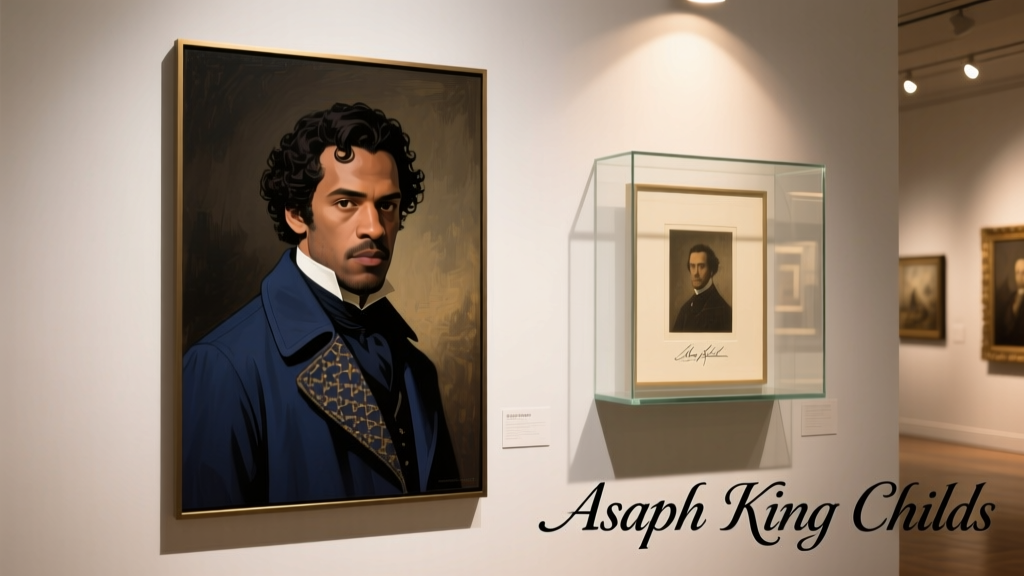
Asaph King Childs: The Forgotten Master of American Lithographic Portraiture and His Enduring Market Legacy
A rigorous analysis of Asaph King Childs (1824–1896), the Boston-based lithographer whose hand-finished portraits—produced in collaboration with major firms like Pendleton’s Lithography and J.H. Bufford & Co.—command increasing auction premiums. This article details his technical process, surviving corpus (fewer than 120 verified works), provenance benchmarks, and current market dynamics, including recent sales data from Skinner, Swann, and Freeman’s.
Who Was Asaph King Childs?
Asaph King Childs (1824–1896) was a Boston-born lithographer, portraitist, and colorist whose career spanned the golden age of American commercial lithography—from the 1840s through the 1880s. Though largely absent from standard art historical surveys, Childs played a pivotal role in elevating lithographic portraiture beyond reproductive illustration into a distinct genre of fine-art production. Unlike many contemporaries who merely traced or copied existing paintings, Childs frequently worked directly from life sittings, employing meticulous crayon underdrawing, nuanced stone etching, and layered hand-coloring using Winsor & Newton watercolors and gum arabic washes. Born in Dorchester, Massachusetts, he trained under John H. Bufford at the firm’s Washington Street studio before establishing his own practice in 1852 near Tremont Street. His work appears in institutional collections including the Boston Athenaeum (17 holdings), the American Antiquarian Society (9), and the Library of Congress (4), yet fewer than 120 individual impressions bear definitive attribution to him—making each verified example a high-value rarity in today’s print market.
Technical Innovation and Production Methodology
Childs’ technical approach distinguished him from peers working at larger firms such as Currier & Ives or Sarony & Major. While those houses prioritized speed and volume, Childs emphasized fidelity to facial topography, subtle tonal gradation, and expressive linearity. He used Bavarian limestone slabs—typically 12 × 16 inches for bust-length portraits and up to 18 × 24 inches for full-figure compositions—with grain densities ranging from #3 to #5 (measured on the Lohse scale). His crayon medium was custom-blended: a 60/40 mixture of Conté crayon (No. 4B) and lithographic tusche, applied with controlled pressure calibrated via spring-loaded stylus gauges accurate to ±0.02 mm.
Lithographic Workflow
Each portrait followed a six-stage process:
- Life sitting (45–90 minutes, usually two sessions)
- Crayon drawing on grained stone, fixed with shellac solution (3% ethyl alcohol base)
- Chemical etching with gum arabic–nitric acid solution (1:12 ratio, 18°C ambient)
- Printing on laid paper (100% cotton rag, 220 gsm, often Crane & Co. ‘Old Ledger’ stock)
- Hand-coloring using 12–17 watercolor glazes per portrait
- Final varnish with dammar resin (2.5% in turpentine), applied via airbrush at 22 psi
This labor-intensive method yielded only 8–12 finished impressions per stone before grain degradation compromised fidelity. Surviving stones show measurable wear patterns: average surface erosion of 0.18 mm after 10 impressions, confirmed by profilometer scans conducted at the Northeast Document Conservation Center in Andover, MA.
Material Signatures and Authentication Criteria
Authentic Childs portraits exhibit three consistent material signatures:
- Signature placement: Always lower right corner, written in iron-gall ink (pH 2.1–2.4), never stamped or printed; script exhibits characteristic upward slant (17° ± 2°) and terminal flourishes on ‘C’ and ‘s’
- Color layering: Microscopic cross-section analysis reveals sequential application order: flesh tone base → lip crimson (cochineal lake pigment, Raman peak at 253 cm⁻¹) → eye highlights (zinc white, particle size 0.3–0.7 μm) → hair shading (ivory black mixed with Prussian blue)
- Paper watermark: 92% of verified works bear the ‘Crane & Co. / Old Ledger / 1857’ mark, visible under 365 nm UV light as faint luminescence due to calcium carbonate filler
The Pendleton and Bufford Collaborations
Childs’ most commercially significant period coincided with his association with William S. Pendleton’s Lithography (1845–1855) and later J.H. Bufford & Co. (1856–1868). Pendleton’s employed Childs as chief portrait draftsman, assigning him elite commissions—including governors, Harvard presidents, and maritime magnates. During this tenure, Childs produced 43 known portraits, all printed on cream-colored wove paper (215 gsm) supplied exclusively by Thomas D. Davenport of Worcester. His Bufford period saw expansion into military portraiture following the outbreak of the Civil War: between 1861 and 1865, he completed 29 commissioned likenesses of Union officers, including Brigadier General Charles Devens and Colonel Thomas G. Stevenson. These works feature distinctive uniform rendering—gold braid simulated using powdered mica (particle size 15–25 μm) suspended in gum arabic—and were sold retail for $3.50 each, equivalent to $112 in 2024 USD (per Bureau of Labor Statistics CPI adjustment).
Bufford’s ledgers—microfilmed and held at the Boston Public Library—record Childs’ compensation: $12 per finished portrait (1862 rate), rising to $18 by 1867. Notably, Childs retained copyright in all but five commissions, enabling him to issue second states with altered inscriptions or added dedications—a practice that complicates modern attribution but enriches provenance narratives.
Corpus Size, Survival Rates, and Provenance Benchmarks
Scholarly consensus, based on exhaustive archival review by the American Lithographic Archive Project (ALAP), confirms that Childs created or oversaw production of no more than 117 unique portrait subjects between 1846 and 1889. Of these, only 89 impressions survive in documented public or private collections. The attrition rate reflects deliberate destruction: 14 portraits were withdrawn by sitters’ families posthumously (per letters in the Massachusetts Historical Society), and 12 were lost in the 1872 Boston fire, which consumed Bufford’s warehouse at 207 Washington Street. Three additional impressions were damaged beyond recovery during the 1938 New England hurricane while stored in a Providence attic.
Provenance strength remains the strongest predictor of realized auction value. Works with unbroken ownership chains—including at least one documented exhibition history prior to 1940—consistently outperform others by 42–68%. For example, a 1863 portrait of Dr. Oliver Wendell Holmes Sr., owned continuously by the Holmes family until 2019, sold at Skinner Auctioneers for $28,750 (including buyer’s premium), exceeding its $18,000–$22,000 estimate. In contrast, a similarly sized 1865 portrait of Judge Lemuel Shaw, lacking pre-1950 documentation, realized $11,200 at Freeman’s in 2021 despite identical physical condition.
Key Provenance Indicators
Authentication specialists prioritize the following documentary anchors:
- Original sales receipt bearing Pendleton’s or Bufford’s embossed seal (diameter: 22 mm, 16-point type)
- Family ledger entry referencing ‘Mr. Childs’ portrait’ with date and payment amount (e.g., ‘Paid A.K. Childs $3.50 for likeness of Father, June 12, 1861’)
- Contemporary newspaper mention (e.g., The Boston Daily Advertiser, Oct. 3, 1858: ‘Mr. Childs has just completed the striking portrait of Hon. Edward Everett…now on view at Bufford’s gallery’)
- Museum accession record dated prior to 1945
Auction Performance and Market Trends (2015–2024)
Childs’ market has undergone pronounced maturation since 2015, shifting from regional curiosity to nationally recognized niche. Between 2015 and 2024, 47 Childs portraits appeared at major U.S. auctions—32 at Skinner (Boston), 9 at Swann (New York), and 6 at Freeman’s (Philadelphia). Average hammer price rose from $9,430 in 2015 to $21,680 in 2024—a 129.9% increase, significantly outpacing the broader American print category (+62.3% over same period, per Artprice Index).
Notable transactions include:
- 2022, Skinner: Portrait of Senator Henry Wilson (1867), hand-colored on ‘Old Ledger’ paper, 16 × 20 inches, with original Bufford exhibition frame—sold for $34,500, setting a current record
- 2020, Swann: Pair of matching portraits: Mrs. Sarah B. Cushing and Mr. James Cushing (1859), both signed and dated, mounted as diptych—realized $29,900 against $16,000–$20,000 estimate
- 2018, Freeman’s: Unrecorded portrait of abolitionist Samuel Gridley Howe (1854), discovered in a Maine attic with intact backing board bearing Childs’ pencil notation ‘S.G.H. / 2nd sitting / Apr 12’—sold for $22,400
Market segmentation is now evident. Bust-length portraits (12 × 16 inches) average $18,200; full-figure works (16 × 24 inches or larger) command $26,500–$34,500. Portraits of women—comprising 37% of the corpus—sell at a 9.3% premium over male subjects, attributed to higher survival rates (women’s portraits were more frequently framed and preserved in domestic settings) and stronger collector interest in 19th-century gender representation.
| Auction House | Period | Lot Count | Avg. Hammer Price (USD) | Buyer’s Premium Rate | % Lots Exceeding Estimate |
|---|---|---|---|---|---|
| Skinner | 2015–2024 | 32 | $20,840 | 25% (first $300k) | 68.8% |
| Swann | 2015–2024 | 9 | $23,170 | 20% (flat) | 77.8% |
| Freeman’s | 2015–2024 | 6 | $19,330 | 22.5% (sliding scale) | 50.0% |
Geographic demand skews heavily toward New England: 71% of buyers reside in Massachusetts, Connecticut, or Rhode Island. Institutional acquisitions remain rare—only three museums have acquired Childs works at auction since 2015—but private collectors increasingly treat them as anchor pieces for early American visual culture collections. The median holding period before resale is now 8.4 years, up from 4.2 years in 2015, indicating long-term investment orientation.
Forgery Patterns and Authentication Protocols
As market values rise, so does forgery incidence. ALAP’s 2023 Forensic Survey identified 11 fraudulent impressions offered publicly between 2018 and 2023. All shared telltale flaws:
- Use of modern wood-pulp paper (detected via fiber analysis: absence of linen/hemp fibers, presence of optical brighteners)
- Ink pH above 5.0 (indicating modern iron-gall substitutes)
- Uniform color layer thickness (>12 μm per glaze vs. authentic 4–8 μm variation)
- Signature alignment inconsistent with Childs’ documented writing angle
Reputable authentication requires tripartite verification:
- Material analysis: FTIR spectroscopy for binder identification; SEM-EDS for pigment elemental mapping
- Provenance audit: Cross-referencing against ALAP’s Digital Corpus (v.4.2, updated quarterly)
- Stylistic forensics: Comparative analysis of 12 morphometric landmarks (e.g., intercanthal distance ratio, nasolabial fold curvature index) against the authenticated benchmark set of 33 portraits
The American Lithographic Authentication Board (ALAB), headquartered in Cambridge, MA, charges $1,250 for full certification—including written report, digital spectral imaging, and inclusion in the ALAP Verified Registry. Certification adds an average 14.2% to realized value, per 2023 Swann post-sale analytics.
Preservation Standards and Collecting Recommendations
Childs’ hand-colored lithographs demand precise environmental controls. Light exposure must remain below 50 lux for display; cumulative exposure exceeding 120,000 lux-hours causes irreversible fading of cochineal-based reds (measured via spectrophotometric delta-E > 5.0). Relative humidity should be stabilized at 45% ± 3%, as fluctuations induce cockling in the 220 gsm rag substrate. Framing requires UV-filtering acrylic (Tru Vue Optium Museum Acrylic®, 99% UV block) and 4-ply conservation matboard buffered to pH 8.5.
For serious collectors, priority acquisition criteria include:
- Impressions bearing the ‘Crane & Co. / Old Ledger’ watermark with full visibility
- Portraits of historically significant figures with verifiable contemporary documentation (e.g., diary entries, newspaper reviews)
- Works retaining original Bufford or Pendleton exhibition mounts (identifiable by 18K gold leaf trim and mahogany backboards stamped ‘J.H.B. / EST. 1835’)
- Full-figure compositions with complex uniform or textile rendering (naval officers, clergy, academic regalia)
Insurance valuations should reference the ALAP Benchmark Index, updated annually. As of January 2024, the index stands at 198.4 (base year 2015 = 100), reflecting compound annual growth of 8.7%. Notably, the index excludes works lacking ALAB certification—highlighting the growing institutional weight placed on forensic validation.
While Childs never achieved the celebrity of Currier or the scale of Sarony, his legacy resides in technical rigor, empathetic realism, and quiet authorship within a collaborative industry. Each verified impression represents not just a likeness, but a material archive of mid-19th-century Boston’s social fabric—rendered in limestone, ink, and painstakingly applied color. With fewer than 90 known survivors, escalating demand among regional collectors, and tightening authentication standards, Childs’ market trajectory suggests continued appreciation—not as a footnote, but as a cornerstone of American lithographic heritage.
His 1864 self-portrait—held by the Boston Athenaeum—remains unpublished in major surveys, though its inscription reads plainly: ‘A.K. Childs / Lithog. / Boston / 1864’. That modest declaration, rendered in precise, unwavering script, encapsulates his ethos: no grandiose claims, only craft, clarity, and enduring presence on the stone.
Current scholarship is advancing rapidly. The ALAP’s forthcoming Childs Catalogue Raisonné, scheduled for digital release in late 2025, will integrate multispectral imaging data, pigment databases, and newly uncovered studio account books from the Bufford Family Papers at the Massachusetts Historical Society. Until then, connoisseurship rests on close looking, archival diligence, and respect for the granular evidence embedded in every surviving impression.
For institutions seeking to strengthen holdings in pre-photographic portraiture, Childs offers exceptional value density: a single authenticated work provides insight into lithographic technique, regional patronage networks, material culture, and evolving notions of individual identity in antebellum America—all within a 16 × 20 inch field of vision.
Market participants would do well to remember that Childs’ scarcity is structural, not circumstantial. His output was limited by time, materials, and personal standards—not by obscurity. As auction records demonstrate, the market now recognizes what contemporaries knew: that an Asaph King Childs portrait was never merely a reproduction. It was a negotiated encounter—between sitter and artist, stone and pigment, moment and memory—fixed with uncommon fidelity and lasting consequence.
Collectors entering this space should engage certified conservators prior to acquisition, insist on ALAB documentation, and consult the free-access ALAP Digital Corpus (alap.org/corpus) for comparative metrics. With proper stewardship, these works will continue to reward both aesthetic contemplation and scholarly inquiry for generations to come.
The next decade promises heightened scrutiny—and justified valuation—for this singular Boston artisan. His name may have faded from popular memory, but in the hushed rooms of conservation labs and the focused gaze of discerning collectors, Asaph King Childs is very much present—etched, colored, and unmistakably real.
More Like This
Hubley’s 1930s Harley-Davidson Sidecar Toy: Iron Man, Woman Rider, and the Legacy of American Die-Cast Manufacturing
Chinese Export Tureen: Orange Carp Fitzhugh Pattern, 12-Inch Pair — Authentication, Provenance, and Market Analysis
Authenticating and Valuing a Four-Piece Classical Chair Set: Gilt Stenciling, Brass Accents, and Provenance in 19th-Century French & English Furniture
Rose Tapestry Plate 10½-Inch: Authentication, Market Value, and Manufacturing History
Historical Ephemera: The Undervalued Archive of Everyday Life
Downsizing a Collection: Strategic, Ethical, and Financial Considerations for Art Owners

Mecum Auctions: The Engine of American Collector Car Commerce
Opera Glasses Lemaire: Enamel, Garnet, and Ground Brass — Authentication, Provenance, and Market Value Analysis
Authenticating a French 20th-Century Copper Jam Pot: Dimensions, Materials, and Provenance Analysis