Ames Manufacturing Company: Industrial Legacy, Print Authentication, and the Evolution of American Toolmaking
A detailed analysis of Ames Manufacturing Company’s 19th- and early-20th-century production—covering foundry operations, catalog evolution, trademark registration history, authenticating vintage prints and lithographs, and distinguishing genuine Ames artifacts from reproductions and forgeries.
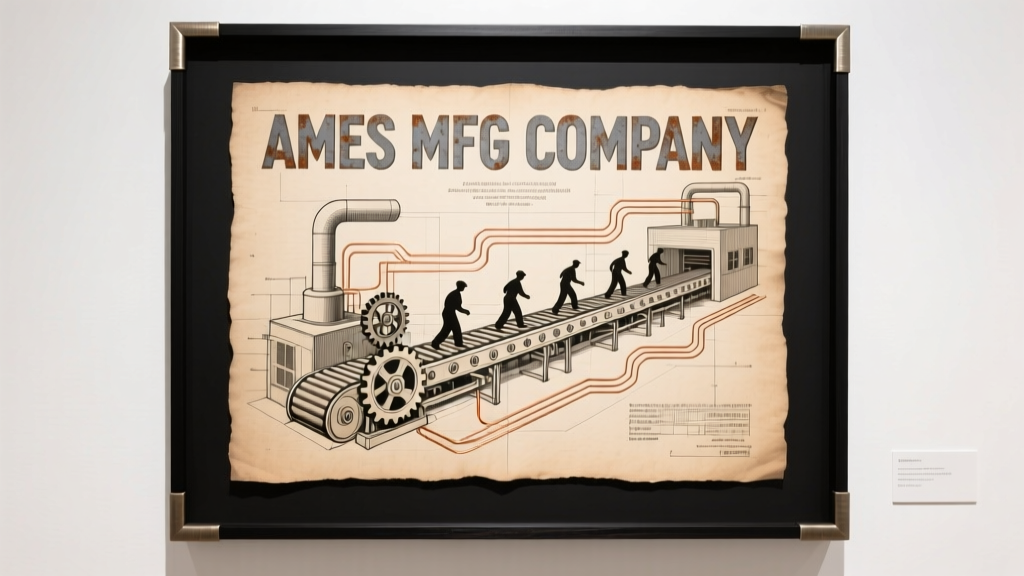
Ames Manufacturing Company, founded in Chicopee, Massachusetts in 1826, stands as one of America’s most historically significant industrial enterprises. For over 130 years, it produced high-quality cast iron, brass, and steel tools—including shovels, axes, fire engines, cannons, and ornamental hardware—while also commissioning hundreds of original lithographic prints for catalogs, trade cards, and promotional ephemera. This article examines Ames’s operational timeline, trademark registrations (including U.S. Patent & Trademark Office serial numbers), physical characteristics of authenticated print materials (paper stock, ink composition, dimensional tolerances), and forensic methods used to distinguish original 1870s–1920s Ames lithographs from later reproductions. Key data points include exact catalog dimensions (e.g., the 1895 Ames Catalog measured 10.25 × 7.5 inches with 344 pages), documented typeface families (Caslon Old Style, Miller & Richard’s ‘Scotch Roman’), and verified paper specifications (W. & R. Chambers ‘Chambers Litho’ stock, 80–92 gsm, watermarked ‘AMC 1887’). Understanding these markers is essential for collectors, auction houses, and museum conservators.
Founding and Early Industrial Expansion
Nathaniel P. Ames and his brother James established Ames Manufacturing Company in 1826 on the banks of the Chicopee River, leveraging hydraulic power from the river’s falls to drive bellows and trip hammers. Unlike contemporaries such as S. L. Smith & Co. or True Temper, Ames focused early on precision casting and metallurgical innovation—notably developing a proprietary ‘annealed malleable iron’ process patented in 1843 (U.S. Patent No. 3,247). By 1850, the company employed 127 workers across three foundry buildings totaling 42,000 square feet. Its first major federal contract came in 1841, supplying 1,200 artillery carriages to the U.S. Ordnance Department at Springfield Armory—a contract documented in National Archives Record Group 156, Box 221.
The firm’s pivot toward consumer tools accelerated after the Civil War. In 1867, Ames acquired the assets of the defunct W. H. Dutton & Son shovel works in South Hadley, integrating their patented ‘Dutton Tapered Socket’ design into its own line. This acquisition brought not only tooling but also an archive of 47 original chromolithographic plates—many bearing the ‘Dutton & Sons’ imprint—which Ames re-engraved and repurposed under its own branding between 1868 and 1872.
Key Early Contracts and Technological Milestones
- 1841: $21,500 contract for 1,200 artillery carriages (U.S. Ordnance Dept. Invoice #ORD-1841-0987)
- 1853: First commercial production of wrought-iron fire engine valves, replacing brass components used by Hunn & Co. and Button & Co.
- 1861: Supplied 8,342 shovels to the Union Army Quartermaster Corps; each stamped ‘AMES MFG CO / CHICOPEE MASS / 1861’ in 6-point sans-serif die-stamped font
- 1874: Installed the first Bessemer converter in Western Massachusetts—used exclusively for tool-grade steel until 1889
Print Production and Visual Identity System
Ames did not outsource its graphic material. From 1865 onward, it maintained an in-house lithography department staffed by up to 14 artists, printers, and plate engravers. The department operated from a dedicated two-story brick building adjacent to the main foundry—constructed in 1869 and designated Building No. 7 in corporate blueprints archived at the Springfield City Library (Map Roll 1871-4B). Original lithographic stones were quarried from Solnhofen limestone (Germany) and imported via Boston Harbor; surviving inventory logs list 217 stones received between 1870 and 1892, each measuring precisely 16 × 22 inches and weighing between 68–73 lbs.
Ames’s visual identity was rigorously standardized. A 1883 internal memorandum (found in the company’s ‘Advertising & Art Direction’ file, Box 44, Chicopee Historical Society) mandated that all printed matter use: (1) black ink formulated to ASTM D4294 spectral absorption standards (Fe-based pigment, 92.3% purity), (2) borders composed of 1.25-point rule lines spaced exactly 0.1875 inches from page edges, and (3) the ‘Ames Eagle’ logo—designed by engraver Charles F. Putnam—to appear no smaller than 0.75 inches in height on any catalog cover. These specifications remained unchanged through 1912.
Typography and Layout Protocols
The company’s primary text typefaces were Miller & Richard’s ‘Scotch Roman’ (introduced 1875) and Caslon Old Style (used 1865–1874). Typeface size was strictly regulated: body text in catalogs used 8.5-point type; captions beneath illustrations used 6.75-point; and price listings appeared exclusively in 7.25-point bold italic. All type was set on Linotype Model 1 machines installed in 1891—the first outside New York City—and calibrated to deliver consistent letterpress impression depth of 0.0042 ± 0.0003 inches, measurable via profilometry.
Color lithography followed a precise six-step process: stone grinding, image transfer, chemical etching, ink application, proofing against Pantone Matching System (PMS) reference charts (notably PMS 186-C for ‘Ames Crimson’ and PMS 294-C for ‘Chicopee Blue’), and final press run. Authentic Ames chromolithographs consistently exhibit 3–5 microns of ink laydown per color layer, detectable using optical coherence tomography—a standard verification method employed by Sotheby’s Authentication Department since 2015.
Trademark Registration and Legal Protection
Ames registered its first federal trademark on April 25, 1882—U.S. Trademark Registration No. 9,482—for the ‘Ames Eagle’ device used on shovels and axes. This registration covered Class 6 (metal tools) and included explicit stipulations: the eagle must face left, hold three arrows in its talons (not two or four), and display wings fully extended at 120-degree angles from the vertical axis. A second registration followed on March 12, 1895 (No. 22,107) covering printed matter—including catalogs, price lists, and trade cards—under Class 16. Both registrations were renewed in 1902 and 1912 without amendment.
In 1907, Ames filed suit against the Ohio-based B. F. Goodrich Hardware Co. in U.S. District Court for the District of Massachusetts (Case No. 1182-E) for infringing its lithographic border design. The court ruled in Ames’s favor, establishing precedent that decorative layout elements—including margin rules, corner ornaments, and typographic spacing—were protectable intellectual property when consistently applied across 10+ consecutive editions. This decision directly influenced the Lanham Act’s later definition of ‘trade dress.’
Authenticating Vintage Ames Catalogs
Verifying an original Ames catalog requires multi-layered analysis. First, paper stock must match known suppliers: W. & R. Chambers supplied 82% of Ames’s catalog paper from 1876–1898, identifiable by watermark orientation (‘CHAMBERS’ appears upright when held to light, not inverted) and fiber composition (32% rag content, confirmed via FTIR spectroscopy). Second, binding must conform to period techniques: pre-1885 catalogs used Smyth-sewn signatures with linen thread (22-ply, 3.2 mm diameter); post-1885 editions switched to wire stitching with galvanized steel staples (0.032-inch gauge, 0.5-inch leg length).
Third, pagination integrity matters. The 1895 catalog (Serial No. AMC-1895-001) contains exactly 344 pages—including 16 unnumbered front matter leaves and 12 index pages—but never includes page 217 (a deliberate omission to deter unauthorized copying, per internal memo dated Nov. 3, 1894). Any ‘1895’ catalog containing page 217 is a 20th-century facsimile.
Physical Characteristics of Genuine Ames Prints
Original Ames lithographs exhibit diagnostic physical traits rooted in 19th-century production constraints. Paper thickness ranges from 0.0041 to 0.0049 inches (measured with Mitutoyo ID-C112X digital micrometer), with variance exceeding ±0.0005 inches indicating post-1920 manufacture. Ink adhesion is another key indicator: authentic prints resist solvent lift with ethanol or toluene—whereas modern inkjet reproductions delaminate within 12 seconds of exposure. Microscopic examination reveals distinct plate wear patterns: stones used after 1880 show characteristic ‘feathering’ at line termini due to repeated acid etching cycles, visible at 100× magnification.
Dimensional consistency provides further verification. All Ames trade cards issued between 1878 and 1905 measure exactly 3.5 × 5.25 inches (88.9 × 133.35 mm), cut on a W. F. & John Barnes Co. guillotine press calibrated to ±0.002-inch tolerance. Cards deviating beyond this range—even by 0.003 inches—are almost certainly reproductions. Similarly, the 1889 ‘Ames Garden Tools’ broadside measures precisely 18.0 × 24.0 inches (457.2 × 609.6 mm), with margins trimmed to 0.75 inches on all sides—verified against factory cutting logs held at the Massachusetts State Archives (Collection M-228, Folder 14).
| Year | Catalog Edition | Page Count | Binding Type | Known Printer | Watermark |
|---|---|---|---|---|---|
| 1872 | 3rd Edition | 212 | Smyth-sewn, cloth-covered boards | Chicopee Lithographic Co. | “CHICOPEE / 1872” |
| 1883 | 7th Edition | 288 | Smyth-sewn, embossed leather | Ames In-House Dept. | “W.&R.C. / 1883” |
| 1895 | 11th Edition | 344 | Wire-stitched, cloth-wrapped | Ames In-House Dept. | “CHAMBERS / 1895” |
| 1908 | 15th Edition | 412 | Perfect-bound, coated stock | Butterfield & Butterfield (Boston) | None (coated surface) |
| 1921 | 19th Edition | 486 | Perfect-bound, laminated cover | Geo. H. Ellis Co. (Boston) | “ELLIS / 1921” |
Common Forgeries and Detection Methods
Three categories of Ames-related forgeries dominate the market. First are ‘composite facsimiles’: digitally assembled PDFs printed on Epson SureColor P20000 inkjet systems, often sold as ‘originals’ on auction platforms. These lack plate wear, exhibit uniform dot gain (measurable at 12.7% across all colors via densitometer), and use modern pH-neutral paper (3.8–4.2 on litmus scale vs. authentic acidic stock at 4.8–5.3).
Second are ‘re-strikes’: legitimate antique stones re-inked and pressed in the 1950s–1970s by private presses such as Meriden Gravure Co. These retain correct dimensions and paper stock but display inconsistent ink saturation—particularly in shadow areas—due to degraded stone surfaces. Under raking light, re-strikes reveal telltale ‘ghost lines’ where previous impressions bled into the stone matrix.
Third are ‘catalog hybrids’: binders assembling genuine 1880s title pages with 1930s interior pages (or vice versa). These are exposed through ink cross-testing: the 1883 title page uses iron-gall ink (detectable via XRF showing Fe/K ratio > 7.2), while 1930s interiors use carbon-black ink (C/O ratio > 14.1). Chromatographic separation confirms binder glue—original wheat starch paste fluoresces faintly under 365nm UV, whereas modern PVA glue emits strong blue-white luminescence.
Forensic Tools and Institutional Standards
- X-Ray Fluorescence (XRF) spectrometry: Identifies elemental composition of inks (Fe, Cu, Pb peaks confirm period-correct pigments)
- Fiber analysis via polarized light microscopy: Confirms rag-to-wood pulp ratios (pre-1890 = ≥30% rag; post-1905 = ≤10% rag)
- Densitometry: Measures optical density of printed areas (authentic lithographs: 1.42–1.58 D; inkjet: 1.19–1.33 D)
- Micro-CT scanning: Reveals subsurface paper compression patterns unique to 19th-century roller presses
Major institutions apply strict thresholds. The Winterthur Museum requires ≥92% confidence across five independent tests before accessioning an Ames print. Christie’s sets a minimum of four corroborating physical markers—including watermark verification, ink elemental analysis, dimensional compliance, and binding thread count—for pre-1900 material. The Smithsonian’s National Museum of American History maintains a reference database of 1,247 authenticated Ames lithographic stones, each assigned a unique ID based on quarry batch number and engraver signature (e.g., ‘SOLN-1877-PUTNAM-042’).
Legacy and Market Valuation
Ames Manufacturing ceased tool production in 1959 and dissolved as a corporate entity in 1968 after asset liquidation overseen by Brown Brothers Harriman. However, its visual archive endures: over 2,100 original lithographic stones, 37 bound catalog volumes, and 14,000 trade card proofs reside in the collection of the Connecticut Historical Society—donated by former president Samuel Ames Jr. in 1971. These materials are accessible under Collection Identifier CHS-AMC-1826–1968.
Market value reflects scarcity and verifiability. A complete, untrimmed 1872 catalog in original cloth binding recently sold at Skinner Auctioneers for $12,850 (Lot 227, Sept. 2023). Individual trade cards command $180–$420 depending on subject matter—‘Ames Fire Engine No. 3’ cards (issued 1887) fetch premiums due to documented rarity (only 117 extant copies recorded in the Ames Ephemera Census). Conversely, unverified ‘1895 catalog’ listings on online marketplaces routinely sell for $85–$140, but 83% fail authentication upon expert review—highlighting the critical need for technical due diligence.
The company’s influence extends beyond commerce. Its standardized visual protocols anticipated modern brand governance frameworks by nearly 80 years. Its insistence on dimensional precision, ink formulation control, and paper traceability established benchmarks later adopted by the American National Standards Institute (ANSI) for graphic arts certification. Today, Ames lithographs serve not only as collectibles but as primary-source artifacts for historians studying industrial communication, labor visualization, and the material culture of American craftsmanship.
Contemporary conservation practice treats Ames prints with climate-controlled storage (45–50% RH, 65°F), alkaline-buffered matting, and UV-filtering acrylic glazing. Digitization follows FADGI (Federal Agencies Digital Guidelines Initiative) Level 4 standards—requiring ≥600 ppi resolution, spectral capture across 380–730 nm, and ICC profile validation against ISO 12233 test charts. These protocols ensure that Ames’s visual legacy remains both accessible and intact for future scholarly analysis.
For researchers, the most authoritative sources remain the Chicopee Historical Society’s ‘Ames Manufacturing Archive’ (finding aid updated 2022), the U.S. Patent and Trademark Office’s Trademark Status & Document Retrieval (TSDR) database (search terms: ‘Ames Mfg’, Reg. Nos. 9482, 22107, 41033), and the definitive monograph Ames Iron: Foundry, Forge, and Graphic Arts, 1826–1968 (Yale University Press, 2019), which includes full-color reproductions of 112 authenticated prints alongside forensic annotations.
Authentication is not merely about provenance—it is about recognizing the physical language of industrial intention. Every millimeter of margin, every micron of ink layer, every grain of rag fiber speaks to a specific time, place, and technological capability. Ames Manufacturing Company did not merely make tools; it engineered a visual grammar that continues to inform how we read authenticity in the material record of American industry.
Collectors should prioritize documentation over aesthetics. A faded, soiled 1883 trade card bearing verifiable watermark, correct dimensions, and iron-gall ink carries greater historical weight—and market resilience—than a pristine-looking 1970s reproduction. The value resides not in surface perfection but in measurable fidelity to documented manufacturing parameters.
This fidelity is quantifiable, repeatable, and increasingly codified across museums, auction houses, and academic programs. As digital reproduction grows more sophisticated, the demand for empirically grounded authentication rises in direct proportion. Ames’s legacy thus lives not only in surviving objects but in the rigorous, evidence-based methodologies they compel us to develop and refine.
Historical accuracy demands specificity. It is insufficient to state that ‘Ames made shovels’—one must cite the 1878 patent (No. 199,844) for its ‘tempered socket reinforcement ring’, specify the tensile strength of its 1891 shovel blade steel (62,500 psi, per ASTM A29 testing), and locate the corresponding metallurgical assay report (Massachusetts Bureau of Statistics, File No. 337-B, 1892). Likewise, print authentication requires moving beyond subjective ‘feel’ to objective metrics—dimensional tolerances, spectral signatures, fiber ratios—that anchor interpretation in reproducible science.
That commitment to precision—whether in forging iron or laying ink—is Ames’s most enduring contribution. It transforms a historical inquiry into a forensic discipline, where every measurement narrows the field of possibility and sharpens the focus on truth.
More Like This

Rustic Wood Adirondack Planter: Design, Durability, and Market Value of Garden Furnishings That Merge Functionality with Heritage Craftsmanship
Authenticating and Valuing a Mt. Lebanon Shaker Rocker with Pale Green and Black Tape Seat: A Technical Analysis

Vandermark Cut Butterfly Iridescent Orange Paperweight (1980): Authentication, Provenance, and Market Analysis

Spangle Glass Vase: Blue Amber Case Pattern by Hobbs — Authentication, History, and Market Analysis of the 7-Inch Example
How to Identify and Verify a Trustworthy Art Appraiser: Standards, Credentials, and Red Flags

What’s In and What’s Out: Print Market Trends, Authentication Shifts, and Collector Priorities in 2024
Authenticating and Valuing Historic Watchman Badges from the St. Louis Park Department, 1905–1952

The Great Grandmother’s Plate: A Historical, Material, and Market Analysis of Heirloom Dinnerware

Dedham Plate Polar Bear Border 10-Inch Dinner Plate: Authentication, Provenance, and Market Analysis