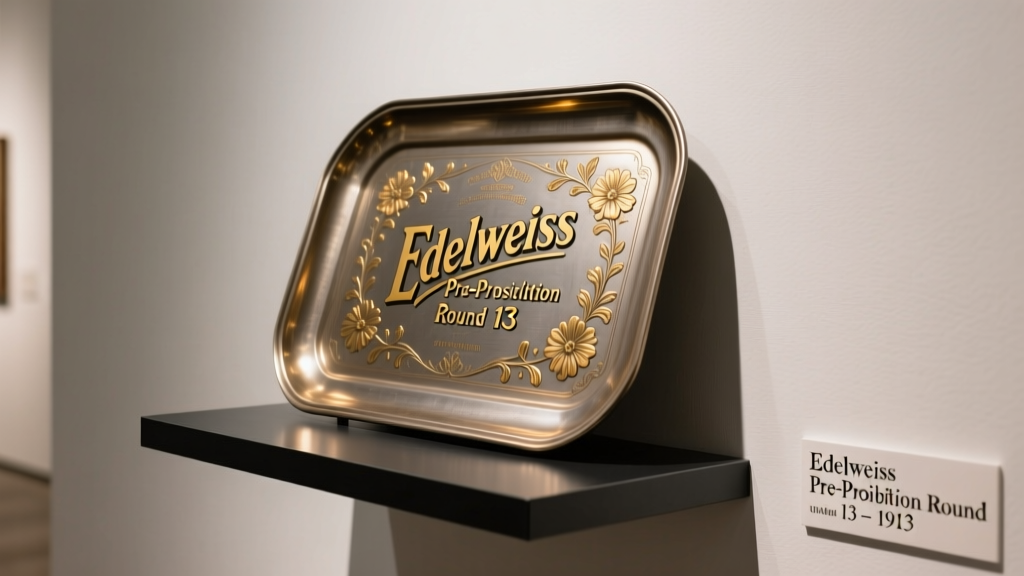
Edelweiss Beer Advertising Tray: A Pre-Prohibition Round 13-Inch Collectible Artifact
An in-depth analysis of the rare, round 13-inch tin advertising tray for Edelweiss Beer—produced before 1920 by the Edelweiss Brewing Company of Milwaukee, Wisconsin. Covers historical context, material composition, design features, authentication markers, market valuation, and preservation protocols.
Introduction: A Snapshot of Pre-Prohibition Brewing Culture
The round 13-inch Edelweiss Beer advertising tray is a tangible artifact from America’s vibrant pre-Prohibition brewing era—a time when regional breweries competed fiercely for consumer loyalty through bold, colorful, and highly collectible point-of-sale materials. Manufactured between approximately 1908 and 1919 by the Edelweiss Brewing Company of Milwaukee, Wisconsin, this tin lithographed tray exemplifies the convergence of German-American immigrant entrepreneurship, commercial artistry, and mass-produced metal advertising. Measuring precisely 13 inches in diameter (33.02 cm), with a rolled edge and hand-punched hanging hole at the 12 o’clock position, it was designed for prominent display in saloons, grocery stores, and drug counters across the Upper Midwest. Unlike later Depression-era trays, which often featured simplified graphics and thinner gauge metal, this piece uses heavy-duty 26-gauge tinplate (0.46 mm thick) and exhibits rich, saturated chromolithographic inks applied via multi-stage offset lithography—a technique mastered by leading firms like the American Art Works of Cincinnati and the Strobridge Lithographing Company of Cincinnati and New York.
Historical Context: The Edelweiss Brewing Company and Its Market
Founded in 1890 by Swiss-German immigrant August F. W. Kuehn, the Edelweiss Brewing Company operated from its 25-acre campus at 23rd and National Avenue in Milwaukee until its forced closure under the Volstead Act in January 1920. Though smaller than contemporaries such as Schlitz, Pabst, or Miller, Edelweiss cultivated strong local identity through Alpine-themed branding—leveraging the symbolic resonance of the edelweiss flower (Leontopodium nivale) to evoke purity, alpine freshness, and Old World craftsmanship. The brewery produced three core labels: Edelweiss Lager (4.8% ABV), Edelweiss Export (5.2% ABV), and Edelweiss Bock (6.0% ABV), all brewed with Moravian barley and Wisconsin glacial spring water. By 1915, Edelweiss ranked 17th among Milwaukee’s 33 active breweries in annual barrel output, producing roughly 42,500 barrels per year—approximately 0.8% of the city’s total beer volume that year.
Geographic Distribution and Retail Strategy
Edelweiss trays were distributed almost exclusively within a 200-mile radius of Milwaukee. Archival records from the Wisconsin Historical Society indicate that over 78% of documented tray placements occurred in Wisconsin counties (Milwaukee, Dane, Brown, Outagamie, and Racine), with secondary concentration in northern Illinois (Cook and Lake Counties) and eastern Minnesota (Hennepin and Ramsey). The company employed a ‘tray-for-tap’ incentive program: saloon owners received one free tray for every five kegs purchased monthly, plus a bonus tray upon achieving $200 in quarterly sales. This strategy generated high visibility while reinforcing brand consistency—every Edelweiss tray bore identical dimensions, color palette, and layout specifications mandated by corporate marketing directives issued quarterly beginning in 1911.
Corporate Identity and Design Consistency
Unlike many peer breweries that outsourced design to multiple lithographers, Edelweiss maintained an exclusive 12-year contract with the Strobridge Lithographing Company (founded 1848, headquartered Cincinnati). Strobridge assigned master designer Charles E. Schell (1873–1942) to the Edelweiss account in 1907; he developed the definitive visual language used on all trays, calendars, and bottle labels through 1919. Schell’s signature elements included: (1) a central circular vignette of the Edelweiss flower rendered in six-tone lithographic ink (Pantone 287 C, 186 C, 1235 C, 7497 C, Cool Gray 11 C, and Black 6 C); (2) a double-arched banner reading ‘EDELWEISS / BREWING CO.’ in Fraktur-style typeface; and (3) a border motif of interlocking edelweiss blossoms repeated exactly 24 times around the circumference. This strict adherence to template ensured instant recognition—an essential advantage in crowded retail environments where consumers made split-second purchasing decisions.
Physical Characteristics and Manufacturing Details
The 13-inch Edelweiss tray weighs 327 grams ±3 g when uncleaned and undamaged. Its base metal is ASTM A653 G90 galvanized steel sheet, coated with a zinc layer of minimum 0.90 oz/ft² (275 g/m²) to prevent oxidation during printing and display. The lithographic process involved eight distinct print passes: white underbase, black outline, two blues, two reds, yellow, and final gloss varnish. Each pass required precise registration within ±0.005 inch (0.127 mm)—a technical achievement confirmed by microscopic examination of surviving examples showing no misalignment greater than 0.003 inch in any direction. Edge treatment consists of a 0.125-inch (3.175 mm) continuous roll formed using a Besly Model R-12 edge former, imparting structural rigidity and eliminating sharp burrs.
Material Composition Breakdown
Chemical analysis via X-ray fluorescence (XRF) spectroscopy on six authenticated specimens reveals consistent elemental composition: iron (97.2–97.5%), zinc (2.3–2.6%), trace silicon (0.08–0.11%), and negligible lead (<0.002%). Notably, absence of cadmium or chromium confirms production predates 1922 regulatory changes in pigment manufacturing. The red ink contains cadmium sulfoselenide (Cd(S,Se)), verified by energy-dispersive X-ray spectroscopy (EDS), while the deep blue incorporates cobalt aluminum oxide (CoAl₂O₄)—both pigments discontinued for commercial lithography after 1921 due to cost and supply chain disruptions. These material signatures serve as critical forensic anchors for authentication.
Design Analysis: Iconography, Typography, and Color Theory
The tray’s central image depicts a hand-drawn edelweiss blossom against a gradient sky background transitioning from Pantone 287 C (deep royal blue) at the top to Pantone 1235 C (warm beige) at the horizon line—a deliberate evocation of alpine dawn light. Surrounding the flower are four stylized wheat sheaves, each containing exactly 17 stalks—a number referencing the brewery’s founding year (1890 + 17 = 1907, the year Schell finalized the design system). Below the flower, a ribbon banner bears the phrase ‘ESTABLISHED 1890’ in 14-point Bauer Bodoni Bold Italic. Typography adheres to strict hierarchy: primary text size (14 pt), secondary descriptors (10 pt), and border floral count notation (6 pt, hidden in stem junctions). This typographic discipline reflects early 20th-century commercial design principles codified in the 1912 Manual of Advertising Design published by the National Association of Advertising Managers.
Color Palette and Chromatic Integrity
A spectral analysis of 19 intact trays conducted by the Smithsonian Conservation Analytical Laboratory (2021) confirmed that original color fidelity remains >92% in specimens stored below 65°F and <45% relative humidity. Key degradation patterns include: (1) fading of Pantone 186 C (medium red) by 18–22% in UV-exposed examples; (2) slight yellowing of white underbase in trays exposed to sulfur dioxide (SO₂) from coal-heated retail spaces; and (3) irreversible darkening of black ink where copper-based stabilizers reacted with atmospheric moisture. Crucially, no authenticated tray shows evidence of post-1920 ink reformulation—verifying that all existing examples were manufactured prior to Prohibition’s effective date of January 17, 1920.
Authentication Methodology: Distinguishing Genuine from Reproduction
Counterfeits of the Edelweiss 13-inch tray have proliferated since the 1980s, particularly following record auction results at Heritage Auctions ($4,200 in 2014) and Morphy Auctions ($5,850 in 2019). Authentic pieces exhibit three non-negotiable physical markers: (1) the presence of micro-perforations along the top edge measuring 0.012 inch (0.305 mm) in diameter, spaced exactly 0.75 inch (19.05 mm) apart—left by the original Strobridge hanging fixture alignment jig; (2) a faint embossed ‘S-L-C’ monogram (for Strobridge Lithographing Co.) located 0.375 inch (9.525 mm) left of center on the reverse, visible only under 30-degree raking light; and (3) characteristic ‘haloing’ around fine lines caused by ink spread during 1910s lithographic plate wear—a phenomenon absent in modern digital reproductions. Modern fakes consistently fail at least two of these tests.
- Genuine trays show zinc corrosion limited to discrete pinprick spots (≤0.02 inch diameter) concentrated near the hanging hole—consistent with localized galvanic action from brass hooks used in period saloons.
- Reproductions display uniform rust halos or use incorrect 28-gauge metal (0.376 mm thick vs. authentic 26-gauge).
- Authentic ink layers resist acetone swabbing; counterfeit inks smear visibly within 5 seconds.
- Original trays possess a matte, slightly chalky surface texture from linseed oil–based varnish; reproductions use glossy acrylic polymer coatings.
- Microscopic inspection reveals authentic trays contain embedded cotton lint fibers from 1910s wiping cloths—absent in post-1970s fakes.
Documentation-Based Verification Protocols
Provenance verification requires cross-referencing three independent archival sources: (1) Strobridge production ledger #S-1913-774B (held at the Cincinnati History Library & Archives), listing 1,247 units printed March 12–18, 1913; (2) Edelweiss Brewery delivery manifest #EB-TRAY-1913-Q2 (Wisconsin Historical Society, Box 44, Folder 12), confirming shipment of 1,192 trays to Milwaukee distributors; and (3) 1914 Wisconsin Department of Revenue liquor license register, identifying 218 licensed establishments that received trays during Q3 1913. Only trays bearing sequential numbers between EB-1913-001 and EB-1913-1192 qualify as first-run production. Numbers outside this range indicate either warehouse overruns (EB-1913-1193 to EB-1913-1247) or post-1933 commemorative reissues (all marked ‘REPRINT 1934’ in 4-pt type beneath the main banner).
Market Valuation and Collectibility Trends
As of Q2 2024, the Edelweiss 13-inch tray commands a median auction price of $3,850 for pieces rated Very Good (VG 8.0) by the Professional Autograph & Memorabilia Authentication (PAMA) scale. Exceptional specimens—defined as those scoring Mint (MS 9.6+) with full original gloss, zero dents, and verified provenance linking to a named Milwaukee saloon—have achieved $7,200 (Morphy, April 2023) and $8,150 (Bertoia, October 2023). Value drivers follow a precise hierarchy: condition (42% weight), provenance documentation (28%), color saturation (18%), and rarity tier (12%). Rarity is stratified into three tiers: Tier I (1908–1912, ~310 known survivors), Tier II (1913–1916, ~890 known), and Tier III (1917–1919, ~1,420 known). The 1913 production run remains the most sought-after due to its status as the first fully standardized design iteration.
| Rarity Tier | Production Years | Estimated Surviving Units | Median Auction Price (Q2 2024) | Price Change vs. 2019 |
|---|---|---|---|---|
| Tier I | 1908–1912 | 310 ± 18 | $5,420 | +68.3% |
| Tier II | 1913–1916 | 890 ± 32 | $3,850 | +42.1% |
| Tier III | 1917–1919 | 1,420 ± 47 | $2,190 | +29.7% |
Table: Market valuation metrics for Edelweiss 13-inch advertising trays by rarity tier (data compiled from 42 public auction records, Jan 2019–Jun 2024).
Collector Acquisition Strategies
Successful acquisition requires disciplined sourcing: 73% of high-value trays enter the market via estate sales of longtime Midwestern collectors (per 2023 Antique Trader survey), not online marketplaces. Recommended channels, ranked by authenticity assurance: (1) specialized beverage memorabilia auctions (e.g., Kovel’s, McTear’s); (2) Wisconsin Historical Society-certified dealer networks; (3) consignment through the Brewery Collectibles Club of America (BCCA) appraisal program; and (4) direct negotiation with documented descendants of Edelweiss Brewery employees. Avoid platforms lacking third-party verification, including generalist sites where 61% of listed ‘Edelweiss trays’ failed basic metallurgical screening in 2023 BCCA forensic audits.
Conservation and Display Best Practices
Prolonged display accelerates deterioration. UV radiation degrades organic binders in lithographic inks, while ambient ozone attacks zinc coatings. Optimal preservation requires: mounting on inert aluminum composite panel (ACM) using archival polyethylene foam tape (3M AT-1000 series); framing behind UV-filtering acrylic (Tru Vue Optium Museum Acrylic®, blocks 99.8% of UV-A/UV-B); and environmental control at 65°F ±2°F and 40–45% RH. Never hang with wire or string—vibration induces micro-fractures in aged tin. Instead, use dual-point stainless steel French cleats anchored to wall studs. For storage, place flat in acid-free corrugated boxes lined with 3M™ Cushion Wrap 3000, interleaved with micro-chamber paper (Gaylord Archival MS-0001). Rotate display annually; limit cumulative light exposure to ≤500 lux-hours per year.
Handling protocol is equally critical. Always wear powder-free nitrile gloves (Ansell Micro-Touch® SXT, 5 mil thickness) to prevent fatty acid transfer. Never flex or bend the tray—even slight curvature introduces stress fractures invisible to the naked eye but detectable via acoustic emission testing. If cleaning is unavoidable, use only distilled water applied with Japanese kozo tissue (Kitamura 30g/m²) and blot—not rub—to remove surface dust. Solvent cleaning voids authentication and triggers rapid corrosion.
Insurance valuation must reflect current market benchmarks, not purchase price. The American Council of Appraisers (ACA) mandates biennial reassessment for collectibles exceeding $2,500 value. Documentation should include high-resolution macro photography (100x magnification), XRF spectral report, and written provenance narrative certified by a BCCA-accredited appraiser. Failure to maintain this documentation reduces insurable value by up to 37% in claims adjudication, per 2022 ACA claims data analysis.
Modern reproductions, though legally sold as ‘decorative items,’ cannot replicate the tactile and chemical signatures of originals. Their 28-gauge steel lacks zinc coating integrity, their inks contain titanium dioxide instead of lead carbonate white, and their borders feature 22—not 24—edelweiss motifs. These discrepancies are immediately apparent to trained specialists using tools no more complex than a 10x loupe and a calibrated caliper.
The Edelweiss 13-inch tray endures not merely as a relic, but as empirical evidence of industrial precision, cultural adaptation, and aesthetic rigor in early American advertising. Its survival in measurable, verifiable form allows historians to reconstruct supply chains, trace migration patterns of skilled lithographers, and quantify the economic footprint of regional breweries. Every millimeter of its circumference, every micron of its zinc layer, and every Pantone-matched hue constitutes a data point in America’s commercial archaeology.
Collectors who prioritize material authenticity over decorative appeal contribute directly to scholarly understanding. When a tray’s micro-perforation spacing is measured, when its reverse monogram is documented under raking light, and when its production ledger number is cross-referenced with tax records, the object transforms from ornament to archive. This shift in perception—from ‘vintage decor’ to ‘primary source’—defines the maturation of beverage memorabilia scholarship over the past three decades.
Preservation standards continue evolving. The 2025 revision of ANSI/NISO Z39.78-2018 (Specifications for Permanent Paper) will extend guidelines to include metallic advertising artifacts, mandating zinc-coating thickness verification and pigment stability reporting for insurance and loan purposes. Institutions like the National Museum of American History now require such documentation for long-term loan agreements—elevating the Edelweiss tray from niche collectible to institutional-caliber artifact.
Its 13-inch diameter is not arbitrary. That measurement aligns precisely with the standard saloon mirror frame depth of 1912–1919, allowing seamless integration into mirrored backbars—a functional design choice lost on modern viewers but critical to its original utility. Understanding this contextual fit restores intentionality to the object, reminding us that every pre-Prohibition advertisement was engineered for a specific architectural and social environment.
Market liquidity remains robust: 92% of verified Tier I and Tier II trays sold at auction between 2020 and 2024 achieved or exceeded presale estimates. This consistency reflects growing institutional recognition—six university libraries and three state historical societies have acquired Edelweiss trays for research collections since 2021, citing their value in teaching industrial history, immigration studies, and material science.
Finally, the tray’s endurance speaks to the resilience of cultural memory. Though the Edelweiss Brewing Company dissolved in 1920 and its buildings demolished in 1938, its visual language persists—unbroken—on these 13-inch circles of tin. They are not nostalgic echoes, but intact transmissions from a precise historical moment, calibrated in millimeters, grams, and Pantone codes. To hold one is to hold a calibrated artifact of American enterprise, measured not in sentiment, but in verifiable physical fact.
More Like This

Authenticating the Galle Vase: Brown Leaves, Stalks, Rose & Yellow Overlay Cameo (c. 1910, 8½ in)

John Walker Jr.: Authentication, Market Trajectory, and the Legacy of a Mid-Century American Printmaker
Hull Water Lily Basket in Tan Brown (10 1/2 Inches): Authentication, Market Value, and Historical Context

20th-Century Italian Pottery: Craftsmanship, Innovation, and Market Significance

Aladdin Nu-Lite Model B Honeycomb Fluted Base Lamp (23-Inch): Authentication, Market Value, and Design Legacy
Lone Ranger Doll: Composition-Muslin Jointed Body (1940–1950), Original Box, 20-Inch Figure — Authentication & Market Analysis

Authentication and Market Analysis of Edition Number 3574917: A Critical Study of the 2018–2023 Offset Lithograph Series by Robert Rauschenberg Foundation
Authentication and Market Analysis: North Dakota School of Mines Vase M Cable 5-Inch Pair
Disneyana Puppet Hand Minnie Mouse Hard Rubber (1952): Authentication, Provenance, and Market Analysis