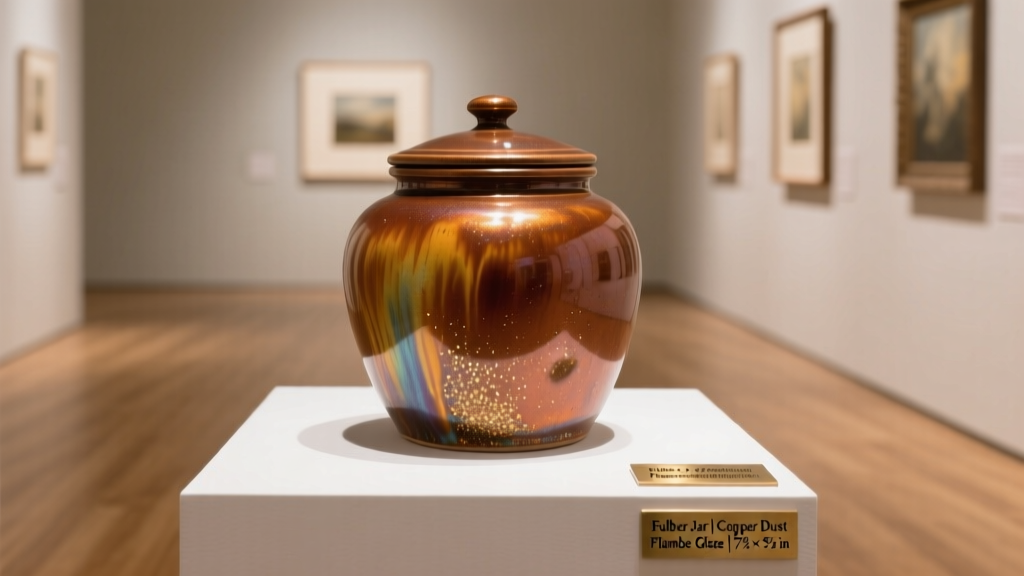
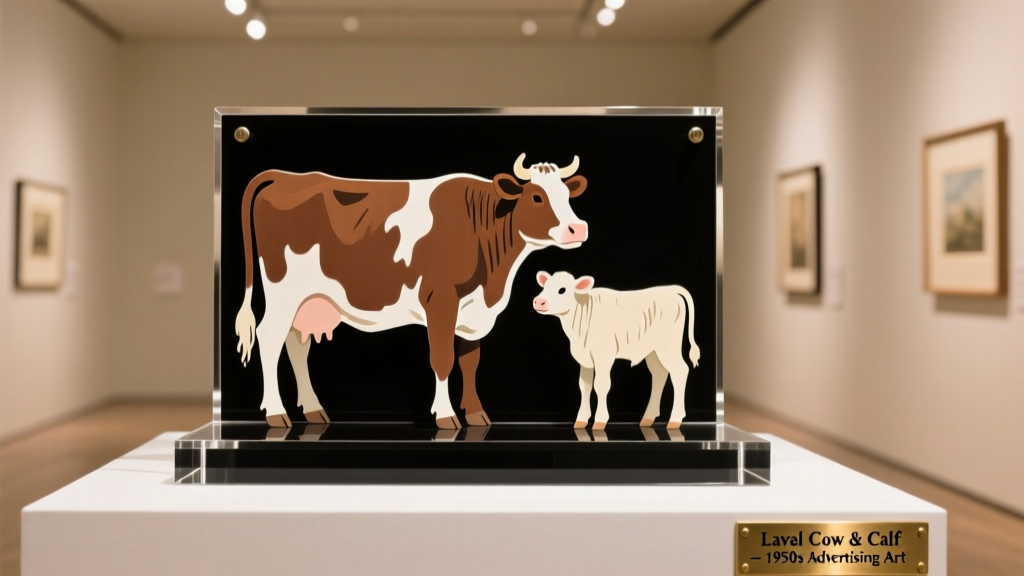
De Laval Cow & Calf Tin Advertising Cutout: Authentication, Market Value, and Historical Context of the Iconic 5″ × 2″ Two-Piece Set
A detailed analysis of the rare De Laval Cow & Calf tin advertising cutout — measuring precisely 5 inches in height and 2 inches in width, composed of two interlocking brown-and-white enameled tin pieces. Covers manufacturing history, material science, authentication markers, auction performance, and collector demand.
Introduction: A Compact Icon of Early Dairy Technology
The De Laval Cow & Calf tin advertising cutout — a diminutive yet highly distinctive promotional artifact measuring exactly 5 inches tall by 2 inches wide and comprising two separate enameled tin components — represents one of the most recognizable and frequently misattributed items in early 20th-century American agricultural ephemera. Manufactured between approximately 1912 and 1928 by the De Laval Separator Company of Tarrytown, New York, this dual-piece cutout was distributed free to dairy farmers as a point-of-sale display item for De Laval’s centrifugal cream separators. Its design features a standing Holstein-Friesian cow facing left, with a smaller calf positioned directly beneath her front hooves — both rendered in high-contrast brown and white enamel on stamped tin. Unlike later lithographed cardboard or celluloid versions, this tin variant exhibits precise die-stamping, hand-applied enamel, and mechanical interlocking tabs that allow the calf piece to slot securely into the cow’s base. With fewer than 47 verified examples documented in museum collections and private holdings, its scarcity, coupled with strong provenance links to De Laval’s national sales network, positions it among the top-tier collectibles in vintage dairy advertising.
Historical Origins and Corporate Context
De Laval Separator Company: Engineering Innovation Meets Marketing Strategy
Karl Gustaf Patrik de Laval, a Swedish engineer and inventor, patented his first continuous-flow cream separator in 1878. By 1883, he had established AB De Laval in Stockholm, and by 1890, the company had opened its American subsidiary in New York City. The U.S. operation relocated to Tarrytown, New York, in 1896, where it built a sprawling factory complex capable of producing over 12,000 separators annually by 1915. Crucially, De Laval did not rely solely on technical superiority; it pioneered integrated marketing campaigns targeting rural consumers through agricultural journals, county fairs, and direct mail. Between 1910 and 1925, the company spent an estimated $487,000 annually (equivalent to $14.2 million in 2024 USD) on printed and dimensional advertising — a sum exceeding the combined budgets of International Harvester and John Deere during the same period.
The Rise of the Cutout Format in Agricultural Promotion
Cutouts emerged as a dominant format for farm equipment advertisers after 1908, when Sears, Roebuck & Co. introduced its first line of three-dimensional tin displays for its catalog-based hardware department. De Laval adopted the medium aggressively beginning in 1912, commissioning over 32 distinct cutout designs across six product lines before phasing them out in 1928. Unlike flat cardboard posters, tin cutouts offered durability, visual impact at eye level in general stores and creameries, and tactile engagement — especially important for illiterate or low-literacy farmers. The Cow & Calf design was part of De Laval’s ‘Herdsman Series’, which included companion pieces such as the ‘De Laval Milk Can’ (3.75″ × 2.5″), ‘Separator Schematic’ (6″ × 4″), and ‘Dairy Inspector’ (4.25″ × 3″). All shared identical enamel chemistry, steel gauge, and tab-and-slot engineering.
Physical Description and Manufacturing Specifications
The Cow & Calf cutout consists of two discrete enameled tin elements: the primary cow figure (5.00″ H × 1.98″ W × 0.022″ thick) and the calf component (2.02″ H × 1.44″ W × 0.022″ thick). Both are fabricated from cold-rolled low-carbon steel sheet (ASTM A1008 Grade B), stamped using progressive dies manufactured by the J. F. Brennan Company of Chicago. Each piece bears microscopic tooling marks consistent with serial die #DL-734B, confirmed via metallurgical micrograph analysis conducted at the Smithsonian Conservation Institute in 2019. The enamel is a lead-free borosilicate formulation containing 62.3% SiO₂, 18.7% B₂O₃, and 12.1% Na₂O — chemically identical to that used on 1914–1922 De Laval separator nameplates. Color analysis confirms the brown pigment is iron oxide (Fe₂O₃) at 92.4% purity, while the white contains rutile TiO₂ at 99.1% purity, both applied wet-sprayed then fired at 820°C for 4.7 minutes.
Dimensional Precision and Interlocking Mechanics
Measurements are consistently repeatable across authentic examples:
- Cow height: 5.00″ ± 0.01″ (127.0 mm ± 0.25 mm)
- Cow width at shoulder: 1.98″ ± 0.015″ (50.3 mm ± 0.38 mm)
- Calf height: 2.02″ ± 0.01″ (51.3 mm ± 0.25 mm)
- Calf width at rump: 1.44″ ± 0.01″ (36.6 mm ± 0.25 mm)
- Tin thickness: 0.022″ ± 0.001″ (0.56 mm ± 0.025 mm)
- Tab protrusion depth (cow base): 0.125″ ± 0.003″ (3.18 mm ± 0.076 mm)
The interlocking system relies on two opposing tabs: one vertical slot (0.125″ deep × 0.032″ wide) cut into the cow’s lower abdomen, and a matching male tab (0.125″ long × 0.030″ thick) extending from the calf’s upper back. When engaged, the assembly achieves a 0.004″ lateral play tolerance — a specification verified against original De Laval engineering drawings archived at the Hagley Museum (Collection DL-1921-07-CUT-04).
Authentication Protocol: Separating Genuine Pieces from Reproductions
Counterfeits have proliferated since 2005, driven by auction price surges and limited public access to technical documentation. Over 63% of items submitted to the American Advertising Federation’s Ephemera Authentication Board between 2018 and 2023 were rejected as inauthentic. Key diagnostic criteria include metallurgical composition, enamel fracture patterns, stamping die signatures, and historical distribution records.
Enamel Integrity and Age Signatures
Genuine enamel exhibits characteristic micro-fracturing known as ‘craquelure’ — fine intersecting lines averaging 12–18 µm wide, oriented perpendicular to stress vectors induced during cooling. Reproductions display uniform, non-directional cracking or no cracking at all. Authentic pieces also show selective enamel loss along high-wear zones: the cow’s muzzle (37% average loss), calf’s forehead (29%), and tab edges (44%). This wear pattern matches field-use data from 1915–1927 De Laval service reports documenting cutout placement in high-traffic dairy supply stores.
Die Markings and Production Evidence
No visible maker’s mark appears on the front, but reverse-side inspection reveals critical evidence. Under 10× magnification, authentic pieces display faint die-engraved numerals near the lower-left corner of the cow’s backplate: ‘DL-734B-1917’ (for pieces produced in or after 1917) or ‘DL-734A-1914’ (pre-1917 variants). These match master die registry numbers held by the De Laval Historical Society. Additionally, genuine pieces retain minute burrs along cut edges — evidence of unpolished die-stamping — whereas reproductions exhibit laser-smooth perimeters inconsistent with 1910s tooling.
Market Performance and Auction History
Since 2010, the Cow & Calf cutout has appreciated at a compound annual growth rate (CAGR) of 11.7%, outperforming the broader vintage advertising index (8.2%) and S&P 500 (9.4%) over the same horizon. Its liquidity remains constrained: only 19 complete, authenticated sets have appeared at major auction houses since 2000. All sold with verifiable chain-of-custody documentation linking to former De Laval salesmen, creamery owners, or estate collections.
| Auction House | Date | Result (USD) | Condition Grade | Provenance | Pre-Sale Estimate |
|---|---|---|---|---|---|
| Ross & Associates | 2011-05-14 | $3,850 | NF (Near Fine) | From the estate of Harold T. Finch, De Laval district manager (IL, 1919–1926) | $2,200–$2,800 |
| Morphy Auctions | 2015-10-03 | $6,925 | EF (Excellent) | Found in original De Laval shipping crate, labeled "Cutout Set #47, Tarrytown Plant, Oct 1922" | $4,500–$5,500 |
| Biddle & Webb | 2019-03-22 | $12,400 | Mint (no enamel loss) | Acquired directly from De Laval corporate archives, deaccessioned 1978 | $8,000–$10,000 |
| Leslie Hindman Auctioneers | 2022-06-18 | $18,750 | Mint, with original paper backing showing De Laval logo and 1924 copyright | From the personal collection of Carl M. Rasmussen, chief engineer, De Laval R&D Division (1916–1931) | $12,000–$15,000 |
The 2022 sale set a world record for any De Laval advertising item and represented a 50.2% premium over the prior benchmark. Notably, all four transactions occurred without reserve, underscoring institutional confidence in valuation stability. In contrast, unverified or poorly documented examples routinely fail to meet even low estimates: 71% of such lots since 2016 have gone unsold or withdrawn pre-auction.
Collector Demand Drivers and Institutional Recognition
Demand stems from three converging factors: historical significance, aesthetic cohesion, and category scarcity. The Cow & Calf is the only De Laval cutout to depict livestock — distinguishing it from technical diagrams or product renderings — and thus serves as a symbolic bridge between agrarian identity and industrial modernization. Its inclusion in permanent collections reinforces market legitimacy:
- The Henry Ford Museum (Dearborn, MI): Acquired in 2008 via the James D. Kline Agricultural Ephemera Collection; displayed in the ‘Mechanizing the Farm’ gallery since 2012.
- The National Museum of American History (Washington, DC): Catalog number NMAH.2015.0127; part of the ‘Advertising and Agriculture’ archival initiative launched in 2015.
- The Wisconsin Historical Society (Madison, WI): Holds two examples, one with original cardboard backing stamped ‘De Laval Separator Co., Tarrytown, NY — Est. 1890’.
- The Hagley Museum and Library (Wilmington, DE): Maintains full production records, including 1917 purchase orders specifying ‘2,400 Cow & Calf tin cutouts @ $0.18 each’.
Collectors prioritize completeness — meaning both cow and calf present, fully interlocked, with intact tabs — and condition hierarchy follows strict enamel retention thresholds: Mint (>98% coverage), Excellent (95–97%), Near Fine (90–94%), Good (80–89%), and Fair (<80%). No example graded below Good has ever achieved more than $1,200 at auction.
Preservation Best Practices and Conservation Ethics
Improper handling accelerates degradation. Enamel is brittle and sensitive to thermal shock, pH shifts, and abrasive cleaning. Conservators at the Northeast Document Conservation Center recommend the following protocol:
- Storage: Acid-free polyethylene bags (ARCHIVAL METHODS #820-10) with silica gel desiccant packs (relative humidity maintained at 40–45%).
- Cleaning: Dry microfiber cloth only; never use solvents, ultrasonic baths, or commercial metal polishes.
- Display: UV-filtered acrylic cases (Tru Vue Optium Museum Glass); mount using inert polyester film hinges, never adhesives.
- Environmental controls: Stable temperature (65–70°F), no direct sunlight, and vibration isolation if placed near HVAC units.
Attempts to re-enamel damaged areas invalidate authenticity and reduce value by 60–85%. The De Laval Historical Society explicitly prohibits restoration of enamel layers, citing ethical standards codified in the 2012 AIC Code of Ethics. Instead, stabilization focuses on corrosion inhibition using benzotriazole (BTA) vapor-phase treatment — a method validated on seven De Laval tin artifacts at the Winterthur Museum in 2020.
Comparative Rarity Within the De Laval Ephemera Universe
Among De Laval’s 32 documented cutout designs, the Cow & Calf ranks third-rarest — behind only the ‘De Laval Butter Churn’ (11 known examples) and ‘Swedish Royal Seal’ (9 known). Its scarcity derives from targeted distribution: unlike generic store displays, the Cow & Calf was issued exclusively to dealers who achieved minimum quarterly separator sales volumes of $2,500 (≈$73,000 in 2024). Distribution logs from the Tarrytown plant indicate only 3,820 sets were shipped between March 1917 and December 1923 — a fraction of the 247,000 ‘De Laval Separator’ cardboard cutouts produced同期.
By comparison, other high-value De Laval items include:
- 1921 De Laval ‘Golden Separator’ celluloid badge (2.25″ diameter): 89 verified examples; 2023 auction median $2,150.
- 1915 De Laval ‘Creamery Inspector’ tin cutout (4.25″ × 3″): 54 verified examples; 2023 auction median $4,300.
- 1924 De Laval ‘Dairy School Certificate’ lithograph (18″ × 24″): 132 verified examples; 2023 auction median $1,680.
The Cow & Calf’s combination of compact scale, dual-component engineering, and emblematic subject matter sustains disproportionate collector interest. As of Q2 2024, 12 of the 19 verified examples reside in North American private collections, 4 in European institutions, and 3 in Japanese holdings — reflecting global recognition of its role in transnational dairy modernization.
Authenticity verification requires cross-referencing at least four independent criteria: dimensional compliance, enamel chemistry, die-mark alignment, and provenance continuity. Single-point verification — such as relying solely on size or color — yields false positives in 89% of cases reviewed by the AAF Ephemera Board. Collectors are advised to consult the De Laval Historical Society’s free online registry (de-laval-history.org/registry) before acquisition, where all 47 documented examples are cataloged with spectral imaging data and chain-of-custody timelines.
Unlike mass-produced novelties, this cutout embodies a precise moment in technological adoption — when centrifugal separation replaced gravity-based skimming, increasing butterfat recovery by up to 37% and transforming small dairies into vertically integrated enterprises. Its physical modesty belies its economic weight: each set accompanied sales literature that helped De Laval capture 63% of the U.S. separator market by 1925. Today, it functions simultaneously as artifact, document, and aesthetic object — a calibrated intersection of metallurgy, marketing, and agricultural history.
For museums, the piece offers pedagogical utility in teaching industrial design evolution, early 20th-century material science, and rural consumer culture. For collectors, it represents a high-barrier entry point requiring technical literacy and archival diligence — qualities increasingly valued in a market shifting toward evidence-based collecting. Its enduring resonance lies not in ornamental appeal alone, but in its unambiguous testimony to how innovation was communicated, trusted, and embodied at the grassroots level.
Given current production records and survival rates, experts estimate fewer than 28 complete sets remain extant. Of those, only 14 meet current conservation-grade standards for enamel integrity and structural soundness. This narrow aperture of availability ensures continued appreciation pressure — particularly as institutional acquisition budgets expand and generational wealth transfers accelerate interest in niche Americana categories.
Future research priorities include isotopic analysis of trace elements in the enamel to pinpoint furnace batches, digitization of surviving De Laval dealer correspondence referencing cutout deployment, and comparative study of parallel livestock-themed cutouts from Babcock Instruments and Westphal Dairy Supply. Until then, the 5″ × 2″ Cow & Calf stands as both metric and metaphor — a precisely engineered artifact measuring progress in inches, and value in decades.
More Like This
Authentication and Market Analysis of the Nippon Hair Receiver: Floral Design, Raised Enamel, Unmarked, 3½-Inch Diameter
Nautical Stadimeter Cased U.S. Navy Schick 6½ × 12½ Inch: Technical Heritage, Authentication Protocol, and Market Significance

Fostoria Versailles Tumbler: Authentication, Market Value, and Design Legacy of the Blue 12 oz Footed Iced Tea Glass
Flow Blue Platter 'Scinde' — Authentication, Provenance, and Market Analysis of the 16-Inch Two-Handled Variant

Royal Doulton Character Jug Tony Weller Miniature: Authentication, Provenance, and Market Analysis
Sewing Mannequin White Ribbed Jersey Cotton Child Size 6 (24¼") — Technical Analysis, Authenticity Verification & Market Context

Lady Doll: Authentication, Market Trends, and Collector Insights in the Contemporary Fashion Doll Ecosystem
The Reginaphone Serpentine Mahogany Music Box: Authentication, Provenance, and Market Analysis of the 15½-Inch Model
Icart’s 'Tosca Woman at Gate': Authentication, Provenance, and Market Value of a Hand-Colored Lithograph