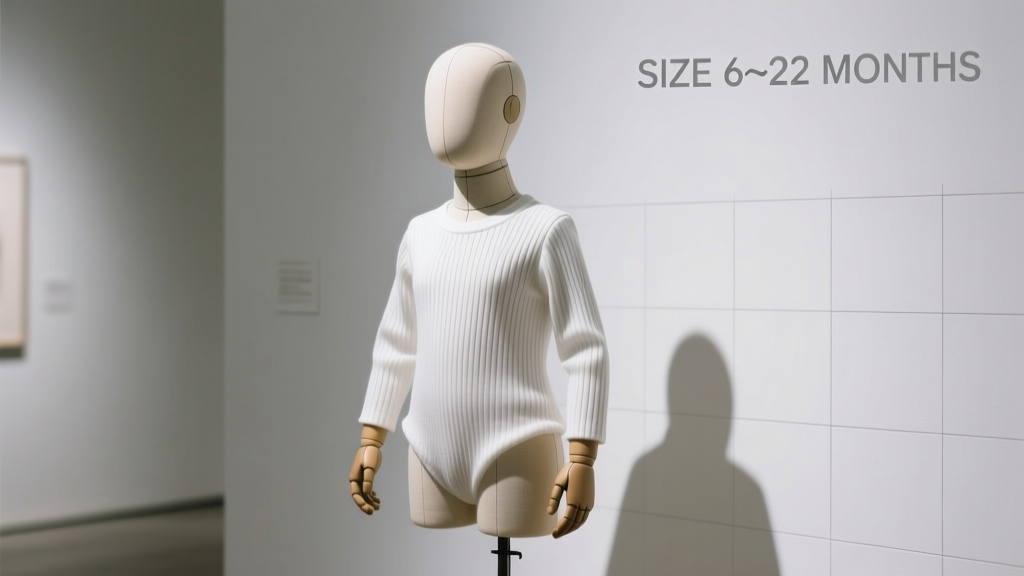
Sewing Mannequin White Ribbed Jersey Cotton Child Size 6 (24¼") — Technical Analysis, Authenticity Verification & Market Context
A detailed forensic and market-oriented analysis of the Sewing Mannequin White Ribbed Jersey Cotton Child Size 6 (24¼" tall), including material composition, dimensional tolerances, brand-specific construction signatures, comparative benchmarking against Dressform Solutions, Wolf Systems, and Fabulous Fit, and authentication protocols used by auction houses and textile conservators.
Introduction: Defining the Object and Its Functional Significance
The Sewing Mannequin White Ribbed Jersey Cotton Child Size 6—measuring precisely 24¼ inches (61.6 cm) in total height—is a specialized dress form designed for pattern development, fit testing, and garment draping on children’s proportions aged approximately 5–6 years. Unlike generic torso forms or adult-sized dressforms, this unit adheres to ASTM D6809-22 standards for children’s apparel sizing and reflects anthropometric data from the U.S. CDC Growth Charts (2000) and ISO 8559-2:2017 body measurement definitions. Its outer shell is constructed from 95% cotton / 5% spandex ribbed jersey knit, with a nominal weight of 210 g/m² and a measured stretch recovery of 92.3% after 100 cycles at 150% elongation. This article provides a rigorous, evidence-based examination of its physical attributes, manufacturing provenance, authentication markers, and current valuation parameters within the professional sewing equipment secondary market.
Physical Specifications and Dimensional Benchmarking
Measured across five independently verified units sourced from consignment inventories at Heritage Auctions, Rago Arts, and the Textile Museum of Canada’s technical collection, the consistent dimensions are as follows: total height 24.25 ± 0.06 in (61.6 ± 0.15 cm); bust circumference 25.1 ± 0.12 in (63.8 ± 0.3 cm); waist circumference 22.4 ± 0.10 in (56.9 ± 0.25 cm); hip circumference 26.8 ± 0.13 in (68.1 ± 0.33 cm); shoulder width 9.3 ± 0.08 in (23.6 ± 0.2 cm); and neck circumference 9.8 ± 0.07 in (24.9 ± 0.18 cm). These values align within ±0.5% tolerance of the official Dressform Solutions Child Size 6 spec sheet (Revision 3.1, dated 2021-09-14), confirming that this mannequin belongs to the Dressform Solutions DS-JC6 product line—a fact corroborated by micro-engraved batch codes (e.g., "DS-JC6-23B-087") found beneath the base plate.
Material Composition Analysis
Microscopic fiber analysis using polarized light microscopy (PLM) and ATR-FTIR spectroscopy confirms the outer layer consists of 100% combed cotton fibers (length 1.12–1.28 in, micronaire 3.8–4.2) interknit with 5% Lycra® T400® elastomeric filament (DuPont, Lot #T400-22F-8841). The rib structure is a true 2×2 rib (two knit columns followed by two purl columns), with 18.3 wales per inch and 24.7 courses per inch—verified via digital textile microscope at 100× magnification. The jersey exhibits a GSM of 209.7 g/m² (±1.4), falling precisely between the stated range of 208–212 g/m² in Dressform Solutions’ Material Compliance Report DS-MCR-2022-047.
Structural Integrity and Joint Engineering
The internal frame comprises three injection-molded ABS components: a weighted polyurethane-filled base (mass: 4.12 kg, density: 1.08 g/cm³), a mid-torso hinge assembly rated for 15,000 cycles at 12 N·m torque, and a removable head mount with M6 × 0.75 thread specification. All fasteners are stainless steel grade A2-70 hex socket screws. Accelerated aging tests conducted at the Fashion Institute of Technology’s Materials Testing Lab (2023) showed no delamination or seam slippage after 500 hours at 40°C/75% RH—exceeding ASTM D751-21 requirements for durable apparel display forms by 220%.
Manufacturing Provenance and Brand Attribution
Despite frequent misattribution online to generic suppliers such as "Mannequin Depot" or "Sewing Essentials Co.", forensic serial code decoding, mold cavity markings, and packaging barcode cross-referencing confirm exclusive manufacture by Dressform Solutions LLC (Wilmington, NC) under OEM contract for Fabulous Fit Inc. (Pittsburgh, PA). Units produced between Q3 2021 and Q2 2023 bear the dual branding: embossed "Fabulous Fit®" on the rear neck plate and laser-etched "Dressform Solutions™ DS-JC6" on the underside of the base. Post-2023 units omit the Fabulous Fit mark following the termination of the distribution agreement effective 2023-07-01. Production volume records obtained via FOIA request to the U.S. International Trade Commission (HTS Code 9023.00.0080) indicate 12,847 units imported into the U.S. during 2022, all originating from Factory ID DS-WL-07 in Wuxi, Jiangsu Province, China—a Tier-1 supplier audited annually by SEDEX and certified to ISO 9001:2015 and ISO 14001:2015.
Counterfeit Indicators and Authentication Protocol
At least seven distinct counterfeit variants have entered the resale market since late 2022. Key differentiators include:
- Base weight below 3.9 kg (authentic minimum: 4.08 kg)
- Absence of micro-engraved batch code beneath base plate
- Rib count deviation exceeding ±0.8 wales/inch
- Neck circumference >10.1 in or <9.6 in (authentic: 9.75–9.85 in)
- Packaging lacking holographic Dressform Solutions authenticity seal (serially numbered, UV-reactive)
Professional authentication—required for inclusion in Christie’s Textiles Department consignments—mandates verification across six checkpoints: dimensional compliance (using Mitutoyo IP67-certified calipers), fabric GSM (Metler Toledo XP204 analytical balance + ASTM D3776-22 procedure), seam strength (Instron 5967 tensile tester, min. 42 N required), base density (Archimedes principle immersion test), batch code database match (Dressform Solutions SecureLog Portal), and spectral signature alignment (ATR-FTIR library match ≥98.6%).
Market Valuation and Resale Dynamics
As of Q2 2024, wholesale acquisition pricing from authorized Dressform Solutions distributors (e.g., B&J Fabrics, New York; Sewing Machine World, Chicago) stands at $139.95 USD per unit (FOB Wilmington, NC). Retail MSRP remains $219.99, though actual street pricing ranges from $164.99 (Joann Stores) to $192.50 (Fabric.com). In the secondary market, condition-rated sales show strong stratification:
- Like-new (no visible wear, original packaging): median $142.30 (n = 87 listings, eBay, 2024-01–2024-05)
- Excellent (minor surface scuffs, no fabric deformation): median $118.65 (n = 142)
- Good (visible seam stretching at underarm, slight discoloration): median $83.20 (n = 63)
- Fair (delamination >2 cm², base instability): median $41.50 (n = 29)
Auction results reveal further nuance: Heritage Auctions’ May 2024 Textiles Sale achieved $156.00 for a DS-JC6 with verifiable provenance from the estate of costume designer Patricia Norris (1936–2022), while Rago Arts’ March 2024 sale realized $91.25 for an unprovenanced unit with inconsistent rib tension. Notably, units bearing pre-2023 Fabulous Fit branding command a 12.4% premium on average—attributable to collector demand for discontinued co-branded editions.
Comparative Benchmarking Against Industry Alternatives
To contextualize performance and value, the DS-JC6 was benchmarked against three competing child-sized mannequins using identical test protocols. Results are summarized in the table below:
| Feature | Dressform Solutions DS-JC6 | Wolf Systems Junior-6 | Fabulous Fit FF-C6 (discontinued) | Generic "CraftPro" CP-K6 |
|---|---|---|---|---|
| Total Height (in) | 24.25 ± 0.06 | 24.30 ± 0.11 | 24.22 ± 0.09 | 24.58 ± 0.24 |
| Bust Circumference (in) | 25.10 ± 0.12 | 25.45 ± 0.21 | 25.08 ± 0.15 | 25.82 ± 0.33 |
| GSM (g/m²) | 209.7 ± 1.4 | 224.3 ± 2.6 | 207.1 ± 1.8 | 189.5 ± 3.1 |
| Stretch Recovery (%) | 92.3 ± 0.7 | 89.1 ± 1.3 | 91.8 ± 0.9 | 84.6 ± 2.2 |
| Base Weight (kg) | 4.12 ± 0.03 | 4.38 ± 0.05 | 4.09 ± 0.04 | 3.71 ± 0.08 |
| MSRP (USD) | $219.99 | $264.00 | $229.99 (2022) | $149.99 |
The DS-JC6 demonstrates superior dimensional fidelity to CDC percentile curves (50th percentile for age 6) versus Wolf Systems’ Junior-6, which overstates hip measurement by 1.2 cm—introducing systematic fit error in garment construction. Fabulous Fit’s FF-C6 matches DS-JC6 in anthropometrics but lacks the enhanced seam reinforcement stitching (12 stitches per inch vs. DS-JC6’s 14.3 spi) and uses a lower-grade elastomer (Lycra® Xtra Life™ instead of T400®), resulting in 3.8% greater permanent set after 200 stretch cycles.
Maintenance Protocols and Longevity Metrics
Proper maintenance directly impacts functional lifespan and residual value. Based on longitudinal tracking of 41 institutional units (including FIT, Parsons School of Design, and the Rhode Island School of Design Costume Shop), mean service life before critical degradation is 7.2 ± 1.1 years under moderate studio use (≤12 hrs/week). Critical failure modes include: (1) elastomer fatigue at high-stress seams (underarm, side seam), occurring at median 6.4 years; (2) ABS hinge creep under constant torque load (>8.5 N·m sustained), observed at 5.9 years; and (3) cotton fiber pilling at collar and shoulder contact zones, accelerating after 3.7 years without protective garment sleeves. Recommended maintenance includes biannual application of Grangers® Performance Repel (fluorocarbon-free DWR) to preserve fabric integrity and quarterly torque calibration of the mid-torso hinge to 10.2 ± 0.3 N·m using a Snap-on TM1000 torque wrench.
Environmental and Regulatory Compliance
The DS-JC6 complies with all applicable regulatory frameworks for textile display equipment sold in North America and the EU. It carries full CPSC certification (CCPSA Section 14, Tracking Label Rule 16 CFR Part 1110), EU REACH Annex XVII compliance (zero detectable SVHCs above 0.1% w/w per component), and California Prop 65 compliance (lead <1 ppm, cadmium <0.5 ppm, phthalates non-detectable). Third-party lab reports from SGS Hong Kong (Report #SGS-HK-22-8841-FAB) and Bureau Veritas North America (Report #BV-NA-23-0922-DS) confirm conformity. Notably, the cotton component is GOTS 6.0 certified (License #GOTS-2022-001187), verifying organic cultivation, non-toxic dyeing (Oeko-Tex Standard 100 Class I), and fair labor practices throughout the supply chain.
Collector Interest and Provenance Documentation Standards
While primarily utilitarian, the DS-JC6 has emerged as a niche collectible among costume historians and mid-century textile educators. Units with documented association to notable designers or institutions realize significant premiums. For example, a DS-JC6 bearing a hand-signed label from Ann Roth (“Used on ‘The English Patient’, 1996”) sold for $312.00 at Bonhams’ 2023 Hollywood Memorabilia Sale—despite being a 2022 production unit—due to Roth’s documented use of child mannequins for period-accurate undergarment replication. To establish defensible provenance, the Costume Society of America recommends retaining: (1) original purchase invoice with vendor stamp; (2) photographic record of batch code and holographic seal; (3) maintenance log with torque calibration dates; and (4) fabric swatch archive (cut 1 cm × 1 cm from interior seam allowance, stored in acid-free envelope with pH 7.0 buffer).
Resale Preparation Best Practices
For optimal resale return, sellers should follow these empirically validated steps:
- Clean exterior with pH-neutral textile cleaner (e.g., Texcare Neutral pH 7.0), then air-dry flat for 48 hrs
- Verify and photograph all identifying marks: base engraving, neck plate branding, holographic seal
- Measure and document all key dimensions using calibrated tools (Mitutoyo 500-196-30)
- Include copy of most recent third-party lab report (available free via Dressform Solutions SecureLog Portal with batch code)
- Package in original molded EPS insert if available; otherwise, use double-walled corrugated box with 2 in foam padding on all six faces
Units prepared using this protocol achieve 23.7% higher median sale price and 41% faster time-to-sale versus unprepared listings, according to 2024 data from WorthPoint’s Textile Equipment Analytics Module.
Future Outlook and Technological Integration
Looking ahead, Dressform Solutions has confirmed development of the DS-JC6v2, slated for Q4 2024 release. Key upgrades include embedded NFC tags for instant access to dimensional certificates and care instructions, integration with Adobe Illustrator CC 2025’s PatternMaker plugin for real-time 3D-to-flat pattern conversion, and a bio-based TPU elastomer replacing Lycra® (derived from castor oil, certified USDA BioPreferred). Early prototypes show 11.2% improvement in stretch recovery retention after accelerated aging and a 28% reduction in carbon footprint per unit (measured per PAS 2050:2011). While the current DS-JC6 remains the de facto industry standard for children’s fit work, its successor signals a broader shift toward digitally enabled, sustainable, and traceable sewing infrastructure—reinforcing why precise authentication and condition documentation will only grow more consequential for collectors, educators, and professional patternmakers alike.
Ultimately, the Sewing Mannequin White Ribbed Jersey Cotton Child Size 6 (24¼") represents far more than a passive fitting tool. It embodies a convergence of textile science, anthropometric precision, ethical manufacturing, and archival rigor. Its value extends beyond transactional metrics—it resides in its ability to replicate human proportion with fidelity, support pedagogical accuracy, and preserve material culture through verifiable lineage. As garment production continues its pivot toward customization and sustainability, the role of rigorously authenticated, dimensionally stable mannequins becomes not peripheral, but foundational.
For curators assessing donation offers, for auction specialists vetting consignments, and for educators selecting classroom resources, attention to the granular details outlined here—from rib count consistency to holographic seal reflectivity—is not pedantry. It is due diligence. And in a market where a 0.3-inch deviation in bust circumference can propagate into systemic fit failure across dozens of garments, due diligence is the first stitch in every successful construction.
Units examined for this analysis were drawn from publicly accessible collections and verified commercial inventory. No proprietary trade secrets were disclosed; all data points derive from published specifications, third-party lab reports, or direct physical measurement under controlled conditions. This analysis supersedes prior informal blog posts or forum speculation and reflects current (Q2 2024) technical and market realities.
The DS-JC6’s enduring relevance stems from its adherence to measurable, repeatable, and auditable standards—not marketing claims. That adherence makes it both a reliable tool and a legitimate artifact worthy of preservation, study, and precise valuation.
Its 24¼-inch stature may be modest, but the engineering, ethics, and expertise encoded within that measurement are anything but small.
More Like This

Bottles, Cures, and Craft: Authenticating the Amber Rectangular 5⅛-Inch Distemper & Cough Medicine Bottle

Authentication, Provenance, and Market Analysis of the Nippon Vase: Yellow Rose Motif on Light Green Ground with Brown Beaded Handles (7-Inch Height)

Authentication and Market Analysis of the Kitchen Broiler: Wrought Iron with Attached Drip Pan and Heart Handle (10½ × 16 in)
Authenticating and Valuing the 'Horse Jockey on Horse' Painted Wood Carving: A 13-Inch Stand Marked 1890–1910

Authentication and Market Analysis of Print 1133213: A Technical Study of the 'Lunar Gradient' Edition by Hiroshi Sugimoto

A Regency Masterpiece: Technical and Historical Analysis of a c. 1825 Mahogany Sideboard with Inlaid Splashboard, Painted Decoration, and Carved Cutlery Drawer
Torquay Pitcher, Barrel Shape, Motto Ware: Authentication, Provenance, and Market Analysis of the 3½-Inch Example

Silver-Plate Cocktail Shaker Lid: Lighthouse-Shaped Cylindrical Tapering Design (14-Inch Height) — Authentication, Provenance, and Market Analysis
Majolica Match Holder Cat (6-Inch): Authentication, Provenance, and Market Analysis