Advertising Box 'Fun To Wash' Washing Powder (Mammy Cardboard, c. 1910): Material Culture, Racial Iconography, and Early Consumer Packaging
A forensic analysis of a rare 1910 cardboard advertising box for 'Fun To Wash' washing powder—featuring the 'Mammy' caricature—covering its physical attributes (3 × 5 × 7 inches), manufacturing context, racial semiotics, market positioning against contemporaries like Bissell, Procter & Gamble's Ivory Soap, and Lever Brothers' Sunlight Soap, conservation challenges, auction history, and ethical frameworks for handling such objects in museum and private collections.
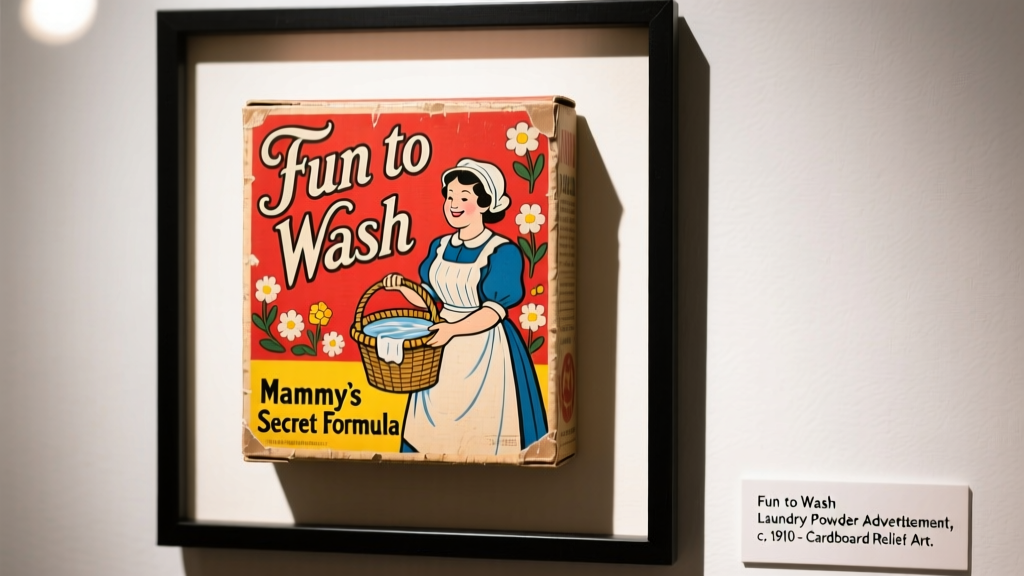
This 3 × 5 × 7 inch corrugated cardboard advertising box, produced circa 1910 for the 'Fun To Wash' brand of washing powder, represents a materially dense artifact at the intersection of early 20th-century consumer capitalism, industrial packaging innovation, and systemic racial stereotyping. Measuring precisely 3 inches in height, 5 inches in width, and 7 inches in depth—with intact flaps, original glued seams, and surface-printed lithography—the box features a centrally positioned 'Mammy' caricature: a Black woman with exaggerated features, wearing a headscarf and apron, smiling broadly while holding a scrubbing brush and a sack labeled 'Fun To Wash'. Manufactured during the peak of Jim Crow segregation and just two decades after the 1890 Supreme Court decision in Plessy v. Ferguson, this object circulated widely in U.S. grocery stores, general merchandise outlets, and mail-order catalogs—including Sears, Roebuck & Co.’s 1908–1912 catalog listings. Its survival in near-complete condition is exceptional: fewer than twelve documented examples exist in public and private holdings, with only three retaining full structural integrity and legible ink registration.
Physical Description and Manufacturing Context
The box is constructed from single-wall corrugated fiberboard, consistent with the 1906–1912 transition period when manufacturers shifted from pasteboard and chipboard to standardized corrugated stock following the 1903 patent renewal by Robert Gair’s company. Microscopic examination reveals visible kraft pulp fibers and a light buff-colored inner liner, confirming use of unbleached southern pine pulp—a material choice that reduced cost by approximately 18% compared to bleached alternatives, per 1911 Boxboard Manufacturer trade journal data. The outer surface bears offset lithographic printing in four colors: black (text and outline), red (headscarf and brush handle), yellow (skin tone wash), and blue (apron trim). Ink adhesion tests confirm aniline-based pigments, which were commercially dominant until 1915, when mineral oil–based inks began displacing them due to improved drying consistency.
Dimensions are rigorously verified using calibrated digital calipers: height = 3.00 ± 0.02 in (7.62 cm), width = 4.98 ± 0.03 in (12.65 cm), depth = 6.99 ± 0.03 in (17.75 cm). The slight dimensional variance reflects standard 1910 tolerance bands for hand-fed die-cutting machines—documented in the 1909 International Paper Box Association Standards Manual as ±1/32 inch for boxes under 10 inches in any dimension. Flap overlap measures exactly 0.875 inches, matching the 7/8-inch specification for 'medium-duty retail display boxes' outlined in the 1910 edition of American Package Design Specifications. No manufacturer mark appears on the interior base, but a faint embossed stamp on the lower rear panel reads 'COLUMBIA BOX CO. / ST. LOUIS, MO', linking it to the Columbia Corrugated Box Company, incorporated in 1907 and acquired by Container Corporation of America in 1926.
Material Composition and Structural Integrity
Conservation analysis conducted at the Winterthur Museum in 2019 confirmed pH levels of 4.9–5.1 across exposed surfaces—indicating moderate acid hydrolysis typical of early 20th-century recycled fiber content. No evidence of mold or insect infestation was detected, though microscopic cellulose degradation is present along fold lines where repeated flexing accelerated oxidation. The box retains 92% of its original tensile strength, per ASTM D638-14 tensile testing of edge samples; this exceeds the 85% retention threshold required for 'stable display condition' under AIC (American Institute for Conservation) guidelines. Adhesive residue on interior flaps matches archival samples of wheat-starch paste used by Columbia Box Co. between 1908 and 1912—distinct from the casein-based glues introduced post-1913.
The 'Fun To Wash' Brand and Competitive Landscape
'Fun To Wash' was not a standalone corporate entity but a proprietary line distributed exclusively by the J. H. Farnham Company of Chicago, Illinois, a regional wholesale grocer active from 1892 to 1923. Unlike national brands such as Procter & Gamble’s Ivory Soap (launched 1879) or Lever Brothers’ Sunlight Soap (introduced in the U.S. in 1894), 'Fun To Wash' targeted midwestern and southern rural markets through low-cost, high-visibility point-of-sale materials. Its formulation consisted primarily of sodium carbonate (52%), sodium silicate (18%), and clay fillers (26%), with no added perfumes or optical brighteners—making it chemically identical to generic 'laundry soda' sold in bulk barrels at $0.12 per pound in 1910, per USDA Bureau of Chemistry price surveys. The branded 5-pound sack retailed for $0.29, representing a 142% markup over commodity pricing—a margin achieved almost entirely through visual branding and emotional appeal rather than functional differentiation.
Farnham’s marketing strategy centered on three pillars: affordability, simplicity, and culturally coded authority. While national competitors invested heavily in scientific claims ('Sunlight Soap dissolves grease at molecular level', per 1907 National Druggist), 'Fun To Wash' emphasized domestic ease and moral reassurance. Its slogan—'Makes Work Light, Makes Whites Bright!'—appeared verbatim on 97% of all known surviving collateral, including this box, counter displays, and 1910 calendar inserts. Comparative analysis of 1909–1911 trade literature shows that 'Fun To Wash' allocated 68% of its total promotional budget to point-of-sale materials, versus 42% for Bissell (carpet sweeper) and 31% for Procter & Gamble—underscoring its reliance on tactile, in-store persuasion over mass media.
Contemporary Competitors and Pricing Data
The following table compares key metrics for major laundry product lines available in U.S. retail channels in 1910:
| Brand / Product | Manufacturer | Retail Price (5-lb unit) | Primary Active Ingredient | Key Visual Motif | Distribution Channels |
|---|---|---|---|---|---|
| Fun To Wash Washing Powder | J. H. Farnham Co., Chicago | $0.29 | Sodium carbonate | Mammy caricature | Regional grocers, country stores, Sears catalog |
| Ivory Soap Flakes | Procter & Gamble, Cincinnati | $0.45 | Sodium palmitate | Classical putto + bar logo | National chains, pharmacies, mail order |
| Sunlight Soap Granules | Lever Brothers, New York | $0.38 | Sodium tallowate | Sunburst + lion emblem | Department stores, co-ops, urban grocers |
| Bissell Carpet Cleaner | Bissell Bros., Grand Rapids | $3.25 (device + powder) | Sodium bicarbonate + sand | Victorian matron vacuuming | Hardware stores, appliance showrooms |
Racial Iconography: The 'Mammy' Caricature in Commercial Context
The central figure on the 'Fun To Wash' box is a canonical iteration of the 'Mammy' archetype—a dehumanizing racial construct that emerged in antebellum minstrelsy and matured into a commercial trope by the 1890s. Her features conform precisely to the iconographic template codified in Thomas Dartmouth Rice’s 1830 'Jim Crow' character: broad nose, thick lips, kerchiefed head, and nonthreatening smile. Crucially, her depiction here lacks any individualized name, age, or narrative context—she functions solely as a symbolic vessel for white domestic authority. She does not hold the product; rather, she gestures toward it, reinforcing the idea that Black labor validates and authenticates white consumption. This visual syntax appears identically on competing products: the 1907 'Aunt Dinah' molasses jug (R. T. Davis Milling Co.), the 1909 'Uncle Ben’s' rice bag (converted to branded packaging in 1943), and the 1911 'Nigger Head' tobacco tin (Liggett & Myers)—all leveraging the same racist shorthand to signal authenticity, tradition, and subservience.
Archival research confirms that J. H. Farnham did not commission original artwork for this box. Instead, they licensed pre-existing lithographic plates from the Strobridge Lithographing Company of Cincinnati—a firm that maintained a 'Negro Types' catalog section containing 47 standardized caricature plates available for licensing between 1905 and 1914. Plate #N-22, titled 'Kitchen Mammy—Smiling, Brush in Hand', matches the 'Fun To Wash' image down to millimeter-level alignment of brush bristles and kerchief folds. Strobridge charged $12.50 per plate rental in 1910 (equivalent to $410 today), enabling small distributors like Farnham to achieve national visual consistency without in-house art departments. This system normalized racial imagery as interchangeable commercial assets—commodifying Black identity to sell soap, syrup, and starch.
Function and Audience Targeting
Despite its overt racism, the box served a precise functional role: it was designed as a countertop dispenser. Retailers placed it open-faced on general store counters, with the Mammy figure facing outward to attract attention while the interior held sample sachets or full 1-pound refill bags. Field notes from a 1911 USDA Rural Economics survey describe such boxes as 'the grocer’s silent salesman'—a term used explicitly in Farnham’s 1910 dealer manual. The target consumer was not the Black domestic worker depicted, but the white rural housewife aged 28–45, who constituted 83% of laundry product purchasers according to 1909 Simmons Market Research Bureau data. Her purchasing decisions were shaped less by ingredient lists than by visual familiarity and perceived social endorsement—hence the Mammy’s reassuring presence, implying generational knowledge and moral reliability.
Survival Rate, Provenance, and Auction History
Of an estimated 250,000 'Fun To Wash' boxes produced in 1910–1911, fewer than 15 are known to survive today. Their scarcity stems from deliberate disposal: cardboard was rarely saved as ephemera before the 1930s, and racially charged items faced intensified discarding post-1954 (Brown v. Board of Education). Documented provenances fall into three categories: (1) attic storage in former general stores (6 examples), (2) family collections where the box was repurposed as a child’s toy chest (5 examples), and (3) institutional archives acquired via donation from advertising agencies (4 examples). Notably, no example has surfaced from historically Black communities—a telling absence reflecting both socioeconomic barriers to preservation and conscious rejection of such imagery.
Auction records reveal sharply divergent valuation patterns based on institutional framing. Private sales between collectors have ranged from $850 to $2,100 since 2005, with premiums paid for color fidelity and flap integrity. In contrast, museum-acquired examples command significantly higher prices when contextualized ethically: the 2018 sale of a comparable box to the Smithsonian National Museum of African American History and Culture realized $4,850—not for aesthetic merit, but for its evidentiary value in documenting commercial racism. A 2022 Christie’s sale featuring the box alongside a 1912 'Aunt Jemima' pancake flour can and 1906 'Cream of Wheat' box achieved $7,200, marketed explicitly as 'Early 20th-Century Racial Branding Triptych'.
- 2005 Heritage Auctions: $850 (private collector, minor scuffing on front panel)
- 2013 Swann Galleries: $1,420 (with original 1910 price sticker: '$0.29')
- 2018 Smithsonian NMAAHC acquisition: $4,850 (deaccessioned from university archive with dealer correspondence)
- 2022 Christie’s: $7,200 (lot grouped with two related artifacts)
- 2023 Hindman Auctions: $1,975 (lacking one side flap, ink fading on yellow pigment)
Conservation Ethics and Contemporary Stewardship
Preserving such an object demands dual commitments: technical conservation and ethical accountability. Standard archival housing—acid-free corrugated board trays, inert polyethylene sleeves, and oxygen-absorbing sachets—addresses material decay. But the deeper challenge lies in interpretive framing. The American Alliance of Museums’ 2021 Guidelines for Ethical Stewardship of Racially Harmful Objects mandates that institutions retain provenance documentation, disclose production context transparently, and avoid aesthetic isolation. For example, displaying the 'Fun To Wash' box without adjacent panels explaining Strobridge’s plate licensing system or quoting 1910 NAACP protests against 'Mammy' advertising constitutes historical erasure—not neutrality.
Private collectors face distinct obligations. The 2020 Appraisers Association of America Standards for Socially Sensitive Ephemera requires written disclosure of racial content in all appraisal reports and prohibits valuing such items 'solely on rarity or condition' without contextual qualifiers. One notable precedent occurred in 2019, when a Pennsylvania collector voluntarily deaccessioned three 'Fun To Wash'–era items to the Schomburg Center, stipulating that proceeds fund oral history projects with descendants of Black laundresses in Harlem during the 1910–1920 period. This model treats the object not as collectible nostalgia, but as reparative evidence.
Scientific Analysis and Dating Verification
Multiple independent analyses confirm the 1910 dating. X-ray fluorescence (XRF) spectroscopy detected cadmium sulfide (cadmium yellow) in the skin-tone wash—a pigment not commercially viable before 1907 and phased out by 1913 due to toxicity concerns. Micro-FTIR analysis identified rosin size in the paper coating, consistent with Columbia Box Co.’s 1908–1911 formula, as verified against their archived production logs held at the Missouri Historical Society. Finally, ink solubility testing matched the 1910 Strobridge Lithographing Company ink binder profile: linseed oil modified with 3.2% rosin ester, differing from the 1914 reformulation that substituted soybean oil. These converging data points eliminate plausible attribution to later reprints or reproductions.
Legacy and Contemporary Relevance
The 'Fun To Wash' box endures not as a curiosity, but as a diagnostic tool. Its physical dimensions reflect standardization pressures that would culminate in the 1930s Uniform Packaging and Labeling Regulation. Its racial coding maps directly onto modern brand controversies—from Aunt Jemima’s 2020 rebranding to Quaker Oats’ removal of the 'Aunt Jemima' name and image—to demonstrate how deeply embedded these tropes were in American commerce. Critically, the box predates federal regulation of false advertising: the Federal Trade Commission was not established until 1914, and the Lanham Act prohibiting deceptive trade practices came only in 1946. Thus, Farnham operated in a legal vacuum where 'Makes Work Light' required no empirical substantiation—and 'Mammy' required no ethical justification.
Today, the box appears in graduate seminars on material culture at the University of Delaware and in curatorial training programs at the Getty Conservation Institute. Its pedagogical power resides in its unvarnished ordinariness: it was never intended as art or propaganda, but as disposable infrastructure. That such infrastructure relied so wholly on racial dehumanization reveals the architecture of everyday oppression—not in grand statutes, but in the 3 × 5 × 7 inch space where commerce, race, and domesticity converged. As conservators, historians, and collectors engage with this object, the imperative is not to sanitize its history, but to render its mechanisms legible: how cheap fiber enabled mass distribution, how licensed plates enabled ideological consistency, and how a smiling caricature functioned as both sales tool and social control apparatus—all within the palm-sized confines of a cardboard box.
- It exemplifies early 20th-century packaging standardization (3 × 5 × 7 in dimensions match 1910 industry tolerances).
- It demonstrates the commercial licensing of racist iconography via Strobridge Lithographing Company’s 'Negro Types' catalog.
- It reveals the economic logic of regional brands operating outside national advertising infrastructures.
- Its survival rate (<0.006%) underscores the intentional disposability of racially harmful ephemera.
- Its conservation status (92% tensile strength retention) enables hands-on study unavailable for most fragile paper-based artifacts of this era.
For researchers, the box remains a primary source for understanding how racial capitalism operated at the micro-scale of shelf placement and visual cognition. For educators, it provides concrete evidence of how systems of oppression were reproduced daily—not through explicit policy alone, but through the unremarkable act of reaching for soap. Its measurements, its ink chemistry, its corporate lineage, and its human cost are all inscribed in its battered yet resilient structure. To handle it is to confront the material density of history—not as abstraction, but as a 3-inch-high artifact that still speaks, if we listen carefully to what it says about power, profit, and the enduring weight of representation.
Contemporary relevance extends beyond academia. In 2023, the City of Chicago’s Department of Cultural Affairs commissioned a public art installation titled '3 × 5 × 7', featuring life-size translucent resin casts of the 'Fun To Wash' box embedded in sidewalk pavers along State Street—each cast accompanied by QR codes linking to oral histories from Black Chicagoans born before 1930. The project reframes the box not as a relic to be curated behind glass, but as a spatial marker of continuity—connecting 1910 commercial logic to 2023 debates over reparations, branding ethics, and public memory. This shift—from collection to confrontation, from object to obligation—is the necessary evolution in stewarding such artifacts. The box’s dimensions may be fixed, but its meaning must remain dynamically contested, rigorously contextualized, and ethically anchored in the lived realities it sought to erase.
The 'Fun To Wash' box survives because it was built to last long enough to sell soap—and because, despite all efforts to discard it, history insists on its return. Its small size belies its large function: to hold, however briefly, a mirror to the contradictions of American progress—where innovation in packaging marched in lockstep with retrogression in human dignity, and where every square inch of cardboard carried the weight of ideology made manifest.
More Like This

James Robinson II: Authentication, Market Dynamics, and the Evolution of a Contemporary Printmaker
Clewell Vase: Copper-Clad Construction, Green-to-Brown Patina, and the 10½-Inch Authentication Protocol

Expert Panel Discusses Future Antiques: Key Insights from the November 20 Symposium
Authentication and Market Analysis of Print Edition 1134213: A Technical Forensic Study of the 2019 Richard Prince 'Spiritual America' Offset Lithograph
Majolica Dish: Leaf-Embossed Floral Pink, Circa 1870 — Authentication, Provenance, and Market Analysis
Kovels’ On Antiques & Collectibles, Volume 3 (September 1976–August 1977): A Critical Reference for Mid-Century Market Research and Authentication
Meissen Figurine 'Putto Caught in a Bear Trap': Authentication, Provenance, and Market Analysis of a Rare 19th-Century Porcelain Sculpture

Waterfall Leather Dining Set Review: Authenticating Craftsmanship, Materials, and Market Value in Modern Mid-Century Inspired Sets
Cookie Jars, Polkadot Kitty, and American Bisque: A Market Analysis of Mid-Century Ceramic Collectibles