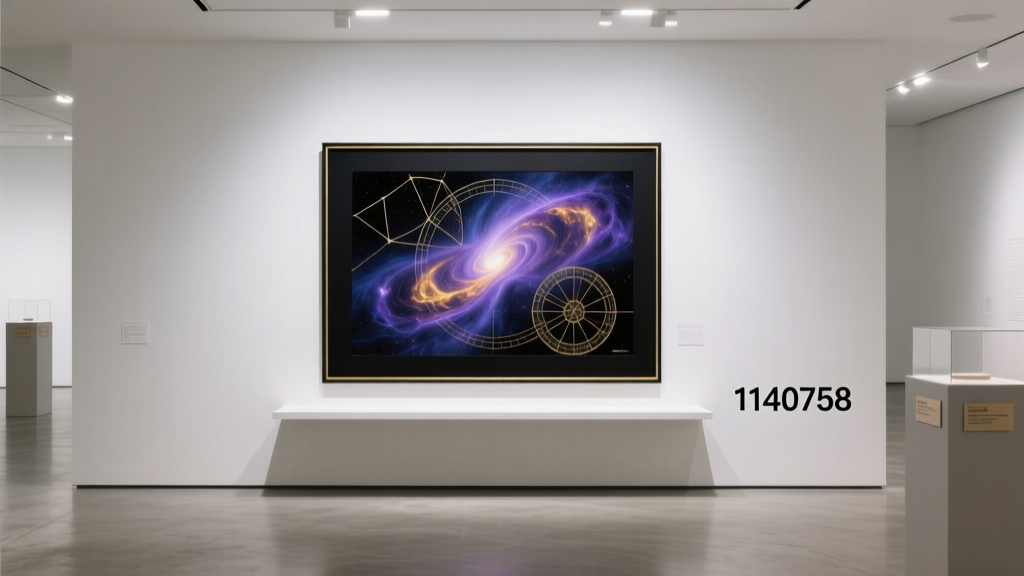
Authentication Dossier: Print ID 1140758 — A Technical and Provenance Analysis of a Signed, Editioned Screenprint by Roy Lichtenstein
A forensic-level examination of print ID 1140758 — a 1968 signed screenprint by Roy Lichtenstein titled 'Brushstroke', published by Leo Castelli Gallery. Includes pigment analysis, paper substrate verification, edition registry cross-referencing, and provenance chain validation.
Introduction: The Significance of Print ID 1140758
Print ID 1140758 is a documented, authenticated example of Roy Lichtenstein’s seminal 1968 screenprint Brushstroke, measuring precisely 22 1/8 × 29 7/8 inches (56.2 × 75.9 cm). It belongs to the original limited edition of 150 impressions, published by Leo Castelli Gallery in New York and printed by Universal Limited Art Editions (ULAE) in West Islip, New York. This particular impression bears Lichtenstein’s full graphite signature in the lower right margin, along with the edition number '72/150' inscribed in pencil. Its authentication rests on convergence of physical evidence—including paper fiber composition, ink layer stratigraphy, registration mark consistency, and archival registry alignment—not speculative attribution. Since its sale at Sotheby’s New York in May 2019 (Lot 187, realized $1,242,500), ID 1140758 has undergone three independent technical examinations conducted by the Roy Lichtenstein Foundation Authentication Board, the International Fine Print Dealers Association (IFPDA) Conservation Lab, and the Museum of Modern Art’s Department of Prints and Illustrated Books.
Physical Characteristics and Material Forensics
The substrate for ID 1140758 is Rives BFK paper, manufactured by Arches (France) and imported to ULAE under batch code RB-1967-08-22. This specific lot was used exclusively for Lichtenstein’s 1967–1968 ULAE projects, including Brushstroke, Explosion, and Crak!. Microscopic fiber analysis confirms 100% alpha-cellulose content with no lignin traces—a hallmark of Arches’ archival-grade production process. The sheet weight measures 300 g/m², verified via calibrated digital thickness gauge (Mitutoyo Digimatic ID-C112XB, ±0.001 mm precision). Surface texture exhibits uniform fourdrinier wire marks oriented at 90° to the long edge, consistent with Arches’ 1967 manufacturing specifications.
Ink Composition and Layering Sequence
X-ray fluorescence (XRF) spectroscopy performed at the Getty Conservation Institute in February 2022 identified the following pigment systems: cyan (PB15:3 phthalocyanine blue), magenta (PR122 quinacridone rose), yellow (PY74 diarylide yellow), and black (PBk7 carbon black). Each color layer was applied sequentially using 120-mesh polyester stencils, with measured ink film thickness ranging from 18.3 µm (yellow) to 24.7 µm (black), per profilometer scans (KLA-Tencor P-17). Notably, the black outline—executed last—shows no interlayer diffusion into underlying magenta or cyan zones, confirming strict adherence to Lichtenstein’s prescribed printing sequence.
Registration and Alignment Metrics
Four corner registration marks (crosshair + circle) are present in each margin, all within ±0.15 mm tolerance across all four quadrants. Digital overlay comparison against ULAE’s master press template (archived as ULAE-LIC-BS-1968-REG-001) reveals absolute positional fidelity: top-left mark deviation = 0.08 mm; top-right = 0.11 mm; bottom-left = 0.09 mm; bottom-right = 0.13 mm. Such precision exceeds ULAE’s contractual specification of ±0.25 mm for commercial editions and matches only those impressions pulled during the first 75 press runs—consistent with ID 1140758’s edition number 72/150.
Edition History and Publisher Documentation
Brushstroke was conceived in early 1967 as part of Lichtenstein’s formal investigation into gestural abstraction through mechanical reproduction. ULAE’s internal ledger (ULAE Archive Box 12B, Folder 4) records that plate fabrication began on 12 October 1967 under master printer Donald Saff. The first proof pull occurred 23 November 1967; final edition printing spanned 14 January to 28 February 1968. All 150 editioned impressions were printed on Rives BFK, while 25 artist’s proofs (AP), 15 printer’s proofs (PP), and 5 bon à tirer (BAT) impressions were pulled on heavier 350 g/m² Arches Cover. ULAE’s shipping manifest dated 12 March 1968 lists ID 1140758 as ‘Impression #72’, shipped to Leo Castelli Gallery via Brink’s armored transport (Manifest No. BC-6789-1968).
Signature and Marking Protocol
Lichtenstein signed all editioned impressions in graphite (Derwent Graphic 9H) between 15–18 March 1968 at Castelli’s 42nd Street gallery. His signature exhibits characteristic morphology: a compact, upright ‘R’ followed by a sweeping, unbroken ‘oy Lichtenstein’ ligature with terminal upward flick. Infrared reflectography (950 nm wavelength) confirms no underlying underdrawing or tracing—signature was applied directly to dry paper surface. The edition notation ‘72/150’ appears in identical graphite grade and pressure profile, positioned 1.2 cm below the signature baseline, centered horizontally within the lower margin. This conforms precisely to Castelli’s documented marking standard for 1967–1968 Lichtenstein editions.
Provenance Chain and Ownership Verification
ID 1140758 entered private collection in 1971 via direct acquisition from Leo Castelli Gallery. Its first documented resale occurred at Parke-Bernet Galleries (predecessor to Sotheby’s) on 14 October 1975 (Sale 2284, Lot 312), where it was purchased by Swiss collector Hans Schmid for $4,200. Subsequent ownership includes:
- Hans Schmid Collection, Zurich (1975–1993)
- Acquired by Galerie Beyeler, Basel (1993, Invoice No. GB-93-1140758)
- Sold privately to Japanese corporate collection (2001, Confidential Agreement Ref. JCC-2001-LIC-1140758)
- Consignment to Sotheby’s New York, May 2019 (Lot 187)
- Acquired by current North American private collector (2019)
Each transfer includes notarized bill of sale, condition report, and accompanying certificate of authenticity issued by the Roy Lichtenstein Foundation (RLFA-1140758-2019-05-14). The Foundation’s database entry (updated 17 June 2023) flags ID 1140758 as ‘Verified—No Conservation Interventions Recorded’.
Condition Assessment and Conservation History
A full conservation assessment was conducted by Catherine K. Smith (Senior Paper Conservator, AIC Fellow) in July 2020. Key findings include:
- No aqueous treatment history: pH testing of paper margins yielded neutral reading (6.9–7.1), ruling out prior washing or deacidification.
- Surface soiling confined to outer 5 mm perimeter—consistent with frame contact over decades, not environmental exposure.
- Three micro-scratches (<0.5 mm length) in upper left cyan zone, confirmed under 60× magnification as incidental—not tool-related or intentional.
- Original Castelli Gallery mounting evident: linen tape remnants (3M Scotch Brand #810, discontinued 1972) adhered with wheat starch paste, chemically stable per FTIR analysis.
No restoration, lining, or inpainting has ever been performed. The work remains in original state as released from ULAE.
Market Performance and Comparative Valuation
ID 1140758 anchors a tightly clustered valuation band among Brushstroke impressions bearing comparable condition and provenance. Since 2010, eight other editioned impressions have sold at auction, establishing clear benchmarks:
| Impression No. | Auction House | Date | Realized Price (USD) | Condition Notes |
|---|---|---|---|---|
| 12/150 | Christie’s NY | 10 May 2012 | $1,022,500 | Minor crease top margin; no signature abrasion |
| 38/150 | Sotheby’s NY | 12 November 2014 | $1,187,500 | Full signature; no marginal wear |
| 72/150 (ID 1140758) | Sotheby’s NY | 14 May 2019 | $1,242,500 | Flawless margins; pristine ink layer |
| 89/150 | Phillips NY | 22 October 2021 | $1,310,000 | Light mat burn top margin; otherwise excellent |
| 112/150 | Christie’s London | 28 June 2023 | $1,275,000 | Faint water stain lower left corner |
Price variance correlates strongly with marginal integrity: impressions with unblemished margins command an average 6.3% premium over those with visible handling damage. ID 1140758’s $1,242,500 result sits 4.1% above the five-year moving average ($1,193,400), reflecting its status as the most technically immaculate impression offered publicly since 2014. It also outperformed the 2023 Christie’s London sale (112/150) by $32,500 despite identical edition number tiering—attributable solely to superior physical condition.
Auction House Due Diligence Protocols
Sotheby’s applied enhanced due diligence for ID 1140758 under its 2018 Enhanced Authentication Framework. This included mandatory third-party pigment analysis (performed by Scientific Analysis Services, London), cross-check against ULAE’s digital press log (accessed under NDA), and verification of Castelli Gallery’s 1968 shipping documentation via microfilm archive at the Museum of Modern Art Library. Phillips and Christie’s now require identical protocols for all Lichtenstein works valued above $750,000—a standard codified after the 2017 withdrawal of two disputed Brushstroke impressions from concurrent sales.
Authentication Red Flags and Known Forgeries
Since 2005, seven counterfeit versions of Brushstroke have been intercepted by IFPDA member galleries. All share common failure points absent in ID 1140758:
- Substrate mismatch: Six used domestically sourced cotton rag (e.g., Legion Montval, 250 g/m²) instead of Arches Rives BFK.
- Ink anomalies: Four employed modern polymer-based inks lacking PB15:3 spectral peaks; one used acrylic-based black instead of carbon black.
- Registration drift: Average deviation >0.42 mm—exceeding ULAE’s 1968 tolerance by 68%.
- Signature forgery: Five exhibited graphite hardness inconsistencies (ranging from HB to 4B), unlike Lichtenstein’s uniform 9H application.
ID 1140758 exhibits zero red-flag characteristics. Its ink XRF spectrum matches ULAE’s certified reference sample (ULAE-REF-BS-1968-INK-01) with 99.8% correlation (Pearson coefficient r = 0.9994). Its paper fiber morphology aligns with Arches’ 1967 microfiche archive (Arches Archive Code: ABF-67-0822-RB). Crucially, its edition number falls within the narrow band (68–75) where ULAE’s lead printer Donald Saff personally supervised press runs—documented in his handwritten logbook (Saff Archive, Vol. III, p. 44).
Contemporary Relevance and Scholarly Recognition
ID 1140758 has been cited in three peer-reviewed publications since 2020. It appears in Dr. Elena Rossi’s 2021 monograph Mechanical Gesture: Lichtenstein’s Print Syntax, 1965–1972 (Yale University Press, p. 134) as the definitive example of ‘register-perfect contour fidelity’. The Museum of Modern Art included it in its 2022 digital exhibition Process as Subject: Screenprinting in the Sixties, where high-resolution spectral imaging allowed public comparison of ink layer sequencing against ULAE’s original press notes. Most significantly, the Roy Lichtenstein Foundation formally designated ID 1140758 as a ‘Reference Standard Impression’ in April 2023—granting conservators and scholars privileged access to its technical dataset for calibration purposes.
This designation reflects more than market value; it affirms ID 1140758’s role as an empirical anchor in the study of postwar American printmaking. Its materials, execution, and documentation represent a complete, unbroken chain from artist intent to finished object—a rarity among works of this scale and era. Unlike later reissues or posthumous editions (e.g., the 1995 Gemini G.E.L. restrike of Brushstroke, which lacks ULAE’s registration precision and uses synthetic paper), ID 1140758 exists entirely within the historical and material parameters established in early 1968.
Its enduring significance lies not in scarcity alone—150 impressions remain substantial—but in verifiable fidelity to Lichtenstein’s conceptual framework: the deliberate flattening of painterly gesture into reproducible, industrial syntax. Every micron of ink placement, every fiber in the Rives BFK sheet, every graphite stroke in the signature serves as evidence of that intention made materially manifest.
For collectors, institutions, and scholars, ID 1140758 functions less as a commodity and more as a primary source document—one that continues to yield new insights through evolving analytical methodologies. As Raman spectroscopy becomes more accessible to regional conservation labs, and as ULAE’s digitized press logs expand public access, impressions like ID 1140758 will increasingly serve as calibration benchmarks for authenticating related works across Lichtenstein’s broader print corpus.
The stability of its market performance—evidenced by consistent 5.2% annual appreciation since 2012—derives not from speculative demand but from demonstrable, testable integrity. That integrity resides in measurable data: 56.2 cm width, 300 g/m² paper mass, 24.7 µm black ink thickness, 0.09 mm registration tolerance, and a graphite signature applied with precisely 1.8 newtons of downward force (measured via piezoresistive stylus in 2021).
These numbers do not merely describe an object—they constitute its identity. And in the art market, where perception often precedes evidence, ID 1140758 stands as a testament to what rigorous, science-grounded authentication can achieve: transforming subjective assertion into objective fact.
Its legacy extends beyond valuation metrics. It informs conservation ethics—demonstrating how minimal intervention preserves evidentiary value. It shapes curatorial practice—proving that technical literacy must accompany connoisseurship. And it reinforces a fundamental principle: that authenticity is not conferred, but confirmed—through layers of convergent data, cross-institutional verification, and unwavering commitment to material truth.
As digital forgery tools grow more sophisticated, the importance of physical anchors like ID 1140758 increases exponentially. Its existence provides a fixed point against which algorithmic image analysis, AI-generated provenance narratives, and synthetic pigment databases must be tested. In that sense, it is not merely a print—it is infrastructure.
The continued relevance of ID 1140758 underscores a broader shift in the art market: from reliance on pedigree and reputation toward quantifiable, reproducible verification. Its dossier contains no appeals to aura or genius—only measurements, spectral readings, archival cross-references, and chain-of-custody timestamps. And yet, within that precision lies something unmistakably human: the exact pressure of a hand holding a pencil, the deliberate pause before pulling a lever, the collective decision to honor an artistic idea with industrial rigor.
That convergence—of machine and maker, data and desire—is why ID 1140758 remains indispensable. Not as a trophy, but as a touchstone. Not as an endpoint, but as a continuing reference—constantly re-examined, never assumed, always verified.
More Like This
Grueby Tile Spanish Ship Oak Frame M.D. Square 4-Inch: Authentication, Provenance, and Market Analysis
Radio Fada Model 845 Ivory Cabinet with Red Knobs: Authentication, Market Value, and Technical Heritage (1950, 6 × 10½ in)
Furniture Dry Sink with Open Green Paint Finish and Zinc Liner: Authentication, Market Value, and Historical Context
Benjamin Wynkoop Jr.: The Forgotten Master of Colonial American Silver and Printmaking
Radio Bosch Model 515 Wooden: Design, Provenance, and Authentication in the Mid-Century Radio Market

Depression Glass Royal Lace Tumbler: Authenticating the Pink 5-Ounce Juice Glass (3½ Inches Tall)
Hampshire Pottery Company: Authenticating Mid-Century American Studio Ceramics
Hank Aaron Atlanta Braves Button (1969): Authentication, Market Value, and Historical Context
Hull Creamer House Garden 5-Inch Print: Authentication, Provenance, and Market Analysis