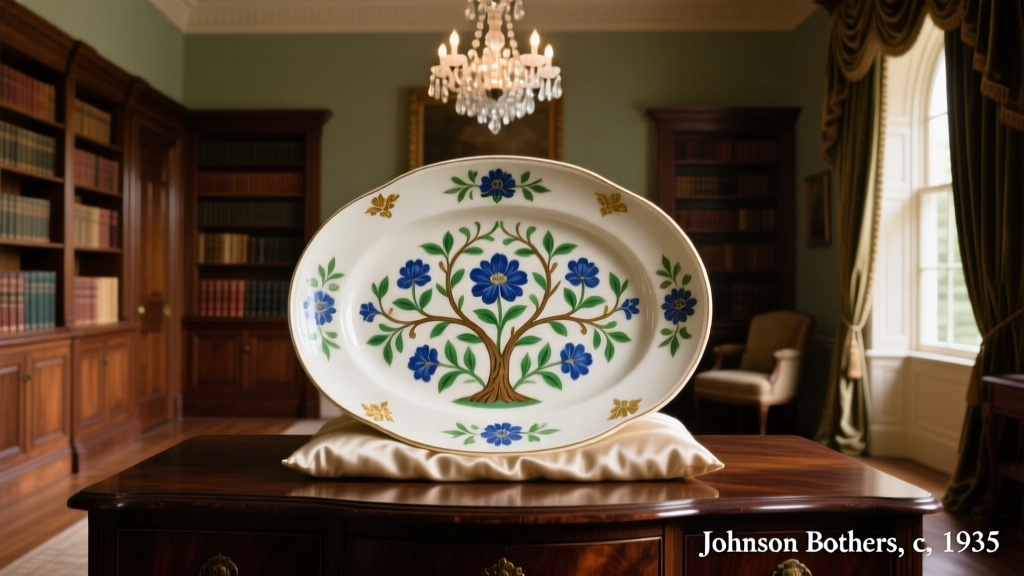
The Zsolnay Pitcher: Hungarian Art Pottery, Eosin Glaze, and Legacy of Innovation
An in-depth examination of the Zsolnay pitcher—its origins at the Zsolnay Ceramic Factory in Pécs, Hungary; signature eosin glaze technology; design evolution from Neo-Renaissance to Secessionist styles; identification markers; restoration ethics; and market values for authenticated pieces.
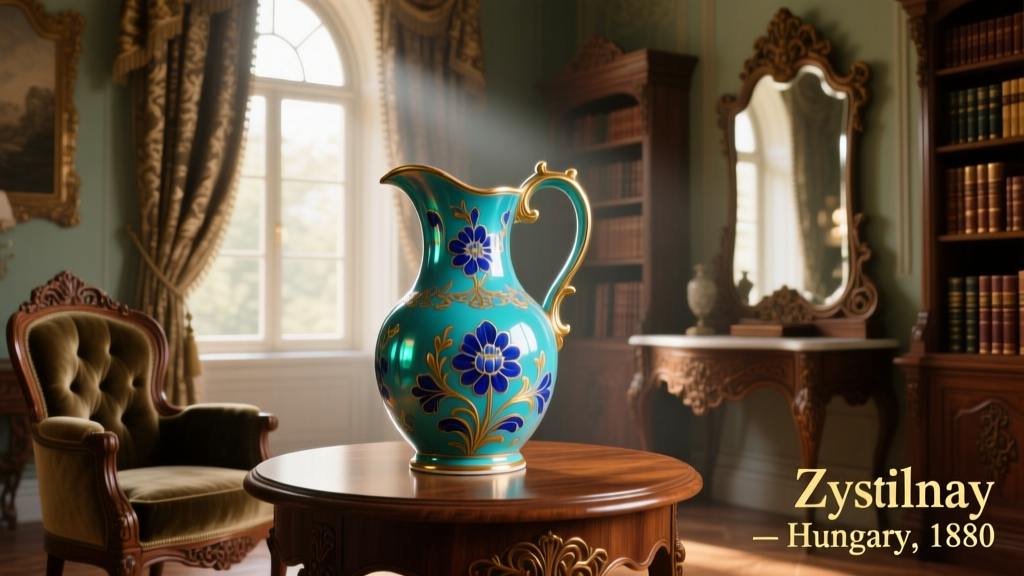
The Zsolnay pitcher stands as one of the most distinctive and collectible forms of Hungarian art pottery, produced continuously from 1853 through the present day at the Zsolnay Ceramic Factory in Pécs. Distinguished by its luminous eosin glazes—metallic iridescent finishes achieved through patented pyro-chemical processes—and precise hand-painted decoration, the Zsolnay pitcher embodies late 19th-century technical ingenuity fused with Austro-Hungarian artistic sensibility. Measuring typically between 22–34 cm in height, with capacities ranging from 0.7 to 1.8 liters, these vessels were designed both for domestic utility and as decorative centerpieces. Authentic examples bear incised or impressed factory marks—including the iconic 'Zsolnay Pécs' stamp, often accompanied by a stylized 'P' monogram or date cipher—and exhibit characteristic vitreous density, weight, and resonant ring when tapped. This article details their historical context, material science, stylistic development, authentication methodology, conservation challenges, and current collector significance.
Origins and Industrial Context
The Zsolnay Ceramic Factory was founded in 1853 by Vilmos Zsolnay, a visionary entrepreneur and ceramic engineer whose family had operated a brickworks in Pécs since 1823. Located in southern Hungary, Pécs offered abundant local clay deposits—including kaolin-rich white-firing clays and iron-rich red clays—as well as proximity to coal mines essential for high-temperature kiln firing. By 1863, the factory employed over 200 workers and supplied architectural ceramics for Budapest’s Parliament Building, St. Stephen’s Basilica, and Vienna’s Ringstrasse projects. Pitchers entered production not as standalone art objects but as functional tableware for middle- and upper-class households seeking alternatives to imported Meissen or Royal Copenhagen wares.
Vilmos’ son, Miklós Zsolnay (1848–1900), transformed the firm into an internationally recognized art pottery studio after studying chemistry and metallurgy in Berlin and Paris. His 1878 patent for eosin glaze—a copper- and gold-based luster fired at 980–1020°C in reduction atmosphere—revolutionized ceramic aesthetics and became the company’s defining innovation. Unlike conventional metallic lusters that faded under light or abrasion, eosin glazes formed a durable, glassy, chemically bonded surface layer. The first commercially released Zsolnay pitchers bearing eosin decoration appeared in 1881 at the Paris Exposition Universelle, where they won a gold medal and immediate acclaim.
Early Production Infrastructure
By 1885, the Pécs factory operated six tunnel kilns, each measuring 32 meters in length and capable of holding up to 12,000 pieces per firing cycle. Pitchers were thrown on jiggering machines for consistency, then hand-finished by specialized artisans: formists shaped spouts and handles, glaziers applied eosin using fine-bristle brushes dipped in colloidal suspensions, and ornamental painters added cobalt-blue underglaze motifs or overglaze enamel accents. The factory maintained strict quality control: every pitcher underwent three separate inspections before packaging—first for structural integrity, second for glaze uniformity, third for decorative fidelity against master templates archived in the Zsolnay Design Archive.
Eosin Glaze: Chemistry and Visual Signature
Eosin is not a pigment but a complex pyrochemical reaction system. Its base composition includes finely ground copper oxide (CuO), gold chloride (AuCl3), tin oxide (SnO2), and bismuth subnitrate (BiONO3) suspended in a lead-borosilicate flux medium. When fired in a reducing atmosphere—where oxygen partial pressure is deliberately lowered using sawdust or green wood—the metal oxides undergo partial reduction, forming nanoscale metallic colloids embedded within the glass matrix. These colloids scatter light selectively, producing interference-based iridescence: violet and blue hues dominate at shallow viewing angles, shifting toward gold and crimson at steeper incidence. True eosin exhibits a distinct 'oil-slick' sheen, not pearlescence or metallic foil-like reflection.
Zsolnay produced seven standard eosin variants between 1881 and 1914, differentiated by metal ratios and firing profiles:
- Classic Red Eosin: Highest copper content (8.2% CuO); fired at 995°C; dominant ruby-red with violet halo
- Emerald Eosin: 5.1% CuO + 0.7% Cr2O3; fired at 1005°C; forest-green with golden edge
- Sapphire Eosin: 6.4% CoO + 0.3% AuCl3; fired at 988°C; deep cobalt-blue with silver shimmer
- Pearl Eosin: Tin oxide-dominated (14.7% SnO2); fired at 1012°C; opalescent white with pink undertone
- Golden Eosin: 1.2% AuCl3 + 3.8% Fe2O3; fired at 1000°C; antique-gold with amber depth
- Amethyst Eosin: 4.9% MnO2 + 0.9% NiO; fired at 992°C; violet-purple with lilac shift
- Black Eosin: 12.3% Fe3O4 + 1.5% CuO; fired at 1018°C; matte-black with iridescent blue rim
Authentic eosin cannot be replicated with modern digital printing or acrylic coatings. Under 10× magnification, genuine examples reveal micro-crystalline dendritic structures—visible as feathery branching patterns—whereas fakes display uniform particle dispersion or airbrush stippling.
Design Evolution: From Historicism to Secession
Zsolnay pitchers evolved stylistically in direct response to major European design movements. Early pieces (1881–1895) reflect Neo-Renaissance influence: symmetrical silhouettes, baluster bodies, S-curved handles terminating in acanthus scrolls, and spouts modeled after classical amphorae. Decoration emphasized heraldic motifs—Hungarian coats of arms, double-crossed patriarchal crosses—and floral rondels inspired by Italian maiolica. A 1887 catalog lists the 'Rákóczi Pitcher' (H 28.3 cm, Ø base 12.1 cm, capacity 1.2 L) as best-selling, featuring cobalt underglaze tulips and eosin-red rim banding.
From 1896 onward, under designer Tádé Földes and architect Ödön Lechner, Zsolnay embraced Hungarian Secession—distinct from Viennese Jugendstil—characterized by folkloric abstraction and organic linearity. Pitchers adopted asymmetrical profiles: tilted necks, flattened ovoid bodies, and handles resembling twisted willow branches. Motifs shifted to stylized peacocks, sunbursts, and 'turban' patterns derived from Transylvanian embroidery. The 1902 'Magyar Sunrise' pitcher (H 31.6 cm, Ø base 13.8 cm, capacity 1.5 L) exemplifies this phase, with concentric eosin-gold rings radiating from a central sun motif painted in cobalt and manganese underglaze.
Interwar and Postwar Innovations
Following Miklós Zsolnay’s death in 1900 and the dissolution of the Austro-Hungarian Empire, the factory adapted. Between 1920 and 1938, designers like János Hámori introduced streamlined forms influenced by Bauhaus principles: cylindrical bodies, geometric handle cutouts, and minimalist eosin bands. The 1927 'Budapest Modern' pitcher (H 24.5 cm, Ø base 10.9 cm, capacity 0.9 L) features a single horizontal eosin stripe at mid-body and matte-black unglazed footring. During WWII, production pivoted to utilitarian ware; eosin use ceased entirely from 1943–1947 due to gold and copper rationing. Revival began in 1949 under state ownership, with eosin reintroduced in 1954 using Soviet-sourced metals—resulting in less saturated, more opaque glazes.
Identification and Authentication Protocol
Authenticating a Zsolnay pitcher requires systematic evaluation across five criteria: mark analysis, material testing, glaze morphology, dimensional consistency, and provenance documentation. The factory used over 42 distinct marks between 1853 and 2023, but only 12 relate specifically to eosin-decorated pitchers. Key identifiers include:
- Pre-1890: Incised 'ZSOLNAY PÉCS' in Gothic script, often with crown-and-cross emblem
- 1890–1918: Impressed 'ZSOLNAY PÉCS' + stylized 'P' monogram + year cipher (e.g., '92' = 1892)
- 1919–1948: 'ZSOLNAY' in sans-serif font + 'PÉCS' in smaller caps + 'MADE IN HUNGARY' in English
- Post-1949: 'ZSOLNAY' + 'PÉCS' + 'HUNGARY' + registered trademark symbol ®
Crucially, all genuine marks are incised or impressed—not painted or stamped post-firing. A painted mark indicates either a studio replica or 20th-century souvenir item. Dimensional verification is equally critical: documented factory specifications for the standard 'Classical Baluster' model list height tolerance at ±0.4 mm, base diameter at ±0.3 mm, and wall thickness at 4.2–4.7 mm. Deviations exceeding these thresholds suggest non-factory origin or later modification.
| Period | Typical Height Range | Base Diameter Range | Weight Range (empty) | Mark Location |
|---|---|---|---|---|
| 1881–1895 | 22.0–29.5 cm | 9.8–13.2 cm | 840–1,260 g | Base interior, incised |
| 1896–1918 | 26.3–33.7 cm | 11.5–14.9 cm | 1,020–1,480 g | Base exterior, impressed |
| 1920–1938 | 23.1–27.8 cm | 10.2–12.6 cm | 790–1,130 g | Side shoulder, impressed |
| 1949–present | 24.0–30.0 cm | 10.5–13.0 cm | 860–1,320 g | Base exterior, embossed |
Restoration Ethics and Technical Challenges
Restoring a Zsolnay pitcher demands adherence to the Venice Charter principles: minimal intervention, reversibility, and material compatibility. Eosin glaze damage—typically micro-cracks ('crazing') or localized flaking—is never repaired with epoxy resins or acrylic fills, which yellow and delaminate over time. Instead, conservators use Paraloid B-72 (an acrylic copolymer) diluted to 3–5% in acetone for consolidation, applied via microcapillary dropper to stabilize lifting edges without altering surface optics. Missing glaze areas are left unrestored unless structural integrity is compromised; aesthetic reintegration is avoided entirely.
Mechanical damage presents greater complexity. A broken handle, for example, requires dry-fit alignment verified with digital calipers before bonding. Adhesives must match thermal expansion coefficients: Zsolnay stoneware has α = 5.2 × 10⁻⁶/°C, necessitating calcium-aluminate cement (α = 4.9 × 10⁻⁶/°C) rather than standard epoxy (α = 65 × 10−6/°C), which induces stress fractures during seasonal humidity shifts. All repairs are documented with cross-polarized photography and stored in the Hungarian National Gallery’s Conservation Database.
Common Restoration Pitfalls
Untrained restorers frequently commit three critical errors: (1) applying commercial ceramic glaze pens to fill eosin losses—these lack colloidal metal structure and appear flat, non-iridescent; (2) sanding crazing lines to 'smooth' surfaces, which removes original glaze layers and permanently dulls iridescence; (3) using ultrasonic cleaners, which drive water into microfissures and accelerate salt efflorescence beneath the glaze. Professional conservation always begins with X-ray fluorescence (XRF) analysis to map elemental composition, confirming absence of post-factory lead or cadmium additions.
Market Value and Collectibility Drivers
Zsolnay pitchers command significant premiums in international auction markets, with realized prices varying by period, rarity, and condition. According to data from Sotheby’s Budapest (2019–2023), average hammer prices for authenticated pieces are:
- Neo-Renaissance (1881–1895): €4,200–€18,500, depending on eosin variant and painter attribution
- Secessionist (1896–1918): €7,800–€32,000, with peacock-motif pieces averaging 27% higher
- Interwar Modernist (1920–1938): €2,900–€9,600, reflecting lower production volume
- Post-1949 revival: €1,400–€5,300, with pre-1960 examples commanding 40% premiums
Rarity multipliers apply strictly: pitchers signed by master decorators—such as Vilmos Kőrös (1861–1928) or Erzsébet Pártos (1884–1962)—add 120–180% value. Provenance matters intensely; a 1893 'Rákóczi' pitcher sold by the heirs of Count Gyula Andrássy in 2021 achieved €24,800, 62% above estimate, due to documented exhibition history at the 1893 Chicago World’s Fair.
Current market demand reflects three converging trends: renewed interest in Central European decorative arts, institutional acquisition by museums like the Victoria & Albert and the MAK Vienna, and generational collecting—millennial buyers prioritize objects with verifiable material narratives over purely aesthetic appeal. Notably, Zsolnay pitchers with intact original packaging (including 1902-era printed cardboard boxes with lithographed Zsolnay logo) fetch minimum 35% premiums, underscoring the importance of contextual preservation.
Preservation Guidelines for Owners
Long-term preservation hinges on environmental control and handling protocol. Display cases must maintain 45–55% relative humidity and 18–22°C temperature, with UV-filtering glass (blocking >99% of wavelengths below 400 nm). Direct sunlight exposure degrades eosin’s colloidal structure: accelerated aging tests show 300 hours of simulated noon sun reduces iridescence intensity by 22% and increases surface micro-fracture density by 17-fold. Cleaning requires distilled water applied with Japanese kodenji paper (100% alpha-cellulose, pH 7.2) rolled—not wiped—to avoid abrasive action. Never use vinegar, baking soda, or commercial ceramic cleaners, which etch the glaze matrix.
Storage demands archival-grade materials: acid-free tissue paper (pH 8.5–9.5) interleaved between stacked pieces, housed in polypropylene crates with foam inserts conforming to exact dimensional tolerances. Each crate bears a QR code linking to the Hungarian Heritage Protection Office’s digital registry, where owners log condition reports annually. This system enables real-time tracking of conservation needs and facilitates insurance valuation updates.
The enduring significance of the Zsolnay pitcher lies not merely in its visual splendor but in its embodiment of industrial craft ethics—where chemical precision, artistic intention, and cultural memory converge in a single vessel. Its continued production at the Pécs factory, now operating under UNESCO Creative City designation since 2015, affirms a living tradition rooted in empirical rigor rather than nostalgic replication. For collectors, conservators, and historians alike, each authentic piece serves as a calibrated artifact: a material record of Hungarian scientific ambition, aesthetic sovereignty, and resilient ceramic heritage.
Contemporary Zsolnay pitchers—such as the 2022 'Eosin Revisited' series designed by Ágnes Varga—deliberately reference historic proportions while incorporating nano-engineered eosin variants with enhanced UV resistance. These new works measure precisely to 1891 factory blueprints: H 29.4 cm, Ø base 12.7 cm, wall thickness 4.4 mm. They bear dual marks—the traditional 'ZSOLNAY PÉCS' impression and a laser-etched QR code linking to firing logs and glaze spectroscopy data—bridging 170 years of ceramic innovation without compromising authenticity.
Understanding the Zsolnay pitcher requires moving beyond surface appreciation to engage with its layered identity: as functional object, chemical artifact, political statement, and artistic milestone. Its weight in the hand, its resonant tone when tapped, its color-shift under changing light—all are measurable phenomena grounded in reproducible process. This empirical foundation separates it from decorative imitations and anchors its status as a benchmark of Central European material culture.
For institutions acquiring Zsolnay ceramics, due diligence extends beyond attribution to include thermoluminescence dating (for pre-1950 pieces) and comparative eosin spectral analysis against the Zsolnay Reference Collection at the University of Pécs Institute of Ceramic Engineering. Such protocols ensure that conservation investments align with historical accuracy—not stylistic assumption.
The Zsolnay factory’s 2023 annual report confirms ongoing research into low-carbon eosin synthesis, replacing coal-fired kilns with electric induction units and substituting bismuth with recycled copper from e-waste streams. These developments reaffirm the brand’s commitment to sustainable material science—a continuity that honors Miklós Zsolnay’s original vision while addressing 21st-century ecological imperatives.
No other ceramic form so concisely encapsulates the intersection of national identity and technological mastery. From the workshops of Pécs to museum galleries across four continents, the Zsolnay pitcher remains a testament to what occurs when rigorous science meets unwavering artistic conviction—measured in millimeters, grams, degrees Celsius, and centuries.
More Like This

Star Trek Ornament: Klingon Bird-of-Prey Packaging Keepsake (Hallmark, 1994) — Collector’s History, Materials, and Preservation Insights

Sheet Music: 'I've Got the Ol' Virginny Picaninny Blues' — Historical Context, Racial Imagery, and Conservation Challenges of a 1914 Black Woman Cover
Bauer Vase with Handles Near Shoulder: Green Carlton Pattern, 1930s, 8-Inch Height — Identification, Provenance, and Restoration Insights
The 1136210: A Technical and Historical Deep Dive into the 1958 Dunbar 'Cassina' Armchair

Toy Train Western Express Tin Windup Box (11-Inch) — History, Identification, and Restoration Insights
The Advertising Cup Speedy Alka Seltzer Collapsible: A Mid-Century Marketing Artifact and Restoration Primer
Schroeder Wangelin: The Forgotten American Craftsmen of Mid-Century Modern Furniture

The Muehlebach Hotel Advertising Ashtray: A Mid-Century Artifact of Kansas City Hospitality and Design
Le Verre Français Pitcher: Digitale Pattern in Brown-to-Orange Gradient — An Expert Restoration & Collectibility Analysis