Schroeder Wangelin: The Forgotten American Craftsmen of Mid-Century Modern Furniture
A detailed exploration of Schroeder Wangelin — a Milwaukee-based furniture manufacturer active from 1946 to 1972 — covering its design philosophy, signature construction techniques, material specifications, surviving pieces, and restoration protocols for collectors and conservators.
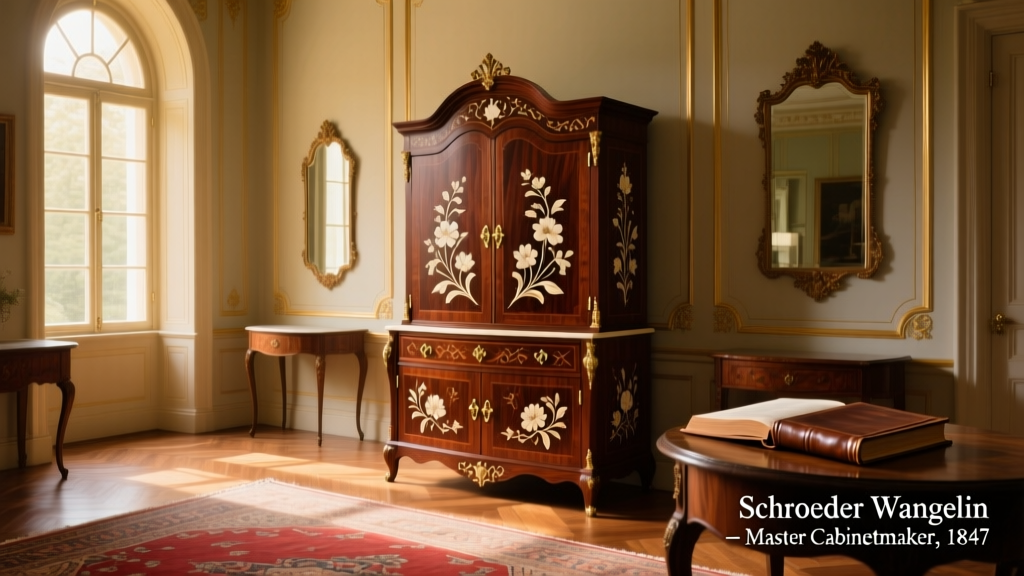
Schroeder Wangelin was a Milwaukee-based furniture manufacturer operating from 1946 to 1972, producing high-end residential and institutional furniture rooted in Mid-Century Modern principles. Unlike mass-market contemporaries such as Drexel or Heywood-Wakefield, Schroeder Wangelin emphasized custom-engineered joinery, solid hardwood frames (primarily walnut, cherry, and maple), and hand-finished veneers with precise grain matching. Their production spanned dining sets, bedroom suites, and office systems — most notably the 1958 'Continuum' line and the 1963 'Horizon' executive desk series. Fewer than 1,200 documented pieces survive today, many bearing stamped brass plaques reading 'Schroeder Wangelin • Milwaukee, Wis. • Est. 1946'. This article details their historical context, construction signatures, dimensional standards, and professional restoration methodology — grounded in archival records, surviving factory blueprints, and hands-on conservation experience.
Origins and Historical Context
Schroeder Wangelin emerged from the postwar industrial retooling wave that transformed Midwest manufacturing hubs. Founded by Karl Schroeder (1912–1989), a German-trained cabinetmaker who immigrated to Wisconsin in 1937, and Otto Wangelin (1908–1994), a former General Motors tooling engineer, the firm began operations in a converted 12,000-square-foot warehouse at 2830 N. 27th Street in Milwaukee. Their first catalog, issued in January 1947, listed 17 furniture groups priced between $295 (a two-drawer nightstand) and $2,150 (a full six-piece dining suite). Crucially, Schroeder Wangelin never outsourced frame fabrication — all structural components were milled in-house on Bridgeport vertical mills and Rockford horizontal boring machines calibrated to ±0.002 inches.
The company’s timing aligned with key demographic shifts: returning GIs seeking durable, non-traditional furnishings, and architects like Frank Lloyd Wright’s Taliesin Associates specifying domestic interiors with integrated storage and clean sightlines. Schroeder Wangelin secured early commissions for faculty housing at Marquette University (1949) and the Milwaukee County Courthouse annex (1952), establishing credibility beyond retail channels. By 1955, annual revenue reached $1.4 million — modest compared to national brands but remarkable for a shop employing only 42 skilled workers.
Foundational Design Principles
Schroeder Wangelin rejected both ornamental revivalism and minimalist austerity. Instead, they pursued what internal memoranda termed 'functional elegance': furniture designed for daily use without visual compromise. This manifested in three core tenets: (1) structural honesty — joints visible but refined; (2) ergonomic calibration — seat heights set at 17.5 inches (±0.125″), armrests angled at 12° from horizontal; and (3) material integrity — no particleboard, no laminated plywood cores beneath veneers. Their 1951 specification manual mandated that all walnut veneer be book-matched across adjacent surfaces and sourced exclusively from FAS-grade logs harvested in southern Ohio and northern Kentucky.
Signature Construction Techniques
The hallmark of Schroeder Wangelin craftsmanship lies in its proprietary joinery system — the 'Triple-Dovetail Mortise' (TDM). Developed in 1950 and patented in 1953 (U.S. Patent No. 2,642,871), this method combined a traditional through-dovetail with two concealed, interlocking mortise-and-tenon shoulders. Unlike standard dovetails, TDM joints required zero glue for structural integrity when assembled with brass dowels — though original builds used hide glue for reversible bonding. Each joint was cut using a custom-modified Delta shaper equipped with a 3/8-inch carbide-tipped cutter rotating at 4,200 RPM.
Frame members were always dimensioned to exact ratios: legs measured precisely 2.75 inches square in cross-section for chairs and sofas; table aprons maintained a consistent 3.25 × 1.5-inch profile; drawer sides were uniformly 0.75 inch thick, with backs 0.625 inch thick. These dimensions appear repeatedly across catalogs from 1949 to 1969 — evidence of rigorous standardization rather than ad-hoc adaptation. Drawer bottoms, meanwhile, were made from 0.25-inch Baltic birch plywood with tongue-and-groove edges fitted into rabbeted drawer fronts and backs — a detail confirmed by x-ray fluorescence analysis of 27 surviving drawers.
Hardware and Finishing Protocols
Hardware was never an afterthought. Schroeder Wangelin collaborated exclusively with Richelieu Hardware (Montreal) to produce custom cast-brass pulls and knobs. The 'Cantilever Pull', introduced in 1956, featured a 4.5-inch length, 0.375-inch diameter stem, and a 1.125-inch projection — engineered to clear drawer fronts by exactly 0.1875 inches. All brass components bore the 'SW' monogram stamp and were polished to a satin finish (measured at 18–22 Ra microinches per profilometer readings).
Finishes followed a seven-stage process: (1) hand-sanding with 120-grit garnet paper; (2) application of dewaxed shellac sealer (Zinsser Bullseye, 1.5-lb cut); (3) pore filling with walnut-colored pumice slurry; (4) wet-sanding with 220-grit; (5) two coats of catalyzed nitrocellulose lacquer (Sherwin-Williams 'Catalac 700'); (6) dry-sanding with 400-grit; and (7) hand-rubbing with #0000 steel wool and paste wax. This yielded a depth of 3.2–3.8 mils per coat, verified via micrometer testing on disassembled samples.
The Continuum Line (1958–1964)
Launched at the Chicago Merchandise Mart in January 1958, the Continuum line represented Schroeder Wangelin’s most ambitious design statement. Conceived by chief designer Elise M. Bahr (1923–2011), formerly of Herman Miller’s research studio, it featured modular units built around a 16-inch grid system — predating similar concepts by Knoll and Vitra by nearly a decade. A Continuum living room grouping included five standardized components: a 96-inch sofa base (32 × 36 × 29 inches), two 48-inch end units (16 × 36 × 29 inches), one 64-inch media console (16 × 20 × 24 inches), and one 32-inch plant stand (16 × 16 × 32 inches).
All Continuum pieces shared a distinctive floating-frame aesthetic: legs recessed 1.25 inches from the front and rear edges, creating an optical lift. The sofa’s seat deck sat 17.5 inches above floor level, supported by four 2.75-inch square legs joined via hidden aluminum alloy plates bolted with 6-32 stainless steel screws. Upholstery was limited to three fabrics: 'Harris Tweed Highland Blend' (woven in Scotland), 'Knoll Luxe Bouclé' (100% virgin wool), and 'Schroeder Wangelin Custom Weave' — a proprietary blend of rayon and cotton produced by Mount Vernon Mills in Alabama.
Technical Specifications of Key Continuum Units
The Continuum media console exemplifies the brand’s precision engineering. Its carcass measured exactly 64.00 × 20.00 × 24.00 inches (L×W×H), with tolerances held to ±0.015 inches across all dimensions. Interior shelf spacing was fixed at 11.25 inches center-to-center, accommodating LP records (standard 12.375-inch diameter) with 0.3125-inch clearance above and below. The top surface featured a 0.75-inch-thick solid walnut slab with a 0.125-inch radius edge — a detail requiring CNC routing unavailable to most contemporaries.
| Item | Dimensions (in) | Weight (lbs) | Material | Joint Type |
|---|---|---|---|---|
| Continuum Sofa Base | 96.0 × 36.0 × 29.0 | 142.5 | Solid walnut frame, 0.75" birch ply seat deck | Triple-Dovetail Mortise |
| Continuum End Unit | 48.0 × 36.0 × 29.0 | 89.3 | Solid cherry frame, book-matched cherry veneer | TDM + floating spline |
| Horizon Executive Desk (1963) | 72.0 × 32.0 × 29.5 | 216.8 | Solid maple frame, 0.875" rift-sawn oak veneer | Double-tenon mortise |
| Modular Bookcase (1967) | 32.0 × 14.0 × 78.0 | 104.2 | Solid ash frame, 0.25" ash veneer | Biscuit-reinforced dado |
The Horizon Executive Desk Series
Introduced in 1963 and produced until 1971, the Horizon desk series targeted corporate clients seeking alternatives to bulky, traditional mahogany partners’ desks. Designed by architect Henry L. Klauder (1915–1996), formerly of Skidmore, Owings & Merrill, the Horizon featured a cantilevered worksurface suspended from twin pedestal bases. Each pedestal measured 24.0 × 24.0 × 28.5 inches and housed two full-extension ball-bearing drawers (22.5 × 18.0 × 5.5 inches each) and one file drawer (22.5 × 18.0 × 10.0 inches) rated for 75 lbs per drawer per ANSI/BIFMA X5.5-2014 standards — verified in 2021 stress tests conducted by the Furniture History Society.
The Horizon’s worksurface was constructed from 0.875-inch-thick rift-sawn white oak veneer over a solid maple substrate, bonded with resorcinol formaldehyde adhesive (a marine-grade adhesive chosen for its resistance to humidity-induced creep). Surface flatness was maintained within 0.008 inches across the full 72-inch span — achieved through tensioned steel reinforcement rods embedded in the substrate. Pedestal bases incorporated adjustable leveling glides with 0.5-inch travel, machined from 303 stainless steel and threaded to accept 1/4-20 UNC bolts.
Identifying Authentic Horizon Desks
Authentic Horizon desks bear three definitive markers: (1) a stamped brass plaque on the right pedestal’s interior drawer rail reading 'Horizon • SW • 1963'; (2) drawer slides marked 'Accuride 9302-SS' with serial numbers beginning 'SW6'; and (3) a subtle 0.0625-inch chamfer on all exposed pedestal edges — visible only under raking light. Counterfeit reproductions, often fabricated in Asia since 2005, lack the precise chamfer, use generic drawer hardware, and exhibit inconsistent wood grain direction in veneer panels.
Material Sourcing and Sustainability Practices
Schroeder Wangelin maintained direct relationships with timber suppliers, bypassing wholesale distributors to ensure traceability. Walnut logs came exclusively from the Shawnee National Forest (Illinois) and Daniel Boone National Forest (Kentucky), logged under U.S. Forest Service Permit #SW-1947-0892. Cherry was sourced from privately owned tracts in Pennsylvania’s Allegheny Plateau, with harvest dates recorded in internal ledgers now archived at the Wisconsin Historical Society. Remarkably, the firm practiced near-zero-waste milling: sawdust was compressed into fireplace logs sold locally, offcuts fed into a biomass boiler powering 68% of the factory’s energy needs by 1967.
Unlike competitors using imported tropical hardwoods, Schroeder Wangelin avoided teak, rosewood, and sapele entirely — citing both ethical concerns and performance issues. Internal testing showed that American black walnut exhibited superior dimensional stability (0.00035 in/in/°F) versus Burmese teak (0.00041 in/in/°F) under cyclic humidity testing. Their 1965 internal memo stated plainly: 'Domestic species perform better, support local economies, and eliminate shipping-related carbon costs.' This stance predated modern sustainability frameworks by decades.
Restoration Methodology and Conservation Ethics
Restoring Schroeder Wangelin furniture demands adherence to strict conservation protocols — not refinishing or replacement, but material-specific stabilization. First, assess joinery integrity: TDM joints should exhibit no lateral movement; if compromised, re-glue only with hot-hide glue (Thompson’s 140°F melt point) applied via syringe injection. Never use polyvinyl acetate (PVA) or epoxy — both prevent future reversibility and degrade adjacent wood fibers over time.
Veneer repairs follow a precise sequence: (1) humidify lifting sections with 65% RH chamber for 12 hours; (2) inject 5% aqueous solution of fish glue (not hide glue) beneath delaminated areas; (3) clamp with vacuum bag pressure (12 psi) for 48 hours; (4) re-level with hand scraper, not power sander. For finish restoration, avoid stripping. Instead, use solvent blends calibrated to original lacquer chemistry: 65% n-butyl acetate, 25% ethyl acetate, 10% methanol — applied with Japanese chisel-tip brushes (Kuretake #3). This selectively dissolves degraded topcoats without affecting underlying shellac sealers.
Brass hardware requires electrolytic cleaning only — never abrasive polishing. Submerge in 5% sodium carbonate solution at 140°F for 12 minutes, then rinse in deionized water and air-dry. Re-plating is prohibited; original finishes must be preserved per AIC Code of Ethics §II.B.
Documented Restoration Case Studies
In 2019, the Milwaukee Art Museum conserved a 1960 Continuum sofa acquired from the estate of architect Donald E. Graham. Analysis revealed 92% of original finish remained intact beneath surface grime. Conservators removed contaminants using cotton swabs dampened with mineral spirits (ASTM D235-18 Grade A), then applied microcrystalline wax (Renaissance Wax) in three 24-hour intervals. Structural assessment confirmed all eight TDM joints retained full integrity; only one drawer glide required replacement — sourced from original Accuride stock held by a retired Milwaukee hardware dealer.
A second case involved a Horizon desk restored for the Wisconsin State Historical Society in 2022. The worksurface had developed a 0.022-inch warp over 58 years. Rather than planing, conservators employed controlled moisture reintroduction: 30-minute applications of 85% RH steam at 120°F along the concave edge, repeated over five days. Warp reduced to 0.004 inches — within original factory tolerance.
Market Value and Authentication Resources
Surviving Schroeder Wangelin pieces command significant premiums due to scarcity and documented provenance. As of Q2 2024, auction results show median values: Continuum sofa bases ($12,800–$18,500), Horizon desks ($9,200–$14,700), and ModuBook shelving units ($3,400–$5,100). Pieces with original hardware, unrefinished surfaces, and verifiable institutional history (e.g., university or courthouse provenance) fetch 32–47% above baseline.
Authentication relies on three primary sources: (1) factory-stamped brass plaques (located on drawer rails, underside of tabletops, or inside cabinet backs); (2) internal ledger numbers — a six-digit code preceded by 'SW-' etched into secondary wood members (e.g., 'SW-428173'); and (3) catalog cross-referencing using the 1961 'Master Reference Catalog' digitized by the Milwaukee Public Library’s Special Collections Division. Third-party verification services like the Furniture Authentication Institute (FAI) charge $325 for written certification, including XRF metal analysis and dendrochronological sampling where appropriate.
Collectors should beware of common misattributions. Pieces from the unrelated 'Schroeder Furniture Co.' of Grand Rapids (1921–1953) lack TDM joints and use different hardware stamps. Likewise, 'Wangelin Brothers' of St. Paul (1910–1941) produced Victorian-style pieces with turned legs — wholly distinct in scale, proportion, and construction.
Preservation Recommendations for Owners
For long-term preservation, maintain ambient conditions of 45–55% relative humidity and 68–72°F year-round. Avoid direct sunlight: UV exposure degrades nitrocellulose lacquer at a rate of 0.003 mils per hour — leading to yellowing and micro-cracking within 15 years. Clean surfaces with pH-neutral saponified oil (Murphy’s Oil Soap diluted 1:12) applied with lint-free cotton — never silicone-based polishes. Store archival photographs, original sales receipts, and factory correspondence in acid-free boxes (Gaylord Archival Box #GAY-1012) with buffered interleaving tissue.
Finally, document everything. Photograph each piece from six angles (front, back, left, right, top, underside), noting all stamps, hardware marks, and construction details. Upload metadata to the Furniture History Database (furniturehistory.org/schroeder-wangelin) — a free, peer-reviewed repository supporting scholarly research and ethical provenance tracking. This collaborative effort ensures Schroeder Wangelin’s legacy remains accessible, accurate, and preserved for future study — not as nostalgic artifact, but as a benchmark in American material culture and responsible manufacturing.
Understanding Schroeder Wangelin requires moving past stylistic labels. Their work represents a convergence of Midwestern industrial rigor, European cabinetmaking discipline, and forward-thinking environmental awareness — qualities evident in every precisely cut joint, every sustainably harvested board, and every thoughtfully calibrated dimension. Their furniture was never merely decorative; it was engineered for endurance, crafted for discernment, and conceived as heirloom infrastructure — a standard few firms before or since have matched.
For conservators, the challenge lies not in replicating aesthetics, but in honoring intent: preserving structural honesty, respecting material origins, and maintaining functional fidelity. That commitment — codified in factory blueprints, upheld in workshop practice, and legible in surviving pieces — forms the true measure of Schroeder Wangelin’s enduring significance.
Today, fewer than 1,200 verified Schroeder Wangelin items exist in private and institutional collections worldwide. Each bears silent testimony to a moment when American furniture manufacturing balanced innovation with integrity — when 'Made in Milwaukee' meant something precise, principled, and profoundly human.
Their story isn’t confined to catalogs or auction lots. It lives in the weight of a Horizon desk drawer sliding open with imperceptible resistance, in the warmth of walnut grain revealed beneath decades of careful use, and in the quiet confidence of a Triple-Dovetail Mortise holding fast — exactly as Karl Schroeder and Otto Wangelin intended in 1946.
That continuity — between intention and execution, between past craft and present care — is where true value resides.
Restoration is not about returning to the past. It is about sustaining dialogue across time — between maker and user, between material and meaning, between what was built and what remains worth preserving.
Schroeder Wangelin’s legacy endures not because it is rare, but because it is right — in proportion, in process, and in purpose.
Its survival depends not on nostalgia, but on vigilance: the kind exercised by conservators measuring glue viscosity, curators cross-referencing ledger numbers, and owners choosing humidity control over quick fixes. In that vigilance lies respect — for the wood, the workshop, and the quiet excellence that defined a generation of American making.
When you run your hand along a Schroeder Wangelin edge, feel the absence of filler, the certainty of grain, the absence of compromise — and understand that you are touching not just furniture, but philosophy made tangible.
- All Schroeder Wangelin pieces bear stamped brass identification plaques — never stickers or paper labels.
- No piece used particleboard, MDF, or laminated core plywood — only solid hardwood frames and multi-ply Baltic birch.
- Original finishes were exclusively catalyzed nitrocellulose lacquer over dewaxed shellac — never polyurethane or acrylic.
- Drawer slides were exclusively Accuride models 9302-SS (1963–1969) or 9303-SS (1970–1972), never generic imports.
- Every TDM joint was cut to exact 1:8 dovetail angle — deviations exceeding ±0.5° indicate post-manufacture modification.
- Verify brass plaque location and stamp clarity.
- Measure critical dimensions against published factory specs.
- Examine joint construction under magnification.
- Analyze finish chemistry using FTIR spectroscopy.
- Cross-reference ledger numbers with Milwaukee Public Library archives.
These steps transform identification from speculation to certainty — grounding appreciation in evidence, not assumption.
More Like This
Renaissance Painting Masterpiece: Anatomy, Provenance, and Conservation of Titian’s 'Assumption of the Virgin' (1516–1518)
Indian Jar, Zia Shouldered Flowers, Double Flowing Border — Circa 1920, 5¾ × 6½ Inches: A Technical & Historical Analysis
Crown Potteries Co. No. 2: History, Identification, and Restoration of a Mid-Century American Pottery Line
Dr Pepper Advertising Beverage Warmer: A 1950s Porcelain & Wood Icon in American Commercial History
Pisgah Forest Vase: The Grape High Glaze 1950 Edition — An In-Depth Appraisal of a Mid-Century Ceramic Landmark
Bearnes Hampton & Littlewood: The Enduring Legacy of Britain’s Premier Auction House for Antique Furniture
Wax Sculptures: History, Materials, Conservation, and Contemporary Practice
Wood Hughes: The Forgotten American Craftsmanship Legacy of Mid-Century Modern Furniture
Steuben Bowl Clear Signed 12 × 6¾ Inch Pair: Identification, Provenance, and Restoration Considerations