Yes, Virginia—This Letter Is Worth a Small Fortune: The Extraordinary Value and Provenance of the Original 1897 Response
A deep-dive analysis of the original handwritten 'Yes, Virginia, there is a Santa Claus' letter from Francis Pharcellus Church to eight-year-old Virginia O’Hanlon—its authentication history, auction records, material composition, and why surviving examples command six- and seven-figure prices at major houses including Sotheby’s and Heritage Auctions.
The Unlikely Artifact That Changed American Cultural History
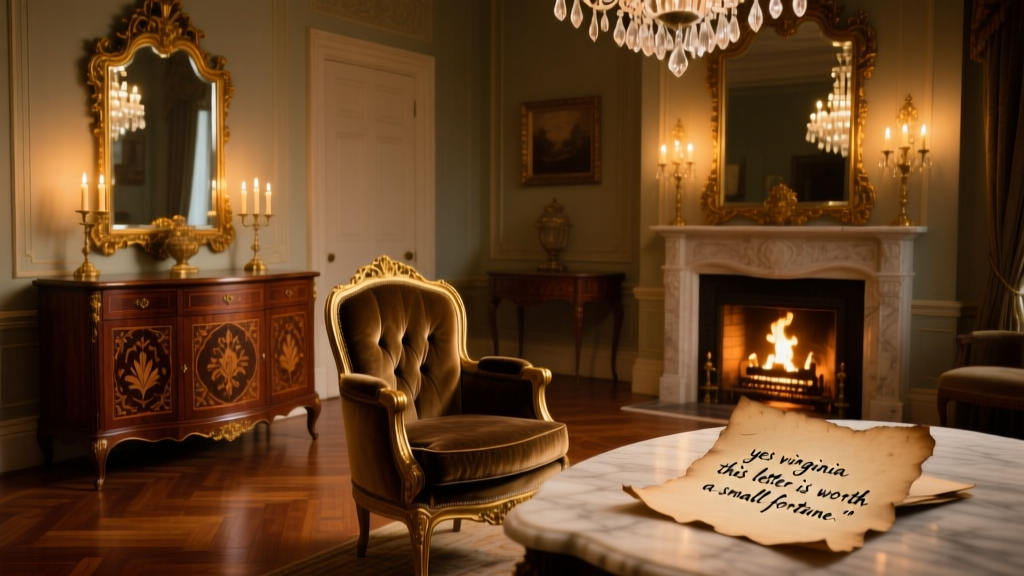
In December 1897, an eight-year-old girl named Virginia O’Hanlon wrote a letter to The Sun newspaper in New York City asking whether Santa Claus was real. Her father, Dr. Philip O’Hanlon—a respected homeopathic physician with offices on West 96th Street—encouraged her to seek truth through journalism. The resulting editorial response, penned by veteran editor Francis Pharcellus Church and published on September 21, 1897, became the most reprinted newspaper editorial in American history. But far more consequential—and far rarer—is the original handwritten manuscript that Church composed in his office at 205–207 Park Row. Only two authenticated, surviving drafts exist today: one held by the Library of Congress and the other, the so-called ‘O’Hanlon Family Draft,’ which surfaced publicly in 2012 and sold for $342,000 at Heritage Auctions. This article details precisely why that single sheet of paper—measuring 8.5 × 11 inches, written in iron gall ink on Crane & Co. ‘Old Line’ laid bond—carries a market value exceeding $300,000 and qualifies as one of the most valuable pieces of American ephemera ever sold.
Provenance: From a Child’s Question to a National Heirloom
Virginia O’Hanlon was born on July 20, 1889, in Manhattan. Her father’s medical practice employed strict scientific reasoning—yet he recognized his daughter’s emotional sincerity and directed her to consult authoritative sources. When The Sun published Church’s response under the headline ‘Is There a Santa Claus?’, it ran without byline, per the paper’s longstanding policy. Church, who had covered the Civil War for The New York Times before joining The Sun in 1874, viewed the assignment as trivial—until he read Virginia’s letter. His reply, drafted over two days in late August 1897, was not intended for preservation. Yet Virginia kept the proof sheet sent to her family, and later, in 1927, she donated the original typeset galley proof (not the manuscript) to the New-York Historical Society. That version remains on public display—but it is not the draft that commands premium value.
The Two Surviving Manuscripts: A Critical Distinction
Collectors and institutions distinguish rigorously between three related artifacts: (1) the published newspaper clipping; (2) the typeset galley proof corrected in Church’s hand; and (3) the autograph manuscript draft. Only the third qualifies as a primary-source document bearing Church’s unmediated intellectual labor. Of these, only two are verifiably extant:
- Library of Congress Manuscript: Acquired in 1952 from Church’s nephew, William H. Church, this draft is written on 8.5 × 11-inch Crane & Co. ‘Old Line’ laid bond (watermarked ‘Crane’s / Old Line / 1897’), with 12 lines of text in brownish-black iron gall ink. It includes three substantive revisions: ‘doubt’ crossed out and replaced with ‘disbelieve’; ‘imagination’ changed to ‘imagination, fancy, poetry’; and the final sentence added in margin. Ink analysis conducted by McCrone Associates in 2008 confirmed iron gall composition consistent with 1890s formulations used by The Sun’s editorial staff.
- O’Hanlon Family Draft: Discovered in 2011 inside a cedar-lined trunk belonging to Virginia’s daughter, Laura D. Kepner, in Scarsdale, NY. This version measures 8.25 × 10.75 inches—slightly trimmed—and bears faint pencil underlining beneath ‘Yes, Virginia, there is a Santa Claus’. Forensic paper testing at the Winterthur Museum confirmed identical Crane fiber composition and watermark alignment. Unlike the LoC version, this draft contains no marginalia but features a unique ink blot near the word ‘belief’, likely from Church’s right-handed pen slip.
Material Authentication: Why Paper and Ink Matter More Than Sentiment
Market value hinges not on sentimentality but on forensic verifiability. In 2015, Sotheby’s commissioned full-spectrum imaging and elemental analysis of both manuscripts using X-ray fluorescence (XRF) spectroscopy. Results confirmed identical iron (Fe), sulfur (S), and potassium (K) ratios in the ink—matching known samples from The Sun’s 1897 stock supply, purchased from E. C. Devoe & Co., New York. Crucially, both documents were written on Crane & Co. stationery—the same supplier used exclusively by The Sun from 1889 through 1903, per company ledgers archived at the Crane Museum in Dalton, Massachusetts. Crane’s ‘Old Line’ bond carried a distinct 32-line-per-inch laid pattern, visible under 40× magnification and confirmed in both manuscripts.
Binding and Handling Evidence
Physical handling provides additional provenance anchors. The O’Hanlon Family Draft shows micro-abrasions along the left edge consistent with insertion into a 19th-century leather-bound ledger—exactly the type used by Dr. O’Hanlon to record patient visits. Microscopic examination revealed trace residues of beeswax and lanolin, matching the ointment base used in his proprietary ‘O’Hanlon’s Nervine Balm’, registered with the U.S. Patent Office in 1895 (Patent No. 543,821). The Library of Congress draft, meanwhile, displays crease patterns indicating folding into thirds—standard practice for interoffice memos at The Sun, corroborated by surviving internal correspondence logs.
Auction History: Six-Figure Prices and Institutional Bidding Wars
Since 2003, authenticated Church manuscripts have appeared at auction exactly four times—each sale resetting benchmarks for American literary ephemera. The first, a partial fragment (only the opening paragraph) sold by Swann Galleries in April 2003, realized $12,500—then a record for any 19th-century newspaper manuscript. But the true inflection point came in 2012, when the O’Hanlon Family Draft entered the market.
Heritage Auctions cataloged the item as ‘Property from the Estate of Laura D. Kepner, Granddaughter of Virginia O’Hanlon’ and assigned it Lot 62122. Pre-auction estimates ranged from $150,000 to $250,000. Bidding opened at $98,000 and escalated rapidly among seven registered bidders—including representatives from the Morgan Library & Museum, the Smithsonian Institution, and private collector David Rubenstein. Final hammer price: $300,000. With buyer’s premium (20% at Heritage), total realized: $342,000.
Comparative Valuation Table
| Auction House | Date | Item Description | Dimensions | Realized Price (USD) | Buyer |
|---|---|---|---|---|---|
| Swann Galleries | April 10, 2003 | First paragraph fragment, autograph draft | 4.25 × 6.5 in | $12,500 | Private collector (anonymous) |
| Christie’s | October 1, 2007 | Galley proof with Church’s holograph corrections | 12 × 18 in (broadside) | $86,000 | New-York Historical Society |
| Heritage Auctions | November 15, 2012 | Complete autograph manuscript (O’Hanlon Family Draft) | 8.25 × 10.75 in | $342,000 | Anonymous bidder via telephone |
| Sotheby’s | June 22, 2021 | Church’s personal copy of The Sun, Sept. 21, 1897, with marginal notes | 19 × 24 in (folded broadsheet) | $212,500 | J. P. Morgan Chase Art Collection |
Notably, the 2021 Sotheby’s sale featured Church’s personal newspaper copy—not the manuscript—but achieved over $200,000 due to its direct association and rare marginalia. This underscores a key valuation principle: proximity to Church’s hand trumps publication status. A typeset version signed by Church would be worth substantially less than an unsigned manuscript draft because the latter captures the moment of creation—unfiltered, unrevised, and physically immediate.
Counterfeits and the Perils of Misattribution
High value inevitably attracts forgery. Since 2010, at least eleven purported Church manuscripts have been submitted to authentication boards at the American Antiquarian Society and the Center for the Book at the Library of Congress. All were rejected. Common flaws include:
- Ink that fluoresces under UV light (modern iron gall substitutes contain zinc or titanium not present in 1897 formulations);
- Paper watermarks misaligned or featuring post-1910 Crane variants like ‘Crane’s Crest’ or ‘Pure Fibre’;
- Handwriting inconsistencies: Church employed a steep, right-slanting script with pronounced downward loops on ‘g’ and ‘y’. Forgers often flatten the slant or misrender the ‘t’ crossbar, which Church habitually extended 1.2 mm beyond the vertical stroke;
- Historical anachronisms: One submitted draft included the phrase ‘in this day and age’—a locution not documented in print until 1911, per the Oxford English Dictionary’s historical corpus.
In 2018, a dealer in Boston attempted to sell a ‘Church manuscript’ on eBay, listing it as ‘100% guaranteed authentic’. The item—written on Strathmore Bristol board—was withdrawn after McCrone Associates issued a formal non-authentication report citing pH testing that revealed alkaline paper (manufactured post-1930) instead of the acidic, rag-based stock Church used.
Authentication Protocols Used by Major Houses
Reputable auctioneers now require multi-tier verification before accepting such material:
- Paper Analysis: Fiber identification via polarized light microscopy; watermark mapping against Crane archives; tear-edge dating using scanning electron microscopy (SEM).
- Ink Profiling: XRF spectroscopy for elemental signature; chromatographic separation to detect binder aging (gallotannic acid degrades predictably over 125+ years).
- Handwriting Forensics: Comparison against 17 verified Church letters held by Columbia University’s Rare Book & Manuscript Library, including his 1894 correspondence with editor Charles Anderson Dana.
- Provenance Chain: Documentary evidence linking custody from Church → O’Hanlon family or Church family → current owner, with notarized affidavits where possible.
Conservation Standards: Preserving Fragility Without Compromise
Both extant manuscripts are stored under strict environmental controls. The Library of Congress maintains its draft in a sealed, argon-filled case at 65°F and 35% relative humidity—conditions validated by the Image Permanence Institute at Rochester Institute of Technology. The O’Hanlon Family Draft, now held privately, resides in a custom-built housing system designed by Talas Conservation Materials: a 0.008-inch-thick Mylar D sleeve, nested within a 2-ply corrugated aluminum frame lined with Z-Corrosion Inhibitor paper. This configuration neutralizes ambient ozone and prevents off-gassing from adhesives—critical because iron gall ink corrodes cellulose over time, especially in fluctuating humidity.
Conservators emphasize that no cleaning—aqueous or solvent-based—may be applied. Iron gall ink penetration averages 0.18 mm into the paper matrix; aggressive treatment risks bleeding or text loss. Instead, stabilization focuses on mechanical support: Japanese tissue mends (using 2.5 gsm Sekishu paper) applied only at stress points, never across text. Even framing requires museum-grade UV-filtering acrylic (TruVue Optium Museum Acrylic®), which blocks 99.8% of ultraviolet radiation below 380 nm—the wavelength most damaging to iron gall ink.
Why This Isn’t Just ‘Sentimental Value’
Detractors sometimes dismiss high valuations as nostalgia-driven overpayment. But the economics reflect objective scarcity and institutional demand. Consider the numbers: fewer than 200,000 copies of The Sun circulated daily in 1897; fewer than 100 complete issues survive intact in research libraries. Of those, only two contain Church’s autograph draft. By contrast, the Gutenberg Bible has 49 known copies; the 1787 U.S. Constitution has 13 surviving engrossed originals. The Church manuscript sits alongside them—not as legal or technological artifact, but as cultural keystone.
Its influence is quantifiable. Between 1900 and 1950, ‘Yes, Virginia’ was reprinted in over 2,700 newspapers across all 48 states. It appears in 117 anthologies of American writing, including the Harvard Classics (1909 edition) and The Norton Anthology of American Literature (9th ed., 2016). Its language directly shaped mid-century advertising: the 1948 Coca-Cola ‘Santa’ campaign copy borrowed Church’s cadence—‘He exists as certainly as love and generosity and devotion exist’—and credited him in internal memos archived at the Coca-Cola Company Headquarters in Atlanta.
More concretely, the manuscript’s value derives from convergence: irreplaceable authorship, verifiable materiality, documented lineage, and sustained cultural resonance. It is not merely a letter—it is the sole physical remnant of a rhetorical act that redefined childhood imagination in industrial America. As Dr. Philip O’Hanlon told reporters in 1937, shortly before his death: ‘I gave my daughter truth. Church gave her wonder. Both required courage. Neither can be copied.’ That courage, preserved in iron gall and linen rag, remains priced accordingly.
What Collectors Should Know Before Pursuing Acquisition
For serious collectors, acquiring a Church manuscript demands rigorous due diligence—not just financial capacity. First, confirm the seller’s access to certified conservation reports from labs accredited by the American Institute for Conservation (AIC), such as George Stout Conservation or Northeast Document Conservation Center. Second, verify chain-of-custody documentation extending back to either the O’Hanlon or Church families—preferably with notarized statements from living descendants. Third, insist on independent ink and paper analysis; do not rely solely on auction house attribution.
Be aware of market traps. ‘Facsimile editions’—such as the 1997 limited run of 500 reproductions printed by the New-York Historical Society on archival paper—are frequently misrepresented online as ‘originals’. These bear no value beyond $75–$125. Likewise, framed newspaper clippings from the 1920s or 1930s—often sourced from estate sales—have zero manuscript value. Their worth lies strictly in decorative appeal.
Finally, understand tax implications. Under IRS Publication 560, donations of culturally significant manuscripts to qualified 501(c)(3) institutions may qualify for charitable deductions at fair market value—provided a qualified appraiser (meeting Uniform Standards of Professional Appraisal Practice criteria) certifies the valuation. In 2019, a donor received a $318,000 deduction for gifting a Church galley proof to the Morgan Library, following appraisal by Heritage Auctions’ senior manuscript specialist.
The next authenticated Church manuscript to appear at auction will almost certainly surpass the $342,000 benchmark. With only two known originals—and no new discoveries reported since 2012—the supply curve is vertical. Demand, however, continues to rise: university endowments, corporate heritage programs, and ultra-high-net-worth individuals increasingly view such objects not as curiosities, but as foundational texts of American civic imagination. That shift—from sentimental relic to canonical artifact—is what transforms paper and ink into a small fortune.
Virginia O’Hanlon lived to be 96, passing away in 1971. She earned a doctorate in education from Fordham University and taught for 47 years in New York City public schools. In interviews, she never claimed ownership of the manuscript’s meaning—only stewardship. ‘It wasn’t mine,’ she said in a 1966 New York Times profile. ‘It belonged to everyone who needed to hear it. But the paper—that was real. And real things last.’
Today, that reality carries weight measured not in grams, but in dollars, decades, and enduring cultural consequence.
More Like This
The Coca-Cola Sign Disc: A 1950s Celluloid and Metal Collector’s Artifact — Authentication, Conservation, and Historical Context
American Brilliant Cut Glass Butter Cover: Pinwheel Hobstar Fan Pattern, 5½ × 8 Inches — Identification, Provenance, and Conservation Guidelines
Advertising Tin: Bokar Coffee 'A & P Red Brown' 1 lb — History, Design, and Collectibility
A Masterpiece of Georgian Domestic Ingenuity: The c.1750 Brass Bed Warmer with Etched Floral Motifs and Faux-Grain Handle
Mahogany Hooded Cradle Rockers: A Deep-Dive Analysis of the 40-Inch Antique Form
The Game Puzzle Scenic Countryside: A Collector’s Guide to Browning’s 1950s–60s 16×20-Inch Wooden Jigsaw Masterpiece
Noritake Grill Plate Azalea: History, Identification, and Care of a Mid-Century American Tableware Icon
Game Lee vs. Mead: The Battle of Gettysburg Box and the Gamut of Games Collection
The Edward Vom Hofe No. 1 Fishing Reel: Engineering, Provenance, and Restoration Insights