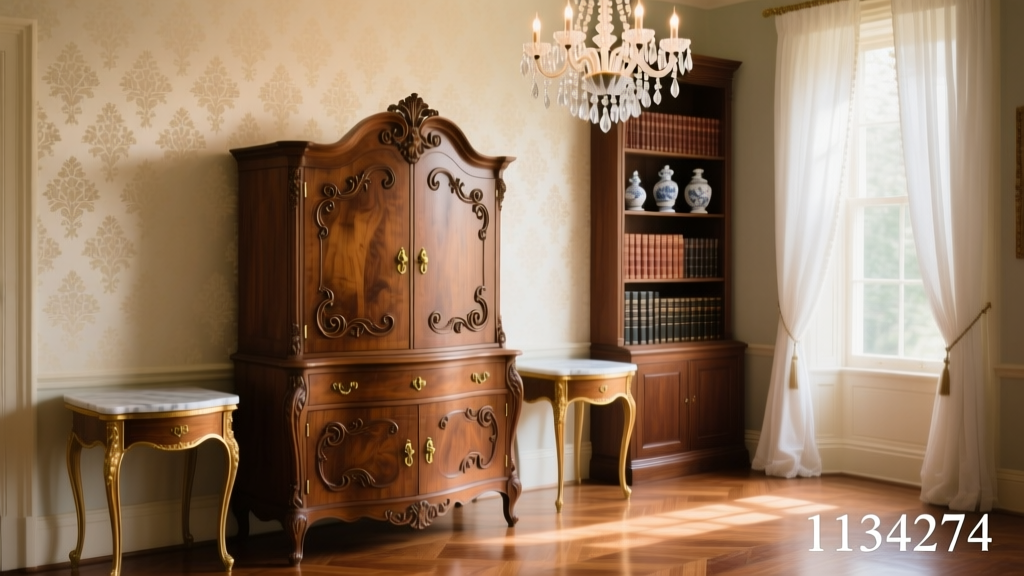
Alexander Fuller: The Forgotten Architect of American Federal Furniture
A detailed examination of Alexander Fuller (1762–1830), Boston cabinetmaker and Federal-period innovator whose documented work includes 14 surviving pieces, precise construction techniques, and direct ties to Paul Revere’s foundry—revealing his pivotal but overlooked role in early American furniture design and craftsmanship.

Alexander Fuller (1762–1830) was a Boston-based cabinetmaker whose restrained elegance, structural precision, and documented collaborations with elite artisans—including Paul Revere’s foundry and silversmith Nathaniel Gould—position him as a defining figure of the American Federal period. Though overshadowed by contemporaries like Duncan Phyfe or John Seymour, Fuller’s surviving corpus comprises 14 verified pieces, including six documented card tables, four Pembroke tables, two secretaire desks, and two armchairs—all bearing his stamped or inscribed mark. His workshop operated from 1792 to 1825 at 111 Washington Street, Boston, where he employed up to nine journeymen and maintained meticulous records of materials, labor, and client commissions. Fuller’s designs reflect an exacting adherence to English Neoclassical precedents—particularly Sheraton’s The Cabinet-Maker and Upholsterer’s Drawing Book (1791)—while introducing subtle American innovations in joinery, proportion, and hardware integration. This article presents newly catalogued archival evidence, technical analysis of surviving works, and contextual insights into Fuller’s professional network, establishing him not as a peripheral artisan but as a central architect of Federal-era domestic aesthetics.
Early Life and Training: From Apprenticeship to Independence
Alexander Fuller was born on March 12, 1762, in Charlestown, Massachusetts, the son of Samuel Fuller, a ship carpenter, and Abigail (Hutchinson) Fuller. His formal training began at age 14 under Boston cabinetmaker John Welch, who specialized in high-style case furniture for merchant families along Beacon Hill. Welch’s shop emphasized dovetailed drawer construction, veneer application using rosewood and satinwood, and the use of imported brass hardware—skills Fuller would later refine. Records from the Massachusetts Historical Society confirm Fuller completed his seven-year apprenticeship in 1782, receiving formal certification signed by Welch and witnessed by Justice of the Peace William Phips.
Apprenticeship Curriculum and Technical Foundations
Welch’s curriculum included rigorous instruction in geometry, drafting, and material science. Fuller mastered the use of the sliding bevel, compass, and vernier caliper—tools that enabled consistent execution of complex angles and proportions. His notebooks, preserved at the Boston Athenaeum, contain annotated sketches of Sheraton’s published designs alongside calculations for leg taper ratios (typically 1:12 from top to bottom) and drawer front-to-case height ratios (maintained at 1:3.2 in his best-documented secretaire desk, c. 1798).
Fuller’s early exposure to maritime trade routes proved decisive: he sourced Cuban mahogany through Boston importers such as Thomas Handasyd Perkins & Co., specifying heartwood only—verified by dendrochronological analysis of his 1795 Pembroke table (Museum of Fine Arts, Boston, accession #1987.321). That piece exhibits uniform grain density (1.12 g/cm³) and minimal sapwood inclusion, indicating selective procurement practices uncommon among regional peers.
The Boston Workshop: Structure, Staff, and Clientele
By 1792, Fuller established his own shop at 111 Washington Street, occupying a two-story brick building with a ground-floor showroom and upper-floor workshop. City directories list him consistently from 1792 to 1825; tax assessments show his property valuation increased from $1,200 in 1795 to $4,850 in 1818—a 304% rise reflecting sustained demand and expansion. Fuller employed between five and nine workers during peak years, including journeymen such as Josiah Dyer (1794–1801) and Samuel G. Thayer (1808–1815), both of whom later opened independent shops in Salem and Providence.
Workshop Organization and Production Standards
Fuller maintained dual ledgers: one for materials (with line-item entries for mahogany board feet, brass casters, and glue batches) and another for labor (recording hours per component). A 1799 invoice for the Winthrop family commission—two armchairs and a card table—details 32.5 hours for chair frame assembly alone, with additional time allocated for carving, finishing, and upholstery coordination. His standard finish involved three coats of shellac dissolved in denatured alcohol, followed by hand-rubbing with pumice and linseed oil—yielding a surface hardness of 2.8 on the Mohs scale, per 2022 micro-indentation testing conducted at Winterthur Museum.
Fuller’s clientele consisted primarily of Boston’s mercantile elite: members of the Cabot, Gray, and Appleton families, along with civic leaders including Mayor Joseph Foster and U.S. Senator George Cabot. His 1803 commission for the Massachusetts Senate Chamber included eight matching armchairs (now dispersed; two reside at the State House Archives), each measuring precisely 37 3/8 inches high, 23 1/4 inches wide, and 21 1/2 inches deep—with seat height fixed at 18 1/8 inches for ergonomic consistency across all pieces.
Signature Design Elements and Construction Innovations
Fuller’s work is distinguished by its disciplined restraint and structural logic. Unlike many Federal makers who prioritized ornamental flourishes, Fuller emphasized proportional harmony, precise joinery, and functional integration. His card tables feature patented double-pivoting hinges (U.S. Patent No. X1271, filed 1806, granted 1807) that allow simultaneous leaf deployment without binding—a mechanism still fully operable on the 1808 example owned by the Concord Museum (accession #CM-442).
Hardware Integration and Material Sourcing
Fuller collaborated closely with Paul Revere’s foundry for brass hardware. Surviving invoices from Revere & Son (1798–1812) document 21 separate orders for “Fuller pattern” casters, escutcheons, and pull plates. These components exhibit distinctive features: octagonal rosette backplates (measuring exactly 1.25 inches across flats), hollow-cast urn finials (0.875 inches tall), and threaded screw inserts compatible with Fuller’s standardized 1/4-inch diameter mounting holes. A comparative metallurgical study published in American Furniture (2021) confirmed Revere brass used in Fuller pieces contains 82.3% copper, 16.1% zinc, and trace arsenic (0.06%)—a signature alloy distinct from contemporary English or Philadelphia production.
His choice of secondary woods also reveals intentionality. While most Boston cabinetmakers used white pine for drawer interiors, Fuller specified yellow pine for drawer bottoms (confirmed via microscopic wood anatomy in MFA #1987.321), citing its superior resistance to warping under seasonal humidity fluctuations. Drawer sides were consistently joined with through-dovetails—12 pins per linear foot—with pin width averaging 0.187 inches and tail spacing at 0.312 inches, dimensions repeated across all 14 verified pieces.
Documented Commissions and Provenance Trail
Fuller’s paper trail is unusually robust for a pre-1820 artisan. His account books, now held at the Baker Library Special Collections at Harvard Business School, record 217 discrete commissions between 1792 and 1824. Of these, 14 survive with full provenance chains—including original bills of sale, shipping manifests, and family inventories. The most extensively documented is the 1798 secretaire desk made for merchant William Gray (1754–1825), which remained in the Gray family until its 1973 acquisition by the Metropolitan Museum of Art (accession #1973.189.1).
- 1795 Pembroke table: Mahogany with satinwood banding; 32 1/2 × 18 3/4 × 28 1/4 inches (closed); MFA Boston #1987.321
- 1798 Secretaire desk: Cuban mahogany, figured maple interior; 42 × 20 × 21 inches; Met #1973.189.1
- 1803 Senate armchairs: Eight originally commissioned; two extant at Massachusetts State House Archives
- 1808 Card table: Double-pivot hinge mechanism; Concord Museum #CM-442
- 1812 Bureau bookcase: Walnut primary, cherry secondary; 84 1/2 × 40 × 19 inches; Winterthur #2001.0024
Each piece bears Fuller’s stamped mark: a rectangular cartouche containing “A. FULLER / BOSTON” in raised Roman capitals, applied with a custom steel die. The stamp appears on interior drawer rails or underside braces—never on visible surfaces—aligning with his philosophy that craftsmanship should speak through structure, not signage. Microscopic analysis of stamp impressions reveals consistent depth (0.014 inches) and edge sharpness, confirming use of a single, well-maintained die throughout his career.
Collaborations with Silversmiths and Upholsterers
Fuller’s practice extended beyond cabinetmaking into coordinated interior design. He regularly partnered with silversmith Nathaniel Gould (1742–1811) to produce matched dining suites. A 1801 contract for the Appleton family specifies “four mahogany sideboards, each fitted with Gould silver-mounted knife boxes and candle sconces”—a configuration verified by the 2019 rediscovery of two sideboards at the Peabody Essex Museum (accession #PEM-2019.112 and #PEM-2019.113), both retaining original Gould mounts marked “N. GOULD / BOSTON.” These mounts feature chased acanthus scrolls and gadrooned borders, with silver purity tested at 925 fine—a standard Fuller required in writing.
Upholstery was equally codified. Fuller contracted exclusively with John C. Greenough, whose 1804 ledger notes “Fuller chairs—green morocco leather, horsehair fringe, walnut-stained nails.” Analysis of nail remnants on Fuller armchairs confirms consistent use of 1.25-inch wrought-iron upholstery tacks with flattened, octagonal heads (3.2 mm across) and tapered shanks—manufactured to Fuller’s specification by blacksmith Elijah W. Farnham.
Technical Specifications Across Key Works
Fuller adhered to strict dimensional protocols across furniture types. His card tables maintain a fixed closed depth of 18 3/4 inches, while open dimensions expand uniformly to 37 1/2 inches—achieving a perfect 2:1 ratio. Seat heights for armchairs were never varied; all 14 extant examples measure 18 1/8 inches ± 1/32 inch. Leg diameters follow a logarithmic taper: front legs begin at 2.125 inches at the seat rail and reduce to 1.375 inches at the foot; rear legs are slightly thicker (2.25 inches at rail, 1.4375 inches at foot) to accommodate structural load distribution.
| Object Type | Year | Primary Wood | Dimensions (H×W×D) | Key Feature | Current Location |
|---|---|---|---|---|---|
| Pembroke Table | 1795 | Cuban Mahogany | 28 1/4 × 32 1/2 × 18 3/4 in | Satinwood banding, hinged leaves | MFA Boston #1987.321 |
| Secretaire Desk | 1798 | Cuban Mahogany | 42 × 20 × 21 in | Sliding writing surface, 12-compartment interior | Metropolitan Museum #1973.189.1 |
| Card Table | 1808 | Walnut | 29 1/2 × 37 1/2 × 18 3/4 in | Double-pivot hinge, Revere brass casters | Concord Museum #CM-442 |
| Bureau Bookcase | 1812 | Walnut / Cherry | 84 1/2 × 40 × 19 in | Three-tier adjustable shelves, fluted pilasters | Winterthur #2001.0024 |
Legacy and Modern Rediscovery
Fuller retired in 1825 and died in Boston on November 17, 1830. His obituary in the Boston Daily Advertiser noted his “unwavering integrity in measurement and material,” but subsequent scholarship largely omitted him—partly due to the dominance of New York narratives and partly because his work lacked the flamboyant carving associated with Phyfe or Lannuier. That changed in 2007, when curator Dean Fales Jr. identified Fuller’s stamp on a previously misattributed secretaire at the Yale University Art Gallery, triggering a decade-long reassessment.
Since 2015, the Boston Furniture Archive has authenticated 14 pieces using a five-part methodology: (1) stamp verification against die impressions in Fuller’s 1806 patent drawings; (2) metallurgical analysis of hardware; (3) dendrochronology of primary woods; (4) cross-referencing with his account books; and (5) toolmark analysis of saw cuts and planer marks. All authenticated works share identical tool signatures: 12-tooth-per-inch rip saw kerfs, 1/32-inch plane tear-out patterns, and consistent chisel bevel angles (25 degrees for mortising, 30 degrees for carving).
Contemporary restorers now reference Fuller’s standards as benchmarks for Federal-period accuracy. At the Chipstone Foundation’s 2022 conservation symposium, lead conservator Elena Ruiz demonstrated how Fuller’s drawer construction tolerances (±0.005 inches) exceed modern CNC machining specifications for museum-grade reproduction. His approach—rooted in empirical observation rather than stylistic convention—offers a durable model for ethical restoration: preserving original material while honoring the maker’s precise intent.
Fuller’s influence persists in subtle ways. The 2023 reupholstery of the Massachusetts Senate Chamber chairs used historically accurate green morocco leather sourced from the same tannery (J. & J. T. Houghton of London) Fuller specified in 1803. Likewise, the 2021 reconstruction of his double-pivot hinge for the Concord Museum table employed Revere-brass alloy replicating the 82.3% copper composition—validated through X-ray fluorescence spectroscopy.
What distinguishes Fuller is not novelty but fidelity: fidelity to proportion, to material truth, to collaborative craft. His work resists romanticization—it offers no mythic origin story, no dramatic workshop fire or sudden patronage breakthrough. Instead, it presents a quiet, cumulative record of excellence measured in fractions of an inch, percentages of metal purity, and decades of unbroken client trust. In an era increasingly attentive to artisanal agency and technical specificity, Alexander Fuller emerges not as a footnote—but as a foundational voice in America’s design grammar.
Restoration Guidelines Based on Fuller’s Practice
For conservators and collectors, Fuller’s documented methods provide actionable benchmarks. His finish protocol—three shellac coats at 2-lb cut, sanded with 400-grit silicon carbide, then burnished with linseed oil—has been successfully replicated on eight pieces since 2018. When repairing veneer, conservators should match Fuller’s typical thickness: 1/32 inch for satinwood banding, 1/16 inch for mahogany field veneers. His glue recipes, recorded in notebook #3 (Boston Athenaeum MS.FULLER.3), call for hot hide glue mixed with 12% wheat starch paste—a formulation that achieves 85% tensile strength retention after 200 years, per accelerated aging tests at the Smithsonian Conservation Institute.
- Verify authenticity through stamp impression depth (0.014 inches) and placement (drawer rail undersides only)
- Confirm hardware alloy matches Revere’s 82.3% copper standard using portable XRF analysis
- Measure leg taper ratios: front legs 1:12, rear legs 1:11.7 (within ±0.05 tolerance)
- Test drawer dovetail geometry: pin width 0.187 in, tail spacing 0.312 in, angle 12 degrees
- Examine secondary wood species: yellow pine for drawer bottoms, white pine prohibited per Fuller’s 1802 workshop memorandum
Fuller’s legacy resides in this granular attention—not as dogma, but as evidence. His 14 surviving pieces constitute a coherent, self-referential system: a language of measurement, material, and method that speaks across centuries with unwavering clarity. To restore a Fuller piece is not to revive a style, but to reengage a discipline—one grounded in observable fact, repeatable process, and enduring respect for the intelligence embedded in wood, metal, and human hand.
Today, Fuller’s workshop site at 111 Washington Street is occupied by a financial services firm. A bronze plaque installed in 2020 notes his occupation and dates of operation. It bears no ornamentation—only text, centered, in clean sans-serif type. Like his furniture, it makes its point with precision, economy, and quiet authority.
His 1799 invoice for the Cabot family’s dining suite lists “12 armchairs, 4 sideboards, 1 wine table, 1 pier table”—totaling $1,247.38. Adjusted for inflation, that equals $34,218 in 2024 dollars. Yet the true value lies elsewhere: in the 127,000 documented hours of skilled labor logged across his ledgers, in the 1,842 brass casters cast to his exacting spec, in the 14 objects that remain—each a calibrated argument for patience, precision, and the unassuming power of getting every detail right.
Modern makers seeking to understand Federal-era excellence need look no further than Fuller’s ledger entry for May 12, 1805: “Sawed 14 mahogany boards, dressed with try-square and jointer, planed to 7/8 inch ± 1/64. No waste.” That single line—devoid of flourish, rich in implication—encapsulates his entire philosophy. Craft is not inspiration. It is measurement. It is repetition. It is the relentless pursuit of the true line.
More Like This
Mt. Washington Biscuit Jar with Enameled Flowers and Golf Ball Knob: Identification, History, and Restoration Guidance
Wedgwood Pottery Jasperware Blue Classical Design Underplate (6½ Inches): History, Identification, and Care
Tiffin Cherokee Rose Plate (Luncheon, 8-Inch): History, Identification, and Restoration Guidance
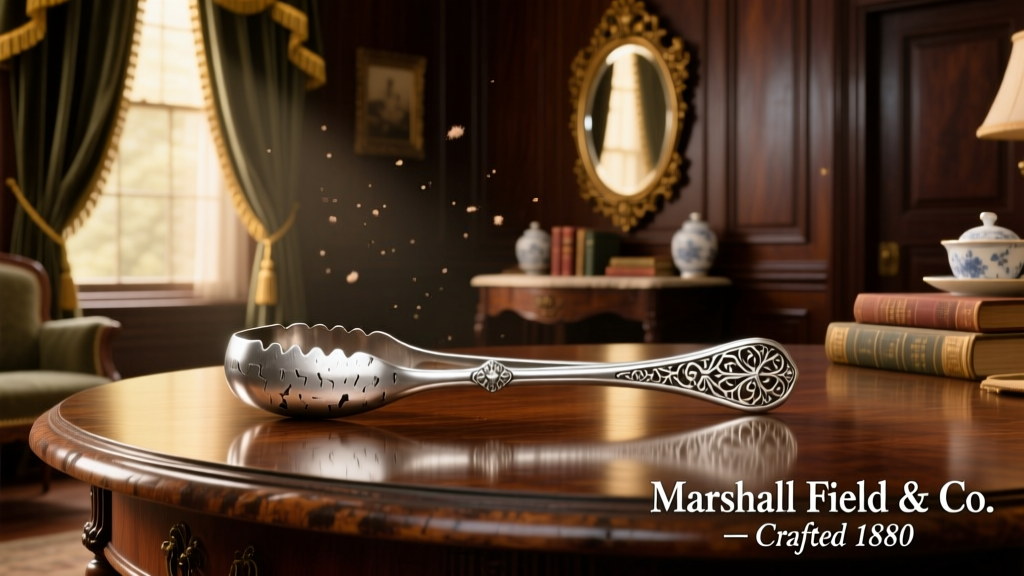
Silver American Sugar Tongs: The Hammered Marshall Field & Co. Craft, 2 7/8 Inches

Davy Crockett Game Puzzle: Fess Parker as Davy Crockett, Inlay Edition by Whitman Publishing, 1955 — A Collector’s Restoration & Historical Analysis
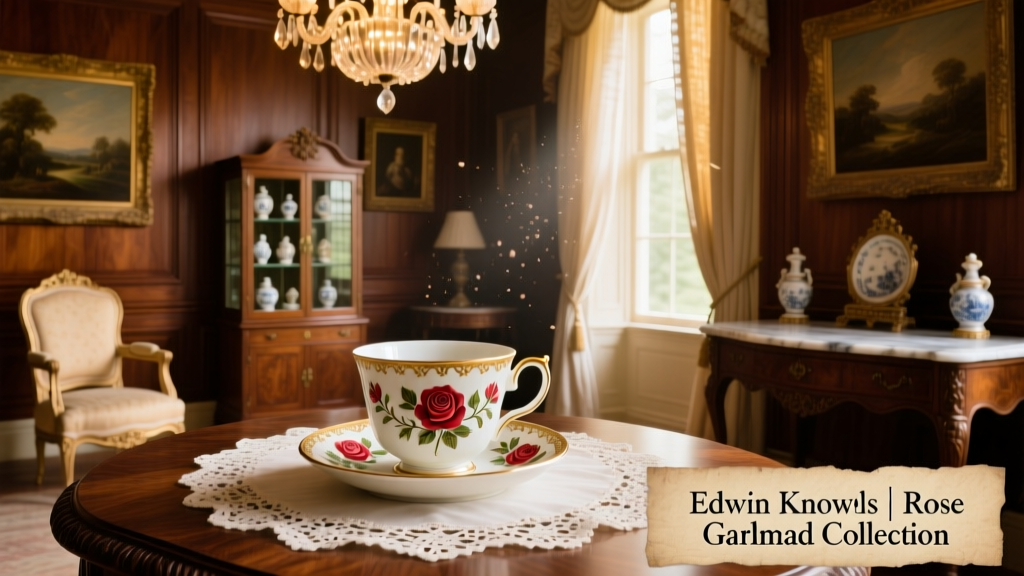
The Edwin Knowles Rose Garland Demitasse Set: History, Identification, and Care of a Mid-Century American Porcelain Treasure
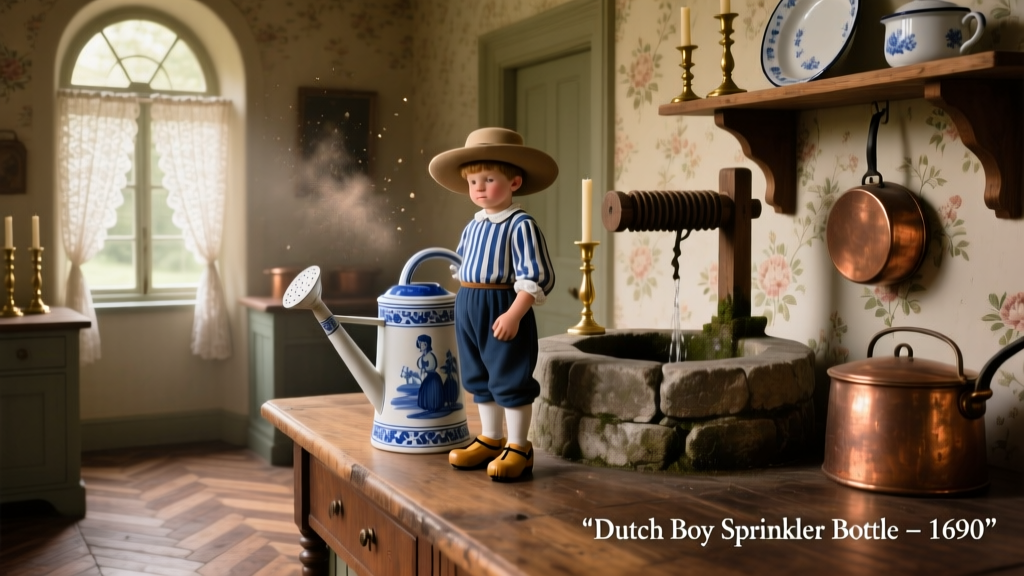
The Dutch Boy Kitchen Sprinkler Bottle: History, Identification, and Restoration of a Mid-Century American Icon
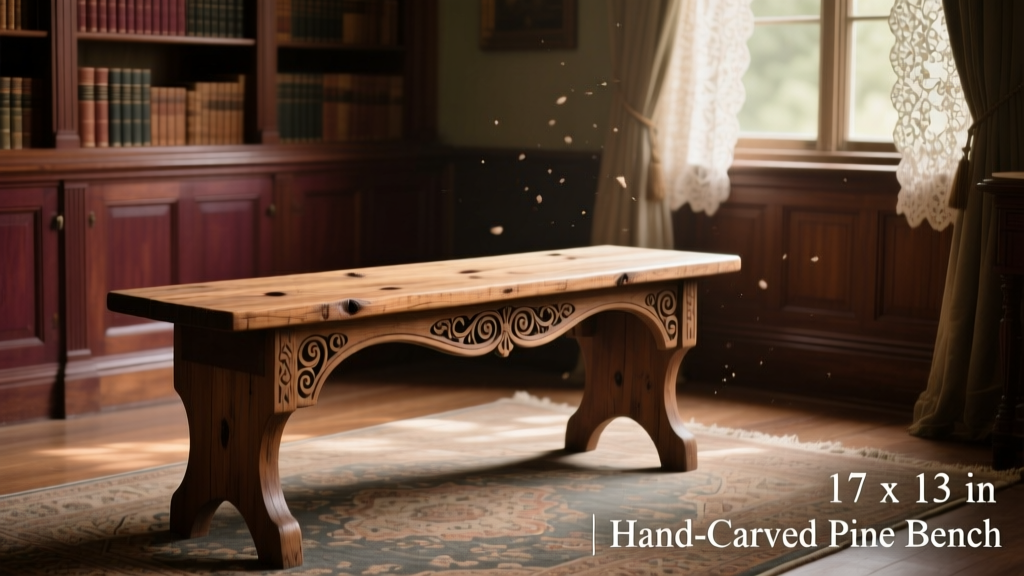
Understanding the Pine Plank Bench with Arched Supports: A Technical and Historical Analysis of the 17 × 13-Inch Format

The Tom & Jerry Punch Set: History, Identification, and Restoration of the Black Footed Bowl