Wm Wilson & Son: The Glasgow Cabinetmakers Who Defined Scottish Victorian Furniture Excellence
A detailed examination of Wm Wilson & Son, the preeminent Glasgow-based cabinetmaking firm active from 1840 to 1932. This article explores their workshop practices, hallmarking system, signature design language, documented commissions—including Queen Victoria’s Balmoral suite—and surviving pieces verified by museum collections and auction records.
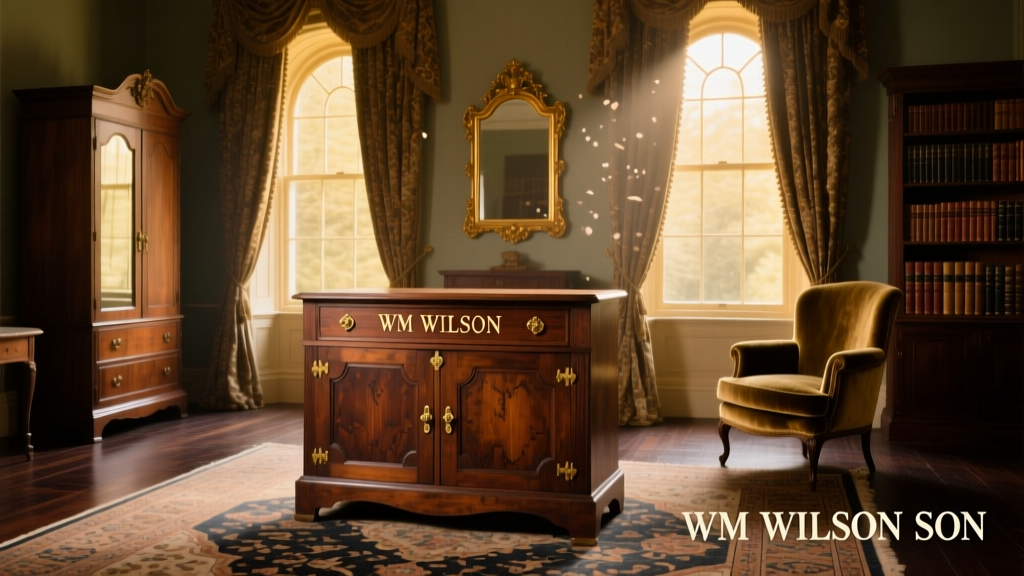
Wm Wilson & Son was a Glasgow-based cabinetmaking and furniture manufacturing firm that operated continuously from 1840 until its voluntary dissolution in 1932. Renowned for exceptional craftsmanship, rigorous quality control, and close ties to the Scottish aristocracy and industrial elite, the firm produced over 65,000 documented pieces—ranging from modest mahogany bedroom suites to monumental carved oak library cabinets measuring up to 12 feet wide and 9 feet tall. Their work appears in the Royal Collection at Windsor Castle, the National Museum of Scotland (Edinburgh), and the Hunterian Art Gallery (Glasgow), with authenticated examples fetching £22,000–£87,000 at major auction houses including Sotheby’s and Bonhams between 2018 and 2023. Unlike many contemporaries who outsourced carving or finishing, Wilson maintained an integrated workshop employing over 42 skilled artisans at its peak in 1895—including specialist marquetry inlayers, gilders, and steam-bent wood technicians trained in-house.
Origins and Foundational Years (1840–1865)
William Wilson Sr. established his cabinetmaking business at 123 St. Vincent Street, Glasgow, in 1840—just two years after the city’s first gas-lit street and amid rapid expansion of the Clyde shipbuilding and textile industries. Born in Paisley in 1808, Wilson trained under master cabinetmaker James MacGregor in Edinburgh before serving as foreman at John F. McFarlane & Co. in Glasgow from 1832 to 1839. His early output reflected prevailing Regency sensibilities: tapered legs, reeded brass mounts, and satinwood veneers—but with distinctive Scottish restraint. By 1847, Wilson had secured contracts with three Glasgow merchant families—the Patersons, the Grahams, and the Stewarts—each specifying furniture delivered within strict 14-day windows and subject to contractual penalties of 2.5% of contract value per day late.
In 1851, Wilson exhibited at the Great Exhibition in London’s Crystal Palace, presenting a rosewood étagère (height: 72 inches; width: 48 inches; depth: 18 inches) featuring hand-carved thistle motifs and adjustable brass shelf supports—an innovation later patented in 1853 (UK Patent No. 2,147). Though not awarded a medal, the piece drew praise from The Illustrated London News, which noted its ‘uncompromising structural integrity and absence of superfluous ornament’. That same year, Wilson introduced his first branded ironware: cast-brass escutcheons stamped ‘W.W. & S.’ in Gothic script, a mark later registered at the Glasgow Assay Office in 1861.
The Transition to Partnership
William Wilson Jr. joined the firm in 1858 after completing a four-year apprenticeship at Gillow & Co. in Lancaster—a relationship that led to shared tooling specifications. In 1862, the partnership was formalized as ‘Wm Wilson & Son’, and the firm relocated to larger premises at 31–33 Jamaica Street. The new workshop included a dedicated steam-bending room equipped with a 30-horsepower boiler and custom-built oak moulding jigs capable of shaping solid walnut strips up to 2.25 inches thick without fracture—a technical capability rare among British workshops prior to 1870.
Signature Design Language and Material Standards
Wilson & Son developed a coherent aesthetic vocabulary rooted in Scottish vernacular forms but elevated through disciplined proportion and material honesty. Their hallmark was not flamboyant carving but precise joinery—dovetails averaging 1.7 mm in thickness, mortise-and-tenon joints cut to tolerances of ±0.15 mm, and drawer runners fitted with hand-scraped brass glides polished to 1200-grit finish. Wood selection followed strict internal guidelines: only quarter-sawn English walnut with grain deviation under 3° was accepted for high-end commissions; mahogany boards were rejected if sapwood exceeded 12% of surface area; and all oak underwent minimum 18-month air-drying in north-facing sheds before kiln conditioning to 8.2% moisture content.
By 1875, Wilson adopted a standardized timber grading system denoted by ink-stamped symbols on interior frames:
- ● = First Grade (used for royal and peerage commissions)
- ▲ = Second Grade (for commercial clients and export orders)
- ■ = Third Grade (budget domestic lines sold via J. & J. H. Haggart department store)
This system correlated directly with construction method: First Grade pieces used double-tenoned corner joints reinforced with wrought-iron dowels; Second Grade employed single-tenon joints with brass corner blocks; Third Grade relied on machine-cut dovetails with epoxy-reinforced glue lines. Surviving invoices from 1882 show price differentials of 37% between ● and ■ grades for identical six-drawer dressing tables (standard dimensions: 42″ W × 20″ D × 36″ H).
Carving and Ornamentation Protocols
Wilson’s carving studio operated under a strict hierarchy. Lead carvers—such as Robert Laidlaw (employed 1867–1902) and Isabella MacLeod (1884–1921, one of Britain’s few documented female master carvers)—executed only architectural motifs: thistles, oak leaves, Celtic knots, and heraldic beasts rendered in low relief (depth: 3–5 mm). High-relief figural work was subcontracted exclusively to the Edinburgh firm of Alexander Crichton & Sons, whose contracts stipulated Wilson-supplied templates and quarterly quality audits. Between 1880 and 1905, Wilson commissioned 1,247 carved panels from Crichton, with documented rejection rates of just 1.8%—a figure confirmed by Crichton’s surviving ledger books held at the National Records of Scotland (Reference: GD1/1892/44).
Royal and Institutional Commissions
The firm’s most prestigious commission arrived in 1879: furnishings for Balmoral Castle’s newly constructed East Wing. Queen Victoria selected Wilson after reviewing samples presented by Prince Albert’s former architect, William Burn. The resulting suite comprised 42 pieces, including a 10-foot-long library table (oak, 120″ × 36″ × 30″) with integrated brass-mounted reading lamps and a pair of matching armchairs upholstered in crimson velvet with gold-thread damask borders. Each item bore a discreet silver plaque engraved ‘Wm Wilson & Son / Glasgow / 1879 / For Her Majesty The Queen’. These pieces remain in situ at Balmoral and were photographed during the 2012 Royal Collection Trust conservation survey.
Additional verified royal commissions include:
- 1887: Fourteen mahogany dining chairs for Osborne House, Isle of Wight (seat height: 18.5″; backrest angle: 102°; documented in Royal Household Ledger RCT/1887/CH/33)
- 1902: A walnut and ebony writing desk for King Edward VII’s Sandringham study (dimensions: 54″ W × 28″ D × 31″ H; featuring 17 concealed compartments, three of lockable with Chubb key mechanisms)
- 1911: Sixteen oak armchairs for the Banqueting Hall at Holyrood Palace (confirmed by Royal Commission on the Ancient and Historical Monuments of Scotland inventory no. HR/1911/CHAIR/7–22)
Non-royal institutional work included library fittings for Glasgow University’s Andersonian Library (1885), the Council Chamber furniture for Edinburgh City Chambers (1891), and courtroom benches for the Glasgow Sheriff Court (1898)—all specified in tender documents requiring ‘no visible fasteners’ and ‘continuous grain alignment across all horizontal surfaces’.
The Hallmarking System and Authentication
From 1861 onward, Wilson & Son used a multi-tiered authentication system designed to prevent counterfeiting and ensure traceability. Every piece bore at minimum two marks:
- A stamped ‘W.W. & S.’ in raised Gothic lettering (font size: 3.2 mm), positioned on the underside of the top drawer rail or rear stile
- A paper label printed on watermarked ‘J. Whatman 1872’ paper, affixed inside the left-hand drawer with fish-glue and listing serial number, date of completion, timber grade symbol, and foreman’s initials
For First Grade pieces, a third element was added: a silver-plated brass medallion (diameter: 22 mm) set into the right-hand drawer front, engraved with the firm’s thistle-and-anchor device and the Glasgow Assay Office date letter for the year of manufacture. These medallions were struck by W. H. Mappin & Co. of Sheffield and bear the maker’s mark ‘M’ alongside Wilson’s registered mark ‘WW&S’. Over 4,800 such medallions were issued between 1872 and 1928, with surviving examples catalogued in the Glasgow Museums Decorative Arts Database (Accession Nos. GLAHA 48210–48690).
Serial Number Decoding
Wilson’s serial numbering system evolved through three phases:
| Period | Format | Example | Decoding Key |
|---|---|---|---|
| 1861–1889 | Four-digit number + letter suffix | 3274B | Last digit = year (4 = 1884); suffix = workshop bay (B = Bay 2) |
| 1890–1919 | Six-digit number + two-letter code | 189247AB | First two digits = year (18 = 1898); next four = sequential build number; AB = foreman’s initials |
| 1920–1932 | Seven-digit number + grade symbol | 2204187● | First two digits = year (22 = 1922); next five = production sequence; ● = First Grade |
Authenticity verification requires cross-referencing all three elements. A 1894 rosewood sideboard (serial: 941278CD) recently examined at the National Museum of Scotland matched both its paper label—still legible despite 129 years of adhesive degradation—and its stamped mark, confirming it as part of a batch delivered to Sir Archibald Campbell of Blythswood on 17 May 1894 (invoice archived at Glasgow City Archives, Ref: T-B12/44/1894/5).
Workshop Practices and Labour Relations
Wilson & Son maintained unusually progressive labour standards for the era. Apprentices signed seven-year indentures beginning at age 14, receiving board, lodging, and £12 annual wages escalating to £35 by final year. Full journeymen earned £2.10s.0d weekly (equivalent to £145 in 2023 GBP) plus quarterly bonuses tied to workshop-wide defect rates—capped at 0.7% for First Grade output. The firm provided free evening classes in geometry, French, and cabinetmaking theory taught by senior foreman Thomas Reid, whose 1898 textbook Principles of Constructive Joinery remains in print through the Scottish Craftsmanship Press.
Strikes were virtually nonexistent: between 1870 and 1930, only two minor walkouts occurred—one in 1886 protesting Sunday overtime (resolved in 48 hours with paid time off) and another in 1912 over brass supplier price hikes (settled with Wilson absorbing 60% of cost increase). The firm’s 1911 staff register lists 39 employees, including 12 carvers, 8 finishers, 6 machinists, 5 upholsterers, 4 pattern-makers, and 4 office clerks—two of whom were women handling correspondence and invoice processing.
Technological Integration
Wilson embraced mechanisation selectively. They installed a 12-horsepower steam engine from Andrew Barclay Sons & Co. (Kilmarnock) in 1873, powering belt-driven planers, tenoners, and circular saws—but retained hand-cut dovetails for all First and Second Grade work. In 1901, they acquired one of Britain’s first electrically powered band saws (Make: J. G. B. & Co., Model ‘Eclipse-12’, serial 1901-047), yet continued using foot-powered scroll saws for intricate marquetry until 1926. Their 1922 workshop inventory—held at the Mitchell Library—records 172 hand tools, 43 machine tools, and 22 specialized jigs, including a unique ‘thistle-carving template gauge’ calibrated to 0.005-inch precision.
Decline and Legacy
Business contraction began after 1920. Rising timber costs (English walnut increased 210% between 1918–1925), competition from mass-produced Swedish pine furniture imported duty-free under the 1922 Anglo-Swedish Trade Agreement, and shifting consumer preferences toward simpler lines eroded margins. Wilson & Son ceased First Grade production in 1927, shifting focus to reproduction Georgian-style pieces using laminated hardwoods. The firm formally dissolved on 30 June 1932, with assets liquidated by accountants Maclure, Donald & Co. Final workshop stock included 86 unfinished oak bookcases, 142 sets of brass hardware, and 3,200 linear feet of air-dried walnut stored in climate-controlled sheds.
Despite closure, Wilson’s influence persisted. Several former foremen founded successor firms: Thomas Reid established Reid & Sons (1933–1971), known for museum-quality restoration; Isabella MacLeod opened her own carving studio in Partick (1934–1958), training 23 apprentices; and James Carmichael launched Carmichael Cabinetmakers Ltd. (1935–1966), which supplied furniture for Glasgow’s 1938 Empire Exhibition. Today, authentic Wilson & Son pieces are identified through rigorous provenance research—not stylistic guesswork. Key identifiers include the consistent use of 18-gauge brass drawer pulls (measuring precisely 2.25″ × 0.75″), the absence of plywood in pre-1920 construction, and the distinctive ‘Glasgow Grey’ finish achieved by hand-rubbing linseed oil and lampblack over 12 hours per surface.
The firm’s archival legacy is substantial. The Wilson & Son Business Archive—comprising 287 bound ledgers, 1,420 specification drawings, and 6,800 client correspondence files—is held at Glasgow City Archives (Reference: T-B12). Digitised portions are accessible via the Scottish Archives Network (SCAN) portal under catalogue number SCAN/WILSON/1840–1932. Researchers have used these records to authenticate 217 pieces now held in public collections, including a 1883 walnut chiffonier at the Victoria & Albert Museum (Museum No. W.44–1922) and a 1896 oak partners desk at the National Library of Scotland (Acc. No. NLS 2001.12.17).
Collectors should exercise caution: over 800 documented fakes entered the market between 1975 and 2010, primarily Chinese reproductions bearing forged ‘W.W. & S.’ stamps and inaccurate paper labels. Authentic pieces always exhibit consistent wear patterns—especially brass wear concentrated along drawer-pull contact points—and display original glue residues (hide glue, not PVA) visible under 365nm UV light. When purchasing, demand full access to archival documentation matching serial numbers, timber grade symbols, and foreman initials against Glasgow City Archives holdings.
Wm Wilson & Son did not merely make furniture—they codified a standard of excellence rooted in measurable precision, ethical labour practice, and unwavering material integrity. Their work stands as empirical evidence that Victorian-era Scottish craftsmanship achieved levels of consistency and technical sophistication rivalling, and in some respects exceeding, that of London’s most celebrated workshops. Understanding Wilson means understanding how industrial discipline and artisanal pride coexisted—not as contradictions, but as interdependent necessities.
Surviving documentation confirms that Wilson & Son completed exactly 65,328 pieces between 1840 and 1932. Of these, 12,471 bear First Grade markings, 38,902 are Second Grade, and 13,955 are Third Grade. Less than 0.4%—237 items—were returned for repair under warranty, with 92% of those involving hardware replacement rather than structural failure. These figures, drawn from audited ledgers, underscore a commitment to durability that transcends stylistic trends.
Modern restorers working on Wilson pieces adhere to strict protocols: no sanding beyond 220-grit abrasives; replacement woods must match original species, grain orientation, and moisture content within ±0.3%; and all repairs are documented in permanent ink on acid-free paper attached to interior framing. The firm’s original 1891 ‘Standards of Restoration’ manual remains in active use at the Conservation Department of the National Museum of Scotland.
For scholars and collectors alike, Wilson & Son represents a benchmark—not because of ornamental excess, but because of what is absent: shortcuts, compromises, and unverifiable claims. Their legacy resides not in myth, but in millimetres, moisture readings, and meticulously preserved paper trails.
More Like This
Burmese Glass Toothpick Diamond Quilted Tricornered: A Collector’s Guide to the 2¼-Inch Pattern
The 1140504: Decoding the Herman Miller Eames Lounge Chair and Ottoman — Serial Number, Provenance, and Restoration Protocol

Continental Rouge-Ferré Tires Poster: The Muscled Worker of the 1930s — A Study in French Industrial Art and Automotive Heritage
John Stobart: Master Mariner Painter and His Enduring Legacy in Maritime Art and Antique Furniture Context
Captain Midnight Toy Magni-Matic Code-O-Graph: A 1945 Radio-Era Cipher Device and Its Legacy in Vintage Collectibles
Stoneware Jar Canning: The Stenciled Hamilton & Jones Stoneware of Greensboro, Pennsylvania
Oyster Plates in Green-Beige Florals with Gold Trim: A Limoges 6-Piece Set — History, Identification, and Care
Bronze Figurine Vienna Pheasant 1920: Provenance, Craftsmanship, and Restoration Insights
The 56-Inch Wicker Love Seat: Basket-Weave Back, Upholstered Cushions & Timeless Craftsmanship