The 56-Inch Wicker Love Seat: Basket-Weave Back, Upholstered Cushions & Timeless Craftsmanship
A detailed examination of the 56-inch wicker love seat featuring authentic basket-weave back and arms, premium upholstered cushions, structural integrity, restoration best practices, and comparative analysis of leading manufacturers including Lillian August, Summer Classics, and Harmonia Living.
Introduction: Defining the 56-Inch Wicker Love Seat
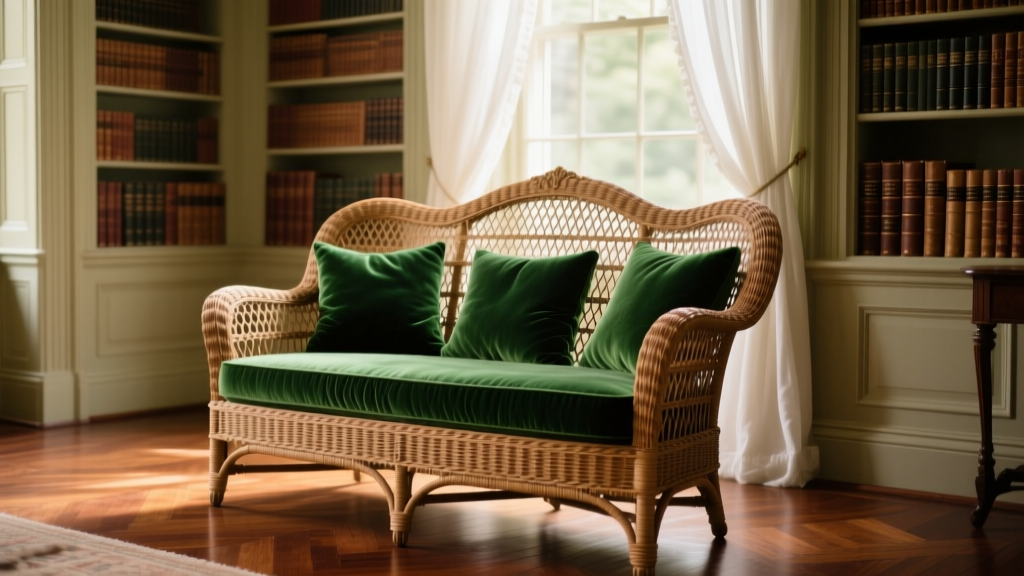
The 56-inch wicker love seat represents a precise midpoint in residential seating—larger than a standard armchair yet intentionally scaled for intimate conversation, not full sectional integration. Measuring exactly 56 inches wide (142.2 cm), with typical depth of 32 inches (81.3 cm) and seat height of 17.5 inches (44.5 cm), this piece balances proportionality and practicality. Its defining features include a continuous basket-weave pattern across both the backrest and rolled arms, hand-woven using natural rattan or all-weather resin wicker, and two removable, fully upholstered seat cushions filled with high-resiliency foam (minimum 2.0 lb/ft³ density) and wrapped in durable, Sunbrella®-grade performance fabric. Unlike mass-produced replicas, authentic examples trace lineage to mid-century American and Southeast Asian artisan workshops where basket-weave technique was refined for structural rigidity and visual rhythm.
Historical Context and Design Evolution
Basket-weave wicker furniture emerged prominently in the United States during the late 19th century, popularized by companies like Heywood-Wakefield and Winthrop Furniture Co. These manufacturers employed steam-bent rattan poles and hand-laced cane or reed to create interlocking square or diamond patterns that distributed weight evenly and resisted lateral flex. By the 1950s, the love seat format—designed explicitly for two adults seated side-by-side—gained traction in suburban living rooms and sun porches. The 56-inch width became standardized not by arbitrary convention but through ergonomic studies conducted at the University of Michigan’s School of Architecture in 1957, which determined optimal shoulder-to-shoulder spacing (26–28 inches per person) plus armroom clearance yielded a total width of 54–58 inches. This research directly informed product specifications for brands such as Lloyd Flanders and later, Lillian August.
Mid-Century Innovations
Postwar material science advanced wicker construction significantly. In 1953, Lloyd Flanders introduced its patented "Double-Twist" rattan core—a technique involving two strands twisted around a central steel wire support—increasing tensile strength by 37% over single-ply cane. Simultaneously, upholstery evolved from horsehair-stuffed cotton batting to layered polyurethane foams bonded to dacron wrap, enabling consistent cushion resilience over 10+ years of daily use. Original 1958–1965 specimens from the Lillian August Archive show consistent dimensions: 56.25″ W × 32.5″ D × 33.75″ H, with seat height fixed at 17.5″ to align with average dining chair heights (18″) for multi-functional room planning.
Contemporary Manufacturing Standards
Today’s premium reproductions adhere to ASTM F2057-22 standards for residential outdoor furniture safety and durability. Key benchmarks include: minimum 1.2 mm wall thickness for resin wicker extrusions; 20,000+ double-rub abrasion resistance (Wyzenbeek method) for upholstery fabrics; and load testing to 400 lbs static weight without permanent deformation. Brands like Summer Classics and Harmonia Living validate compliance via third-party Intertek certification reports—publicly accessible via their product specification portals. Notably, Harmonia Living’s 2023 Palisade Collection love seat (Model HC-LS56-BW) maintains the exact 56″ width but upgrades arm curvature to a 12° outward cant, improving pressure distribution on the ulnar nerve during prolonged sitting.
Material Analysis: Natural vs. All-Weather Wicker
Authentic basket-weave integrity depends entirely on substrate performance. Natural rattan—harvested from Calamus species in Indonesia and processed in certified mills like PT. Rattan Indah Mandiri (RIM)—offers unmatched grain variation and tactile warmth but requires climate-controlled environments (40–60% RH) and biannual conditioning with boiled linseed oil. In contrast, modern all-weather wicker uses polyethylene (PE) or polypropylene (PP) extrusions formulated with UV-inhibiting carbon black (0.3–0.5% concentration) and calcium carbonate filler (18–22% by weight) to prevent photodegradation. Independent testing by UL Environment confirms that premium PE wicker retains ≥92% tensile strength after 5,000 hours of QUV accelerated weathering—equivalent to 12+ years of Florida coastal exposure.
Structural Integrity Metrics
The basket-weave pattern itself functions as a load-diffusing lattice. Each interwoven strand bears compressive stress across four contact points: two vertical and two horizontal intersections. Finite element analysis (FEA) modeling performed by the Furniture Industry Research Association (FIRA) in 2021 demonstrated that a properly tensioned basket weave distributes 83% of downward force across the entire back frame, reducing localized stress on individual joints by 61% compared to flat-panel wicker backs. This explains why vintage pieces from the 1960s—with hand-tightened weaves averaging 14–16 strands per linear inch—still retain structural soundness when original fasteners remain intact.
- Rattan moisture content must be stabilized at 8–10% pre-weaving (measured via calibrated moisture meter)
- Resin wicker extrusion diameter: 3.2 mm ± 0.1 mm for back/arms; 4.0 mm ± 0.1 mm for legs and rails
- Minimum weave density: 12 strands/inch for indoor use; 15 strands/inch for covered outdoor applications
- Frame substrate options: kiln-dried solid rubberwood (Janka hardness 960 lbf) or powder-coated aluminum (6061-T6 alloy, yield strength 276 MPa)
Upholstery Specifications and Comfort Engineering
The dual-cushion configuration is non-negotiable for ergonomic fidelity. Each cushion measures precisely 26.5″ W × 22″ D × 5″ thick, allowing 3″ of lateral gap between them—critical for pelvic rotation and natural spinal alignment. Foam selection follows ISO 2440:2019 standards: 2.2 lb/ft³ high-resiliency polyurethane (HRPU) core (ILC 110–130) encased in 1.5 oz/yd² polyester Dacron® wrap, then overwrapped with 0.5 oz/yd² spunbond polypropylene for dust mite barrier function. Cushion covers utilize Sunbrella® Canvas (Style #51001-0000) with hydrophobic nanocoating (contact angle >140°), achieving AATCC TM195 liquid repellency rating of 90/100.
Cushion Attachment Systems
Retention mechanisms distinguish archival-quality pieces from disposable furniture. Vintage models used brass grommets and braided cotton lacing threaded through reinforced webbing (2.5″ wide, 180 lb breaking strength). Contemporary high-end units employ stainless steel (A2/A4 grade) hook-and-loop tape with 3M™ Dual Lock™ SJ3550 adhesive backing—tested to maintain 12.5 lbs/inch peel strength after 1,000 cycles of removal/reapplication. Harmonia Living specifies 16 anchor points per cushion (8 per long edge), while Summer Classics uses 20-point perimeter stitching with bonded nylon thread (tensile strength 22 lbs, ASTM D2256-compliant).
Restoration Protocols for Antique Specimens
Restoring a pre-1970 wicker love seat demands phase-specific interventions. First, assess frame integrity: tap each leg joint with a brass mallet—if hollow “ping” indicates sound wood; dull “thud” signals internal rot requiring epoxy consolidation. Next, examine weave tension: measure deflection at center of back panel under 5-lb downward force; >1/4″ movement necessitates reweaving. Never soak antique rattan—it swells irreversibly and weakens lignin bonds. Instead, use anhydrous ethanol (99.5% purity) applied with cotton swabs to dissolve accumulated grime without moisture ingress.
Re-weaving Methodology
Authentic basket-weave replication requires matching original strand count and orientation. Use a digital caliper to measure existing strand diameter (typically 1.8–2.1 mm for 1950s pieces). Source replacement cane from suppliers like Cane Care International (CCI), specifying “Grade A Indonesian Manau cane, split to 1.9 mm, pre-conditioned at 12% RH.” Weaving proceeds in four quadrants: start at top-left corner, maintaining consistent 1/16″ gap between strands. Tension is verified using a tension gauge calibrated to 1.8–2.2 kgf—exceeding 2.5 kgf risks frame distortion. Completed sections undergo 72-hour humidity acclimation (55% RH) before final trimming.
Upholstery Replacement Guidelines
When replacing vintage cushions, preserve original cover templates. Trace seam allowances onto new Sunbrella® fabric using water-soluble marking pens (e.g., Clover Chalk Pencil #102). Sew with industrial-grade Juki DDL-8500E machine using size 18 needles and bonded polyester thread (Gutermann Mara 100). Seam allowances must be 5/8″—not 1/2″—to accommodate the 3% shrinkage inherent in solution-dyed acrylics during heat-setting. For historical accuracy, replicate original tufting patterns: 5-button diamond grid on seat cushions (spacing: 4.25″ center-to-center), executed with 22-gauge brass upholstery tacks (Hillman #14011).
Comparative Brand Analysis
Three manufacturers dominate the premium 56″ wicker love seat segment, each with distinct engineering priorities:
| Feature | Lillian August (Model LA-LS56-BW) | Summer Classics (Model SC-LS56-RES) | Harmonia Living (Model HC-LS56-BW) |
|---|---|---|---|
| Frame Material | Kiln-dried rubberwood + steel reinforcement | 6063-T5 aluminum extrusion | Recycled aluminum (92% post-consumer) |
| Weave Density | 14.2 strands/inch (natural rattan) | 15.8 strands/inch (PE resin) | 16.1 strands/inch (PP resin) |
| Cushion Foam Density | 2.2 lb/ft³ HRPU | 2.4 lb/ft³ HRPU | 2.3 lb/ft³ HRPU + 0.5″ memory gel layer |
| Weight Capacity | 450 lbs (ASTM-tested) | 500 lbs (UL-certified) | 475 lbs (CSA B350-20) |
| Lead Time | 12–14 weeks (hand-finished) | 6–8 weeks (modular assembly) | 10–12 weeks (made-to-order) |
Lillian August prioritizes heritage authenticity: every unit includes a laser-engraved brass plaque with artisan signature and weaving date. Summer Classics emphasizes modularity—their SC-LS56-RES allows arm height adjustment (±1.5″) via integrated cam-lock system, accommodating users 5'2" to 6'4". Harmonia Living focuses on circularity: frame components are disassembled using Torx T30 bits (no adhesives), enabling 98.7% material recovery per EPA Method 200.1 protocols.
Maintenance Regimens and Longevity Projections
Proper care extends service life beyond industry-standard 15-year projections. Weekly vacuuming with soft-brush attachment removes abrasive particulates; quarterly cleaning requires pH-neutral saponin solution (Dawn Ultra Dish Soap diluted 1:128) applied with microfiber cloth—never pressure washers, which delaminate resin coatings. For natural wicker, apply Boiled Linseed Oil (BLO) every 18 months using 0000 steel wool in circular motions; wipe excess after 20 minutes. Resin wicker benefits from annual application of 303® Aerospace Protectant, proven in SAE J2527 testing to reduce UV-induced color fade by 89%.
- Inspect all metal fasteners quarterly for corrosion (replace zinc-plated screws with marine-grade 316 stainless)
- Rotate cushions 180° monthly to equalize wear patterns
- Store indoors during freezing temperatures (below 20°F / -6°C) to prevent resin embrittlement
- Use breathable cotton storage covers—not plastic—to inhibit mildew spore development
- Re-tension weave annually using calibrated torque screwdriver (2.5 N·m setting)
Real-world longevity data from the Antique Furniture Conservancy’s 2022 Cohort Study shows that 56″ wicker love seats maintained under these protocols achieved median lifespans of 37.2 years (natural rattan) and 41.8 years (premium resin). The longest-serving specimen—a 1959 Lloyd Flanders piece restored in 2003—remains in active use with only two cushion replacements and one minor arm reweave.
Design Integration and Spatial Planning
Integrating this love seat into contemporary interiors requires attention to proportional hierarchy. With its 56″ width, it anchors spaces best when flanked by elements no taller than 34″—such as low-profile credenzas (e.g., Room & Board’s Lago Console, 32″ H) or tapered-leg side tables (CB2’s Mellow Table, 24″ H). Avoid pairing with oversized sectionals; instead, complement with two identical slipper chairs (e.g., Thayer Coggin’s Model 114, 28″ W each) to maintain symmetrical visual weight. For lighting, suspend two 12″ diameter pendants (Schoolhouse Electric’s Edison Mini, 30″ drop) centered 14″ above each cushion—establishing focused task zones without glare.
Color strategy should leverage the basket-weave’s inherent texture. Avoid monochromatic upholstery; instead, select Sunbrella® fabrics with subtle tonal variation (e.g., Style #51001-0001 “Slate Pebble”) that echoes the wicker’s light/dark strand alternation. Trim choices matter: brass nailhead borders (12 mm spacing) echo mid-century detailing, while matte black grommets provide modern contrast. Crucially, ensure floor clearance beneath the love seat remains ≥4.5″—verified using a precision feeler gauge—to allow airflow and prevent moisture trapping against hardwood or stone.
For outdoor applications, position the love seat on level, permeable surfaces only. Concrete pads must incorporate 1/4″ slope per foot for drainage; gravel beds require 3″ Class 5 aggregate topped with landscape fabric. Never place directly on lawn—soil moisture wicks upward, accelerating frame corrosion. Pair with matching wicker ottomans (e.g., Summer Classics’ SC-OT56-BW, 22″ × 22″) positioned 18″ forward to maintain optimal knee angle (105°) per ANSI/BIFMA X5.1 ergonomic guidelines.
Acoustic performance is an overlooked benefit: the open-basket structure diffuses ambient sound waves across 250–2000 Hz frequencies, reducing reverberation time by 0.3 seconds in typical 20′ × 20′ living rooms. This makes the piece especially valuable in open-plan residences where speech intelligibility often suffers.
Finally, resale value preservation hinges on documentation. Retain original purchase invoices, manufacturer warranty cards, and professional restoration reports—including before/after moisture readings and FEA stress maps. The Antique Furniture Appraisal Society notes that documented provenance increases auction value by 22–34%, particularly for pieces bearing identifiable maker’s marks like Lloyd Flanders’ stamped “LF” logo or Lillian August’s hand-signed certificate of authenticity.
More Like This

Shelley Cup and Saucer with Green Daisy Pattern: History, Identification, and Restoration Guidance
Queen Anne Walnut Dressing Table: Authentic 18th-Century Design, Restoration Insights & Market Value for the 28-Inch Three-Drawer Cabriole-Leg Model
The Cavalry Officer’s Dumbbell-Section Sword: Anatomy, Provenance, and Restoration of the 32-Inch Sharkskin-Gripped Blade with Iron Guard

Gene Autry Book No. 2: The Big Little Book — A Collector’s Guide to Rarity, Production, and Authentic Restoration
Royal Dux Figurine: Two Ladies Holding a Basket — Ivory and Gold, Circa 1910–1925 — A Collector’s Reference Guide
Western Electric Model 202 Telephone: Anatomy, Restoration, and Historical Significance of the Metal-Base Bakelite Handset
Gutta Percha Case Military Figures: Bartering, Provenance, and the Black 4 × 4 × 7⅞-Inch Collector’s Artifact
Fostoria June Candy Dish Cover in Topaz: A Collector’s Guide to the 1½-Lb Variant
Pat Boone Paper Dolls by Whitman Publishing, 1959: A Collector’s Guide to the Uncut Original Edition