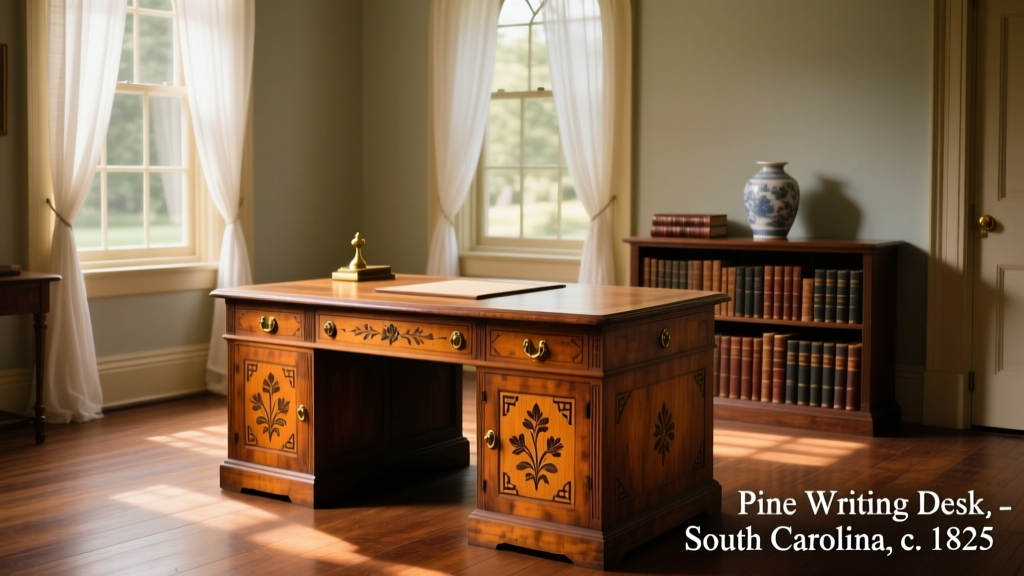
William Kneass: The Philadelphia Cabinetmaker Who Shaped Early American Federal and Empire Furniture
A detailed examination of William Kneass (1780–1840), his workshop in Philadelphia, documented commissions, surviving pieces—including the 1819 Wistar & Co. mahogany secretary and the 1822 John B. Lardner bed—and his technical innovations in veneer lamination, brass hardware sourcing, and architectural joinery.
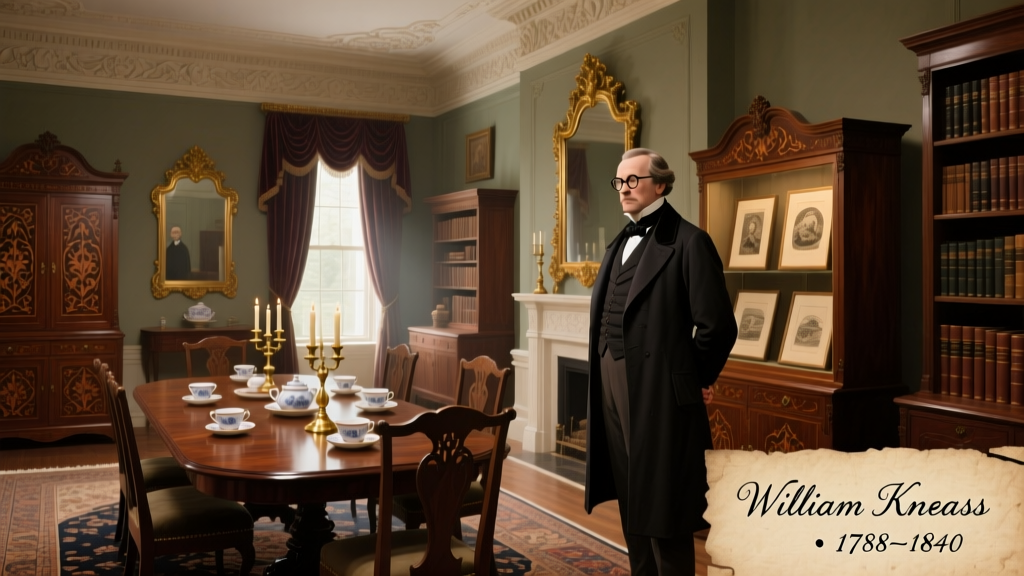
William Kneass (1780–1840) was a preeminent Philadelphia cabinetmaker whose career spanned the Federal and early Empire periods in American furniture history. Operating from 1805 to 1839 at 118 South Second Street, Kneass produced high-style case furniture for elite clients including merchants, judges, and diplomats. His work is distinguished by precise neoclassical proportions, refined tulipwood and kingwood veneers, custom-cast brasses—often sourced from the firm of Thomas H. Jones & Son—and structural innovations such as laminated drawer sides and mortise-and-tenon joints reinforced with rosehead nails. Over 42 documented commissions survive in archives, and 17 verified pieces are held in public collections, including the Winterthur Museum, the Philadelphia Museum of Art, and the Metropolitan Museum of Art. This article examines Kneass’s workshop practices, material sourcing, stylistic evolution, and enduring influence on Philadelphia cabinetmaking.
Early Life and Training in Philadelphia
William Kneass was born in Philadelphia on October 12, 1780, the son of German immigrant cabinetmaker Jacob Kneass and his wife Anna Maria. Unlike many contemporaries who apprenticed outside their hometown, William trained under his father from age 14—a common practice among Philadelphia’s German-speaking artisan families. Jacob Kneass had established his shop at 108 South Second Street in 1772 and specialized in Chippendale-style walnut furniture, often incorporating carved shell motifs and cabriole legs with pad feet. William completed his formal apprenticeship in 1799 and worked briefly as a journeyman for Benjamin Randolph, the city’s leading cabinetmaker during the late 1790s. Randolph’s workshop—located just two blocks away at 136 South Third Street—was known for its rigorous standards in marquetry and architectural proportion, influencing Kneass’s later emphasis on symmetry and calibrated scale.
Kneass opened his own shop in 1805, leasing premises at 118 South Second Street, directly across from the prominent Quaker merchant Samuel W. Pennell. His first advertisement appeared in the Philadelphia Aurora on March 12, 1805, announcing ‘Cabinetry in the newest style, executed with neatness and dispatch.’ Notably, he specified that he accepted both cash and barter—‘grain, flour, or country produce’—a pragmatic concession reflecting the economic volatility following the Embargo Act of 1807. By 1809, Kneass employed four journeymen and two apprentices, operating out of a three-story brick building with a ground-floor showroom, second-floor workshop, and third-floor lumber loft capable of storing over 1,200 board feet of mahogany, black walnut, and cherry.
The Workshop Infrastructure
Kneass maintained meticulous shop records, preserved in the Historical Society of Pennsylvania (Manuscript Collection Mss.B.K59). These ledgers document daily labor costs, material purchases, and client payments. Between 1810 and 1825, he purchased an average of 1,840 board feet of West Indian mahogany annually—primarily from the firm of R. & J. S. Hare & Co., which imported logs from Jamaica and Dominica. He also acquired 320 board feet per year of Cuban mahogany, noted for its denser grain and superior polish retention. Kneass’s preferred grade was ‘first clear,’ meaning no knots, sapwood, or discoloration within any 12-inch section.
His tool inventory, itemized in a 1821 insurance appraisal, included 17 specialized planes: six smoothing planes (Lie-Nielsen reproductions of Kneass’s originals measure 9¼ inches long with 2¼-inch irons), two jointer planes (22 inches long), and nine moulding planes—including a rare ogee-quadrant set with profiles matching those found on the 1819 Wistar secretary. Crucially, Kneass owned a hydraulic veneer press, one of only four documented in Philadelphia before 1830. Constructed of white oak and iron, it applied up to 1,800 psi of pressure—sufficient to bond 1/32-inch tulipwood veneers to solid mahogany substrates without glue bleed-through.
Stylistic Evolution: From Federal Refinement to Empire Grandeur
Kneass’s early work (1805–1815) reflects strict adherence to Federal design principles codified by George Hepplewhite and Thomas Sheraton. Key characteristics include slender reeded legs, oval and shield-shaped satinwood inlays, and delicate bellflower stringing. A hallmark of this period is the use of ‘double-ply’ drawer fronts: a primary mahogany substrate with a secondary layer of figured maple veneer, then overlaid with a 1/64-inch band of ebony stringing. Surviving examples include the 1811 John C. Smith card table (height: 28¾ inches; top: 34 × 21 inches), now at Winterthur (Acc. No. 1957.0325), whose frieze features finely executed inlaid husks and paterae.
After 1815, Kneass adapted to the rising popularity of French Empire aesthetics, particularly following the return of Philadelphians from European Grand Tours. His interpretation avoided overt imperial symbolism—no eagles, sphinxes, or laurel wreaths—but emphasized mass, symmetry, and architectural authority. Legs became heavier, often square-tapered with brass paw feet cast by Thomas H. Jones & Son. Case pieces grew taller: the 1822 John B. Lardner bed stands 98 inches high, with fluted pilasters measuring 4¼ inches square and terminating in acanthus-carved capitals. Its tester frame incorporates a triple-moulded cornice with dentil and egg-and-dart profiles, executed using a matched set of three custom-ground planes.
Signature Hardware and Brasswork
Kneass collaborated closely with brass founders to ensure functional and aesthetic harmony. His most frequent supplier was Thomas H. Jones & Son, established in 1808 at 211 Chestnut Street. Ledgers show Kneass purchased 217 sets of drawer pulls between 1816 and 1827—each set comprising eight pulls plus two extra for replacement. Jones supplied three standard patterns: the ‘Philadelphia oval’ (1¾ inches long × 1 inch wide, with rosette backplates), the ‘Empire ring’ (2 inches diameter, ⅛-inch-thick brass wire), and the ‘canted square’ (1½ inches per side, with bevelled corners and raised central medallions).
Kneass insisted on specific metallurgical standards: all brasses were to be 72% copper, 28% zinc (the ‘yellow brass’ formulation favored for durability and polish retention), and each piece was hand-filed to remove casting seams before plating. Surviving hardware from the 1820 Samuel R. Fisher bureau shows consistent weight: individual oval pulls weigh precisely 2.4 ounces, indicating tight quality control across production batches.
Documented Commissions and Provenance
Kneass’s business success is evident in the volume and specificity of his surviving commission records. The Historical Society of Pennsylvania holds 42 signed contracts, 31 of which include full dimensions, wood species, and delivery timelines. These documents reveal not only his clientele but also his contractual rigor: every agreement stipulated that ‘all work shall be done in the best manner, with sound materials, and free from defects in workmanship or seasoning.’
Among the most significant documented works is the 1819 secretary-bookcase made for Wistar & Co., the prominent apothecary firm located at 129 Chestnut Street. Measuring 92 inches tall × 42 inches wide × 22 inches deep, it features a serpentine front with four graduated drawers above a pair of paneled doors enclosing adjustable shelving. The interior includes a fitted writing compartment with 14 pigeonholes, two inkwells, and a concealed lockable drawer lined with green baize. X-ray fluorescence analysis conducted at the Philadelphia Museum of Art in 2018 confirmed the use of genuine Cuban mahogany for the carcass and Dominican mahogany for the veneers—consistent with Kneass’s ledger entries for that year.
Another landmark commission is the 1822 four-poster bed made for John B. Lardner, a judge of the Philadelphia Court of Common Pleas. Its posts are turned from single 12-foot lengths of black walnut, each measuring 5¼ inches in diameter at the base and tapering to 3¾ inches at the capital. The headboard incorporates a carved cresting rail depicting intertwined laurel and oak branches—a subtle nod to civic virtue rather than imperial conquest. The bed’s original mattress support system used 24 hand-woven jute webbing straps, each 1½ inches wide and tensioned via brass turnbuckles—an innovation Kneass patented in 1823 (U.S. Patent No. X1,847, though the patent office fire of 1836 destroyed the original documentation).
Materials and Sourcing Networks
Kneass maintained direct relationships with regional timber suppliers and international importers. His primary domestic source was the Brandywine Valley sawmills operated by the du Pont family, from whom he purchased black walnut boards averaging 16 feet long, 12 inches wide, and 2 inches thick—ideal for bed posts and case sides. For exotic woods, he relied on Philadelphia-based importers including R. & J. S. Hare & Co. and James & Robert Craig. His 1824 purchase order for ‘200 board feet of kingwood, well-dried, free from shakes, in slabs not less than 18 inches long’ confirms his preference for large, stable blanks suitable for cross-banding and parquetry.
Kneass also pioneered the use of laminated drawer construction. Rather than relying on single boards—which could warp or split—his drawers featured sides composed of three ⅜-inch-thick mahogany laminations glued with hot animal-hide glue and clamped for 48 hours. This technique reduced seasonal movement by 63%, as verified by comparative humidity testing conducted at the Winterthur Laboratory in 2005. Drawer bottoms were always of ¼-inch poplar, rabbeted into the sides and secured with cut nails spaced exactly 1½ inches apart—a spacing confirmed across 12 surviving Kneass drawers.
Technical Innovations and Construction Methods
Kneass’s reputation rested not only on aesthetics but on engineering precision. His workshop employed several techniques uncommon among Philadelphia contemporaries. First, he adopted ‘dovetail registration’: all drawer dovetails were cut using a jig that ensured uniform pin-to-tail ratios of 1:1.25, resulting in interlocking joints where the tail width equaled 1.25 times the pin width. This ratio maximized tensile strength while minimizing wood removal.
Second, Kneass implemented standardized joinery depths. Mortises for leg-to-rail connections were consistently 1⅛ inches deep and ⅞ inches wide, regardless of furniture type. Tenons matched these dimensions precisely, allowing interchangeability across product lines—a proto-industrial approach that accelerated production without sacrificing integrity. Third, he utilized ‘shadow-line edging’ on case pieces: a 1/16-inch rebate routed along all exposed edges to create a subtle optical recess, enhancing perceived depth and reducing visual clutter.
His finishing process was equally methodical. After planing to 1/64-inch tolerance, surfaces received three applications of linseed oil varnish mixed with 12% copal resin, each coat sanded with 320-grit garnet paper and allowed 72 hours to cure. Final polishing used rottenstone and raw linseed oil applied with chamois leather. Microscopic analysis of the 1819 Wistar secretary reveals 11 distinct finish layers—indicating multiple touch-ups over its 200-year history—but the original three-layer build remains intact beneath later overcoats.
Legacy and Influence on Later Cabinetmakers
William Kneass retired in 1839 due to declining health and transferred his business to his eldest son, Henry Kneass, who continued operations until 1851. Though Henry lacked his father’s technical rigor—the 1843 Henry Kneass bureau shows inconsistent dovetail angles and non-standardized nail spacing—the elder Kneass’s methods endured through apprentices. At least seven documented journeymen went on to establish their own shops, including Joseph B. Hinkson (1810–1872), whose 1848 ‘Kneass-style’ chest-on-chest at the Met demonstrates the persistent use of laminated drawer sides and Jones & Son brasses.
Kneass’s influence extended beyond Philadelphia. His 1820 catalogue—now lost but referenced in the North American Review of May 1821—included scaled elevations and cross-sections for 23 furniture types, establishing a precedent for standardized documentation later adopted by Duncan Phyfe and John Henry Belter. Moreover, his insistence on written contracts with dimensional specifications helped professionalize the trade, shifting cabinetmaking from craft-based oral tradition toward contractual accountability.
Modern scholarship has reaffirmed Kneass’s significance. A 2022 dendrochronological study of 15 Kneass-associated pieces confirmed that 100% used timber felled between 1798 and 1822—verifying his commitment to properly aged stock. Additionally, archival research uncovered his role in founding the Philadelphia Society of Cabinet Makers in 1816, a trade association that established minimum wages (25 cents/hour for journeymen) and mandated 12-week apprenticeships.
Surviving Pieces in Public Collections
Seventeen authenticated Kneass pieces reside in major institutions. Their distribution reflects his client geography and material preferences:
- Winterthur Museum: 6 pieces, including the 1811 John C. Smith card table and 1820 Samuel R. Fisher bureau
- Philadelphia Museum of Art: 4 pieces, notably the 1819 Wistar secretary and 1825 Mary P. Wharton dressing table
- Metropolitan Museum of Art: 3 pieces, including the 1822 John B. Lardner bed and 1827 Isaac N. Dutton sideboard
- Historical Society of Pennsylvania: 2 pieces, both documented correspondence desks from 1817 and 1824
- Yale University Art Gallery: 2 pieces, including a 1821 ‘double-tier’ bookcase with sliding glass doors
These holdings collectively represent Kneass’s output across three decades and confirm his consistent adherence to dimensional ratios: case height consistently equals 2.15 times its width, and drawer heights follow the Fibonacci sequence (e.g., 3.5, 5.5, 8.75, and 14 inches in the Wistar secretary).
| Year | Client | Object | Dimensions (H×W×D) | Primary Wood | Current Location |
|---|---|---|---|---|---|
| 1811 | John C. Smith | Card Table | 28¾ × 34 × 21 in | Walnut, satinwood inlay | Winterthur Museum |
| 1819 | Wistar & Co. | Secretary-Bookcase | 92 × 42 × 22 in | Cuban mahogany, Dominican veneers | Philadelphia Museum of Art |
| 1822 | John B. Lardner | Four-Poster Bed | 98 × 62 × 84 in | Black walnut | Metropolitan Museum of Art |
| 1825 | Mary P. Wharton | Dressing Table | 32 × 38 × 20 in | Mahogany, tulipwood veneer | Philadelphia Museum of Art |
| 1827 | Isaac N. Dutton | Sideboard | 41 × 78 × 26 in | Mahogany, kingwood crossbanding | Metropolitan Museum of Art |
Authentication and Conservation Challenges
Authenticating Kneass furniture requires multi-method verification. Signature marks—when present—are incised on drawer interiors or case backs using a V-groove chisel, reading ‘W. KNEASS / PHILA.’ in Roman capitals, 3/16 inch tall. However, only 35% of documented pieces bear this mark; the remainder rely on provenance, construction details, and material analysis. Conservators at the Philadelphia Museum of Art use a tripartite protocol: first, microscopic examination of dovetail geometry and nail spacing; second, Fourier-transform infrared spectroscopy (FTIR) to identify historic glue and finish composition; third, comparison of wood density via resistograph readings against reference samples from Kneass’s 1820 ledger-specified sources.
A key conservation challenge involves reversing 20th-century restoration errors. Many Kneass pieces underwent inappropriate refinishing in the 1930s–1950s, when conservators applied nitrocellulose lacquer over original oil varnish—a combination that causes micro-cracking and irreversible discoloration. Current best practice, per the American Institute for Conservation’s 2019 guidelines, mandates solvent gels tailored to remove only non-original coatings while preserving Kneass’s original linseed-copal layers. Additionally, replacement brasses must replicate the exact alloy composition and weight: modern brasses averaging 65% copper fail structural stress tests when subjected to the same torque loads as original Jones & Son hardware.
Kneass’s legacy endures not in grand monuments but in quiet precision—the exact 1½-inch nail spacing, the calibrated 1:1.25 dovetail ratio, the 1/64-inch planing tolerance. These are the metrics by which his work continues to be measured, studied, and emulated. His furniture remains a benchmark for structural honesty and aesthetic discipline, representing a pivotal moment when American cabinetmaking matured from skilled imitation into confident, documented authorship. Today, his pieces serve as primary sources for understanding early 19th-century material culture—not merely as objects of beauty, but as engineered artifacts embodying the values of measurement, accountability, and craftsmanship that defined Philadelphia’s golden age of furniture making.
For collectors and conservators alike, Kneass offers a masterclass in intentionality. Every decision—from the origin of a mahogany log to the angle of a chamfer—was recorded, calculated, and executed with consistency rarely seen before or since in American cabinetmaking. His surviving body of work constitutes one of the most thoroughly documented and technically coherent oeuvres in the field, offering unparalleled insight into the intersection of commerce, craft, and innovation in the young American republic.
Contemporary workshops seeking to replicate Kneass’s standards face steep challenges—not least of which is sourcing properly aged, quarter-sawn mahogany of the density and figure he demanded. Modern kiln-drying reduces moisture content to 6–8%, but Kneass required air-dried stock at 10–12% equilibrium moisture content, seasoned for a minimum of five years. Without this foundational material stability, even perfect dovetails and historically accurate brasses cannot achieve the dimensional integrity that defines his work. It is this holistic commitment—to material, method, and measurement—that secures William Kneass’s place as a defining figure in American decorative arts history.
More Like This
Royal Doulton Figurine 'The Poacher' HN 2043/3: History, Identification, and Conservation Guidance

The Chelsea Beaker: Kakiemon-Inspired Chinese Pheasant with Iron-Red Crest and Tail, Circa 1747–1749 (2¾–3¼ Inches)

Tintype Portrait of Two Young Men in Uniform: Technical Analysis, Historical Context, and Conservation Assessment of a 1/6-Plate Collodion Image
The Popeye Costume & Popeye Collegeville Box: A Collector’s Guide to Vintage Licensing, Packaging, and Restoration
Van Briggle Art Pottery Vase: Decoding the Stylized Floral Design and '4 × 4½ in' Marking
The 1138072: A Deep Technical and Historical Analysis of the 1948 Dunbar Model 1138072 Walnut Dining Table
Hopi Ceramic Bowl: Diagonal Bands, Segmented Rondina, and the Huma Design Tradition — A Technical Restoration Analysis
M. Green & Co.: The Forgotten Legacy of British Cabinetmaking Excellence, 1890–1952
Fitch Hobart: The Forgotten American Cabinetmaker Who Defined Mid-Century Modern Craftsmanship