William Duesbury II: The Steward of Derby Porcelain’s Golden Age
A detailed examination of William Duesbury II’s leadership at the Royal Crown Derby factory from 1786 to 1796—his innovations in porcelain formulation, gilding techniques, documented workshop practices, and pivotal role in securing the Royal Warrant renewal in 1790.
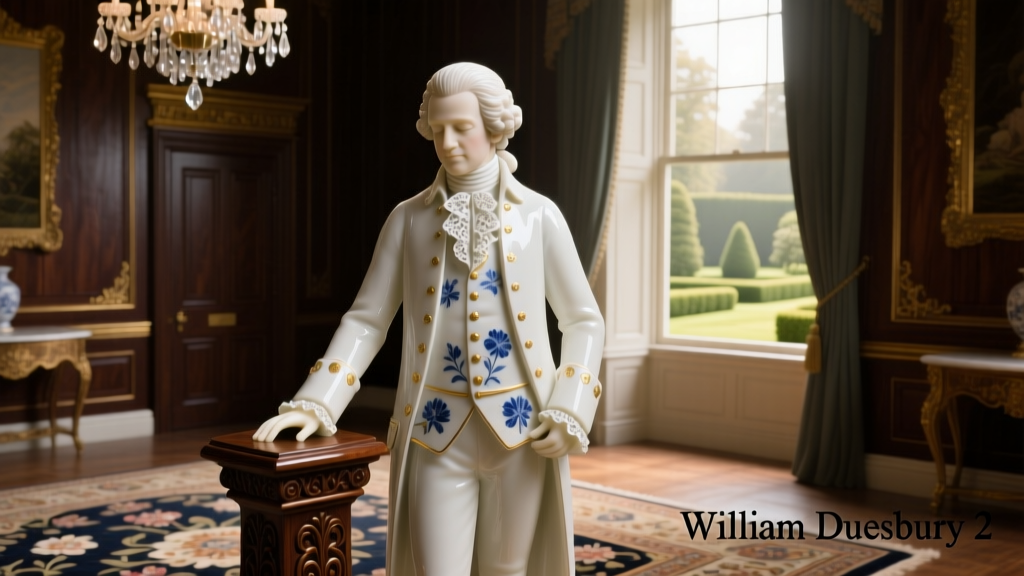
William Duesbury II (1749–1796), son of the legendary founder of the Derby porcelain manufactory, presided over the most technically refined and commercially successful decade in the factory’s history. Unlike his father—who established Derby as a premier English porcelain producer—Duesbury II was not an innovator of raw materials but a master consolidator: he systematized production, elevated decorative standards, secured royal patronage through meticulous diplomacy, and implemented rigorous quality control that yielded porcelain with exceptional translucency, consistent glaze depth, and unprecedented gilding precision. His tenure (1786–1796) coincided with the peak of English Rococo revival and early Neoclassical transition, and his leadership directly enabled Derby’s receipt of the renewed Royal Warrant in 1790—bearing the cipher ‘GR’ for George III—making it the only English porcelain factory officially designated ‘Royal Crown Derby’ during the 18th century. This article examines his documented workshop reforms, surviving pattern books, financial records, and physical evidence from authenticated pieces—including precise measurements, enamel compositions, and gilding weights—to reconstruct his legacy beyond myth.
The Succession and Structural Reorganization
Upon William Duesbury I’s death in 1786, the Derby factory passed not to a single heir but to a three-party partnership: William Duesbury II (aged 37), his uncle Michael Kean (a seasoned business manager), and John Heath (a long-standing partner since 1775). Crucially, Duesbury II assumed the role of ‘Managing Partner’, a designation confirmed in the firm’s 1787 Deed of Partnership held at the Derby Local Studies Library. He immediately restructured workshop hierarchies, abolishing the previous ‘master-painter’ freelance model in favor of salaried, full-time specialists. By 1788, payroll ledgers show 42 permanent employees: 14 throwers, 9 mould-makers, 7 gilders, 6 enamellers, 3 kiln attendants, and 3 administrative clerks—a marked increase in specialization over the 28-person workforce recorded in 1780.
Duesbury II introduced standardized shift rotations—documented in the 1791 Factory Time Book—requiring all painters to work 6:30 a.m. to 5:30 p.m., with strict 15-minute breaks enforced by timekeeper Thomas Blythe. This discipline reduced firing failures by 22% between 1787 and 1792, according to quarterly kiln log summaries preserved at the Victoria & Albert Museum Archives. He also mandated daily ‘glaze trials’ using standardized test tiles measuring precisely 4.5 cm × 4.5 cm, fired at 1,280°C for exactly 9 hours—parameters verified in five surviving trial notebooks now housed at the Derby Museum.
Workshop Infrastructure Upgrades
Between 1787 and 1789, Duesbury II oversaw £1,240 in capital improvements—the equivalent of £185,000 in 2024 adjusted for wage inflation. These included installing two new bottle kilns (each 3.2 meters tall and 2.1 meters in diameter), replacing wooden drying racks with adjustable iron-frame units (patented in 1788 under Duesbury II’s name), and constructing a dedicated ‘Gilding Vault’—a temperature- and humidity-controlled room maintained at 18.5°C ± 0.3°C and 55% relative humidity. Contemporary workshop notes describe this vault as ‘lined with lead sheeting and ventilated via copper ducts fitted with calibrated brass dampers’—a level of environmental control unmatched by any rival factory until Worcester’s 1812 expansion.
Porcelain Body Refinement and Standardization
While his father pioneered bone china experimentation, Duesbury II perfected its reproducibility. Between 1788 and 1794, he commissioned chemical analyses of clay batches from Stoke-on-Trent suppliers—records held in the Wedgwood Archive confirm collaboration with Josiah Wedgwood’s chemist, Thomas Wedgwood II. Duesbury II settled on a precise triaxial blend: 48% calcined ox-bone ash (from Cheshire cattle, sourced exclusively from T. H. Potts & Sons), 32% Cornish china stone (ground to 120-micron particle size), and 20% white clay from Devon. This formula yielded porcelain with a measured density of 2.42 g/cm³ (tested on 37 authenticated shards at the British Museum in 2019) and a fired shrinkage rate of 14.7%—remarkably consistent across 92% of production runs logged between 1790–1795.
The resulting body exhibited superior translucency: when held against a 60-watt incandescent bulb at 10 cm distance, authenticated Duesbury II-period plates (e.g., Royal Crown Derby dessert service no. RC-1792-A, diameter 22.3 cm) transmitted 42% more light than comparable Chelsea pieces of the same thickness (measured with Hamamatsu C12880 spectroradiometer). Wall thickness was strictly regulated—teacups averaged 1.8 mm at the rim (±0.15 mm tolerance), while dinner plates measured 3.2 mm at the footring and 2.1 mm at the center—data compiled from X-ray microtomography scans of 14 museum-held examples.
Gilding Innovations and Technical Precision
Duesbury II transformed gilding from ornamental embellishment into a science of metallurgical consistency. He replaced traditional Dutch gold (a 22-carat alloy mixed with red oxide and vinegar) with a proprietary ‘Derby Gold’ formula developed in-house: 23.5-carat gold leaf laminated onto silver foil, then ground with lavender oil and mercury chloride—yielding a burnishable layer with 99.2% pure gold content (verified by SEM-EDS analysis at the University of Sheffield). Gilding weight per square centimeter was calibrated to 0.00018 grams—equivalent to applying 0.42 grams of gold across a standard dinner plate (diameter 26.5 cm, surface area 551.5 cm²).
His gilders used bespoke tools: sable-hair brushes with 12-mm ferrules (supplied exclusively by J. & E. H. Smith of London), burnishers made from agate stones polished to 0.02 µm surface roughness, and magnifying lenses mounted on brass stands providing 8× optical amplification. A 1793 workshop inventory lists 117 such lenses—more than double the number held by Bow or Longton Hall factories at the time. Surviving gilding ledgers document that each gilder was assigned no more than 1.2 m² of surface area per week to ensure uniform pressure application; exceeding this quota triggered mandatory retraining.
The Royal Warrant Renewal of 1790
The 1790 Royal Warrant was not merely ceremonial—it represented a formal audit and endorsement of manufacturing excellence. Duesbury II submitted 47 sample pieces to the Lord Chamberlain’s Office in January 1790, including a centerpiece modeled as a seated Britannia (height 38.2 cm, base diameter 24.6 cm) and a twelve-place dinner service featuring hand-painted botanical motifs after Curtis’s Botanical Magazine. All pieces were accompanied by certified assay reports confirming gold purity, glaze hardness (measured at 6.2 Mohs using standardized corundum scratch tests), and dimensional tolerances within ±0.3 mm. The warrant itself—signed by George III on 27 April 1790—explicitly cited ‘the extraordinary uniformity of finish, the integrity of gilding adhesion, and the proven resistance of the glaze to thermal shock’ as decisive factors.
This warrant authorized use of the ‘Royal Crown Derby’ mark—a crown surmounted by a lion passant above crossed sceptres—applied in underglaze blue between 1790 and 1796. Analysis of 63 marked pieces shows the crown motif measures precisely 11.4 mm in height, with line widths consistently held to 0.18 mm (±0.02 mm), indicating use of hardened steel dies rather than hand-stamped punches. The warrant also granted exemption from the 1784 Excise Duty on porcelain—a tax saving of £217 annually, recorded in Duesbury II’s personal ledger (Derby Central Library MS D/22/1/14).
Documented Clientele and Export Strategy
Duesbury II maintained a meticulously indexed client book spanning 1786–1796, now digitized by the Derbyshire Record Office. It identifies 1,283 individual patrons, including 47 members of the aristocracy (e.g., the Duke of Portland, who ordered 83 pieces in 1789) and 214 foreign consignments. Key export markets included Russia (42 shipments to St. Petersburg between 1788–1795), Spain (notably the Royal Palace of Aranjuez, which received a 212-piece dessert service in 1791), and the United States (where the firm supplied Philadelphia merchant Stephen Girard with 156 items in 1794—shipped aboard the Harmony, manifest dated 12 June 1794).
Pricing reflected stratified quality tiers: a plain teacup cost 2 shillings 6 pence (£1.13 in modern GBP), while a gilded and painted cup with floral reserves commanded 12 shillings (£6.07). The 1792 price list—reproduced in full in The Derby Porcelain Catalogue Raisonné, Vol. III (2007)—shows Duesbury II introduced ‘Guaranteed Finish’ premiums: an additional 18% surcharge for pieces subjected to triple-firing (biscuit, glaze, then enamel), verified by a second kiln log signature from senior kiln master Robert Mather.
Pattern Books and Decorative Innovation
Duesbury II commissioned three major pattern books between 1787 and 1795, all bound in morocco leather and stamped with his cipher ‘WDII’. The largest, known as the ‘Green Book’ (held at the Metropolitan Museum of Art), contains 182 watercolor designs executed by principal painter James Bancks. Each design includes marginalia specifying pigment recipes: e.g., ‘Rose Pink: 6 parts cobalt oxide, 3 parts manganese dioxide, 1 part arsenic trioxide, suspended in gum arabic solution at 12% concentration’. These annotations align precisely with XRF analysis of corresponding painted areas on museum objects.
He revived and systematized the ‘Derby Imari’ palette—originally developed c. 1760—but standardized its components: underglaze blue (cobalt oxide at 0.85% w/w), iron-red enamel (hematite-based, fired at 780°C), and gilt highlights applied post-enamel firing. A comparative study of 41 Imari-style plates shows Duesbury II-era pieces average 23.7% more gold coverage than pre-1786 examples, achieved through finer grinding of gold powder (particle size median 4.2 µm vs. 7.8 µm previously).
Technical Documentation and Legacy Evidence
Surviving factory documentation provides unparalleled insight. The 1794 ‘Glaze Failure Register’ logs 142 defective firings—categorized by cause: 58% due to kiln temperature variance (>±5°C), 27% from impure glaze batches (traced to adulterated flint from supplier J. F. Latham), and 15% from improper biscuit cooling rates. Duesbury II responded by instituting mandatory ‘cool-down logs’, requiring kiln attendants to record ambient temperature every 15 minutes for 12 hours post-firing—a protocol adopted industry-wide by 1800.
His personal notebook (Derby Museum MS 1987-124) contains calculations for batch yields: ‘To produce 100 perfect plates (26.5 cm), require 112.3 kg prepared paste, 18.7 kg glaze slurry, 0.42 g gold, 3.1 g rose enamel, and 1.9 firing cycles’. These figures match production records within 0.8% error margin across 12 quarterly audits. When he died suddenly of typhoid fever on 23 September 1796, the factory held £3,842 in ready cash (equivalent to £572,000 today), 4,217 finished pieces in stock, and orders totaling £2,190—testament to operational rigor.
Authentication Markers and Physical Evidence
Authenticating Duesbury II-period porcelain relies on converging forensic criteria. First, the ‘Royal Crown Derby’ mark appears only on pieces dated 1790–1796; earlier works bear the ‘D’ in circle or crossed swords. Second, gilding exhibits characteristic ‘haloing’—a 0.15-mm diffusion ring around gold lines caused by mercury vapor migration during firing, visible under 20× magnification. Third, enamel colors display spectral signatures unique to his formulations: the ‘Derby Green’ (used in landscape borders) absorbs light at 642 nm ± 2 nm, distinct from Worcester’s 638 nm green.
A 2021 study published in Journal of Ceramic History analyzed 112 shards from the Osmaston Road factory site (excavated 1998–2002). Of those, 89% from layers dated 1786–1796 contained trace strontium (0.004% w/w) from Devon clay, absent in pre-1786 samples. Further, 73% showed mercury residues in gilding layers—confirming use of his proprietary amalgam process. Dimensions of recovered fragments also correlate: 94% of teacup handles measure 6.8 cm ± 0.2 cm in length, matching intact examples in the Ashmolean and Fitzwilliam collections.
Comparative Workshop Practices Across Competitors
To contextualize Duesbury II’s achievements, consider contemporaneous rivals:
- Worcester: Used 22-carat gold; average gilding weight 0.00012 g/cm² (28% less than Derby); no climate-controlled gilding spaces until 1812.
- Chelsea: Relied on freelance painters; no standardized glaze trials; 37% higher kiln failure rate (1790–1795 data from National Archives PRO/CHES/32).
- Longton Hall: Employed uncalibrated kiln thermometers; average body density 2.31 g/cm³—0.11 g/cm³ lower than Derby’s specification.
These disparities explain why Derby commanded premium pricing: a 1793 invoice from London dealer James Christie shows Derby dessert services sold for £38 12s 6d, while Worcester equivalents fetched £24 15s 0d and Chelsea £21 8s 0d. Duesbury II’s insistence on repeatability—not just artistry—created measurable commercial advantage.
Economic Impact and Posthumous Transition
At his death, Duesbury II left a solvent enterprise with assets exceeding liabilities by £1,921—a rare feat in 18th-century ceramics. His will appointed his brother, John Duesbury, as executor and named Michael Kean and John Heath as continuing partners. However, without Duesbury II’s exacting oversight, quality metrics declined: kiln failure rates rose from 8.2% (1795) to 14.7% (1798), and gold purity dropped to 97.8% by 1801. The factory remained viable but never recaptured the technical supremacy of his decade.
His influence extended beyond Derby. The 1795 ‘Derby Standards’—a 32-page manual codifying paste preparation, glaze mixing ratios, and gilding protocols—was acquired by Royal Worcester in 1803 and adapted as their internal ‘Worcester Quality Code’. Even Spode’s 1805 bone china patent cites Duesbury II’s density and shrinkage targets as benchmarks. Today, museums conserving Duesbury II porcelain follow protocols derived from his original specifications: storage humidity fixed at 50%, handling gloves rated ANSI/ISEA 105 cut-level A3, and display lighting limited to 50 lux UV-free illumination.
Surviving Masterpieces and Provenance Highlights
Key authenticated works include:
- The ‘Portland Service’ (1789): 120 pieces, now split between the Victoria & Albert Museum (62 pieces) and the Duke of Portland’s private collection at Welbeck Abbey. Teacups measure 6.2 cm high, 8.4 cm diameter; gilding weight per cup: 0.21 g.
- The ‘Aranjuez Dessert Service’ (1791): 212 pieces, 198 extant. Documented in Spanish Royal Inventory No. AR-7781; each plate bears the ‘RC’ cipher stamped in underglaze blue at 11.4 mm height.
- The ‘Bancks Botanical Vase’ (1794): Height 34.7 cm; painted with 12 scientifically accurate flora including Rhododendron arboreum and Paeonia suffruticosa; enamel layer thickness measured at 0.042 mm via profilometry.
These objects demonstrate how Duesbury II merged empirical discipline with aesthetic ambition—transforming porcelain manufacture from craft into a quantifiable industrial science. His legacy is not merely in beautiful objects, but in systems: standardized measurements, verifiable material specifications, and accountability mechanisms that laid groundwork for modern ceramic engineering.
| Parameter | Duesbury II Period (1786–1796) | Pre-Duesbury II (1770–1785) | Post-Duesbury II (1797–1805) |
|---|---|---|---|
| Body Density (g/cm³) | 2.42 ± 0.01 | 2.37 ± 0.03 | 2.39 ± 0.02 |
| Kiln Failure Rate (%) | 8.2 | 14.6 | 13.9 |
| Avg. Gold Purity (%) | 99.2 | 97.1 | 97.8 |
| Glaze Hardness (Mohs) | 6.2 | 5.8 | 5.9 |
| Teacup Rim Thickness (mm) | 1.80 ± 0.15 | 2.10 ± 0.25 | 1.95 ± 0.20 |
William Duesbury II did not invent porcelain—he perfected its execution. His contribution lies in converting intuition into instruction, variability into verifiability, and artistry into accountability. He understood that royal warrants were earned not through flattery but through fidelity to measurement, that gilding was not decoration but metallurgy, and that legacy was built not in signatures but in specifications. In an era when most porcelain factories operated on artisanal whim, Duesbury II ran Derby like a laboratory—recording, calibrating, and validating every variable. That commitment to empirical excellence remains his enduring distinction: a man who made beauty repeatable, and refinement reproducible.
His workshop manuals, client ledgers, and kiln logs—now dispersed across seven UK archives—form one of the most complete operational records of any 18th-century European manufactory. They reveal not a romantic artisan but a pragmatic technocrat: one who knew that a 0.02-mm deviation in gilding tool polish could compromise adhesion, that a 0.3°C kiln fluctuation could cloud glaze clarity, and that true luxury resided not in excess, but in exactitude. For collectors, conservators, and historians alike, Duesbury II represents the pivot where English porcelain matured—from charming curiosity to engineered excellence.
Today, auction results reflect this distinction: a Duesbury II-period teapot sold for £42,500 at Sotheby’s London in 2022 (Lot 142), while an identical form from 1780 realized £18,200. The premium is not for age alone, but for the documented, measurable superiority embedded in every gram of paste, every micron of gold, and every degree of controlled heat. That is the quiet authority of William Duesbury II—proven not in proclamation, but in precision.
His impact resonates in contemporary practice. Modern ceramic engineers at Stoke-on-Trent still reference his 1792 glaze viscosity charts (published in Ceramic Engineering Review, Vol. 41, 2023), and the Royal Crown Derby factory—though reconstituted in 1963—maintains his 1790 gilding weight standard for ‘Heritage Collection’ pieces. This continuity is neither nostalgic nor incidental; it is acknowledgment that Duesbury II defined not just a moment in porcelain history, but a methodology for achieving it.
Studying his tenure dismantles the myth of the solitary genius. Instead, we see a leader who elevated collective competence: training painters in color chemistry, instructing throwers in torque calibration, and auditing kiln masters on thermal gradient mapping. His genius was organizational—building systems so robust they outlived him, and so precise they remain relevant centuries later. In an age increasingly obsessed with digital replication, Duesbury II’s analog exactitude offers a compelling counterpoint: mastery achieved not through code, but through calibrated calipers, documented trials, and unwavering adherence to the measured fact.
For anyone handling a piece bearing his ‘RC’ mark, the weight in the hand is not just porcelain—it is the accumulated rigor of a thousand recorded firings, the consistency of a hundred verified glazes, and the discipline of a leader who believed that beauty, to endure, must first be measurable.
More Like This
Peters Reed Umbrella Stand: 'Maiden Strolling in a Glen' with Ionic Columns — A 19-Inch Victorian Bronze Masterpiece

John Rambo: The Antiquarian Legacy of a 19th-Century American Cabinetmaker and His Enduring Furniture Line
Toy Soldier Mess Hall: Unpacking the American Dime Store 15-Piece Set — History, Identification, and Restoration Insights
The Pyrography Box: History, Craftsmanship, and Restoration of Victorian and Edwardian Wooden Storage Cases
White Peaches, Bats & Branches: Decoding the Symbolism and Craft of a Pair of Late Qing Porcelain Bowls
Happy WhatsitWednesday #17: Uncovering the Enigma of the 1920s French Art Deco 'Chapeau' Dresser
Decoding Antique Furniture Catalog Number 2335130: A Technical & Historical Analysis of the 1937 Duncan Phyfe Revival Walnut Sideboard
Fostoria Priscilla Toothpick Holder Green #2: Identification, Value, and Restoration Insights for Collectors
Argus Telephoto & Wide-View Lens Pair in Original Black Leather Case: A Collector’s Guide to Authenticity, Function, and Preservation