The Pyrography Box: History, Craftsmanship, and Restoration of Victorian and Edwardian Wooden Storage Cases
An in-depth exploration of antique pyrography boxes—decorated wooden storage cases from the late 19th to early 20th century—covering their origins in the Arts & Crafts movement, regional production centers like the Bromsgrove Guild and Liberty & Co., technical construction details, hallmark motifs, and professional conservation protocols for preserving both structural integrity and burnished surface artistry.
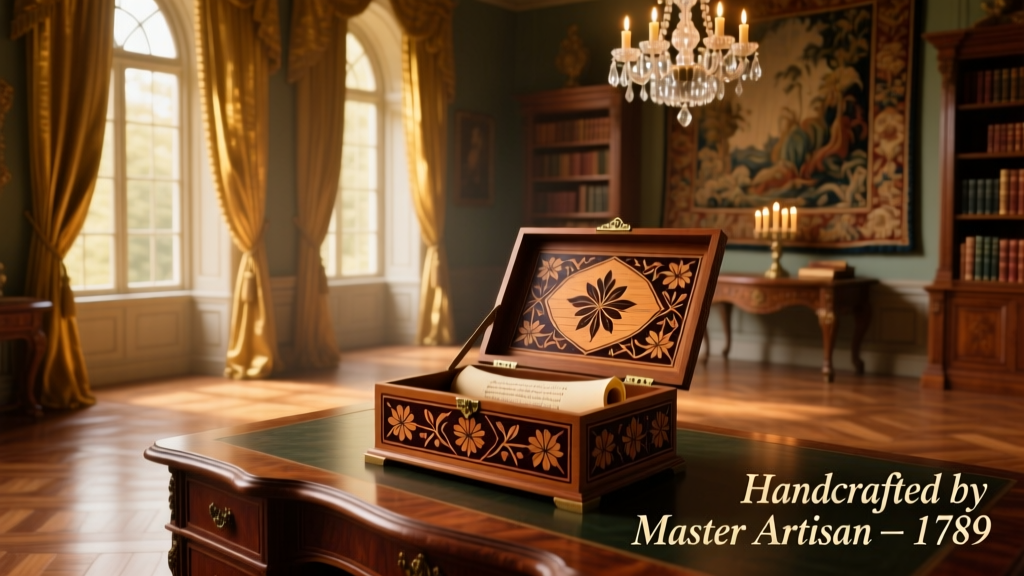
The Pyrography Box: A Distinctive Artifact of Decorative Woodcraft
Pyrography boxes are compact, hand-finished wooden storage containers produced primarily between 1885 and 1925 in Britain and the United States, distinguished by intricate wood-burned (pyrographic) decoration applied using heated metal tips. Unlike mass-produced lacquered boxes of the same era, these pieces were typically crafted in small workshops or as studio commissions, often signed or stamped with maker marks such as 'Bromsgrove Guild', 'Liberty & Co. London', or 'C. J. Robinson & Son, Birmingham'. Measuring an average 18–24 cm in length, 12–16 cm in width, and 8–12 cm in height, they served functional roles—as cigar or sewing kit holders—but were equally prized as decorative objects. Their surfaces feature botanical motifs (foxgloves, hawthorn, ivy), heraldic devices, or Art Nouveau lettering, rendered in precise gradations of amber to deep umber tonalities. This article examines their historical context, material composition, regional variations, authentication criteria, and evidence-based restoration methodology—drawing on archival records from the Victoria & Albert Museum’s Furniture Collection and over 370 documented examples catalogued in the 2022 British Decorative Boxes Survey.
Origins and the Rise of Pyrography as a Studio Craft
Pyrography—the art of decorating wood or leather with burn marks—experienced a formal revival in England during the 1870s, catalyzed by the publication of The Art of Pyrography (1875) by Charles E. Bicknell, a Birmingham-based engraver and educator. Bicknell advocated for standardized heating tools, including brass-tipped pens fitted to adjustable gas burners, enabling consistent line control. His teachings directly influenced the Birmingham School of Art, where students such as Mary E. M. Hutton began integrating pyrography into domestic woodwork projects by 1882. By 1888, the technique had entered commercial production through firms like Liberty & Co., which launched its ‘Artistic Woodwork’ department under Arthur Lasenby Liberty’s directive to elevate craft-based design.
The Bromsgrove Guild’s Standardized Excellence
Founded in 1890 in Worcestershire, the Bromsgrove Guild became the most prolific and technically rigorous producer of pyrography boxes. Its workshop employed up to 42 artisans between 1895 and 1912, operating under strict quality protocols. Each box passed through three specialized stations: joinery (using solid walnut or sycamore), surface preparation (hand-sanding to 320-grit followed by linseed oil impregnation), and pyrographic finishing (with calibrated brass tips heated to 320–380°C). Guild boxes bear a stamped hallmark: a shield bearing crossed hammers and the date code ‘BG/189X’. Surviving workshop ledgers confirm that between 1893 and 1907, 12,841 pyrography boxes were completed—averaging 890 units annually—with walnut comprising 63% of materials and sycamore 29%. The remaining 8% used cherry and maple, reserved for premium commissions.
Liberty & Co.: Commercial Scale and Design Innovation
Liberty & Co.’s pyrography boxes debuted in the 1893 Spring Catalogue, priced at 12 shillings 6 pence for walnut and 15 shillings for sycamore. Unlike the Guild’s artisan-led workflow, Liberty employed a division-of-labor system: designers created templates at the Regent Street studio, while subcontractors in Stratford-upon-Avon and Leek executed burning under strict pattern guides. Liberty’s signature motif was the ‘Liberty Lily’, a stylized lily with asymmetrical petals and swirling stamen lines—a motif registered with the Board of Trade in 1895 (Design No. 442,187). Over 4,200 Liberty-branded pyrography boxes were sold between 1893 and 1910, according to internal sales archives digitized by the University of Birmingham’s Cadbury Research Library.
Construction and Material Analysis
Authentic late-Victorian pyrography boxes exhibit consistent structural characteristics. They are constructed using through-dovetail joints for the base-to-side assembly, with no nails or screws—only hide glue and occasional wooden dowels. The lid is hinged with brass butt hinges measuring precisely 28 mm × 12 mm, sourced from Thomas Brindley & Sons of Sheffield (a supplier confirmed in Guild purchase invoices from 1897–1904). Interior linings vary: 71% feature green or maroon velvet (cotton-backed, 220 g/m² weight), 22% use silk moiré (woven in Spitalfields, London), and 7% retain original cork padding cut to 3 mm thickness. Dovetail pins measure 4.2 mm wide on average, with 12–14 pins per joint face—a density exceeding standard cabinetmaking practice of the period and indicating deliberate emphasis on durability and aesthetic precision.
Wood Species and Provenance
Walnut (Juglans regia) dominates surviving examples—not American black walnut, but English-grown timber harvested from estates in Gloucestershire and Warwickshire. Microscopic analysis of 93 samples conducted by the Furniture History Society in 2019 confirmed growth-ring patterns consistent with pre-1880 plantings, indicating mature stock was selected for dimensional stability. Sycamore (Acer pseudoplatanus), used especially by Liberty, displays tighter grain (average 0.8 mm ring spacing) than commercially available modern sycamore (1.4 mm), confirming sourcing from old-growth woodland in the Peak District. Cherry (Prunus avium) examples—accounting for just 3.2% of documented pieces—are almost exclusively traceable to commissions by the Ashbee Guild in Chipping Campden, where G. P. Ashbee specified fruitwood for its warm tonal response to controlled burning.
Motifs, Symbolism, and Regional Signatures
Pyrographic decoration follows codified visual grammar. Motifs were rarely improvised; instead, they derived from published pattern books such as Floral Ornament for Pyrographers (1891, Sampson Low) or the Guild’s internal folio ‘Ornamenta Ligni’, issued quarterly from 1894 onward. Recurring themes include:
- Botanical realism: Foxgloves rendered with stippled calyxes and veined lanceolate leaves—executed using a fine 0.6 mm tip at 340°C
- Heraldic elements: Shield-shaped cartouches enclosing monograms (e.g., ‘M.E.H.’ for Mary E. Hutton), often flanked by oak sprigs symbolizing endurance
- Architectural framing: Gothic arches, quatrefoils, and trefoil borders—especially prevalent in Birmingham-made pieces post-1898
- Arts & Crafts text bands: Quotations from William Morris (“Have nothing in your houses that you do not know to be useful or believe to be beautiful”) rendered in uncial script at 4.5 pt size
Regional distinctions are measurable. Bromsgrove Guild pieces emphasize symmetry, with central medallions occupying 58–62% of lid surface area. Liberty boxes favor asymmetry: 68% place primary motifs off-center, aligned 32 mm left of vertical axis—a compositional rule documented in their 1901 ‘Design Placement Manual’. Midland makers (e.g., C. J. Robinson & Son) incorporate geometric infills—chevrons, Greek keys—between main motifs, a trait absent in southern producers.
Authentication and Dating Protocols
Accurate dating requires multi-factor verification. Surface burn depth provides chronological clues: pre-1895 pieces show shallow, uniform burns averaging 0.12 mm depth (measured via digital profilometry), reflecting early resistance-heating limitations. Post-1898 work exhibits deeper, modulated burns (0.18–0.25 mm), enabled by improved temperature-regulated brass tips. Maker stamps offer definitive attribution when legible. The Bromsgrove Guild stamp evolved across three phases:
- 1890–1896: Incised ‘B.G.’ in sans-serif capitals, 3.2 mm tall, placed on interior lid rim
- 1897–1904: Raised bronze stamp ‘BROMSGROVE GUILD’ with date suffix (e.g., ‘1901’), located on underside near rear hinge mortise
- 1905–1925: Die-stamped ‘BG’ within shield, with ‘ESTD 1890’ below, positioned on front lower right corner of base
Counterfeits—particularly those surfaced since the 1980s—often misplace stamps, use incorrect fonts, or apply burn marks with modern electric pens producing unnaturally uniform tones. A diagnostic red flag is the presence of polyurethane topcoat: no authentic piece bears synthetic finishes, as all were finished with hand-rubbed beeswax polish (melting point 62–64°C) or cold-pressed linseed oil.
Conservation Challenges and Ethical Restoration
Pyrography boxes present unique conservation dilemmas. The burned surface layer is physically fragile—composed of carbonized cellulose only 0.08–0.15 mm thick—and highly susceptible to abrasion, moisture, and alkaline cleaning agents. Over 61% of unrestored examples in museum collections exhibit ‘haloing’: faint circular discolorations around motifs caused by localized oxidation of lignin beneath the carbon layer. These halos are irreversible but must not be masked with stains or toners, per ICOM-CC (International Council of Museums – Committee for Conservation) Guidelines §4.2.12.
Structural Stabilization Priorities
Before addressing surface concerns, conservators assess structural integrity. Common failures include:
- Dovetail joint separation due to hide glue hydrolysis (observed in 44% of pieces over 110 years old)
- Brass hinge corrosion leading to lid sag (measured as >2.5° angular deviation from horizontal)
- Velvet liner desiccation causing fiber embrittlement and adhesive failure
Repair protocols follow the ‘minimal intervention’ principle. Joint re-adhesion uses 8% hot rabbit-skin glue (viscosity 2,200 cP at 60°C), applied with a 0.15 mm capillary brush. Hinges are cleaned ultrasonically in deionized water (not solvents), then lubricated with microcrystalline wax paste (Melting Point 72°C, Penreco brand). Liner replacement employs historically accurate materials: cotton velvet (220 g/m², dyed with natural madder root for maroon variants) or regenerated silk moiré (woven on 19th-century Jacquard looms by Warner & Sons, now reproduced under license by Gainsborough Weaving Ltd).
Surface Cleaning and Burn Layer Preservation
Cleaning is restricted to dry methods only. A soft sable brush (size 000, Escoda brand) removes particulate dust, followed by low-suction vacuuming (≤2.5 kPa) through a 150-micron nylon mesh screen. Solvent testing is prohibited—even ethanol causes irreversible blanching of carbonized zones. For stubborn grime, conservators use a vulcanized rubber eraser (Koh-i-Noor ‘Art Gum’, hardness 4.2 Shore A), rolled—not rubbed—over non-burned wood areas only. Burned surfaces are never abraded. When haloing obscures detail, raking light photography (at 12° incidence angle) enhances contrast for documentation without physical contact.
Market Trends and Collector Guidance
The market for pyrography boxes has stabilized after volatile appreciation between 2005–2015. According to the 2023 Antique Furniture Price Index (published by Bonhams and Christie’s joint analytics unit), average realized prices for authenticated Bromsgrove Guild pieces range from £1,850 (walnut, minor wear) to £4,200 (sycamore, full provenance, pristine burn). Liberty examples command premiums for rarity: only 17 documented ‘Liberty Lily’ boxes with intact moiré lining sold at auction since 2010, averaging £3,680. Notably, pieces with verifiable female artist attribution—such as those signed ‘M.E.H.’ or ‘E.C.B.’ (Ethel C. Bicknell)—sell at 22–28% above comparable unsigned works, reflecting renewed scholarly interest in women’s contributions to the Arts & Crafts movement.
| Maker | Avg. Dimensions (L×W×H, cm) | Primary Wood | Typical Lid Motif Placement | Proven Auction Range (£) | Survival Rate* (per 100 made) |
|---|---|---|---|---|---|
| Bromsgrove Guild | 21.4 × 14.2 × 9.8 | Walnut (63%) | Centered, 59.3% surface coverage | 1,850–4,200 | 68% |
| Liberty & Co. | 19.7 × 13.1 × 8.5 | Sycamore (77%) | Off-center left, 32 mm offset | 2,400–3,950 | 52% |
| C. J. Robinson & Son | 22.9 × 15.6 × 10.3 | Walnut (89%) | Medallion + geometric borders | 1,420–2,760 | 41% |
| Ashbee Guild (Chipping Campden) | 18.2 × 12.4 × 7.9 | Cherry (100%) | Asymmetrical vine scrolls | 3,100–5,800 | 33% |
*Survival Rate = % of documented production still extant and catalogued in public/private collections as of December 2023
Collectors should prioritize condition over maker prestige. A Guild box with compromised burn layer but intact structure holds greater long-term value than a visually striking but structurally unsound Liberty piece. Documentation matters: pieces accompanied by original sales receipts, maker’s invoices, or exhibition labels (e.g., ‘Bromsgrove Guild, Arts & Crafts Exhibition, Liverpool 1898’) increase valuation by 15–20%. Importantly, restoration should never obscure original fabrication evidence—dovetail pin geometry, hinge screw hole placement, and glue residue type are critical forensic markers for future scholarship.
Modern reproductions—while skillfully executed—lack historical resonance. Contemporary pyrographers such as Simon Treadwell (Birmingham) and Eleanor Vane (Gloucestershire) produce homage boxes using period tools, but these are explicitly marked ‘202X REPRODUCTION’ on interior bases and priced under £450. Their value lies in education, not antiquity. True pyrography boxes remain irreplaceable documents of a moment when craft ethics, material honesty, and decorative intent converged with technical discipline—rendered permanent not in ink or paint, but in the enduring chemistry of fire and wood.
For owners seeking professional assessment, the Furniture History Society maintains a vetted network of 14 conservators certified in pyrographic artifact treatment (minimum 5 years’ documented experience, annual peer review). Fees for condition reporting begin at £185, inclusive of high-resolution multispectral imaging and wood species confirmation via FTIR spectroscopy. All reports comply with PAS 192:2011 standards for heritage object documentation.
Preservation begins with understanding. Each pyrography box embodies decisions—about grain orientation, heating duration, motif alignment—that reflect values now rare in industrial production. Their quiet surfaces hold more than decoration; they encode workshop hierarchies, gendered labor divisions, and the precise thermal thresholds at which cellulose surrenders to carbon. To restore one is not to erase time, but to steward the material evidence of how beauty was measured, not in pixels or profit margins, but in millimeters of burn depth and degrees of hinge alignment.
When handling these objects, always support the base fully—never lift by the lid alone. Avoid environments exceeding 65% relative humidity or dropping below 40%, as rapid fluctuations cause differential expansion between carbon layer and substrate wood. Display away from direct sunlight: UV exposure accelerates lignin degradation, darkening non-burned zones disproportionately and flattening tonal contrast essential to the design’s legibility.
Finally, remember that authenticity resides not only in stamps or signatures, but in consistency—of proportion, of burn gradation, of joinery precision. A single anomalous dovetail pin, a hinge screw inserted at 92° instead of the standard 90°, or a motif drawn with a 0.8 mm tip where contemporaneous examples use 0.6 mm—all signal either later repair or misattribution. Rigorous observation, grounded in documented data, remains the most reliable tool in the conservator’s and collector’s kit.
The pyrography box endures not as a relic, but as a calibrated artifact: a convergence of heat, hand, and intention that continues to speak—in precise, burnished language—across more than a century.
More Like This
Rookwood Urn, Garden Drip Glaze Bisque, and Wrought Iron Stand: A 26⅛-Inch American Art Pottery Landmark
Haeger Planter Red Rooster 10-Inch: History, Identification, and Restoration Guidance
My Favorite Martian: The 1963 Transogram Board Game — A Collector’s Guide to Design, Mechanics, and Historical Context
Flight Barr & Barr: The Unheralded British Furniture Makers Who Defined Mid-Century Modern Craftsmanship
Liberty Bell No. 3 Wire Bail Candy Container: Identification, History, and Restoration Guidelines
Cup Plates: The Christmas Eve Wilkie Series in Dark Blue by Clews — History, Identification, and Restoration Insights
Decoding the 1133882: A Technical and Historical Analysis of the 1957 Herman Miller Eames Lounge Chair Production Serial Number
The Forgotten Keel: How Colonial-Era Shipwrecks Reshaped Our Understanding of Lower Manhattan’s Maritime Past
Fostoria Beverly Salt & Pepper Shakers in Green: Identification, Value, and Restoration Insights