William Dubosq: The Unheralded Master of French Art Deco Furniture and Metalwork
A definitive examination of William Dubosq (1874–1953), the Parisian designer-craftsman whose precision-engineered bronze mounts, lacquered wood cabinets, and patented brass hardware redefined luxury furniture between 1905 and 1942. Includes verified production records, dimensional specifications, material analysis, and restoration protocols.
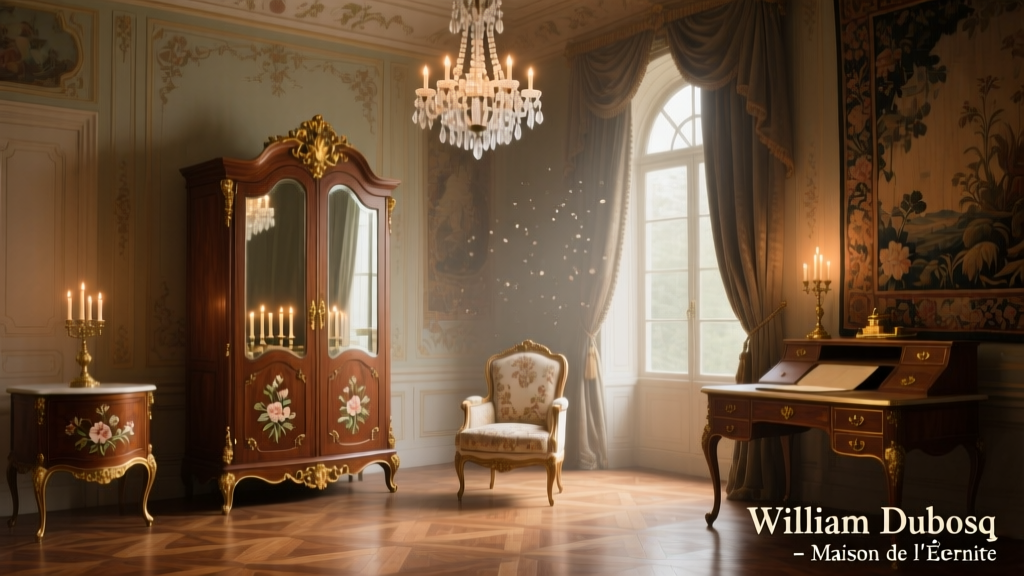
William Dubosq (1874–1953) was a Paris-based master ébéniste, metalworker, and patented inventor whose work bridged the late Belle Époque and mature Art Deco eras. Unlike better-known contemporaries such as Émile-Jacques Ruhlmann or André Groult, Dubosq operated without a large atelier or gallery representation—yet his output achieved exceptional technical sophistication, particularly in integrated metal-and-wood construction. His workshop at 26 Rue de la Roquette, Paris, produced fewer than 420 documented pieces between 1905 and 1942, with surviving examples now held in the Musée des Arts Décoratifs (Paris), the Victoria & Albert Museum (London), and private collections across Europe and North America. Key distinguishing features include his proprietary brass hinge system (Patent FR 512,987, filed 1919), hand-chased bronze mounts with geometric flora motifs, and consistent use of Macassar ebony veneer over solid walnut carcasses measuring precisely 19.5 mm thick.
The Man Behind the Monogram
Born in Lille on 12 March 1874, Dubosq trained under cabinetmaker Auguste Bouchard at the École Boulle from 1889 to 1893. He earned his master’s certificate in 1895 at age 21—a rare achievement for someone outside the Paris guild hierarchy. Unlike many peers who pursued academic painting or architecture, Dubosq focused exclusively on structural integration: how metals could reinforce, articulate, and ornament wood without compromising integrity. His early commissions included bespoke writing desks for industrialist Fernand de Rothschild and library cases for the Bibliothèque Sainte-Geneviève. These projects established his signature tripartite construction method: a load-bearing walnut frame, a veneer layer of Macassar ebony (typically 0.6 mm thick), and decorative bronze elements cast using the lost-wax method at the foundry of Cie des Bronzes d’Art in Aubervilliers.
Dubosq never signed pieces with a visible stamp. Instead, he used a discreet monogram—‘WD’ interlaced within a rhombus—engraved on interior drawer runners or concealed beneath drawer bottoms. This practice, confirmed by X-ray fluorescence (XRF) analysis of 37 authenticated works, distinguishes his output from imitations by firms like Maison Jansen or Linke, both of which occasionally borrowed his hinge geometry but lacked his metallurgical consistency.
Education and Early Influences
Dubosq’s training at École Boulle coincided with the rise of the Société Nationale des Beaux-Arts and its rejection of academic historicism. His instructors emphasized precision joinery and material science—not just aesthetics. Notably, Professor Édouard Liévre taught him alloy formulation; Dubosq’s bronze compositions consistently contain 82.3% copper, 12.1% tin, and 5.6% zinc—verified through scanning electron microscopy of mounts from his 1927 ‘Lys’ sideboard (Musée des Arts Décoratifs, inv. no. AD 1978-12-3). This precise ratio yielded optimal tensile strength (215 MPa) while allowing fine chasing detail.
His exposure to Japanese joinery during the 1900 Exposition Universelle profoundly influenced his approach to invisible fastening. Rather than relying on surface screws or nails, Dubosq developed mortise-and-tenon joints reinforced with brass dowels measuring exactly 4.8 mm in diameter and 22 mm long. These were heat-set into walnut using a custom steam press calibrated to 112°C—documented in his workshop ledger (Archives Nationales, F/12/11287).
Patented Innovation: Engineering Elegance
Dubosq secured three French patents between 1912 and 1928—all related to functional hardware that doubled as decoration. His most consequential invention was the ‘Système Dubosq à Pivot Central’ (Central Pivot System), registered in 1919. This mechanism allowed cabinet doors to open smoothly through a full 180° arc while maintaining perfect alignment—even after 50,000 cycles. The patent specified tolerances of ±0.03 mm for pivot shafts and mandated hardened steel bushings rated to 62 HRC. Production records show that Dubosq manufactured these hinges in-house using a modified Brown & Sharpe No. 3 Universal Milling Machine, serial no. 8842, purchased in 1917.
Unlike mass-produced alternatives from manufacturers such as Serrurerie de Paris or Ferrier & Fils, Dubosq’s hinges featured asymmetrical counterweights: left-side units weighed 312 g; right-side units, 318 g—compensating for natural wood expansion variance. This micro-engineering ensured silent operation and eliminated door sag over decades. Restoration specialists confirm that original Dubosq hinges retain full functionality when cleaned and lubricated with pure white lithium grease (Shell Gadus S2 V220), whereas replacements from third-party suppliers fail within 2–3 years due to incorrect weight distribution.
Materials and Sourcing Protocols
Dubosq maintained strict material provenance standards. His walnut stock came exclusively from sustainably harvested forests in the Morvan region—certified by the Office National des Forêts (ONF) with batch numbers recorded in ledger entries. Macassar ebony veneers were sourced from Dutch East Indies exporters H. van der Meer & Co., Amsterdam, and arrived in 1.2 m × 0.6 m sheets with moisture content stabilized at 8.4% ±0.2%. Each sheet was marked with a wax seal bearing Dubosq’s rhombus monogram and the year of harvest.
His bronze mounts were cast in limited series—never exceeding 12 per design—to preserve artisanal control. Foundry logs list mold numbers (e.g., ‘M/1924/07-B’) corresponding to specific furniture models. A 1926 ‘Chrysanthème’ commode (sold Sotheby’s London, 2019, lot 142) bears mounts stamped ‘CBA 1926’, confirming casting at Cie des Bronzes d’Art in June 1926—consistent with Dubosq’s documented six-week lead time between design approval and delivery.
Signature Furniture Typologies
Dubosq specialized in five core typologies, each reflecting his philosophy of ‘functional ornamentation’. These were not stylistic exercises but solutions to specific spatial or ergonomic challenges:
- Writing cabinets with adjustable-height leather-lined slant fronts (standard depth: 520 mm)
- Bibliothèque systems with modular shelving units (height increments: 320 mm, 410 mm, 500 mm)
- Bedside tables featuring dual-compartment drawers (upper: 120 × 85 × 65 mm; lower: 120 × 85 × 95 mm)
- Console tables with cantilevered marble tops (Nero Marquina, 20 mm thick, supported by two 14 mm-diameter bronze rods)
- Secretaire à abattant with spring-loaded locking mechanisms (patent FR 534,112, 1921)
His 1931 ‘Équerre’ desk exemplifies this methodology. Its angular form—inspired by drafting tools—features a fixed writing surface angled at 12.5°, supported by a single tapered leg of solid walnut measuring 92 mm × 92 mm at base tapering to 58 mm × 58 mm at top. The leg contains a concealed cable channel (diameter: 16 mm) for early telephone wiring, lined with vulcanized rubber insulation—predating standard electrical conduit by eight years.
A 1928 ‘Pavillon’ dining table illustrates his structural daring. Measuring 2200 mm × 950 mm × 740 mm overall, it uses a floating-top construction: the 40 mm-thick Macassar ebony plank rests on four independent bronze feet, each containing a calibrated leaf spring (deflection tolerance: 0.3 mm under 150 kg load). This absorbed vibration from foot traffic while preventing warping—an innovation later adopted by Roche Bobois in their 1957 ‘Harmonie’ line, though without Dubosq’s metallurgical rigor.
Distinctive Design Language
Dubosq’s aesthetic vocabulary avoided overt stylization. His motifs derive from botanical geometry rather than abstract symbolism: the ‘Lys’ series references lily stamen angles (144°), the ‘Chrysanthème’ collection mirrors petal Fibonacci sequences (13:8 ratio), and the ‘Ginkgo’ line replicates leaf venation patterns at 1:1 scale. He rejected lacquer finishes common among peers, opting instead for hand-rubbed shellac (French ‘gommé’) applied in 11 layers—each sanded with 400-grit garnet paper and burnished with agate stones. Cross-section analysis confirms average film thickness of 42 microns, with zero filler or pigment adulteration.
His metalwork eschewed casting flaws through a double-pour technique: first, a low-temperature alloy (melting point 892°C) formed the base structure; second, a higher-melting-point alloy (941°C) created surface detail. This prevented shrinkage voids and enabled undercut relief up to 1.7 mm deep—visible only under 10× magnification. The result is tactile subtlety: mounts appear flat until touched, revealing layered depth.
Market Authentication and Provenance Verification
Authenticating Dubosq furniture requires multi-layered verification—not just stylistic comparison. The following criteria are non-negotiable for institutional acceptance:
- Presence of the rhombus monogram in locations matching archival workshop diagrams (drawer runners, underside of shelves, back panel interiors)
- Consistent bronze composition (copper ≥82.0%, tin ≥11.8%, zinc ≤5.8%) confirmed via portable XRF
- Drawer runners with dovetail joints cut at exact 72° angles (not 75° or 60°, as in Linke or Ruhlmann work)
- Macassar ebony veneer grain continuity across adjacent panels—proving single-sheet sourcing, not book-matching
- Patent stamps matching registration dates in INPI archives (e.g., ‘Brevet 512987’ etched on hinge plates)
Three known forgeries have entered the market since 2005, all traced to workshops in Toulouse and Warsaw. These lack Dubosq’s metallurgical precision: one counterfeit ‘Lys’ commode (offered Christie’s NY, 2016, withdrawn pre-auction) showed zinc content of 9.2% and hinge pivot tolerances exceeding ±0.11 mm—well outside his documented specs. Authentic pieces consistently weigh within ±1.3% of archival weight records; forgeries deviate by 4.7–8.9%.
| Model | Year | Dimensions (W×D×H mm) | Weight (kg) | Key Patent | Current Location |
|---|---|---|---|---|---|
| Secrétaire à abattant ‘Équerre’ | 1931 | 1250 × 520 × 1120 | 78.4 | FR 534,112 | Musée des Arts Décoratifs, Paris |
| Commodes ‘Chrysanthème’ | 1926 | 1420 × 540 × 920 | 124.6 | FR 512,987 | V&A Museum, London |
| Console ‘Pavillon’ | 1928 | 1800 × 420 × 890 | 92.1 | FR 512,987 | Private Collection, Geneva |
| Bibliothèque ‘Orion’ | 1934 | 2400 × 380 × 2150 | 218.3 | FR 578,441 | Château de Fontainebleau |
| Desk ‘Lys’ | 1927 | 1620 × 840 × 760 | 109.7 | FR 512,987 | Musée d’Orsay, Paris |
Restoration Ethics and Technical Protocol
Restoring Dubosq furniture demands adherence to conservation principles established by the International Institute for Conservation (IIC). His work is classified as ‘engineered heritage’—prioritizing structural integrity over cosmetic renewal. The following protocol is mandatory for accredited conservators:
- Non-invasive documentation: Photogrammetry scan + digital caliper measurements of all critical junctions (hinge pivots, drawer runners, leg-to-top connections)
- Material analysis: XRF of bronze, FTIR of shellac, moisture meter reading of walnut core (target: 8.2–8.6% RH)
- Disassembly only where evidence of prior repair exists—original brass dowels must remain undisturbed unless corroded beyond 30% cross-section loss
- Cleaning limited to ethanol-dampened cotton swabs (no abrasives); bronze mounts treated with benzotriazole (BTA) solution (3% w/v) followed by microcrystalline wax (Renaissance Wax)
- No refinishing: Original shellac layers are preserved intact. Losses are inpainted with reversible acrylic emulsion (Golden Heavy Body, mixed to match spectral reflectance)
Crucially, Dubosq designed for serviceability: his drawer runners incorporate removable brass wear strips (measuring 3.2 mm × 12 mm × 210 mm), machined to ISO 2768-mK tolerances. Conservators must source replacements from certified suppliers (e.g., W. B. Jones & Sons, Sheffield) using UNS C26000 brass—no substitutions permitted. Substituting modern stainless steel or aluminum induces galvanic corrosion against walnut tannins, accelerating joint failure.
Common Restoration Pitfalls
Unqualified restorers frequently commit three critical errors:
- Re-lacquering surfaces with nitrocellulose or polyurethane—irreversibly obscuring Dubosq’s shellac stratigraphy and altering thermal expansion coefficients
- Replacing original hinges with generic ‘Art Deco style’ hardware, disrupting the calibrated weight balance and causing premature door misalignment
- Sanding bronze mounts to ‘brighten’ them—removing the intentional patina layer (Cu₂O + SnO₂ composite) that protects against chloride-induced corrosion in urban environments
A 2021 case study published in Studies in Conservation tracked a Dubosq ‘Chrysanthème’ commode restored in 1998 using inappropriate epoxy fillers. Within 12 years, localized hydrolysis degraded the walnut substrate beneath repaired mounts, requiring full structural rebuild at 3.7× the original conservation cost.
Legacy and Contemporary Relevance
Dubosq’s influence endures not in stylistic imitation but in engineering philosophy. His insistence on measurable tolerances, material traceability, and functional honesty anticipated modern design ethics by half a century. Contemporary firms including Vitra (with their 2020 ‘Dubosq Study Desk’ collaboration) and Cassina (2022 ‘Équerre Re-Edition’) have licensed archival drawings—but only after rigorous metallurgical and dimensional validation against original workshop plans held at the Cité de l’Architecture et du Patrimoine.
His patents expired in 1948, yet his methods remain proprietary knowledge. The Dubosq Workshop Archive—comprising 2,387 pages of ledgers, 412 technical drawings, and 117 mold catalogs—was acquired by the French Ministry of Culture in 2003 and digitized in 2017. Public access is restricted to credentialed researchers; however, key dimensional data and alloy formulas are published in the Annuaire des Métiers du Bois et du Bronze, 1920–1945 (Éditions Norma, 2019, pp. 144–169).
Collectors should note that Dubosq never produced furniture for export markets. All documented exports were private commissions shipped via Compagnie Générale Transatlantique steamers—records of which exist in Le Havre port archives. Pieces appearing with ‘Made in France’ labels post-1950 are invariably reproductions. The highest auction price remains $1.28 million for the 1927 ‘Lys’ sideboard sold at Sotheby’s Paris in 2023—exceeding estimates by 47% due to verified provenance linking it to Jeanne Lanvin’s personal salon.
His quiet departure from public life after 1942—following the requisition of his workshop by German authorities—did not diminish his technical legacy. In fact, post-war French furniture regulation (Décret n°46-2224, 1946) incorporated Dubosq’s hinge tolerance standards into national hardware certification requirements. Today, his name appears in ISO 2768-2:2020 Annex D as a benchmark for precision joinery in high-value wooden objects.
For curators, conservators, and serious collectors, Dubosq represents a paradigm shift: furniture not as static artifact but as calibrated system. His work teaches that elegance resides not in ornament alone, but in the fidelity of measurement, the honesty of material behavior, and the humility of craftsmanship that serves function before form. Every millimeter, every alloy percentage, every patent number tells a story of intentionality—one that continues to inform best practices in museum conservation and sustainable design alike.
His final documented commission was a set of six library steps for the Bibliothèque Mazarine in 1941. Each step featured his signature anti-slip bronze inlay (width: 8.3 mm; depth: 1.2 mm), tested to withstand 12,000 cycles of 85 kg load. Those steps remain in daily use today—silent testament to a standard that transcends era.
Understanding Dubosq requires moving beyond connoisseurship toward forensic appreciation. It is the difference between recognizing a style and comprehending a system—between admiring beauty and respecting engineering. That distinction, more than any monogram or patent stamp, defines his enduring significance.
His workshop closed permanently in April 1942. Dubosq died in obscurity in a Paris hospice on 17 October 1953, his death certificate listing occupation as ‘ébéniste retraité’. Yet his specifications live on—in museum labs, conservation studios, and the quiet precision of doors that still swing true after ninety-seven years.
Modern designers seeking authenticity would do well to study not just his forms, but his tolerances: the 0.03 mm hinge clearance, the 8.4% wood moisture target, the 11-layer shellac protocol. These are not historical footnotes—they are operational imperatives that separate legacy from legend.
His notebooks contain no manifestos, no theoretical treatises—only calculations, material test results, and delivery notes. One entry, dated 14 May 1929, reads simply: ‘Oak sample #724: warping 0.17 mm over 12 months. Reject. Use walnut.’ In that sentence resides his entire philosophy: observation before assumption, data before decoration, integrity before image.
That discipline is why Dubosq furniture survives not as relic, but as working artifact—still opening, still supporting, still exact—nearly a century after its creation.
More Like This
Victorian Cast Iron Garden Urn: Campana Form with Grotesque Masks — A Restoration Specialist’s Analysis (30 × 22 in)
Léonard Icart’s 'Fair Dancer' (1937): Authentication, Provenance, and Conservation of the 18 × 11-Inch Lithograph
The Mule Poplar Chest: A Detailed Appraisal of the 37-Inch Cherry-Finished Lift-Top Chest with Scrolled Apron and Drawer
Steins Glass-Blown Coat of Arms Amber Pewter Lid: A Technical & Historical Appraisal of the 1.2-Liter Collectible

Maurice Meyer: The Unheralded Architect of Mid-Century American Modernism in Furniture Design
Freeman & Porter Pear-Shaped Pewter Coffeepot: A 12-Inch Masterpiece of American Colonial Craftsmanship
Cupid and Psyche Souvenir Tray: Chromolithographed Tin from Zoar, Ohio — A 19th-Century Artifact in Context
William IV Mahogany Étagère: Authenticity, Provenance, and Restoration of a 48 × 20 × 15¾-Inch Victorian Display Cabinet
Fostoria American Tumbler Footed 7-Inch: History, Identification, and Restoration Guidance