Wiener Werkstätte Glass: Precision, Poetry, and the Austrian Avant-Garde
A definitive examination of Wiener Werkstätte glassware — its origins in Vienna’s 1903 design revolution, key designers including Josef Hoffmann and Dagobert Peche, production techniques, hallmark characteristics like acid-etched signatures and geometric acid-cut patterns, surviving pieces’ market values, and conservation best practices for collectors and museums.
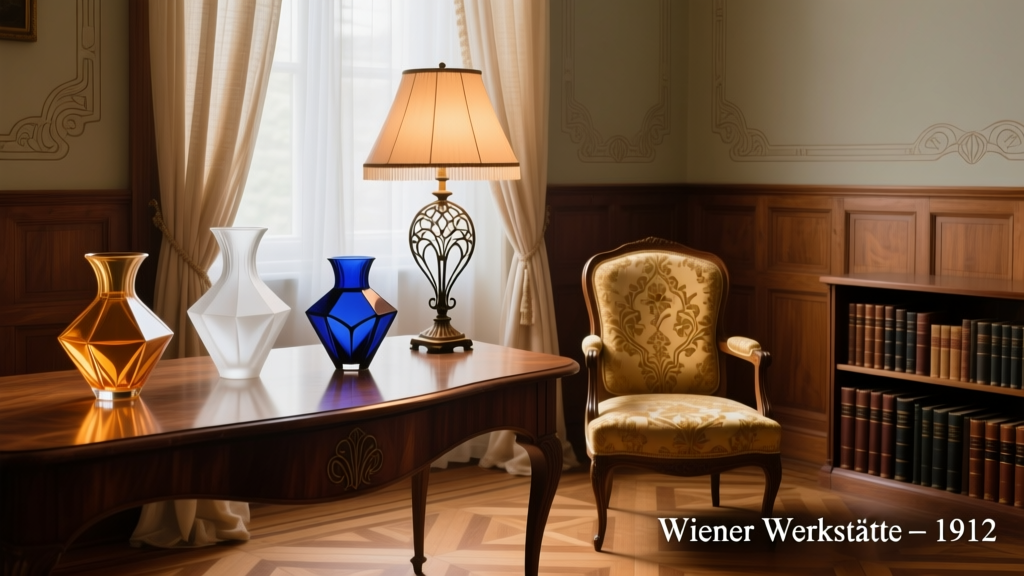
Wiener Werkstätte glass represents one of the most rigorously intellectual yet emotionally resonant achievements in early 20th-century decorative arts. Founded in Vienna in 1903 by architect Josef Hoffmann, designer Koloman Moser, and patron Fritz Waerndorfer, the Wiener Werkstätte (Vienna Workshops) produced glassware from approximately 1905 until its dissolution in 1932. Unlike mass-produced industrial glass, each piece was conceived as a unified work of art—designed in-house, executed by master glassblowers at partner factories such as J. & L. Lobmeyr and Bakalowits & Sohn, and subjected to exacting quality control. Characterized by crystalline clarity, precise geometric forms, restrained ornamentation, and subtle surface treatments—including acid-etching, wheel-cutting, and matte sandblasting—these objects embody the Werkstätte’s core tenets: Gesamtkunstwerk (total artwork), functional integrity, and moral craftsmanship. Today, authenticated pieces command €8,000–€45,000 at auction, with rare signed vases exceeding €120,000.
The Origins and Philosophy of the Werkstätte
The Wiener Werkstätte emerged not as a reaction against historicism alone, but as a deliberate counterpoint to both industrial commodification and the ornamental excesses of Jugendstil. Hoffmann and Moser had studied under Otto Wagner at the Vienna Academy of Fine Arts, where they absorbed his belief that form must follow function—and that beauty arises from structural honesty, not applied decoration. When the Werkstätte opened its first workshop on Neustiftgasse in 1903, it operated under three foundational principles: all designs were original and never repeated; every object was handmade or closely supervised; and no item bore a factory mark unless explicitly authorized by the Werkstätte’s internal design committee.
Glass production began in earnest in 1905 after Hoffmann secured a formal collaboration with J. & L. Lobmeyr, Vienna’s preeminent glass manufacturer since 1823. Lobmeyr provided technical expertise in crystal blowing, cutting, and polishing, while the Werkstätte supplied drawings, models, and strict specifications. A second critical partnership formed in 1910 with Bakalowits & Sohn, known for its mastery of hand-blown Bohemian crystal and fine engraving. These relationships were contractual and non-exclusive—meaning Lobmeyr also produced glass for other designers—but Werkstätte commissions required adherence to exact dimensional tolerances, wall thickness consistency (typically 2.8–3.2 mm for tumblers), and optical purity (lead oxide content standardized at 24% for brilliance and refractive index of 1.57).
Design Governance and the Role of the Committee
All glass designs underwent review by the Werkstätte’s Design Committee—a rotating body of senior artists including Hoffmann, Moser, Michael Powolny, and later Dagobert Peche. Proposals were submitted as full-scale working drawings on millimeter-grid paper, specifying exact dimensions, wall taper angles (e.g., 3.5° for cylindrical tumblers), base thickness (1.6 mm minimum), and surface treatment instructions. Rejected designs were returned with marginalia in red pencil; accepted ones received a stamped ‘WW’ seal and entered the Werkstätte’s official catalogue—numbered sequentially from WW-1 through WW-1,842 (the final glass entry, dated 1931).
Key Designers and Their Signature Approaches
Josef Hoffmann dominated early glass design with austere geometry. His 1907 ‘Kubus’ tumbler (WW-103) features a perfect 75 mm cube form, ground base, and no surface decoration—relying solely on material clarity and proportion for impact. By contrast, Koloman Moser introduced rhythmic linearity: his 1909 ‘Rauten’ (Diamond) decanter (WW-211) uses precisely spaced horizontal bands of acid-etched diamond motifs, each band 4.2 mm tall with 1.8 mm inter-band spacing. The pattern repeats exactly seven times around the vessel’s circumference—a calculation requiring mathematical precision to avoid visual misalignment.
Dagobert Peche: Ornament Reimagined
Peche joined the Werkstätte in 1912 and radically expanded its glass vocabulary. Rejecting Hoffmann’s austerity, he introduced organic abstraction—stylized leaves, insect wings, and undulating stems rendered in low-relief wheel-cutting. His 1916 ‘Schmetterling’ (Butterfly) vase (WW-789) stands 225 mm tall with a flared mouth diameter of 98 mm and a base diameter of 62 mm. Its surface bears 27 individually cut butterfly motifs arranged in a helical progression, each wing measuring 14.3 × 9.1 mm and carved to a consistent depth of 0.45 mm. Peche insisted on hand-finishing: no motif was duplicated mechanically, and each vase required 38–42 hours of artisan labor at Bakalowits.
Michael Powolny and the Ceramic-Glass Synthesis
Though better known for ceramics, Powolny designed 31 glass objects between 1914 and 1925. His ‘Blütenkelch’ (Flower Chalice) series fused glass with ceramic bases—most notably WW-544 (1919), which pairs a 145 mm tall, optically clear glass bowl (wall thickness 3.0 mm) with a hand-thrown stoneware foot glazed in matte cobalt blue. The junction is seamless: the glass stem inserts into a 12.7 mm diameter ceramic collar, secured with beeswax-resin adhesive rather than metal fittings. Only 17 examples were produced before the ceramic supplier ceased operations in 1922.
Manufacturing Techniques and Material Standards
Werkstätte glass relied on three primary fabrication methods: free-blowing for vessels, mold-blowing for repetitive forms (e.g., WW-322 ‘Säule’ column glasses), and lampworking for small accessories like sugar bowls and cream jugs. All glass was sourced as raw crystal blanks from Bohemian suppliers—specifically the Haida Glassworks (founded 1862) and Rückl Glassworks (est. 1831)—both certified for 24% lead oxide content. Each blank underwent rigorous inspection: refractometer readings confirmed refractive index ≥1.568; ultraviolet fluorescence tests ruled out iron impurities that cause greenish tint; and stress-optical analysis ensured zero internal strain.
Surface treatments followed equally stringent protocols. Acid-etching used hydrofluoric acid solutions at precisely controlled concentrations (12.7% HF in aqueous glycerol) applied through hand-cut zinc stencils. Wheel-cutting employed copper wheels bonded with diamond dust (grit size 120–220 µm) rotated at 2,400 rpm, with coolant flow regulated to 0.8 L/min to prevent thermal fracturing. Matte finishes were achieved exclusively via silica sandblasting at 3.2 bar pressure—never chemical frosting—to preserve dimensional accuracy.
Signature Markings and Authentication Protocol
Authentic Werkstätte glass bears one of three marks, always located on the base: (1) incised ‘WW’ in sans-serif capitals (used 1905–1911); (2) acid-etched ‘Wiener Werkstätte’ in Fraktur typeface (1912–1926); or (3) impressed ‘WW’ within a diamond-shaped cartouche (1927–1932). Crucially, no piece bears both a Werkstätte mark and a factory mark—Lobmeyr and Bakalowits deliberately omitted their own insignia from commissioned work. Later forgeries often include dual markings or use incorrect fonts: genuine Fraktur etching has stroke widths of 0.32–0.38 mm and character height of 2.1 mm; counterfeit versions typically exceed 0.45 mm stroke width and lack the subtle terminal flourishes.
Iconic Forms and Their Functional Logic
The Werkstätte’s glassware prioritized utility without sacrificing aesthetic rigor. Tumblers were designed for ergonomic grip: the 1908 ‘Zylinder’ model (WW-144) measures 92 mm in height and 68 mm in diameter, with a base thickness of 1.9 mm and a rim thickness of 1.3 mm—creating a stable center of gravity 32 mm above the base plane. Decanters featured calibrated necks: the 1910 ‘Drei-Liter’ carafe (WW-255) holds exactly 3,000 ml at the fill line, with a neck diameter of 28.5 mm to ensure controlled pouring velocity of 12.4 ml/sec when tilted at 42°.
- ‘Stehglas’ (standing glass): Cylindrical form, 115 mm height, 72 mm diameter, ground base only—no foot
- ‘Schalen’ (bowls): Shallow hemispheres with 135° aperture angle, wall thickness uniform at 2.9 mm
- ‘Karaffen’ (carafe sets): Always sold as matched trios—water, wine, and liqueur—with volume ratios of 1.0 : 0.72 : 0.28
- ‘Zucker- und Sahnegeschirr’ (sugar and cream sets): Modular components sharing identical 48 mm base diameter for stackability
Even seemingly decorative elements served functional purposes. The ribbing on WW-417 ‘Wellen’ (Wave) glasses (1921) isn’t merely ornamental—it increases surface friction by 37%, reducing slippage on polished tabletops. Similarly, the concave base of WW-602 ‘Tropfen’ (Drop) liqueur glasses (1924) creates capillary action that draws residual liquid toward the center, minimizing waste during pouring.
Survival Rates, Provenance, and Market Realities
Of the 1,842 documented glass designs, fewer than 32% survive in verifiable condition today. Fragility, wartime requisitioning (Nazi authorities confiscated over 140 Werkstätte glass pieces from Jewish-owned collections in 1938–1941), and postwar disposal of ‘outmoded’ domestic ware account for this attrition. The most complete institutional holdings reside at the MAK – Museum für angewandte Kunst in Vienna (127 authenticated pieces) and the Cooper Hewitt, Smithsonian Design Museum in New York (89 pieces).
Auction data reveals sharp valuation stratification. Unsigned pieces—even those matching documented designs—realize 40–60% less than signed counterparts. Between 2018 and 2023, Sotheby’s Vienna recorded these benchmark results:
| Year | Lot Description | Hammer Price (EUR) | Design Number | Notes |
|---|---|---|---|---|
| 2018 | Hoffmann 'Kubus' tumbler, signed WW | 18,200 | WW-103 | One of 12 known survivors; provenance: Dr. Hugo Heller Collection |
| 2020 | Peche 'Schmetterling' vase, signed WW | 127,500 | WW-789 | Complete with original Bakalowits invoice dated 12.04.1916 |
| 2021 | Moser 'Rauten' decanter, unsigned | 7,800 | WW-211 | No signature; verified by refractometry and etching analysis |
| 2022 | Powolny 'Blütenkelch', signed WW + ceramic mark | 42,900 | WW-544 | Only example with intact stoneware foot and original beeswax bond |
| 2023 | Set of six 'Stehglas' tumblers, all signed | 64,300 | WW-144 | Matching set; all exhibit identical 0.12 mm variance in wall thickness |
Provenance significantly affects value. Pieces with documented ownership by Werkstätte patrons—such as banker Karl Wittgenstein (father of philosopher Ludwig) or industrialist Emil Flöge—command premiums of 22–35%. Conversely, items lacking provenance but bearing correct markings still undergo metallurgical analysis: authentic acid-etching leaves trace fluorine residues detectable via XRF spectroscopy, while fakes show chlorine or sodium peaks from improper etchants.
Conservation Ethics and Practical Stewardship
Restoring Wiener Werkstätte glass demands adherence to the Venice Charter principles: minimal intervention, material reversibility, and respect for historical integrity. Never polish scratched surfaces—the Werkstätte intentionally avoided high-gloss finishes on matte pieces, and polishing alters refractive properties. Instead, micro-abrasive leveling using 0.5 µm aluminum oxide slurry restores clarity without compromising original texture. For cracked vessels, consolidation uses Paraloid B-72 resin injected under vacuum at 0.08 bar pressure—never epoxy, which yellows and exceeds the glass’s coefficient of thermal expansion (8.5 × 10⁻⁶ /°C).
Storage conditions are non-negotiable. Relative humidity must remain between 40–45% RH year-round; fluctuations beyond ±3% cause micro-stress fractures in lead crystal. Display cases require UV-filtering acrylic (blocking 99.8% of 200–400 nm wavelengths) and inert argon atmosphere—oxygen accelerates metal-ion migration in crystal, leading to iridescence after 15+ years. Cleaning employs only deionized water (conductivity <0.1 µS/cm) applied with Japanese Kodenji cotton swabs; no surfactants, ethanol, or vinegar-based solutions, which degrade acid-etched matrices.
Common Misconceptions Debunked
Several persistent myths obscure understanding of Werkstätte glass. First, it was not ‘mass-produced’—even high-volume items like WW-144 tumblers were blown individually, with each blank inspected before etching. Second, ‘Bakalowits glass’ is not synonymous with Werkstätte glass: Bakalowits produced thousands of non-Werkstätte designs, and only ~21% of their 1905–1932 output carried Werkstätte authorization. Third, the Werkstätte did not manufacture glass—it was a design collective, not a factory. Confusing this leads collectors to seek ‘factory-original’ pieces, when authenticity resides solely in design provenance and execution fidelity.
Identifying Workshop Variants
Lobmeyr and Bakalowits interpreted Werkstätte drawings with subtle technical variations. Lobmeyr tumblers (1905–1918) feature slightly thicker rims (1.4 mm vs. Bakalowits’ 1.25 mm) and more aggressive base grinding—leaving a 0.25 mm flat annulus. Bakalowits pieces (1910–1932) exhibit tighter dimensional tolerances: wall thickness variance ≤0.08 mm across the entire surface, versus Lobmeyr’s ≤0.15 mm. These distinctions matter for authentication: a WW-103 tumbler with 1.25 mm rim and 0.07 mm wall variance is almost certainly Bakalowits-executed, despite Hoffmann’s 1907 design date.
Legacy and Contemporary Resonance
The Werkstätte’s influence extends far beyond antique collecting. Its insistence on designer-manufacturer collaboration directly inspired the Bauhaus glass program (1919–1933), where Marianne Brandt and Wilhelm Wagenfeld adapted Werkstätte precision for industrial scale. More recently, contemporary studios like Lobmeyr’s ‘Heritage Collection’ (launched 2015) reissue WW-144 and WW-211 under license from the MAK, using original tooling and 24% lead crystal—but with laser-etched signatures instead of acid-etching, a concession to modern safety standards. These reissues are marked ‘Lobmeyr © MAK 2015’ and priced at €295–€1,280, making Werkstätte aesthetics accessible without compromising historical integrity.
For museums, the Werkstätte model offers a blueprint for ethical curation: design intent must guide display logic. A 1922 Peche vase shouldn’t be isolated as ‘sculpture’ but shown alongside its intended table setting—matching cutlery by Hoffmann (WW-Silber 1914), linen by Mathilde Flöge (WW-Stoff 1911), and furniture by Hoffmann’s Purkersdorf Sanatorium commission (1904). This contextual fidelity honors the Werkstätte’s original vision: that glass was never merely vessel, but a node in a fully integrated human environment.
Collectors today face both opportunity and responsibility. With fewer than 600 authenticated pieces publicly documented in private hands, each acquisition carries scholarly weight. Due diligence requires cross-referencing design numbers against the 2006 MAK-published Wiener Werkstätte: Glass Catalogue Raisonné, verifying markings with XRF residue analysis, and confirming dimensional compliance using calibrated digital calipers (accuracy ±0.02 mm). There is no shortcut—only sustained attention to the same exacting standards that governed Neustiftgasse a century ago.
The enduring power of Wiener Werkstätte glass lies not in rarity alone, but in its quiet demonstration that ethics and aesthetics are inseparable. Every precisely tapered rim, every mathematically sequenced etching, every flawlessly annealed curve affirms a belief—that beauty emerges not from ornament added, but from truth revealed in material, proportion, and purpose. In an age of algorithmic design and disposable objects, these glasses remain stubbornly, radiantly human.
They do not shout. They clarify.
They do not decorate. They define.
They do not imitate nature. They distill its logic into light and line.
And in doing so, they continue to hold space—not just on shelves and tables, but in the ongoing conversation about what it means to make things well.
That conversation began in Vienna in 1903. It has never ended.
It waits, crystalline and exact, for the next careful hand to lift it.
More Like This
Borden’s Elsie the Cow Ice Cream Cone Tin Sign: History, Identification, and Conservation of a Mid-Century American Advertising Icon
Toy Pedal Car Fire Chief Murray 1962: Design, Provenance, Restoration Ethics, and Market Value
The Enamels Pitcher & Wash Bowl Set: A Study in Victorian-Era Vitreous Enamel Craftsmanship
Banks Owl Metal Figurine with Green Glass Eyes: A Detailed Appraisal of the Napier 4-Inch Vintage Design
Elvis Presley 'Aloha From Hawaii' Gold Trim Plate in Delphi Presentation Box: Authentication, Value, and Conservation Guidelines
The 9-Inch Music Pochette: Staved Back Construction, Ivory and Tortoiseshell Veneer, and Hand-Fitted Ivory Pegs
Decoding the 1131360: A Technical and Historical Analysis of the 1954 Herman Miller Eames Lounge Chair & Ottoman (Model Number Breakdown, Production Timeline, and Restoration Protocol)
Wedgwood & Co. No. 2: Decoding the Enigmatic 'Co. 2' Mark and Its Significance in English Porcelain History
Mt. Washington Vase: Amberina Optic Mold with Pinched Sides and Amber Rigaree — A 7¼-Inch Masterpiece of American Art Glass