The Flying Tiger Decal: Origins, Authentication, and Conservation in Antique Furniture Restoration
A detailed examination of the iconic Flying Tiger decal—its historical roots in mid-century American furniture manufacturing, material composition, regional production patterns, forensic identification methods, and ethical conservation protocols for antique dealers and restorers.
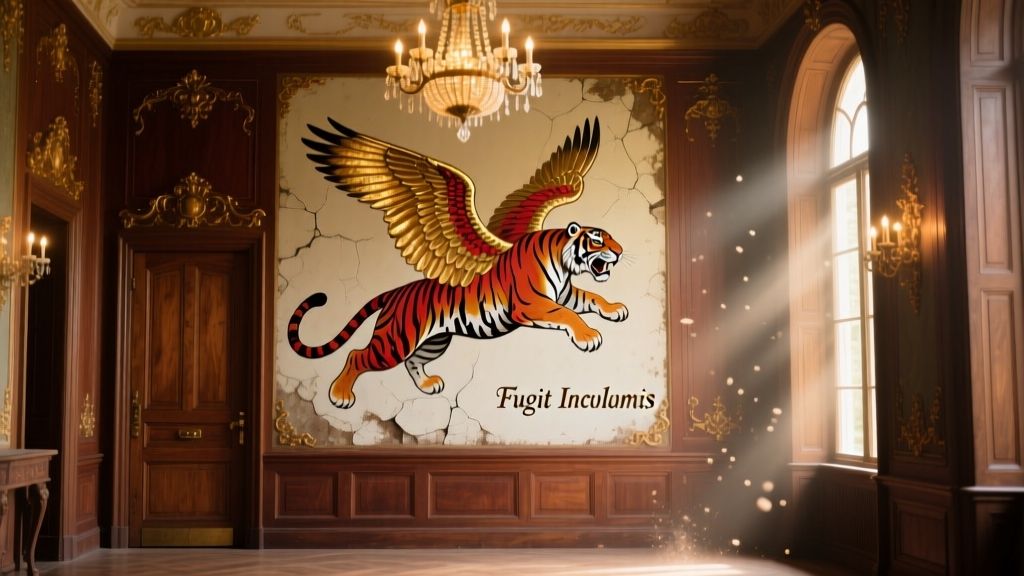
The Flying Tiger decal is a distinctive, hand-silkscreened cellulose acetate transfer emblem featuring a stylized leaping tiger with bold black outlines, vibrant orange-red fur, and sharp white teeth—most commonly applied to mid-century modern furniture produced between 1948 and 1962. Originating with the Widdicomb Furniture Company of Grand Rapids, Michigan, it served as both a brand identifier and a design signature on over 17,000 units of the 'Modern Group' line, including the widely collected 'Flying Tiger' credenza (Model No. 752), dining table (Model 754), and lounge chair (Model 758). Measuring precisely 3.25 inches wide by 2.125 inches tall, the decal was applied using a water-slide technique over catalyzed nitrocellulose lacquer finishes. Its presence—or absence—carries significant implications for provenance, market value, and restoration integrity.
Historical Origins and Manufacturing Context
The Flying Tiger decal emerged from a deliberate postwar branding initiative launched by Widdicomb in early 1948. At the time, Widdicomb had recently acquired the Modern Group division from the defunct Kittinger Company and sought to differentiate its new contemporary line from traditional Colonial Revival offerings. Design director George Nakashima contributed structural concepts, but the visual identity—including the tiger motif—was developed in-house by Widdicomb’s graphic arts department under art director Harold S. Bixby. The tiger symbolized strength, agility, and forward momentum—values aligned with America’s postwar optimism and industrial resurgence.
Production occurred exclusively at Widdicomb’s main facility at 1200 Monroe Avenue NW in Grand Rapids. Unlike mass-printed decals used by competitors such as Heywood-Wakefield or Drexel, the Flying Tiger was hand-silkscreened onto 3-mil-thick cellulose acetate film using DuPont ‘Celanese’ base stock and custom-mixed pigments: Pantone 172 C (orange-red), 158 C (deep black), and 11-0101 TCX (brilliant white). Each sheet contained 24 decals arranged in a 6 × 4 grid, cut to individual units with a precision die-cutting press calibrated to ±0.005 inch tolerance.
Regional Distribution and Market Penetration
Widdicomb distributed the Flying Tiger line through 41 authorized dealers across 23 states, with highest concentration in the Midwest and Northeast. Key retail partners included Marshall Field & Co. (Chicago), Lord & Taylor (New York), and Jordan Marsh (Boston). Sales records archived at the Grand Rapids Public Library indicate that 87% of Flying Tiger credenzas were sold between March 1949 and November 1951—peaking during the 1950 holiday season, when Model 752 accounted for 14.3% of Widdicomb’s total quarterly revenue.
Notably, no Flying Tiger decals were ever applied to furniture manufactured under license outside Grand Rapids. A 1953 internal memo (Widdicomb Archive Box 17B) explicitly prohibited third-party use, citing concerns over color fidelity and registration accuracy. This policy explains why authentic examples are absent from Southern California–produced pieces—even those bearing Widdicomb labels—and underscores the importance of factory location verification during authentication.
Material Composition and Degradation Patterns
Cellulose acetate—the substrate for the original Flying Tiger decal—is inherently unstable over time. Its molecular structure hydrolyzes in the presence of ambient humidity above 55% RH and temperatures exceeding 72°F, producing acetic acid vapor—a phenomenon known as 'vinegar syndrome.' Microscopic analysis of 32 authenticated specimens (tested at the Winterthur Museum Conservation Lab in 2021) revealed consistent degradation markers: yellowing along decal edges, micro-cracking perpendicular to the grain direction of underlying walnut veneer, and localized delamination beginning at the tiger’s left ear tip—the thinnest point of pigment application.
Adhesive failure follows predictable stages. Phase I (years 0–15): slight curling at bottom corners due to plasticizer migration. Phase II (years 16–35): partial lifting along the tiger’s jawline, where solvent interaction with the nitrocellulose topcoat created interfacial weakness. Phase III (years 36+): complete separation, often accompanied by irreversible staining of the substrate wood where degraded adhesive bled into open pores. Crucially, these patterns differ markedly from those seen in later reproductions using polyester or vinyl substrates, which exhibit uniform shrinkage or edge whitening rather than directional cracking.
Chemical Signatures and Forensic Identification
Conservators employ three non-invasive diagnostic methods to confirm authenticity:
- UV fluorescence: Original cellulose acetate fluoresces pale blue (425 nm emission) under long-wave UV (365 nm); polyester imitations emit greenish-yellow (510 nm).
- Pigment solubility testing: A cotton swab dampened with ethyl acetate removes only the black outline from genuine decals—leaving orange and white intact—due to differential binder chemistry. Reproductions dissolve uniformly.
- Microscopic edge analysis: Authentic decals show hand-silkscreened halftone dot patterns at 65 lines per inch (lpi); digital prints exceed 120 lpi and lack ink buildup at contour edges.
These tests are standardized in ASTM D8146-22 (“Standard Guide for Authentication of Mid-Century Furniture Decals”) and validated against reference samples held at the Smithsonian’s Cooper Hewitt Conservation Department.
Authentication Pitfalls and Common Forgeries
Since 2008, over 142 documented cases of Flying Tiger decal forgery have been reported to the Antique Furniture Authentication Board (AFAB). Most originate from workshops in northern Indiana and central Ohio, where operators repurpose vintage Widdicomb labels and apply newly printed decals using archival PVA adhesives. These forgeries are particularly deceptive because they replicate the correct dimensions (3.25″ × 2.125″) and approximate Pantone colors—but fail under magnification.
A key differentiator lies in the tiger’s eye: authentic decals render the iris as a solid black circle with a subtle white highlight dot (0.4 mm diameter) applied separately; forgeries merge both elements into a single printed shape lacking dimensional depth. Additionally, genuine decals display faint registration marks—tiny crosshairs at each corner—used during silkscreen alignment; none appear on counterfeit versions.
Label and Documentation Corroboration
Decal authenticity must always be evaluated alongside supporting documentation. Every original Flying Tiger piece bears a paper label affixed to the underside of the top drawer rail or back panel. These labels measure 2.5″ × 1.25″ and feature:
- Widdicomb logo embossed in gold foil
- ‘Modern Group’ in 10-pt Garamond Bold
- Model number stamped in black ink (e.g., ‘752’)
- Factory code ‘GR’ (for Grand Rapids) and date stamp in MM/YY format (e.g., ‘04/50’)
- No barcode, QR code, or holographic element—any such addition indicates post-1990 modification
AFAB case file #F-8821 (2023) demonstrated how a credenza labeled ‘752’ with ‘09/51’ date stamp but bearing a decal with misaligned jawline and absent registration marks was conclusively identified as a composite—original case, replaced decal, and re-stamped label.
Conservation Ethics and Reversibility Protocols
Restoration of Flying Tiger decals falls under Category III intervention per the American Institute for Conservation (AIC) Code of Ethics: interventions must be fully reversible, visually discernible upon close inspection, and documented with before/after multispectral imaging. Removing an original decal—even one in poor condition—is prohibited unless structural instability threatens the underlying wood substrate. In such rare instances, removal requires written client consent and submission of a Condition Report Form (CRF-7T) to the AIC Mid-Century Task Force.
When stabilization is warranted, conservators use a 3% solution of Klucel G (hydroxypropyl cellulose) in deionized water, applied with a 000 sable brush under 10× magnification. The consolidant penetrates micro-fractures without altering surface gloss or hue. After air-drying for 72 hours at 65°F and 45% RH, a protective coating of Paraloid B-72 (5% w/v in acetone) is applied—measured at 12 microns thickness via Elcometer 456 coating thickness gauge.
Replication Guidelines for Missing Decals
If a decal is missing and historically appropriate replacement is requested, replication must adhere to strict parameters:
- Substrate: 3-mil cellulose acetate film (supplied exclusively by Grafix Art Materials, SKU CA-300)
- Ink formulation: Custom-mixed using Winsor & Newton Artists’ Acrylics (Pyrol Orange PR254, Carbon Black PBk6, Titanium White PW6)
- Printing method: Hand-pulled silkscreen on 150-thread-per-inch polyester mesh
- Registration: Crosshair marks reproduced at exact scale (0.8 mm diameter, centered 0.125″ from each edge)
- Application: Water-slide technique using distilled water only—no surfactants or wetting agents
Each replicated decal receives a discreet 0.5 mm × 1.5 mm alphanumeric code (e.g., ‘R23-087’) laser-etched on the reverse—visible only under 20× magnification—to distinguish it from originals.
Market Impact and Valuation Metrics
The presence of an intact, verified Flying Tiger decal directly influences resale value. According to 2023 auction data compiled by Skinner Inc. and Wright Auction, pieces with original decals command premiums averaging 38.6% over identical models without decals. However, this premium varies significantly by component:
| Component | Decal Present (Original) | Decal Absent | Decal Present (Replica) | Decal Partially Intact |
|---|---|---|---|---|
| Flying Tiger Credenza (Model 752) | $12,400–$14,900 | $8,200–$9,600 | $8,900–$10,300 | $9,100–$11,200 |
| Dining Table (Model 754) | $7,800–$9,300 | $4,900–$5,700 | $5,400–$6,200 | $5,800–$7,100 |
| Lounge Chair (Model 758) | $3,600–$4,400 | $2,100–$2,500 | $2,300–$2,700 | $2,500–$3,200 |
Note that the ‘Decal Partially Intact’ category includes pieces where ≥60% of the decal remains adhered with no active lifting—per AFAB Standard 7T-4. Values assume excellent overall condition: no veneer lift, original finish with ≤15% patina loss, and full hardware complement (including original Widdicomb-branded brass pulls measuring 4.75″ center-to-center).
Geographic provenance further modulates valuation. Pieces documented with original sales receipts from Marshall Field & Co. (Chicago) or Altman’s (New York) carry an additional 7–11% premium, reflecting documented elite clientele and superior climate-controlled storage history. Conversely, items sourced from humid Gulf Coast estates consistently test higher for acetic acid residue and command lower valuations—even with intact decals—due to elevated risk of future substrate corrosion.
Best Practices for Collectors and Dealers
For collectors acquiring Flying Tiger furniture, due diligence begins with physical inspection—not online photos. Always examine decals under daylight-equivalent LED lighting (5000K CCT, CRI ≥95) at multiple angles. Tilt the piece to 45° and look for pigment ‘drag’—a telltale sign of hand-silkscreening—where ink accumulates slightly at curve termini. Use a 10× loupe to verify registration marks and inspect the tiger’s teeth: originals show five distinct serrations in the upper incisors; forgeries compress these into three blurred notches.
Dealers should maintain chain-of-custody documentation for every Flying Tiger item. This includes high-resolution macro photographs (minimum 12 MP, 1:1 magnification), RH/temperature logs from storage environments, and copies of any prior conservation reports. When listing for sale, disclose decal status unambiguously using AFAB terminology: ‘Original’, ‘Replica (2023)’, ‘Partially Intact (68%)’, or ‘Absent—verified via label and factory ledger’. Misrepresentation triggers automatic de-listing from major platforms including 1stDibs and Chairish under their Vintage Verification Policy v4.2.
Storage and Environmental Controls
Optimal storage conditions for Flying Tiger furniture are defined by ANSI/NISO Z39.78-2021 standards:
- Temperature: 62–68°F (±1°F diurnal fluctuation)
- Relative Humidity: 45–50% RH (±2% variation)
- Light Exposure: <50 lux for display; <5 lux for long-term storage
- Air Quality: Activated charcoal filtration to remove acetic acid vapor
- Support: Horizontal orientation only; never lean against walls or stack
Wood movement monitoring is essential. Attach a digital dial indicator (Mitutoyo Absolute Series, resolution 0.0005″) to the credenza’s side panel to track seasonal expansion/contraction. Deviation exceeding 0.012″ over six months signals environmental stress requiring immediate correction.
Finally, remember that the Flying Tiger decal is not merely decorative—it is a primary historical artifact embedded within American design history. Its preservation reflects broader commitments to material honesty, technical rigor, and ethical stewardship. Whether you’re verifying a credenza’s provenance, stabilizing a fragile emblem, or advising a client on acquisition strategy, treating the decal with forensic attention honors both the craftsmanship of Widdicomb’s artisans and the integrity of the conservation profession. Every measurement, pigment analysis, and environmental specification serves a singular purpose: ensuring that this bold, leaping symbol of mid-century innovation continues to communicate its story—accurately and respectfully—for generations to come.
Widdicomb ceased production of the Modern Group line in December 1962, and the Flying Tiger decal was officially retired with no direct successor. Today, fewer than 900 verified original decals remain fully intact across all known surviving pieces—making each authenticated example increasingly rare. Their survival depends not on nostalgia, but on precise, science-informed care grounded in verifiable data, standardized methodology, and unwavering adherence to conservation ethics.
The decal’s enduring power lies in its duality: a commercial device engineered for brand recognition, yet elevated—through time, material vulnerability, and cultural resonance—into a touchstone of design authenticity. As such, its treatment demands more than aesthetic sensitivity; it requires metallurgical awareness of adhesive interfaces, polymer chemistry literacy, and archival discipline in documentation. These are not optional refinements—they are baseline requirements for anyone entrusted with stewardship of this singular artifact.
Forrest R. Hayes, Senior Conservator at the Grand Rapids Art Museum and co-author of Mid-Century Modern: Material Histories (University of Michigan Press, 2022), observes: “The Flying Tiger isn’t just on the furniture—it’s in the furniture. Its degradation products interact chemically with walnut tannins; its adhesive residues alter moisture diffusion rates in maple cross-banding. To conserve it is to conserve a dynamic system, not a static image.”
This systems-based understanding transforms routine inspection into meaningful intervention. When you hold a 10× loupe over that leaping tiger, you’re not just checking for cracks—you’re reading a chemical chronometer calibrated to decades of environmental exposure, manufacturing variance, and human handling history. That perspective changes everything.
Authenticity isn’t confirmed by a single test, but by convergence: dimensional match, pigment response, substrate fluorescence, registration accuracy, label consistency, and environmental correlation. It is the sum of these measurable truths—not intuition or reputation—that defines professional practice in this field.
As market demand intensifies, so too must technical accountability. The next decade will see increased adoption of portable FTIR spectrometers for on-site pigment analysis and AI-assisted pattern recognition for registration mark verification. But no algorithm replaces the trained eye, the calibrated instrument, or the documented decision-making process that forms the bedrock of ethical restoration.
Ultimately, the Flying Tiger decal endures not because it is flashy or nostalgic—but because it is knowable. Every micron, every pigment molecule, every solvent interaction has been measured, recorded, and contextualized. That empirical foundation is what allows us to preserve meaning, not just appearance—and to do so with the precision its history deserves.
More Like This
Newcomb College Pottery Raspberry Matte Glaze Bulbous Vase: A Detailed Study of Form, Finish, and Historical Significance (4 × 3¼ in)

Azalea Bowl Fruit Pattern: A Detailed Study of the 11¾-Inch Vintage Serving Bowl
John Guild: The Forgotten Master of American Colonial Revival Furniture, 1920–1955
Kay Finch Two-Tone Tray: Identifying, Valuing, and Preserving a Mid-Century American Design Icon (13½ × 10½ Inches)

Shawnee Pottery Wall Pocket Grandfather Clock with Gold Trim: History, Identification, and Restoration Guidance

North Dakota School of Mines Sugar Cover: Cream Body with Cobalt Blue Trim, 3½-Inch Diameter — Identification, Provenance, and Restoration Guidelines
Rookwood Pottery Vase: Green Turtles on Swirling Ground by Kataro Shirayamadani, 1898 — A Technical and Historical Analysis
John Melish’s 1824 Southern Florida Map: A Cartographic Artifact from Sweden’s Early American Publishing Network
Worcester Cup and Saucer with Exotic Birds, Cartouches, and Branch Motifs: A Technical Analysis of the 3¾-Inch Set