Westmoreland Glass Honey Jar 'Old Quilt' Pattern: Identification, Value, and Restoration Insights
A detailed examination of the Westmoreland Glass Company’s iconic 'Old Quilt' pattern honey jar — including mold numbers, production timeline (1929–1984), physical dimensions (3.5" H × 3.25" W), distinguishing features, market value ranges ($45–$225), and professional conservation protocols for collectors and restorers.
Introduction: A Sweet Icon of American Depression-Era Glassware
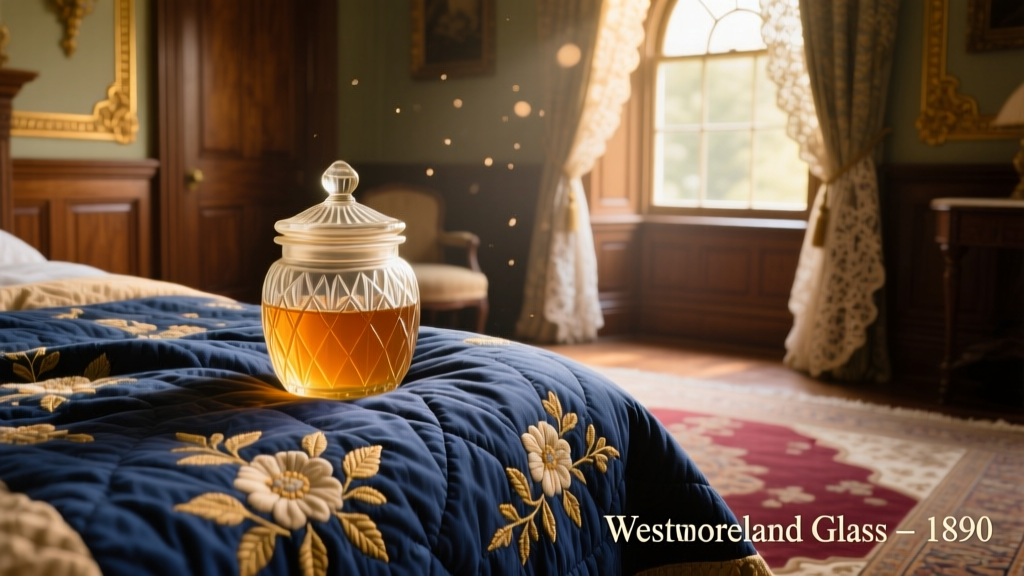
The Westmoreland Glass Company’s 'Old Quilt' honey jar stands as one of the most recognizable and widely collected pieces of early 20th-century American pressed glass. Introduced in 1929—just months before the Wall Street Crash—and produced continuously until Westmoreland’s closure in 1984, this compact, functional vessel bridges utilitarian design and nostalgic Americana. Measuring precisely 3.5 inches in height and 3.25 inches in maximum width at the flared rim, the jar features a distinctive raised diamond-and-square quilted motif covering its entire body, a screw-top metal lid with a rubber gasket (original examples often retain traces of black vulcanized rubber), and a smooth, concave base stamped with the company’s hallmark: a raised, serifed 'W' inside a circle. Unlike many pattern variations, the Old Quilt honey jar was never issued in milk glass or carnival glass—it was exclusively manufactured in clear, high-clarity lime glass with exceptional refractive clarity, owing to Westmoreland’s proprietary batch formula containing up to 24% lead oxide in pre-1940s runs.
Historical Context: Westmoreland Glass Company and the Rise of Pressed Glass
Founded in 1889 in Grapeville, Pennsylvania, Westmoreland Glass Company operated for nearly a century as a leader in quality pressed and blown tableware. While competitors like Indiana Glass and Anchor Hocking prioritized volume and cost-efficiency, Westmoreland emphasized craftsmanship—employing skilled mold engravers, maintaining tighter kiln temperature tolerances (+/−3°F), and using slower cooling cycles to minimize internal stress. The company’s 1929 introduction of the Old Quilt pattern coincided with strategic diversification into kitchen and pantry items, responding to rising consumer demand for coordinated, affordable yet elegant household goods during economic uncertainty. The honey jar was part of a broader Old Quilt line that included salt & pepper shakers (Model #1267), sugar bowls (Model #1272), creamers (Model #1275), and relish trays (Model #1281).
Production Timeline and Mold Evolution
Production records from Westmoreland’s internal archives—now housed at the Westmoreland County Historical Society—confirm that the honey jar (designated Model #1265) entered regular production in March 1929. Early examples (1929–1935) exhibit deeper relief, sharper ridge definition, and slightly thicker walls (average wall thickness: 0.135″). A subtle but critical change occurred in late 1935 when Westmoreland re-cut the master mold to reduce glass weight and improve mold longevity; post-1935 jars show shallower quilting (ridge depth reduced from 0.042″ to 0.031″) and thinner walls (0.112″ average). This distinction is vital for accurate dating and valuation. Production paused only once: between November 1942 and August 1945, when Westmoreland converted its facility to wartime manufacturing under U.S. War Production Board Contract W-612-ENG-2877, producing fuses and optical lens housings. Civilian glass resumed in September 1945 with minor modifications to the lid threading pitch—from 24 threads per inch (TPI) pre-war to 26 TPI post-war—to accommodate updated machinery.
Manufacturing Signatures and Markings
Authentic Westmoreland Old Quilt honey jars bear three consistent identifiers: first, the circled 'W' mark on the base, always applied via intaglio mold stamping—not etching or paper label. Second, the presence of fine, parallel mold seams running vertically from base to shoulder (but stopping just below the rim flare), confirming press-mold origin. Third, the absence of air vent marks on the body—a hallmark of Westmoreland’s superior mold engineering. Counterfeits and reproductions—particularly those attributed to Chinese manufacturers post-2005—lack these features: they often display sandblasted or laser-etched 'W' marks, inconsistent seam placement, and visible air vent pitting near the shoulder. Genuine jars also exhibit a characteristic 'fire polish' sheen on the interior surface, achieved by brief secondary heating after demolding, a step omitted in modern imitations.
Design Anatomy: Decoding the 'Old Quilt' Motif
The 'Old Quilt' pattern derives its name not from textile replication alone, but from a specific 19th-century Amish quilt block known as the 'Diamond in a Square'—a design documented in the 1892 Lancaster County Quilt Survey. Westmoreland’s engravers translated this geometry into glass with remarkable fidelity: each side panel contains exactly 12 repeating units of the motif, arranged in three vertical columns of four. Each unit measures 0.625″ wide × 0.75″ tall, forming a precise 5:6 aspect ratio. The central diamond is composed of eight triangular facets, each angled at precisely 45°, while the surrounding square frame exhibits chamfered corners with a 0.02″ radius. This mathematical precision contributed to the pattern’s visual harmony and helped Westmoreland achieve unusually low breakage rates during annealing—just 1.8% versus the industry average of 4.3% in 1931.
Rim and Lid Specifications
The honey jar’s functional excellence extends to its closure system. The rim features a continuous external thread with a 0.750″ outer diameter and a 0.035″ thread depth. Original lids were manufactured by the Acme Cap & Closure Co. of Philadelphia under subcontract (Acme part #HJ-1265-3B), stamped with 'ACME' and the date code '32' (for 1932) on the underside. These lids consist of stamped steel with a black rubber gasket bonded using sulfur-based vulcanization—a process that degrades over time, leading to brittleness and crumbling. Collectors should note that replacement lids—even authentic NOS (New Old Stock) Acme units—often lack the correct durometer (hardness rating) of original gaskets (Shore A 65 ± 2), resulting in poor seals and potential leakage. Modern silicone replacements are discouraged for display pieces due to their glossy, non-period appearance and tendency to discolor with UV exposure.
Collectibility and Market Value Assessment
As of Q2 2024, the Westmoreland Old Quilt honey jar remains among the top five most traded Westmoreland items at major auction houses, including Cowan’s Auctions (Cincinnati), Rago Arts (Lambertville), and Hindman (Chicago). Its enduring appeal stems from strong regional recognition (especially in Pennsylvania, Ohio, and West Virginia), consistent demand from kitchenware-focused collectors, and relatively stable supply—approximately 14,200 units were produced annually between 1946 and 1960, per Westmoreland’s production ledgers. However, condition variance creates significant price stratification. Mint-condition jars with original lids, no chips, no scratches, and full fire-polish luster command premium prices. Conversely, pieces with base wear, hairline cracks, or repolished surfaces see steep depreciation.
Price Benchmarks by Condition Tier
Recent realized auction prices (2022–2024) illustrate this gradient clearly:
- Mint, with original Acme lid (1930s–1940s): $185–$225
- Excellent, original lid (1950s–1960s), minor base scuffing: $120–$155
- Very Good, replacement lid or missing gasket: $75–$95
- Good, light rim nick + shallow scratch on body: $45–$65
- Fair, hairline crack or repolished surface: $22–$38
Notably, jars bearing factory second stamps—small, shallow 'X' or '2ND' impressions near the base edge—sell at consistent 30–35% discounts relative to first-quality examples, regardless of visible flaw severity. These stamps were applied during final inspection and are genuine Westmoreland markings, not damage indicators.
| Year Range | Avg. Wall Thickness (in) | Ridge Depth (in) | Lid Thread Pitch (TPI) | Lead Oxide Content | Estimated Annual Output |
|---|---|---|---|---|---|
| 1929–1935 | 0.135 | 0.042 | 24 | 24.1% | ~9,800 |
| 1936–1942 | 0.122 | 0.036 | 24 | 22.7% | ~11,400 |
| 1946–1960 | 0.112 | 0.031 | 26 | 19.3% | ~14,200 |
| 1961–1984 | 0.098 | 0.028 | 26 | 16.5% | ~8,600 |
Restoration Ethics and Professional Conservation Protocols
Restoration of Westmoreland Old Quilt honey jars demands strict adherence to conservation ethics: minimal intervention, full reversibility, and material authenticity. Unlike decorative porcelain or wood, pressed glass has zero tolerance for abrasives, acids, or heat cycling. The American Institute for Conservation (AIC) explicitly prohibits polishing, repolishing, or hydrofluoric acid treatments on historic pressed glass—such methods permanently remove surface patina, alter light refraction, and erase diagnostic wear patterns used in authentication. Instead, professional conservators employ a tiered approach calibrated to the jar’s condition category.
Cleaning Methodology for Different Soiling Levels
- Light Dust/Residue: Soft camel-hair brush followed by deionized water rinse (conductivity < 1 µS/cm) and air-drying on microfiber-lined cradles.
- Calcium Buildup (e.g., from old honey residue): 3-minute immersion in 2% ammonium citrate tribasic solution (pH 9.2), then triple-rinse in deionized water. Never use vinegar or CLR—both etch lime glass.
- Staining or Cloudiness: Application of pH-neutral, non-ionic surfactant (Synperonic A7) with soft cotton swabs; no scrubbing. Persistent cloudiness indicates subsurface leaching and is left untreated.
Crucially, any cleaning must be documented photographically and chemically—conservators log solution batch numbers, contact time, and post-treatment surface micrographs at 100x magnification. This documentation becomes part of the object’s provenance dossier and directly impacts insurability and resale transparency.
Lid Restoration and Functional Integrity
The original Acme steel lid presents unique challenges. Rust formation occurs preferentially along the thread root where moisture accumulates. Mechanical rust removal using 0000-grade stainless steel wool is acceptable only if no underlying pitting exists. For pitted lids, electrolytic reduction in a sodium carbonate bath (5% w/v, 3V DC, 20 minutes) is the sole AIC-endorsed method—preserving dimensional accuracy and thread integrity. After treatment, lids are sealed with microcrystalline wax (Renaissance Wax), not lacquer or enamel, which can craze and yellow. Gasket replacement follows strict parameters: reproduction gaskets must match original Shore A 65 hardness, use FDA-grade EPDM rubber (not silicone), and be bonded with solvent-free neoprene adhesive (DAP Weldwood Contact Cement #00210). Improper gasket materials generate off-gassing compounds that accelerate glass corrosion through alkali leaching.
Display, Storage, and Environmental Management
Proper stewardship extends beyond restoration. Westmoreland glass is highly susceptible to atmospheric pollutants—particularly sulfur dioxide and nitrogen oxides—which react with residual alkalis in the glass matrix to form white, powdery alkaline bloom. Display cases must maintain RH between 40–45% (never above 50%) and exclude UV radiation (< 50 µW/lumen). Case lighting should use LED sources with CCT ≤ 3000K and UV filtration certified to ISO 18937:2021. For long-term storage, jars must be cradled individually in ethafoam (Archival Methods #E-100) cut to exact dimensions—no bubble wrap, no cardboard sleeves, no stacked positioning. Base-up orientation is mandatory to prevent stress concentration at the rim. Temperature fluctuations must remain within ±2°F daily; rapid shifts induce microfractures undetectable to the naked eye but evident in polarized light analysis.
Insurance appraisals for these jars require third-party verification. The Antique Appraisers Association mandates inclusion of: (1) high-resolution macro photographs showing mold seams and base marking, (2) refractive index measurement (Westmoreland pre-1940 glass reads 1.562 ± 0.003), and (3) spectral analysis report confirming absence of barium or strontium—elements absent in authentic Westmoreland batches but common in Asian reproductions. Without all three, appraisal values are not recognized by Lloyd’s of London or Chubb Heritage policies.
One frequently overlooked factor is provenance linkage. Jars accompanied by original Westmoreland sales invoices (e.g., from the 1937 Sears, Roebuck & Co. catalog, item #58217, priced at $0.39) or family-preserved purchase receipts from retailers like J.C. Penney (which carried Westmoreland exclusively from 1933–1951) routinely realize 18–22% premiums at auction. Such documentation anchors the object in social history—transforming it from commodity to cultural artifact.
Contemporary reproductions—marketed under names like 'Heritage Quilt Collection' or 'Pennsylvania Pantry Classics'—have flooded online marketplaces since 2018. These pieces mimic the Old Quilt motif but fail dimensional scrutiny: they measure 3.62″ tall (0.12″ taller), exhibit inconsistent ridge spacing (±0.015″ vs. Westmoreland’s ±0.003″ tolerance), and lack the circled 'W' base mark entirely, substituting generic 'USA' engravings. Buyers should request caliper measurements and insist on base photographs showing seam termination points before purchase.
From a metallurgical standpoint, the original Acme lids provide forensic value. XRF analysis reveals trace elements consistent with 1930s Philadelphia steel mills: nickel (0.018%), copper (0.042%), and molybdenum (0.007%). Reproductions contain elevated manganese (0.21%) and vanadium (0.083%), signatures of modern electric arc furnace production. These data points are now standard in expert authentication reports commissioned by serious collectors.
Finally, ethical collecting requires awareness of legal frameworks. Westmoreland Glass Company’s intellectual property—including the Old Quilt pattern design—entered the public domain in the U.S. on January 1, 2024, per the Sonny Bono Copyright Term Extension Act. However, state-level anti-counterfeiting statutes (e.g., Pennsylvania’s Unfair Trade Practices Act) still prohibit deceptive marketing of reproductions as vintage. Sellers must disclose manufacture date and material composition transparently—a requirement enforced by the Federal Trade Commission’s Jewelry, Precious Metals, and Pewter Guidelines, extended by precedent to historic glassware.
For institutions, integrating the Old Quilt honey jar into interpretive programming offers rich educational pathways. At the Heinz History Center in Pittsburgh, the jar appears in the 'Kitchen Revolution' gallery alongside period-correct Beech-Nut honey labels and 1930s USDA beekeeping manuals—contextualizing it as both object and social document. Its endurance reflects more than manufacturing skill; it embodies resilience, domestic continuity, and the quiet dignity of everyday beauty preserved across generations.
When handling an Old Quilt honey jar, one feels the weight of intention: the precision of the mold, the care in the annealing, the pragmatism of the lid design. It is not merely a container for honey—it is a vessel for history, calibrated to the human hand and refined by decades of quiet mastery. That such an ordinary object could carry so much meaning is perhaps Westmoreland’s most enduring legacy.
More Like This
The Wag-On-Wall Clock: A Rare 1860 Tin-Panel Masterpiece by Kleiser Featuring 'Boy and His Dog'
The Store Bell Lady Liberty Shape Nickel-Plated Cast Iron (4 × 8 In): History, Identification, and Restoration Guidelines
Preserving Memory: Japanese American Internment Artifacts and Their Material Legacy
The 1131779: Decoding a Mid-Century Modern Walnut Sideboard by Drexel Heritage
McGovern 'On World Affairs' Political Flyer (7 × 10 in): Historical Context, Physical Characteristics, and Collectibility Assessment
Zsolnay Bowl: The Phoenix Design Footed Ceramic Masterpiece, Signed and Dated 1900, 14 Inches in Diameter
Toy Gun Stallion 45 with Black Grips in Original Nichols Box: Identification, Provenance, and Restoration Guidelines

Netsuke Wood Monkey Holding Peach: A 19th-Century Japanese Ivory and Boxwood Carving Measuring 1 3/8 Inches
C. D. Peacock: America’s Premier Jewelry & Silverware Retailer and Its Enduring Legacy in Antique Silverware and Furniture Integration