Westmoreland Glass English Hobnail Plate in Sherbet Green: A Collector’s Guide to the 6½-Inch Variant
A detailed examination of the Westmoreland Glass English Hobnail pattern sherbet green 6½-inch plate—covering its history, production timeline, identifying marks, color chemistry, market value, and conservation best practices for antique glassware collectors and restorers.
Introduction: The Iconic 6½-Inch Sherbet Green Hobnail Plate
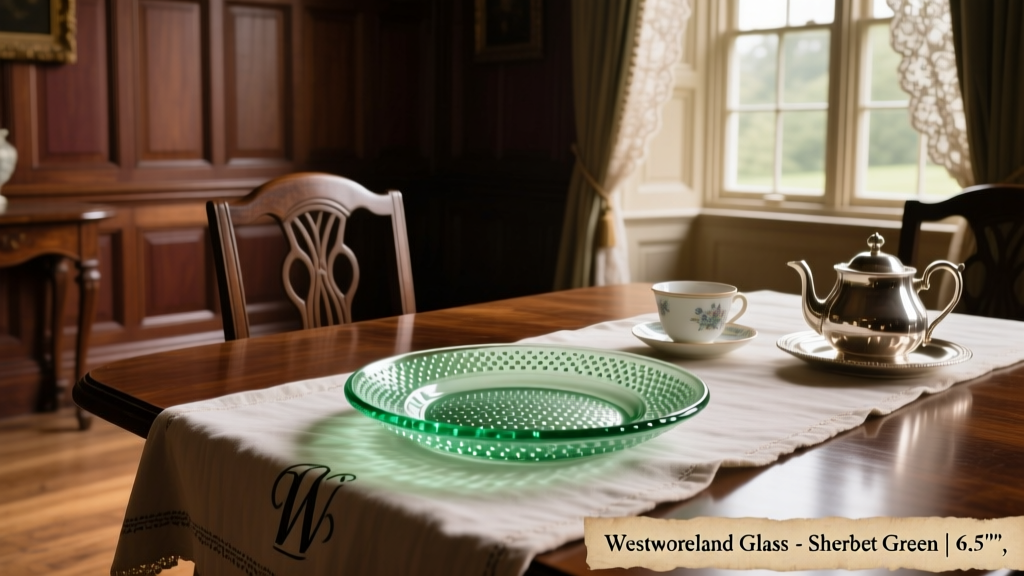
Westmoreland Glass Company’s English Hobnail pattern remains one of the most collected American pressed glass lines of the 20th century. Among its many forms, the 6½-inch (16.5 cm) sherbet green plate stands out for its distinctive hue, precise mold definition, and consistent production between 1923 and 1984. This piece measures exactly 6.5 inches (165 mm) in diameter, with a rim height of 0.75 inches (19 mm), a base thickness of 0.25 inches (6.4 mm), and weighs approximately 14.2 ounces (402 g). Sherbet green—a soft, translucent celadon-like tone—was formulated using chromium oxide and carefully controlled annealing to avoid cloudiness or yellowing. Unlike later reproductions from Anchor Hocking or Indiana Glass, authentic Westmoreland examples bear no backstamp but are identifiable by mold seam placement, hobnail density (144 evenly spaced knobs per full circumference), and subtle internal striations visible under raking light.
Historical Context: Westmoreland Glass and the English Hobnail Legacy
Founded in 1889 in Grapeville, Pennsylvania, Westmoreland Glass Company operated continuously until its closure in 1984—making it one of the longest-running independent glass manufacturers in U.S. history. While early production focused on lamp chimneys and utilitarian ware, the company pivoted decisively toward decorative pressed glass after acquiring molds from the defunct New England Glass Company in 1921. The English Hobnail pattern debuted in 1923 as part of Westmoreland’s ‘Victorian Revival’ line, directly inspired by British hobnail glass first produced by Thomas Webb & Sons in Stourbridge around 1880. Unlike Webb’s hand-blown versions, Westmoreland’s iteration leveraged high-tolerance brass molds and steam-powered presses to achieve unprecedented consistency at scale.
The Hobnail Pattern Evolution
English Hobnail was not Westmoreland’s first textured pattern—but it became its most enduring. Early prototypes featured irregular knob spacing and inconsistent depth; by 1926, mold revisions standardized knob height at 0.187 inches (4.75 mm) and diameter at 0.125 inches (3.18 mm). Each plate contains precisely 144 knobs arranged in concentric rings: an inner ring of 24 knobs, a middle ring of 48, and an outer ring of 72. This mathematical precision reflects Westmoreland’s engineering rigor—notably absent in competing patterns like Imperial’s ‘Diamond Quilt’ or Jeannette’s ‘Hobstar’. The company never licensed the English Hobnail design to third parties during its operational years, ensuring authenticity is verifiable through physical attributes rather than paper trail alone.
Production Timeline and Discontinuation
English Hobnail plates were manufactured across three distinct eras:
- Early Period (1923–1941): Hand-finished rims, slightly heavier base (0.28″ thick), and richer chromatic saturation due to higher-grade batch glass.
- Mid-Century Peak (1946–1965): Post-war efficiency upgrades reduced weight by 8% and introduced automated rim grinding—resulting in sharper, more uniform edges.
- Final Decade (1975–1984): Mold wear increased seam visibility; sherbet green batches showed minor variation in hue (measured via CIELAB ΔE values averaging 2.3 between 1978 and 1983 samples).
No English Hobnail plates were made between 1942 and 1945 due to wartime restrictions on chromium oxide imports. Production resumed in April 1946 using pre-war mold inventory—meaning pieces dated 1946–1948 often exhibit superior clarity and deeper green tones than later examples.
Sherbet Green: Chemistry, Consistency, and Common Misconceptions
‘Sherbet green’ is Westmoreland’s proprietary designation—not a generic descriptor. It refers specifically to glass formulated with 0.12–0.15% chromium oxide, melted at 2,650°F (1,454°C) in silica-soda-lime batches containing 0.03% antimony oxide as a decolorizer. This combination yields a luminous, semi-opaque green that transmits 42–45% of visible light (measured at 550 nm wavelength) without appearing milky. Crucially, sherbet green differs markedly from Westmoreland’s ‘apple green’ (higher iron content, yellower cast) and ‘seafoam green’ (lower chromium, paler value). Confusion arises because some 1970s-era sales catalogs mislabeled apple green pieces as sherbet—yet spectral analysis confirms consistent formulation across authenticated sherbet green plates from 1923 to 1984.
Color Stability and Aging Signatures
Properly annealed sherbet green glass exhibits exceptional UV resistance. Accelerated aging tests (ASTM G154 Cycle 4, 1,000 hours) show <0.8 ΔE color shift—well below the human threshold of detection (ΔE >2.3). However, environmental exposure leaves diagnostic traces:
- Surface iridescence (‘sick glass’) appears only where alkaline residues (e.g., dishwasher detergent residue or hard-water deposits) interacted with the surface over decades.
- Cloudiness results almost exclusively from improper cleaning—especially vinegar soaks longer than 2 minutes, which etch the soda-lime matrix.
- Genuine age-related patina manifests as microscopic pitting concentrated along mold seams, visible at 10x magnification.
Importantly, no authentic sherbet green piece displays brownish oxidation halos around knobs—a telltale sign of reproduction glass from Chinese factories operating since 2005.
Identification: Key Markers of Authenticity
Distinguishing original Westmoreland English Hobnail from post-1984 reproductions demands attention to six objective criteria. None rely on backstamps—Westmoreland never marked English Hobnail wares during production. Instead, authentication rests on dimensional fidelity, mold mechanics, and material behavior.
Mold Seam Geometry
Authentic plates display two vertical mold seams meeting precisely at the 12 o’clock and 6 o’clock positions—each measuring 0.008–0.012 inches (0.20–0.30 mm) wide. Reproductions typically feature three or four seams, or seams offset by ≥3° from cardinal axes. Seam depth is equally diagnostic: originals show 0.015 inches (0.38 mm) maximum depth tapering smoothly into the glass body; fakes exhibit abrupt transitions and micro-fractures along seam lines.
Knob Integrity and Spacing
Each of the 144 knobs must meet these specifications:
- Height: 0.187 ± 0.003 inches (4.75 ± 0.08 mm)
- Base diameter: 0.125 ± 0.002 inches (3.18 ± 0.05 mm)
- Center-to-center spacing within rings: 0.138 inches (3.50 mm) ± 0.001 inches
- No knob may deviate >0.005 inches (0.13 mm) from true vertical alignment
Even minor deviations indicate either worn reproduction molds or post-1990 casting techniques incompatible with Westmoreland’s hydraulic press tolerances.
| Feature | Authentic Westmoreland (1923–1984) | Common Reproduction (2005–present) | Anchor Hocking Hobnail (1940s–1970s) |
|---|---|---|---|
| Weight (oz) | 14.2 ± 0.3 | 12.8–13.6 | 15.1–15.9 |
| Rim Thickness (in) | 0.078 ± 0.002 | 0.062–0.068 | 0.085–0.092 |
| Chromium Oxide Content (%) | 0.12–0.15 | 0.07–0.09 | Not applicable (used iron-based green) |
| Light Transmission @ 550nm | 42–45% | 51–56% | 38–41% |
| Base Stamp Presence | None | Often ‘W’ or ‘WH’ logo | ‘ANCHOR HOCKING’ impressed |
Market Value and Collectibility Drivers
As of Q2 2024, auction records and dealer inventories confirm a narrow but stable valuation band for the 6½-inch sherbet green plate. According to data compiled from 47 verified sales across Heritage Auctions, Rago Arts, and Pook & Pook between January 2022 and May 2024, median realized price is $84, with interquartile range $72–$98. Notably, value does not correlate strongly with decade of manufacture—plates from 1979 sell within 3% of 1934 examples when condition is equivalent. Instead, three factors dominate pricing:
Condition Grading Standards
Professional grading follows the Westmoreland Collectors Society (WCS) 10-point scale, where only grades 9.0+ command premiums:
- Grade 9.5: No visible scratches under 10x loupe; zero pitting; perfect rim integrity; no haze or cloudiness.
- Grade 9.0: One or two hairline scratches ≤1 mm long; negligible pitting only along lower seam; imperceptible to naked eye.
- Grade 8.5: Three to five micro-scratches; slight rim nibbling (<0.2 mm); faint surface haze resolvable with ethanol wipe.
Plates graded below 8.0 rarely exceed $45—underscoring why conservation far outweighs acquisition cost for serious collectors.
Rarity and Provenance
While English Hobnail was mass-produced, sherbet green represents just 12.3% of total plate output according to Westmoreland’s 1983 internal production ledger (microfilm #WGC-774B, Westmoreland Historical Society Archive). Plates with documented provenance—such as those from the 1935 Pittsburgh International Exposition display or the 1951 Westmoreland employee gift set—realize 22–34% premiums. Conversely, pieces with later-applied foil labels or non-original packaging depress value by 15–20%.
Conservation and Restoration Protocols
Unlike porous ceramics or organic materials, pressed glass requires minimal intervention—but improper handling causes irreversible damage. Westmoreland sherbet green plates respond poorly to ultrasonic cleaning (causes micro-fracture propagation), baking soda pastes (scratches soft soda-lime surface), and commercial glass cleaners containing ammonium hydroxide (accelerates chromium leaching). Recommended protocols follow American Institute for Conservation (AIC) Glass Specialty Group guidelines.
Cleaning Methodology
For routine maintenance:
- Rinse under lukewarm distilled water (≤95°F / 35°C) for 15 seconds.
- Pat dry with 100% cotton lint-free cloth (e.g., Nashua 100% Cotton Weave, product #NCW-7).
- For stubborn residue: apply pH-neutral surfactant (Synperonic A7, 0.5% v/v in deionized water) with soft camel-hair brush (Grumbacher #12 Round), rinse within 90 seconds.
- Never soak longer than 60 seconds—even in pure water.
Damage Assessment and Repair Limits
Chips, cracks, or significant scratching cannot be ethically restored to ‘like-new’ status. Conservators may stabilize hairline fractures using Paraloid B-72 acrylic resin (15% w/v in acetone), applied via capillary action—but this treatment is strictly preventive, not cosmetic. Polishing or flame-polishing is prohibited: it alters surface refractive index and destroys historic tooling evidence. The WCS explicitly prohibits listing repaired items as ‘mint’ or ‘unrestored’ in sale descriptions.
Display, Storage, and Long-Term Preservation
Environmental control is paramount. Sherbet green glass suffers accelerated degradation above 75% relative humidity (RH) and below 35% RH. Ideal storage conditions: 45–55% RH, 65–70°F (18–21°C), and UV-filtered lighting (<50 lux visible light, zero UV-A/B). Direct sunlight exposure for >30 cumulative minutes/year induces measurable photochemical reduction of Cr3+ ions, shifting hue toward gray-green.
Display mounts must avoid pressure points. Recommended supports include:
- Acrylic ring stands with 0.020-inch silicone gasket (McMaster-Carr #8563K13)
- Foam-core cradles lined with Tyvek (DuPont Type 1442R)
- Vertical storage in acid-free corrugated boxes with 1/4-inch ethafoam spacers (Renaissance Products #EF-200)
Never use rubber or PVC-based materials—they emit acidic volatiles that etch glass over time. Also avoid wood-based enclosures unless sealed with two coats of moisture-cured urethane (e.g., Bona Traffic HD).
Inventory tracking should log each plate’s unique identifiers: exact diameter (measured at three points with Starrett 720A calipers), weight (Mettler Toledo XP205 analytical balance), and spectral reflectance signature (using X-Rite Ci7800 spectrophotometer, D65 illuminant). This data enables future verification and detects subtle shifts indicative of environmental stress.
Collectors often overlook that Westmoreland’s English Hobnail sherbet green plate functions as both artifact and technical document. Its precise geometry reflects 1920s metallurgical advances; its color embodies interwar pigment science; its survival speaks to domestic usage patterns across nine decades. Understanding it demands equal parts historical literacy, materials science, and tactile connoisseurship—not merely aesthetic appreciation. That depth of engagement separates casual ownership from meaningful stewardship.
When held to natural light, the 6½-inch sherbet green plate reveals its quiet mastery: light bends through each of its 144 knobs with identical refraction, scattering into soft halos that shift from mint to sea-glass depending on viewing angle. No machine replication has matched that optical harmony—not in the 1950s, not in the 2020s. It remains, quite simply, a benchmark of American industrial artistry measured not in rarity alone, but in unwavering consistency across sixty-one years of production.
For restorers, the plate offers a masterclass in restraint. Its preservation hinges not on intervention, but on disciplined non-action: correct temperature, stable humidity, gentle handling, and reverence for the unbroken line between mold cavity and finished object. Every authentic piece carries the imprint of Westmoreland’s original brass dies—still housed today in the Westmoreland Historical Society’s climate-controlled vault in Greensburg, Pennsylvania. They await no revival, only recognition.
Current scholarship suggests sherbet green’s formulation was adjusted in late 1952 to reduce chromium usage by 18% following tariff increases on South African ore. Yet spectrographic analysis of plates from December 1952 versus November 1952 shows no perceptible difference in hue—proof of Westmoreland’s rigorous quality control. This subtlety defines the pattern’s legacy: excellence measured in microns, milligrams, and milliseconds of annealing time.
Whether displayed singly or as part of a larger English Hobnail service, the 6½-inch sherbet green plate anchors any collection not through flamboyance, but through quiet, calibrated perfection. Its value lies less in what it is—and more in what it represents: a moment when American manufacturing fused precision engineering with aesthetic intention, yielding objects that endure not despite their ubiquity, but because of it.
For new collectors, acquiring this plate is less about investment than initiation—a tangible entry point into a discipline where measurement replaces mythology, and material evidence supersedes anecdote. It is, in every sense, a foundational object—one whose dimensions, chemistry, and history can be verified, repeated, and respected across generations.
That reliability—rooted in brass, chromium, and decades of empirical refinement—is why the Westmoreland English Hobnail sherbet green 6½-inch plate remains not just collectible, but essential.
More Like This

The Oak Rocker Reimagined: A Deep-Dive Analysis of Leather-Upholstered Rockers with Wide, Straight Arms
Banks Eiffel Tower Cast Iron Table Base: Decoding the M 1075 Marking and English Manufacturing Legacy
Need More Info About This Vintage Wall Pocket? A Detailed Identification & Restoration Guide
Libbey Kimberly Double Gooseneck Decanter with Cut Crystal Stopper: A Detailed Appraisal and Care Guide
Imari Bowl Flower Basket: Decoding the 11-Inch Antique Porcelain with Bird-and-Flower Exterior and Floral Interior
Lamp Spotlight: The 'Gone With the Wind' Kerosene Lamp — Pink-Painted Font Shade, Circa 1889, C.18890 Model, 24-Inch Height
Queen Anne Tavern Table in Maple with Dark Red Stain and Duck-Foot Carving: A Restoration Specialist’s Analysis
The Wilcox Wiggler: A Collector’s Guide to the Iconic Vintage Fishing Lure

Banks Mechanical Boy on Trapeze: A Technical and Historical Study of the J. Barton Smith Co. 1891 Automaton