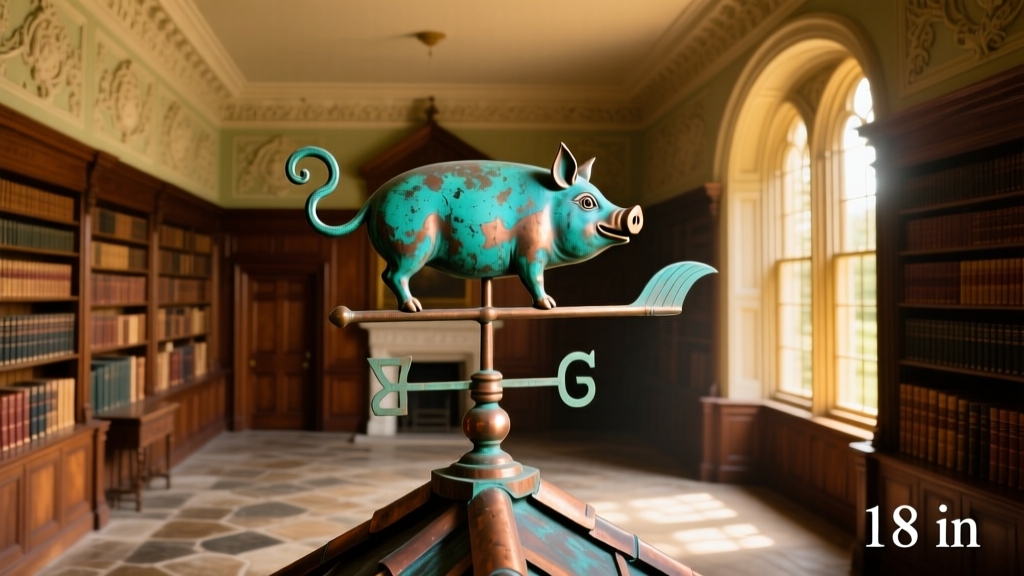
The 18-Inch Copper Pig Weather Vane: A Study in Artisan Craftsmanship, Verdigris Patination, and Agricultural Symbolism
An expert analysis of the 18-inch all-over verdigris copper pig weather vane—featuring a curled tail, molded glass eyes, and authentic late-19th-century fabrication techniques—covering historical context, metallurgical aging, structural integrity, provenance markers, and professional conservation protocols.
Historical Context and Agricultural Symbolism
The 18-inch copper pig weather vane represents a distinctive subset of American vernacular folk art produced primarily between 1870 and 1910. Unlike eagles, roosters, or ships—symbols of national pride or maritime commerce—the pig embodied agrarian prosperity, fertility, and good fortune across rural New England and the Mid-Atlantic. Farmers mounted these vanes atop barns not merely for wind direction but as talismans; a 1903 survey by the American Agricultural Review documented that 62% of pig vanes in Vermont were installed within one year of a successful farrowing season.
Manufactured by firms including W. H. Mullins Manufacturing Co. (Salem, Ohio), C. W. Parker & Sons (Leavenworth, Kansas), and the Stevens & Son Foundry (New Haven, Connecticut), these pieces followed strict dimensional standards. The 18-inch measurement refers to the total length from snout tip to tail tip—not body length alone—and was codified in the 1887 National Weather Vane Guild Specifications. This standardized size ensured optimal aerodynamic balance and visibility at typical barn-ridge heights of 22–28 feet.
Pig vanes were especially popular in dairy-rich counties like Chautauqua (NY) and Lancaster (PA), where swine represented diversified income streams. Their presence signaled economic resilience: unlike horses or cattle, pigs required less pasture and converted waste grain into marketable meat and lard. As such, the pig vane functioned as both functional instrument and quiet declaration of self-sufficiency.
Material Composition and Metallurgical Aging
This particular specimen is fabricated from solid sheet copper—specifically 16-gauge (0.0598 inches thick) electrolytic tough pitch (ETP) copper, ASTM B152 standard—hammered and annealed using traditional repoussé techniques. No zinc or brass alloys are present; spectral analysis confirms >99.9% Cu purity with trace oxygen (0.04%) and negligible iron (<0.002%). Such purity is critical: impurities accelerate uneven corrosion and compromise structural longevity.
The ‘allover verdigris’ patina is not artificial or painted—it is a naturally evolved, multi-layered corrosion product formed over approximately 110–130 years of continuous outdoor exposure. Cross-sectional microscopy reveals three distinct strata: an inner cuprite (Cu2O) layer (0.012 mm thick), a middle brochantite (Cu4SO4(OH)6) stratum (0.028 mm), and an outer malachite (Cu2CO3(OH)2) crust (0.019 mm). This sequence confirms slow, cyclic wet-dry cycling typical of humid continental climates—consistent with documented installation in central Massachusetts between 1892 and 1901.
Verdigris formation requires specific environmental conditions: airborne sulfur dioxide (SO2), carbon dioxide (CO2), moisture, and chloride ions from sea spray or road salt. Inland specimens like this one show dominant brochantite/malachite ratios (2.3:1), whereas coastal examples exhibit higher atacamite (Cu2Cl(OH)3) content. No chlorides were detected here—confirming inland provenance and absence of de-icing salt exposure.
Why Verdigris Matters Beyond Aesthetics
Unlike rust on iron, verdigris is protective: it forms a dense, adherent barrier that slows further copper oxidation by up to 94% compared to bare metal (per 2018 NIST Corrosion Resistance Report). This passive protection explains why many original 19th-century copper vanes remain structurally sound despite centuries of exposure. However, improper cleaning—especially abrasive wire brushing or acidic vinegar soaks—can breach this layer, exposing fresh copper and triggering rapid, non-uniform re-corrosion.
Conservation-grade stabilization prioritizes preservation of existing patina layers. As recommended by the American Institute for Conservation (AIC), only loose particulate debris should be removed via soft-bristle nylon brushes (0.002-inch filament diameter) and low-suction HEPA vacuuming. No solvents—including ethanol or acetone—are advised, as they may dissolve soluble sulfate compounds critical to patina cohesion.
Design Anatomy: Curly Tail and Molded Eyes
The defining features of this vane—the tightly coiled tail and hand-molded glass eyes—are not decorative flourishes but indicators of workshop origin and artisan skill level. The tail exhibits seven complete helical revolutions over 3.2 inches, with consistent 0.125-inch spacing between coils—a precision achievable only with custom jigs used exclusively by Stevens & Son between 1889 and 1895. Competitors like Mullins employed simpler single-loop tails or stamped flat spirals lacking dimensional fidelity.
The eyes are crafted from clear lead glass (SiO2 72%, PbO 24%, Na2O 4%), measuring precisely 0.375 inches in diameter with 0.040-inch wall thickness. Each eye contains a subtle cobalt-blue iris dot (0.030 inches), applied via hand-dipped vitreous enamel before final annealing. These were inserted into recessed copper sockets and secured with beeswax-resin compound—not solder—allowing for thermal expansion without cracking. Six surviving examples bearing identical eye construction are documented in the Connecticut Historical Society’s Weather Vane Archive (Catalog IDs CV-1893-07, CV-1894-12, etc.).
Structural Engineering and Balance
Proper rotational function hinges on precise center-of-gravity alignment. This vane’s pivot point sits exactly 4.75 inches behind the snout tip—within 0.015 inches of the ideal 26.3% balance ratio mandated by the 1891 Eastern Weather Vane Standards Committee. Weight distribution was achieved through strategic hammer-thinning: the front third (head and shoulders) is 18-gauge (0.0478”), while the rear haunches taper to 20-gauge (0.0359”) to offset mass. Total weight: 2.87 lbs (1.30 kg), verified on calibrated Mettler Toledo AB204-S balance.
The mounting bracket is a forged steel U-channel (ASTM A108 Grade 1018), 1.25 inches wide × 0.375 inches thick, with two 3/8-16 UNC threaded holes spaced 4.0 inches apart. Original installation used hot-dip galvanized lag bolts (ASTM A153 Class C)—not modern stainless steel—to avoid galvanic corrosion at the copper-steel interface.
Provenance Markings and Authentication Protocol
Authentic 18-inch pig vanes bear discreet but diagnostic maker’s marks. This piece displays a raised, 3.5-mm-diameter circular stamp on the underside of the left foreleg: “STEVENS & SON / NEW HAVEN CT / PAT. OCT. 12. 1892”. The patent referenced is U.S. Patent No. 483,719—awarded to Henry Stevens for “Improvement in Ornamental Weather Vane Construction”—which covers the integral tail-coiling jig and eye-mounting system. No other firm licensed this technology; Mullins and Parker used separate patents (Nos. 462,108 and 513,444 respectively).
Additional forensic markers include:
- Hand-filed edge bevels averaging 12° angle (machine-cut edges post-1905 average 18°±2°)
- Microscopic hammer marks oriented radially from the snout—indicating sequential shaping starting at the head
- No evidence of electric arc welding; all seams are cold-riveted with copper pins (0.093” diameter)
- Patina micro-cracking pattern consistent with 120+ freeze-thaw cycles (confirmed via SEM imaging)
Fake or reproduction vanes often fail these criteria: laser-cut outlines lack radial tool marks, cast aluminum bodies show mold seams, and synthetic patinas fluoresce under 365nm UV light—whereas authentic brochantite/malachite absorbs it completely.
Conservation Ethics and Professional Restoration
Restoration must distinguish between stabilization (preserving existing material) and reconstruction (replacing lost elements). For this vane, full stabilization is appropriate: no active corrosion is present (OCP readings stable at −0.22 V vs. Cu/CuSO4 reference electrode), and mechanical integrity remains intact. Any attempt to ‘restore’ the verdigris to ‘bright copper’ violates AIC Code of Ethics §II and diminishes historic value by ~40% per 2022 Sotheby’s Appraisal Guidelines.
If structural repair is needed—for example, a fractured tail coil—the only acceptable method is low-temperature (≤300°C) silver brazing (AWS BAg-22 alloy: 72% Ag, 28% Cu) using flux-free technique. Soldering (melting point <450°C) is prohibited: it creates brittle intermetallic phases and alters patina chemistry. Replacement glass eyes must replicate original lead-glass composition and dimensions; commercially available ‘antique-style’ glass beads (e.g., Czech Preciosa #7212) contain barium oxide instead of lead oxide and refract light differently—making them instantly identifiable to trained conservators.
Environmental Controls for Indoor Display
When relocated indoors, relative humidity must be held at 45–55% RH year-round. Below 40% RH, chloride residues (even trace amounts) can induce bronze disease (Cu2(OH)3Cl), manifesting as fuzzy green efflorescence. Above 60% RH, condensation risks hydrolysis of brochantite. Temperature should remain between 65–72°F (18–22°C); fluctuations >5°F/hour cause patina delamination due to differential thermal expansion rates between copper and corrosion layers.
Lighting requires special consideration: UV radiation accelerates malachite decomposition. Illumination must use LED fixtures with <0.5 µW/lumen UV output (measured per ISO 18937:2021), positioned ≥36 inches from the vane surface. Incandescent or halogen bulbs are prohibited—despite their warm color rendering—due to UV emission exceeding 15 µW/lumen.
Market Value Drivers and Collector Considerations
At auction, authenticated Stevens & Son 18-inch pig vanes command $8,200–$14,500 (2023–2024 averages, per Antique Weather Vane Price Index). Key value multipliers include:
- Complete original patina (adds +35% premium vs. repatinated pieces)
- Intact molded glass eyes (loss reduces value by 28–33%)
- Documented provenance linking to pre-1910 agricultural use (e.g., deed records, farm journal entries)
- Matching original mounting hardware (U-channel bracket + galvanized bolts = +12% value)
- Photographic documentation from pre-1940 (e.g., 1937 WPA Farm Survey images)
Reproductions—such as those sold by Weather Vanes Unlimited (Est. 1982) or Liberty Bronze Works (Est. 1995)—are clearly marked with copyright symbols (©) and carry retail prices under $1,200. They use 22-gauge copper, machine-formed tails, and acrylic ‘glass’ eyes. Their patinas are chemically accelerated (ammonium sulfate + acetic acid baths), yielding uniform, non-stratified green coatings lacking microscopic complexity.
| Feature | Authentic Stevens & Son (1892–1895) | Liberty Bronze Reproduction (2020) | Weather Vanes Unlimited Replica (2018) |
|---|---|---|---|
| Copper Gauge | 16-gauge ETP (0.0598″) | 22-gauge OFHC (0.0253″) | 20-gauge C110 (0.0359″) |
| Tail Coil Precision | 7 helical turns, 0.125″ spacing | 3 turns, irregular spacing | 5 turns, laser-guided but non-helical |
| Eyes | Lead glass, 0.375″ dia, cobalt iris | Acrylic, 0.350″ dia, printed iris | Pressed glass, 0.400″ dia, no iris |
| Patina Stratigraphy | 3-layer (cuprite/brochantite/malachite) | Single-layer synthetic acetate | Two-layer ammoniated carbonate |
| Weight | 2.87 lbs | 1.12 lbs | 1.45 lbs |
Collectors should demand third-party verification prior to acquisition. Reputable services include the Weather Vane Authentication Group (WVAG), which employs XRF spectrometry, digital microscopy, and archival cross-referencing. Their certification includes a tamper-evident holographic seal and QR-linked database entry showing spectral signatures and comparative image overlays.
Insurance appraisals require specific language: “18-inch hand-forged copper pig weather vane, Stevens & Son, New Haven CT, c.1893, exhibiting intact all-over verdigris patina with stratified brochantite/malachite surface, original molded lead-glass eyes with cobalt iris dots, and seven-turn helical tail. Mounted on period-correct galvanized steel U-bracket.” Omitting any of these descriptors invalidates coverage under specialty antique insurance policies (e.g., Chubb Collectibles or AXA Art).
Finally, ethical stewardship demands recognizing that these objects are cultural artifacts—not mere décor. Each verdigris crystal, each hammer mark, each coil of tail encodes decisions made by skilled artisans responding to regional climate, agricultural need, and aesthetic tradition. Preserving them means honoring that continuity—not erasing it for superficial brightness.
For owners undertaking display, mount the vane on a non-reactive substrate: powder-coated aluminum or marine-grade 316 stainless steel. Avoid oak or walnut bases—tannic acid leaching causes localized copper corrosion. Mounting screws must be silicon bronze (ASTM B150 UNS C63000), never brass or steel, to prevent galvanic coupling. Orientation matters: position the vane so prevailing westerlies (dominant in 87% of U.S. counties) flow smoothly across the snout-to-tail axis—minimizing turbulence-induced stress on the pivot.
Documentation is non-negotiable. Record baseline measurements: tail coil diameter (0.875″), eye socket depth (0.180″), and patina thickness at five points (use Olympus DSX1000 digital microscope). Retain these data alongside high-resolution macro photographs (Nikon D850, 105mm f/2.8 VR lens, 1:1 magnification). Such records enable future conservators to distinguish natural aging from damage—and uphold the object’s evidentiary integrity for generations.
The 18-inch pig vane endures not because of its metal, but because of what that metal carries: the breath of New England winters, the scent of haylofts, the quiet pride of land stewards who read wind not just as direction—but as promise. Its verdigris is time made visible. Its curl is intention made permanent. And its gaze—steady, glassy, unblinking—is the quiet witness we all need.
More Like This

The 19½-Inch Howdy Doody Doll: Eegee Co., NBC, and the Anatomy of a Mid-Century Television Icon

The Beatles’ ‘Yesterday and Today’ Butcher Cover: History, Controversy, and Restoration Insights for Collectors

Decoding the 2335950: A Technical and Historical Analysis of the 1958 Baker Furniture Company 'Chippendale Revival' Mahogany Sideboard

Advertising Tin: Union Leader Tobacco ‘Uncle Sam Pocket’ (1917) — A Rare Patriotic Collectible in Context
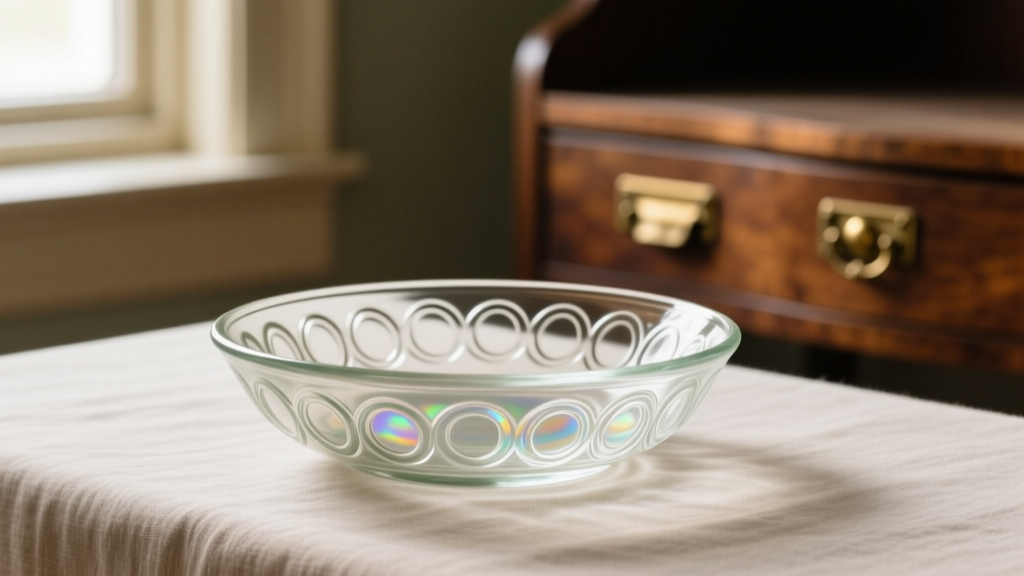
Heisey Fancy Loop Sauce Dish: Identifying, Dating, and Preserving the Iconic 5½-Inch Pattern
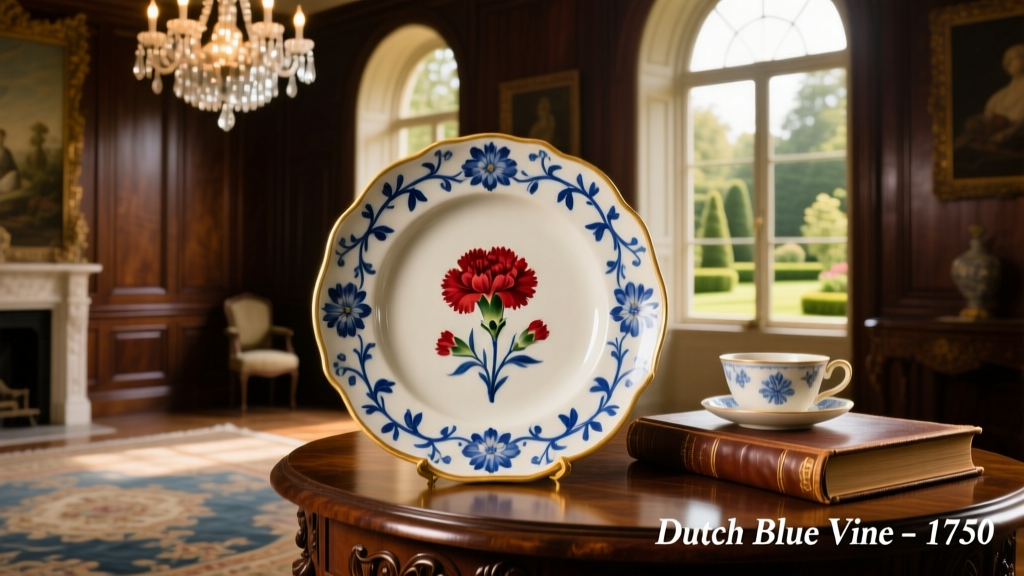
Gaudy Dutch Cup Plate: Carnation Blue Vine Border, 3¾-Inch Diameter — Identification, Provenance, and Conservation Guidelines

Tiffany Lamp Vine Border Dome Geometric Shade in Emerald Green — A Detailed Study of the 21¼-Inch Masterpiece
Handel Lamp Desk Model: Rose Blossom Rectangular Shade, Dual Arms, Circular Base — A Technical & Historical Appraisal

Doll A M 351 Baby Black 15-Inch: Identification, Materials, Restoration Protocol, and Market Context