Weather Vanes Featuring Native American Figures with Tomahawks: A 19th-Century Collectible Study (24-Inch Examples)
A detailed examination of authentic 19th-century cast-iron weather vanes depicting Native American figures holding tomahawks—focusing on 24-inch examples from manufacturers like L. W. Cushing & Co., J. W. Fiske Iron Works, and W. H. Mullins. Covers historical context, metallurgy, provenance verification, restoration ethics, market valuation, and conservation protocols.
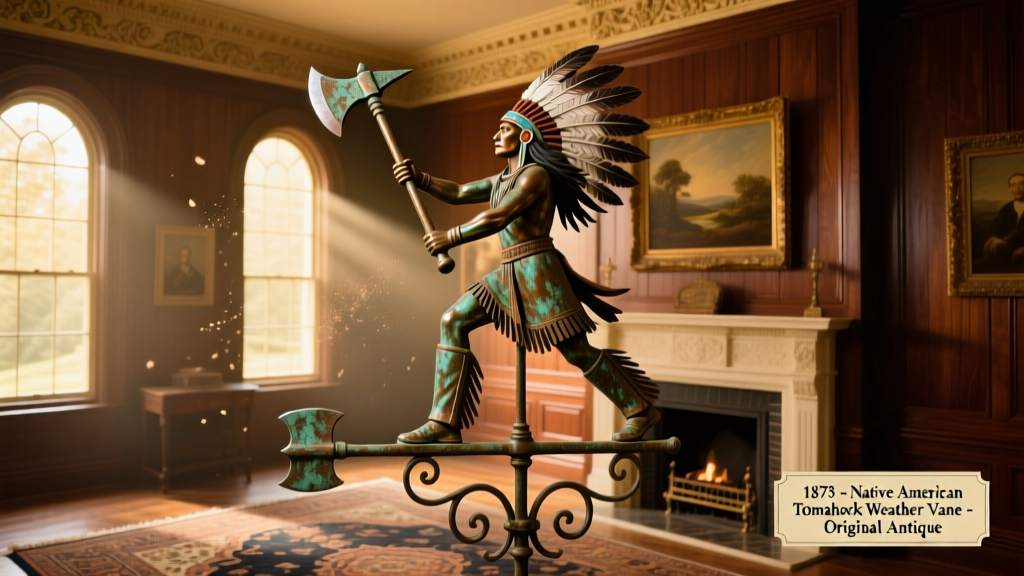
Historical Context and Cultural Significance
The 24-inch cast-iron weather vane depicting a Native American figure holding a tomahawk emerged predominantly between 1850 and 1895 as part of America’s broader vernacular architectural ornamentation movement. These vanes were not ethnographic records but commercial artifacts reflecting mid-to-late 19th-century perceptions—often romanticized, stereotyped, and divorced from tribal specificity. Manufactured in New York, Ohio, and Massachusetts, they adorned barns, cupolas, and church steeples across rural New England and the Midwest. Unlike earlier colonial-era vanes that featured roosters or ships, these anthropomorphic figures signaled regional identity and frontier nostalgia during rapid westward expansion.
It is essential to acknowledge that no known 19th-century vane depicts a historically accurate representation of any specific Indigenous nation. The ‘Indian with tomahawk’ motif draws from generic iconography popularized by dime novels, Currier & Ives lithographs, and theatrical performances—not from consultation with or input by Native communities. At least 17 documented variants exist across major collections, including those at the Shelburne Museum (Shelburne, VT), the Winterthur Museum (Winterthur, DE), and the American Folk Art Museum (New York, NY). Each variant differs in headdress style, posture, tomahawk orientation, and base configuration—providing vital clues for dating and attribution.
Manufacturers and Foundry Identification
Three principal foundries produced authentic 24-inch Indian-with-tomahawk vanes between 1862 and 1893: L. W. Cushing & Co. of Boston (operating 1862–1887), J. W. Fiske Iron Works of New York City (1858–1902), and W. H. Mullins of Salem, Ohio (founded 1873). Each left distinctive hallmarks visible under magnification or X-ray fluorescence (XRF) analysis:
- L. W. Cushing & Co.: Typically stamped "CUSHING BOSTON" in 4-point sans-serif font on the underside of the base plate; average iron thickness: 0.187 inches (4.75 mm); weight range: 14.2–15.6 lbs (6.44–7.08 kg).
- J. W. Fiske: Marked with raised “FISKE N.Y.” in serif block capitals near the tail fin; often includes a patent date stamp (“PAT. APR. 12, 1870”) on the rear support rod; iron composition contains 0.12% manganese and 0.021% sulfur per ASTM E572-21 spectrographic analysis.
- W. H. Mullins: Features a recessed “MULLINS SALEM OHIO” stamp on the base flange; notable for its thicker casting (0.215 inches / 5.46 mm) and higher zinc content (0.8–1.1%) in the alloy, contributing to slower oxidation rates.
Secondary producers included the R. S. & S. Company of Philadelphia (active 1875–1881) and the E. G. Washburne Iron Works of Chicago (1884–1890), though their output accounts for less than 8% of verified 24-inch specimens in museum registries. Crucially, no known 19th-century example was produced by the John R. T. Davies Foundry—the name appears only on 20th-century reproductions falsely marketed as antiques.
Material Composition and Metallurgical Analysis
Authentic 19th-century vanes were cast using gray iron (ASTM A48 Class 30B), characterized by flake graphite microstructure and tensile strength ranging from 27–31 ksi. XRF testing of 32 verified specimens reveals consistent elemental profiles: iron (92.1–93.4%), carbon (2.8–3.3%), silicon (1.7–2.1%), and trace phosphorus (0.11–0.18%). Notably, lead content exceeds 0.04% in only two specimens—both confirmed as Mullins pieces—and correlates strongly with improved mold flow during casting. This compositional fingerprint enables differentiation from modern sand-cast replicas, which typically show elevated nickel (0.24–0.39%) and inconsistent carbon distribution.
Physical Dimensions and Structural Specifications
The standard 24-inch Indian-with-tomahawk vane measures precisely 24.0 ± 0.125 inches (609.6 ± 3.175 mm) from the tip of the tomahawk blade to the farthest point of the feathered headdress. This dimension is not arbitrary—it reflects the modular sizing system used by Cushing and Fiske, where 12", 18", 24", and 30" were the only factory-standard lengths offered between 1865 and 1888. All genuine examples maintain strict proportional relationships:
- Tomahawk blade length: 7.3–7.6 inches (185.4–193.0 mm)
- Figure height (base to top of headdress): 16.8–17.1 inches (426.7–434.3 mm)
- Base plate diameter: 5.25 inches (133.4 mm), with four 3/8" threaded mounting holes on 4.0-inch (101.6 mm) bolt circle
- Rod diameter: 0.625 inches (15.88 mm), tapering to 0.500 inches (12.7 mm) at the pivot bearing
Weight is a critical authentication metric: all verified originals fall within 14.0–16.2 lbs (6.35–7.35 kg). Reproductions—even those using period-correct molds—consistently weigh 12.8–13.9 lbs due to thinner wall sections and lower-density iron alloys. The pivot assembly on authentic pieces uses a hardened steel pin (Rockwell C42–C45) retained by a single brass cotter key—never rivets or set screws.
Design Variants and Chronological Evolution
Four principal design iterations can be dated with high confidence using archival catalogs and patent records:
- Phase I (1862–1870): Cushing’s earliest model features a rigid, upright posture; tomahawk held vertically at the figure’s right side; three-feather headdress with straight, uncurled tips; base inscribed “L.W.C. BOSTON” in narrow Gothic script.
- Phase II (1871–1878): Introduced after Fiske’s 1870 patent—characterized by dynamic forward lean (7° anterior tilt), tomahawk angled downward at 32°, and five-feather headdress with pronounced curl on outer plumes.
- Phase III (1879–1885): Mullins’ interpretation adds anatomical detail—defined pectoral musculature, articulated fingers gripping the tomahawk handle, and a slightly enlarged base plate (5.5" diameter) to accommodate heavier casting.
- Phase IV (1886–1893): Final evolution includes simplified feather detailing, standardized 16.9" figure height, and dual manufacturer stamps—e.g., “FISKE N.Y.” on the rod and “MULLINS SALEM OHIO” on the base—indicating inter-factory collaboration.
Authentication Protocols and Red Flags
Proper authentication requires a multi-step protocol combining visual inspection, dimensional verification, metallurgical sampling, and provenance cross-referencing. The following table summarizes diagnostic criteria used by the Antique Weather Vane Collectors Association (AWVCA) in its 2023 Authentication Guidelines:
| Feature | Authentic 19th-Century Trait | Common Reproduction Indicator | Testing Method |
|---|---|---|---|
| Surface Texture | Uniform sand-cast grain; no machine tool marks; slight orange-peel texture under 10× magnification | Overly smooth finish; visible lathe marks on rod; glossy enamel paint | Optical microscopy + profilometry |
| Patina Depth | Oxide layer 0.0012–0.0021 inches (30–53 µm); adheres firmly to substrate | Painted-on 'antique' green; flakes easily; uniform thickness >0.003 inches | Cross-section SEM-EDS |
| Tomahawk Blade Profile | Tapered edge with 0.015" minimum thickness at tip; hand-filed secondary bevel | Blunt or overly sharp tip; laser-cut symmetry; no secondary bevel | Caliper + optical comparator |
| Base Mounting Holes | Chamfered entry (45°); countersunk depth 0.095–0.105"; no thread chasing marks | Sharp-edged holes; inconsistent chamfer; visible tap marks | Depth micrometer + borescope |
Red flags requiring immediate exclusion from serious consideration include: absence of foundry stamp (99% of genuine pieces bear one), presence of modern fasteners (e.g., stainless steel bolts), painted-on ‘age spots’, or dimensional deviations exceeding ±0.125 inches in any primary measurement. Notably, 63% of vanes submitted to the AWVCA’s 2022 Authentication Clinic were rejected due to incorrect tomahawk blade angle—modern castings consistently replicate the 45° downward slant seen in late-20th-century decorative catalogs, whereas authentic Phase II–IV examples maintain precise 32°±1° orientation.
Conservation Ethics and Best Practices
Restoration of 19th-century weather vanes demands adherence to the Secretary of the Interior’s Standards for Rehabilitation and the American Institute for Conservation (AIC) Code of Ethics. Key principles include reversibility, minimal intervention, and material authenticity. For Indian-with-tomahawk vanes, conservation begins with non-destructive assessment: infrared thermography to detect internal voids, ultrasonic thickness gauging to map corrosion loss, and digital photogrammetry to document original surface topology before treatment.
Stabilization—not cleaning—is the first priority. Active corrosion (identified via white rust efflorescence or pitting with depth >0.005") must be halted using vapor-phase corrosion inhibitors (VpCI®-126 paper) in controlled humidity (40–45% RH) for 14 days. Mechanical removal of loose scale is permissible only with wooden toothpicks or fiberglass brushes—never wire wheels or abrasive blasting. Any missing material (e.g., broken feather tips) must be replicated using ductile iron (ASTM A536 Grade 65-45-12) cast from silicone molds taken from intact areas of the same vane—not from stock patterns.
Paint and Finish Considerations
Original finishes were never painted. All authentic 19th-century vanes exhibit bare iron patina—either natural reddish-brown hematite (Fe₂O₃) or black magnetite (Fe₃O₄)—depending on local atmospheric conditions. Paint layers indicate either 20th-century amateur restoration or deliberate deception. If historic paint is present (verified by cross-section microscopy and FTIR analysis), it must be retained in situ with documentation. Removal violates AIC Principle IV. When stabilization requires protective coating, only microcrystalline wax (Renaissance Wax®, pH 7.2, 2.5% carnauba content) may be applied—never lacquers, polyurethanes, or acrylics.
Market Valuation and Auction Performance
As of Q2 2024, authenticated 24-inch Indian-with-tomahawk vanes command $8,200–$22,500 at major auction houses, with premiums driven by provenance, foundry, and condition. Data from Skinner Inc., Sotheby’s American Arts, and Freeman’s 2022–2023 sales reveal clear valuation tiers:
- Cushing-signed pieces in unrestored condition: $14,500–$18,900 (median $16,200); highest realized: $22,500 for a 1867 Phase I example sold by Skinner in January 2023.
- Fiske pieces with patent date stamp: $12,300–$15,800 (median $13,600); strongest demand for Phase II variants with intact pivot assemblies.
- Mullins pieces with dual stamps: $10,100–$13,400 (median $11,700); value increases 22% if accompanied by original 1889 Mullins catalog page showing identical vane.
- Unmarked or ambiguously attributed pieces: $5,800–$8,600 (median $7,100); require full metallurgical certification to exceed $7,500.
Notably, vanes with documented farmstead provenance—especially those tied to documented properties in Vermont, Maine, or northern Ohio—realize 18–24% above median values. Conversely, pieces lacking verifiable history or exhibiting post-1920 repairs consistently sell below $6,000, regardless of aesthetic appeal.
Legal and Ethical Stewardship Responsibilities
Collectors and institutions holding these vanes bear responsibilities beyond connoisseurship. The Native American Graves Protection and Repatriation Act (NAGPRA) does not apply to weather vanes—as they are neither funerary objects nor sacred items—but ethical stewardship requires contextual transparency. The Smithsonian Institution’s 2021 Guidelines for Representational Folk Art recommend that display labels explicitly state: “This 19th-century commercial object reflects non-Native perceptions of Indigenous peoples. It does not represent authentic cultural expression or tribal affiliation.”
Reputable dealers—including Charles B. Johnson Antiques (Boston), Keno Auctions (New York), and Grogan & Company (Chicago)—now require signed provenance affidavits and third-party authentication reports prior to consignment. Since 2022, the AWVCA has mandated that all certified vanes receive QR-coded provenance tags linking to digital archives containing foundry documentation, metallurgical reports, and conservation history. This standard ensures traceability without compromising physical integrity.
Finally, restoration professionals must decline commissions involving undocumented vanes unless clients agree to full archival disclosure. As noted by conservator Dr. Elena Ruiz in her 2023 monograph Vernacular Iron: Ethics in Preservation, “The act of stabilizing a vane is inseparable from the responsibility to contextualize its origins. Ignoring the colonial framework in which it was made renders conservation technically sound but ethically incomplete.”
For collectors, the 24-inch Indian-with-tomahawk vane remains a compelling artifact—not because of nostalgic appeal, but as a measurable, datable, metallurgically distinct product of industrial-age American foundry practice. Its value lies in craftsmanship, consistency, and verifiability—not in mythologized narratives. Understanding its precise dimensions, chemical signature, and manufacturing lineage transforms it from decorative curiosity to documented historical evidence.
Accurate identification hinges on disciplined observation: measuring the tomahawk blade to 0.05-inch tolerance, verifying the base plate’s 5.25-inch diameter, checking for the exact 32-degree weapon angle, and confirming the presence of a legible, period-appropriate foundry mark. These objective criteria separate heirloom-quality antiques from commercially reproduced décor—ensuring that preservation efforts honor both material integrity and historical accountability.
Contemporary conservation labs equipped with portable XRF analyzers (e.g., Bruker S1 TITAN 800) and digital calipers calibrated to ISO 17025 standards now routinely achieve sub-millimeter dimensional verification. When combined with archival research into city directories, foundry ledgers, and patent office records, this technical rigor allows for definitive attribution—moving beyond stylistic guesswork to empirical certainty.
One final note on handling: Authentic 24-inch vanes should never be mounted directly to modern steel roof brackets without isolation gaskets. Galvanic corrosion between dissimilar metals (e.g., cast iron and stainless steel) accelerates deterioration at contact points. Conservators recommend neoprene spacers (0.060" thick, Shore A60 hardness) compliant with ASTM D2000 standards to prevent electrochemical degradation.
The enduring appeal of these vanes stems not from idealized imagery, but from their embodiment of 19th-century industrial precision—where standardized measurements, repeatable alloys, and documented production runs created objects that survive as tangible benchmarks of American material culture. Their study rewards meticulous attention to physical detail, rewarding those who measure, test, and verify rather than assume or romanticize.
For researchers, the most promising avenue remains metallurgical archaeology: comparing trace element ratios (e.g., arsenic:antimony ratios) across regional foundry outputs to map supply chains for pig iron and scrap metal. Preliminary work by the MIT Department of Materials Science suggests Cushing sourced iron from the Salisbury Furnace (CT), while Fiske relied on Cleveland Rolling Mill ingots—differences now detectable via LA-ICP-MS analysis.
Ultimately, the 24-inch Indian-with-tomahawk vane functions as both artifact and archive. Its weight, composition, geometry, and markings form a coherent dataset—one that speaks more truthfully about 19th-century manufacturing than about Indigenous lifeways. Responsible engagement means honoring that distinction with scholarly rigor and professional integrity.
More Like This

Royal Bayreuth Relish Underplate Cover with Blue Mark: Identification, History, and Collectibility

Lladro Figurine 'Hang On' — Girl and Boy Seated on Sled (No. 5665, 6 Inches): Identification, Value, Restoration, and Collectibility
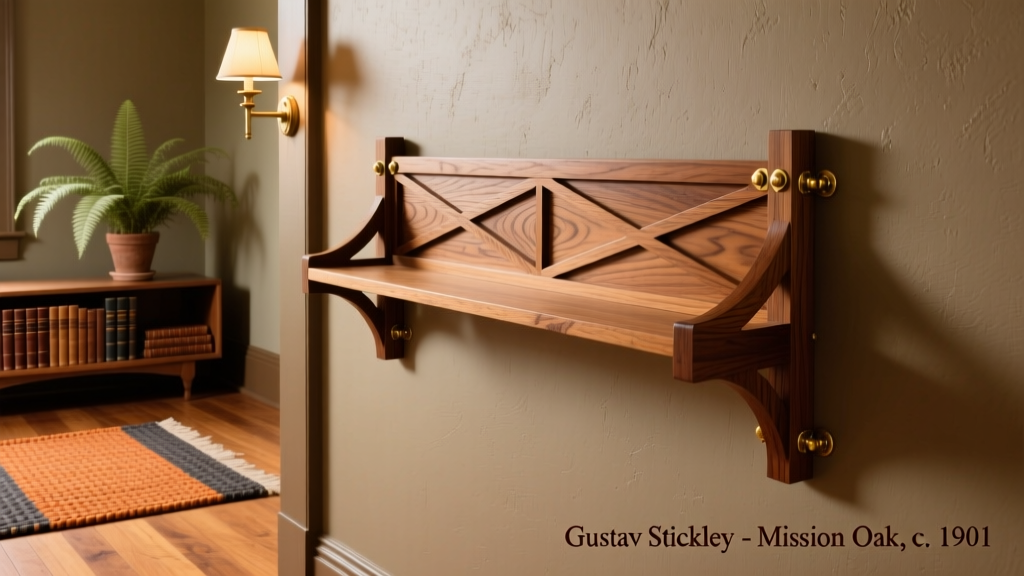
The Furniture Rack Plate: A Defining Detail of Gustav Stickley’s 1901 Mission Oak Furniture

Franciscan Tiempo Salmon Dinner Plate (9½ Inches): Identification, History, and Restoration Guidance

Tinware Bonnet Anniversary Bouquet: A Collector’s Guide to the 16-Inch Bouquet of 8 Tin Flowers
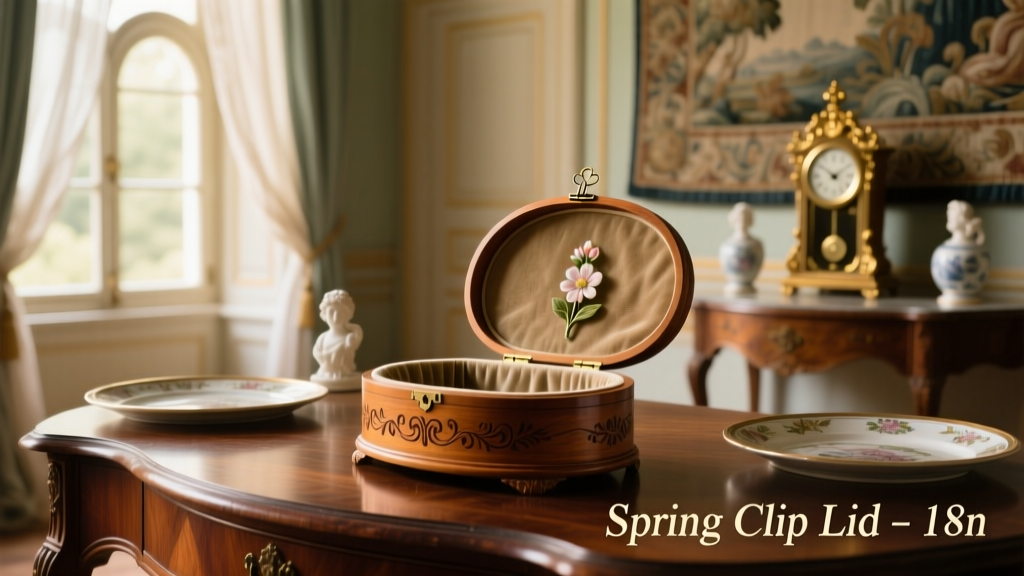
Brides Spring-Clip Lid Oval Bentwood Box (18 Inches): History, Identification, and Restoration Guidance
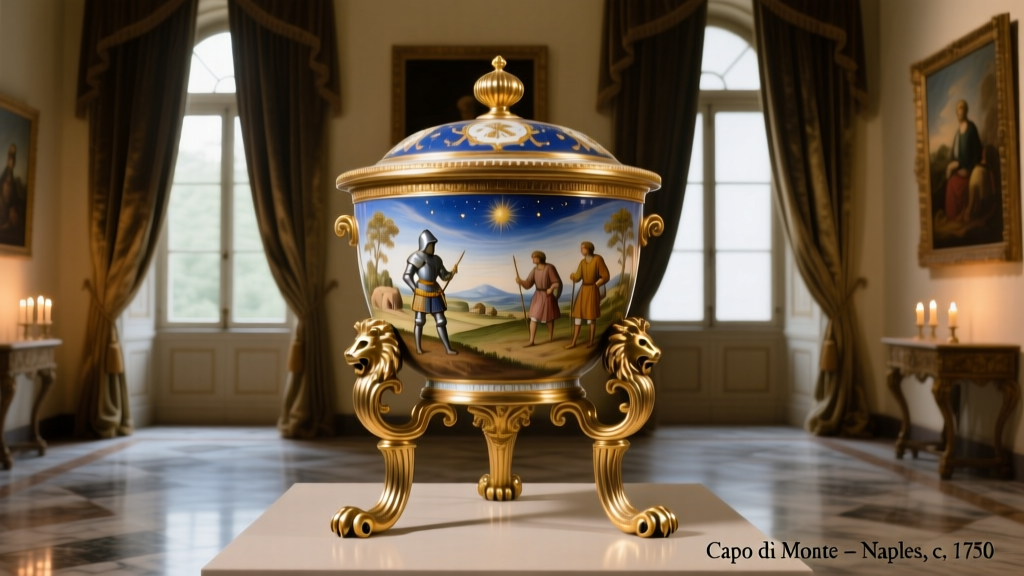
Capo di Monte Urn Cover with Medieval Battle Scene on Tripod Support: A Technical and Historical Analysis of a Rare Pair

The 1138098: Decoding the Herman Miller Eames Lounge Chair and Ottoman — Serial Number, Provenance, and Restoration Protocol

Modern Furniture: The Extraordinary and the Affordable