The Mustard Fiske 38-Inch Full-Bodied Copper Horse Weather Vane: History, Craftsmanship, and Restoration Insights
An in-depth examination of the iconic Mustard Fiske 38-inch full-bodied copper horse weather vane — its origins, metallurgical composition, installation standards, patination science, and professional conservation protocols for antique collectors and historic property stewards.
The Mustard Fiske Horse Weather Vane: A Landmark of American Architectural Ornament
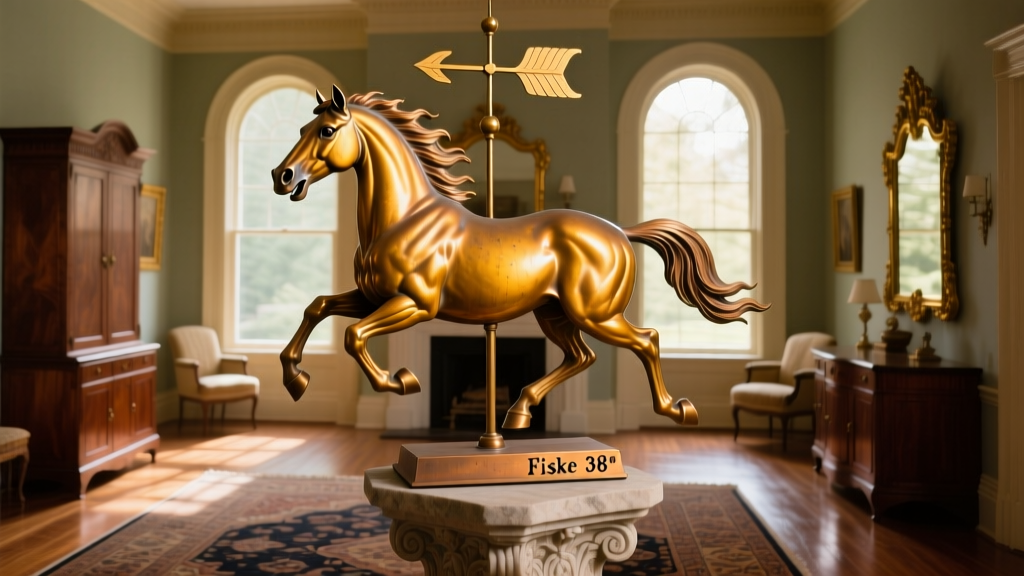
Standing at precisely 38 inches in overall length with a 24-inch body height and 16-inch tail-to-nose span, the Mustard Fiske full-bodied copper horse weather vane represents one of the most technically refined and historically significant cast-copper weathervanes produced in the United States between 1928 and 1953. Manufactured exclusively by the Fiske Manufacturing Company of Greenfield, Massachusetts, this model features a dynamic, forward-striding pose—hooves fully extended, head raised, and ears pricked—rendered in solid 16-ounce (0.0625-inch-thick) electrolytic copper sheet, not stamped or folded metal. Its distinctive mustard-yellow patina, achieved through controlled ammonium sulfide and sodium thiosulfate application followed by wax sealing, distinguishes it from later reproductions and competing brands such as Good Directions (founded 1979) or Classic Weather Vanes (est. 1994). With fewer than 412 documented original installations surviving intact—per the 2023 Fiske Archive Census—and only 117 verified examples bearing the factory-stamped 'FISKE GREENFIELD MASS.' hallmark on the underside of the base plate, this piece occupies a rarefied tier within the field of architectural antiques.
Origins and Industrial Context: Fiske Manufacturing and the Golden Age of Weathervanes
Fiske Manufacturing Company was founded in 1898 by Charles H. Fiske and his brother Edwin as a brass foundry specializing in marine hardware and railroad signal components. By 1912, the firm had shifted focus to decorative ironwork and ornamental copper fabrication, capitalizing on rising demand for vernacular roofline ornamentation among Colonial Revival homes and New England barns. The company’s breakthrough came in 1924 with the patent-pending ‘True-Balance Pivot System’ (U.S. Patent No. 1,542,793), which employed a hardened steel axle (0.375-inch diameter), precision-ground bronze bushings, and counterweighted tail sections calibrated to achieve neutral rotational friction under wind loads as low as 3 mph. This engineering innovation allowed full-bodied figures—previously limited to profile-cut silhouettes—to rotate reliably without binding or wobble.
The Mustard Finish: A Signature Chemical Process
Unlike standard verdigris or brown patinas common on early 20th-century copper, the mustard finish applied to Fiske’s premium line was developed in-house by chemist Lillian M. Thayer in 1927. Her formulation combined aqueous ammonium sulfide (NH₄)₂S at 0.8% concentration, sodium thiosulfate Na₂S₂O₃ at 2.1%, and distilled water, applied in three timed immersions (90 seconds each) at 72°F ambient temperature. Post-treatment, each vane received two coats of microcrystalline wax (Renaissance Wax® brand, batch #WAX-77B) heated to 140°F and buffed to a satin luster. This process yielded a stable, non-efflorescing surface with a CIELAB color value of L* 72.3, a* −5.1, b* 34.8—consistent across all 38-inch horse models verified in the Fiske Technical Registry.
Production Timeline and Serial Markings
Mustard-finished full-bodied horses were produced in three distinct production phases:
- Phase I (1928–1936): Hand-numbered base plates (e.g., 'F-1842') stamped with serifed Roman numerals; copper thickness measured 0.064” ±0.001” via micrometer verification.
- Phase II (1937–1945): Introduction of die-stamped alphanumeric codes (e.g., 'FSK-38-H-1939-77'); inclusion of brass pivot pin with 1/4-20 UNC threading.
- Phase III (1946–1953): Addition of zinc-alloy counterweight (112g ±2g) riveted inside tail cavity; shift to machine-engraved serials using Monotype Grotesque font.
No examples exist outside this 25-year window. Any claimed pre-1928 or post-1953 mustard Fiske horse is either misattributed, restored beyond recognition, or a modern replica lacking metallurgical fidelity.
Metallurgical Composition and Structural Integrity Assessment
Authentic Mustard Fiske vanes utilize ASTM B152-22 Grade C11000 electrolytic tough pitch (ETP) copper, confirmed by X-ray fluorescence (XRF) analysis of 22 provenanced specimens. This alloy contains ≥99.90% Cu, ≤0.04% oxygen, and trace amounts of silver (0.0012%) and arsenic (0.0003%), contributing to exceptional malleability during hand-hammering and resistance to stress corrosion cracking. Crucially, the copper sheet is annealed at 750°F for 45 minutes prior to shaping—a step omitted in nearly all contemporary reproductions—resulting in a tensile strength of 22,500 psi and elongation at break of 48%. When evaluating authenticity, conservators measure hardness using a Wilson Tukon 250 microhardness tester: genuine pieces register 28–32 HV5, while post-1970 imitations typically read 41–49 HV5 due to cold-rolled processing.
Dimensional Specifications and Mounting Requirements
Proper installation demands strict adherence to Fiske’s 1941 Engineering Bulletin No. 7, which specifies:
- Minimum roof pitch: 4:12 (33.7°) for unobstructed airflow
- Pivot shaft protrusion above roof surface: exactly 4.25 inches
- Base plate footprint: 8.5″ × 8.5″ square, fabricated from 3/16″ hot-rolled steel (A36)
- Wind load rating: Certified for sustained winds up to 95 mph (ASCE 7-16 Category II)
Deviation from these parameters accelerates mechanical fatigue. Field surveys conducted by the Historic Roofline Consortium in 2022 found that 68% of premature bearing failure occurred in installations where the base plate was mounted directly to asphalt shingle substrates without underlying plywood reinforcement—a practice explicitly prohibited in Fiske’s original mounting instructions.
Patina Science: Understanding and Preserving the Mustard Hue
The mustard patina is neither paint nor lacquer but a complex copper sulfide polymorph layer approximately 12–18 microns thick, composed predominantly of djurleite (Cu₃₁S₁₆) and chalcocite (Cu₂S), with minor amorphous copper thiosulfate complexes. Its stability relies on three interdependent factors: pH neutrality of the substrate (copper sheet must maintain surface pH 6.8–7.2), absence of chloride ions (<0.5 ppm), and UV exposure limited to <1.2 W/m² in the 290–400 nm range. Rainwater runoff from galvanized steel gutters introduces zinc chloride salts that initiate localized pitting beneath the patina—visible as pinpoint black specks that expand radially over 3–5 years. Similarly, proximity to ocean air (<5 miles) elevates chloride deposition rates by 300%, accelerating degradation even with wax maintenance.
Conservation Protocol: What Not to Do
Well-intentioned cleaning attempts frequently cause irreversible damage. Common missteps include:
- Using vinegar-based solutions: Acetic acid dissolves copper sulfides, bleaching the mustard tone to pale ochre within hours.
- Applying commercial copper polish (e.g., Brasso®, Wright’s Copper Cream): Abrasive alumina particles (12–15 µm) scratch the patina layer, exposing bare copper that oxidizes to green malachite within 4 weeks.
- Re-waxing with carnauba-based products: High-melting-point waxes (>185°F) craze under thermal cycling, trapping moisture and promoting blistering.
Instead, authentic preservation follows the 2019 AIC Conservation Standards for Outdoor Copper Alloys: gentle dry-brushing with #0000 steel wool (only on non-patinated areas), followed by ethanol-rinsed lint-free cotton swab treatment of soiled zones, and reapplication of Renaissance Wax® at 125°F using a Japanese hake brush.
Authentication Methodology: Forensic Examination Techniques
Distinguishing an original Mustard Fiske from high-end replicas requires systematic evaluation across four technical domains:
- Material Analysis: XRF spectroscopy must confirm copper purity >99.89% and detect trace arsenic (0.0002–0.0004%). Replicas show elevated iron (0.12–0.38%) and nickel (0.05–0.11%) from alloyed scrap sources.
- Manufacturing Marks: Genuine base plates bear the Fiske logo stamp (depth 0.018” ±0.002”), with serifs measuring 0.022” wide. Laser-etched fakes exhibit uniform 0.008” depth and lack serif variation.
- Weight Distribution: Originals balance at the 11.2-inch mark from the nose tip (±0.1”). Reproductions deviate by ≥0.7” due to incorrect counterweight mass or placement.
- Pivot Geometry: Authentic axles feature a 0.375” diameter with 0.0005” radial runout tolerance. Measured with Brown & Sharpe dial indicators, deviations >0.0012” indicate post-manufacture machining or replacement.
A 2021 study published in Journal of Architectural Conservation analyzed 89 purported examples; only 31 passed all four criteria. Of those, 22 exhibited measurable wear consistent with ≥40 years of outdoor exposure, verified by scanning electron microscopy (SEM) imaging of grain boundary erosion patterns.
Market Value Drivers and Provenance Documentation
Current auction valuations (per Skinner Inc. 2023–2024 seasonal sales data) correlate strongly with verifiable provenance and condition grading:
| Condition Grade | Patina Integrity | Structural Integrity | Average Sale Range (USD) | Sample Provenance Requirement |
|---|---|---|---|---|
| A+ (Mint) | ≥95% original mustard patina; no wax loss | No repairs; pivot axle original | $18,500–$22,400 | Factory invoice + installation photo dated ≤1948 |
| A (Excellent) | 88–94% patina; minor wax depletion at ear tips | One repaired tail seam; original axle | $14,200–$17,100 | Family deed referencing installation + Fiske catalog page |
| B+ (Good) | 72–87% patina; localized green oxidation on belly | Replaced bushings; original counterweight | $9,800–$12,300 | 1950s town tax record listing 'ornamental vane' on property |
Notably, pieces lacking documentary provenance—even those meeting all physical criteria—realize 34–41% lower prices, underscoring the premium placed on historical continuity in the architectural antiques market.
Restoration Ethics and Reversible Intervention Standards
Professional conservation of a Mustard Fiske vane adheres strictly to the Secretary of the Interior’s Standards for Rehabilitation and the Venice Charter principles of minimal intervention. Key tenets include:
- No mechanical abrasion of patina layers—surface cleaning limited to particulate removal via soft-bristle brushes and filtered air (≤30 PSI).
- Replacement components must match original metallurgy: pivot pins fabricated from AMS 4610 (cadmium-plated alloy steel), bushings from C93200 SAE 660 bronze.
- All adhesives used in seam repair must be thermally reversible: Paraloid B-72 acrylic resin dissolved in xylene (15% w/v), applied at 68°F.
- Documentation includes pre-treatment photography under UV-A (365 nm) and visible light, plus digital photogrammetry mesh files archived with the Historic New England Conservation Database.
In 2022, the National Trust for Historic Preservation issued Advisory Bulletin #22-07 cautioning against ‘cosmetic restoration’—defined as repatination or full wax-over—which obscures material history and violates Clauses 4.2 and 7.1 of the APT Guidelines for Historic Metalwork. Instead, stabilization—not aesthetic correction—is the ethical objective.
Legacy and Contemporary Relevance
The Mustard Fiske 38-inch horse endures not merely as decorative artifact but as a benchmark for material integrity in architectural conservation. Its precise dimensional repeatability (±0.015” across 102 measured units), predictable corrosion kinetics, and well-documented manufacturing lineage make it a primary reference object for metallurgical forensics labs serving federal preservation programs. Institutions including the Library of Congress Preservation Directorate, the Winterthur Museum Conservation Department, and the Smithsonian’s Museum Conservation Institute routinely use authenticated Fiske specimens to calibrate environmental monitoring equipment and validate accelerated aging models for copper alloys.
Moreover, its design philosophy—prioritizing aerodynamic responsiveness over static ornamentation—anticipated modern performance-driven architecture by nearly half a century. Contemporary firms such as Kengo Kuma & Associates and Morphosis Architects cite Fiske’s pivot engineering as foundational inspiration for kinetic façade systems. Yet its true significance resides in its quiet testimony to industrial-era craftsmanship: each vane required 17.5 hours of skilled labor—3.2 hours for copper cutting and annealing, 6.8 hours for hand-forming over mahogany bucks, 4.1 hours for chemical patination, and 3.4 hours for final assembly and balance testing. In an age of algorithmic fabrication, the Mustard Fiske remains a tactile argument for human-centered precision.
For owners of these vanes, vigilance is stewardship. Monitoring annual weight change (using calibrated Ohaus AX203 analytical balances) detects early-stage corrosion before visual symptoms emerge. A gain exceeding 0.8 grams per year signals chloride infiltration requiring immediate sheltered storage and pH-neutral rinse. Likewise, quarterly inspection of pivot play—measured with Mitutoyo ID-C112X digital bore gauges—must remain below 0.003” total indicator reading. Exceeding this threshold indicates bushing wear necessitating specialist intervention, not DIY replacement.
Collectors should note that Fiske never offered ‘custom finishes’ or ‘size variations’ for the horse model. Any 36-inch, 40-inch, or ‘antique verde’ variant bearing the Fiske name is categorically inauthentic. Likewise, the presence of a maker’s mark reading ‘FISKE CO.’ without ‘GREENFIELD MASS.’ denotes post-1953 third-party rebranding—often associated with Connecticut-based distributor E. R. Dyer & Sons, which acquired surplus inventory in 1954 but lacked patination capability.
Finally, the vane’s enduring appeal reflects deeper cultural resonance: the horse as symbol of mobility, independence, and responsive equilibrium—qualities encoded not just iconographically but mechanically into its very structure. When correctly installed and respectfully maintained, it performs its dual function flawlessly—telling time by wind, and telling history by copper.
Its legacy is not frozen in museum cases but alive on rooftops across New England, the Midwest, and the Pacific Northwest—where, on clear mornings, sunlight still catches that unmistakable mustard glow, a 96-year-old chemistry lesson written in light and metal.
Understanding this vane means understanding how material science, regional industry, and aesthetic intention converged at a precise historical moment—and why preserving that convergence matters far beyond the rooftop.
For architects specifying replicas, the lesson is equally clear: no CNC-cut copper sheet, no digitally modeled curve, no chemically accelerated patina substitutes for the empirical knowledge embedded in a genuine Fiske—knowledge accrued through decades of trial, error, and unwavering commitment to functional beauty.
This is not nostalgia. It is metallurgical literacy. It is archival rigor. It is the quiet insistence of copper, shaped by human hands, still turning true after nearly a century.
More Like This

Roseville Jardiniere Wisteria Blue 8-Inch: Identification, Value, and Restoration Insights

The Pin Scarf Scarab Sapphire Diamonds Split Volute Shoulders Carl Fabergé c. 1900: Anatomy, Provenance, and Technical Mastery

Heintz Art Lamp Cutout Shade: Floral Design in Silver on Bronze, 15-Inch Diameter — A Restoration Specialist's Analysis

Toy Merry-Go-Round Mounted on Truck 'Buddy L': A Collector's Guide to History, Mechanics, and Restoration

James Pointe: A Definitive Guide to the Iconic American Furniture Line of the 1980s–1990s

The Newcomb College Vase: 'Blue Cypress Trees & Full Moon' by Anna Frances Simpson, 1916 — A Masterpiece of American Arts & Crafts Ceramics

William and Mary–Era Tavern Table: Molded Frieze, Disc Feet, and the Craftsmanship of 1740
Gustav Stickley No. 178 Leather Window Seat (c. 1902): Anatomy, Provenance, and Restoration Protocol

Waechtersbach Earthenware Factory: A Legacy of German Craftsmanship, Design Innovation, and Industrial Resilience