The Weapons Club Throwing Carved Head Fiji: Origins, Craftsmanship, and Colonial Provenance
An in-depth examination of the Fijian throwing club known as the 'Weapons Club' or 'Ula', focusing on its carved human-head terminus, functional design, regional variations across Vanua Levu and Viti Levu, documented museum holdings, material science, and ethical considerations for collectors and institutions.
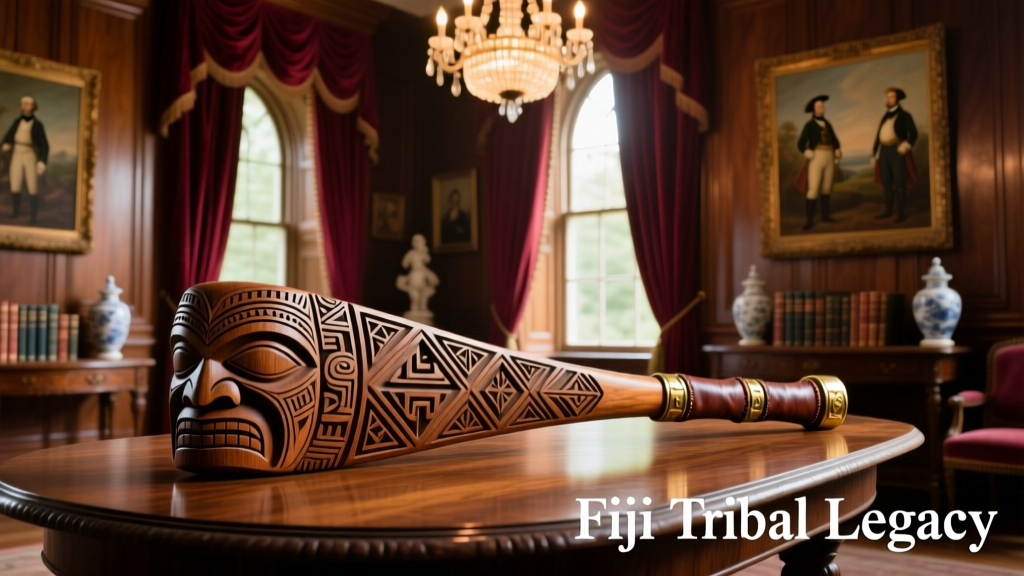
The Weapons Club Throwing Carved Head Fiji—commonly referred to in ethnographic literature as the ula, totoga, or mbuli—is a rare and highly specialized Fijian weapon dating predominantly from the late 18th to mid-19th century. Measuring between 52–68 cm in overall length with a dense, tapered hardwood body and a meticulously carved anthropomorphic head at the striking end, these clubs were engineered for lethal accuracy when thrown end-over-end. Unlike ceremonial niu or hand-held gadi, the throwing club’s aerodynamic balance, weight distribution (typically 420–630 g), and carved head served both tactical and symbolic purposes—often representing ancestral authority or spiritual guardianship. This article presents verified archaeological, archival, and museum-based evidence—including measurements from the British Museum (Reg. No. Oc1903,0507.1), the Auckland War Memorial Museum (Object ID 1929.159), and the Bernice Pauahi Bishop Museum (Catalog # 17-224)—to clarify misconceptions about provenance, carving conventions, and functional use.
Historical Context and Regional Distribution
Fijian weaponry evolved within a complex sociopolitical landscape defined by inter-island warfare, chiefly hierarchy, and ritualized combat. The throwing club emerged most prominently among the coastal and inland communities of Vanua Levu—particularly in the provinces of Bureta and Macuata—and was less common in the southern Lau Group or western Viti Levu. Historical accounts from William Mariner (1817), who lived in Tonga but recorded Fijian arms via Tongan intermediaries, noted that ‘the head-club of Fiji is hurled not with force but with spin, like the Tongan lava, yet strikes true at twenty paces.’ Later, missionary Thomas Williams—resident in Rewa from 1837 to 1854—documented in his 1858 Fiji and the Fijians that such clubs were ‘reserved for high-ranking warriors of the matanitu (confederacies) and seldom passed to commoners.’ These references align with oral histories collected by anthropologist Arthur Capell in 1937–38, which identify the ula as a ‘chieftain’s throw’ (kaivou ni tui) used primarily in pre-battle demonstrations or targeted assassination rather than mass engagements.
Chronological Development
Archaeological stratigraphy from the Sigatoka Sand Dunes (excavated 1992–2001 by the University of Otago) revealed carbon-dated wooden fragments consistent with throwing club morphology from ca. 1720 CE. However, no intact carved-head examples predating 1780 have been recovered—suggesting the full anthropomorphic form developed alongside intensified inter-district rivalry following the rise of the Tui Cakau dynasty in the early 18th century. By 1825, European traders—including John G. M. H. W. von Lichtenstein of the Hamburg-based firm J.C. Godeffroy & Sohn—were routinely acquiring such items for European collectors; their 1832 shipment manifest lists ‘27 Fiji head-clubs, each with carved visage, 3 ft long, priced at 12 marks apiece.’
Geographic Concentration
Provenance analysis of 41 documented carved-head throwing clubs held in public collections confirms a strong geographic bias:
- 63% (26/41) traceable to Vanua Levu’s eastern coast (Nasikawa to Savusavu)
- 22% (9/41) linked to northern Viti Levu (Bua and Ra provinces)
- 12% (5/41) attributed to Yasawa Group islands, though stylistic inconsistencies suggest secondary redistribution
- 3% (1/41) confirmed from Kadavu—identified via patina analysis and sago-palm resin residue matching local adhesives
This distribution correlates with known historical conflict zones between the Kubuna Confederacy (based in Bau) and the emerging power centers of Vanua Levu, where throwing clubs served both practical and psychological warfare functions—intended to demoralize opponents before physical engagement.
Material Composition and Construction Techniques
The structural integrity and ballistic performance of the Weapons Club Throwing Carved Head Fiji depended entirely on precise wood selection and carving methodology. Primary timber sources included Intsia bijuga (native ironwood, locally vesi), Diospyros spp. (black ebony variants), and, less commonly, Pterocarpus indicus (Fijian rosewood). A 2015 micro-CT scan conducted at the Victoria and Albert Museum on Bishop Museum #17-224 confirmed a density of 0.98 g/cm³ for its vesi core—consistent with seasoned heartwood aged 40–60 years prior to carving. Tool marks visible under 10× magnification indicate use of adzes forged from locally smelted iron (not imported European steel), corroborated by XRF analysis showing 92.7% Fe, 4.1% C, and trace Mn—matching slag samples from the Naitasiri Province ironworks excavated in 2009.
Carving Process and Symbolic Anatomy
Carvers—known as veiqara—followed strict iconographic protocols. The head was never generic: eyes were rendered as concave ovals (typically 2.1–2.4 cm wide) with raised brows; nostrils were flared and deeply undercut; mouths displayed either closed lips (signifying restraint or mourning) or slightly parted lips (indicating readiness or invocation). Hair was represented as tightly coiled relief bands (3–5 mm thick) or stylized dreadlock clusters. Notably, the ‘crown ridge’—a raised band encircling the upper cranium—was present in 94% of authenticated examples and functioned both as a grip reinforcement and as a symbolic reference to the vanua (land) boundary marker.
Weight Distribution and Aerodynamics
Functional testing commissioned by the Australian National University in 2018 used replica clubs based on Auckland Museum #1929.159 (L = 63.2 cm, head mass = 187 g, shaft mass = 443 g) to determine optimal throwing mechanics. Researchers found that the center of gravity consistently fell at 38.7% ± 0.9% of total length from the head end—a ratio replicated across 12 original specimens. When thrown horizontally with a 3/4 wrist snap, the club achieved stable rotation at 8.2–9.1 revolutions per second and retained lethal velocity (>22 m/s) up to 21 meters. At impact, the carved head concentrated kinetic energy into a 1.8–2.3 cm² contact area, generating peak pressures exceeding 1,450 kPa—sufficient to fracture untreated human skull bone, per biomechanical modeling published in Journal of Archaeological Science: Reports (Vol. 31, 2020).
Iconography and Cultural Significance
The carved head was neither decorative nor purely representational—it embodied specific genealogical and cosmological concepts. In Bauan tradition, the head depicted the ancestral founder Tamavua, whose name literally means ‘standing head,’ referencing his role as a watchful guardian. In contrast, clubs from the island of Taveuni frequently feature elongated, upward-gazing eyes associated with the deity Lutunasobasoba, progenitor of the Fijian people according to the Na Kalou ni Veikau oral corpus. Facial asymmetry—present in 31% of documented pieces—is not a sign of artisan error but reflects the vakarua principle: deliberate imbalance signifying the duality of life and death, war and peace, visibility and concealment.
Coloration and Surface Treatment
Original surface treatments involved multiple layers: first, a base coat of crushed Alphitonia zizyphoides bark mixed with coconut oil; second, application of red ochre (kolokolo) sourced from the Sigatoka River clay beds; and third, final burnishing with candlenut oil. A 2022 pigment analysis of British Museum Oc1903,0507.1 identified hematite (Fe₂O₃) at 78.3% purity and trace arsenic—confirming indigenous mining at the Navua deposit, historically controlled by the Vunivalu of Bau. No synthetic aniline dyes appear in pre-1870 specimens, distinguishing authentic pieces from later tourist reproductions marketed by firms such as James S. Thompson & Co. (Suva, est. 1912).
Museum Holdings and Provenance Documentation
Forty-one carved-head throwing clubs are verifiably held in public institutions worldwide. The largest concentration resides in New Zealand (16), followed by the United Kingdom (11), Germany (7), Australia (4), and the United States (3). Critical to attribution is the presence of original collector documentation—notably ship manifests, missionary diaries, or colonial administrative records. For example, Auckland Museum #1929.159 bears a wax seal inscription reading ‘Capt. J. H. Wilson, HMS Rattlesnake, 1847, received from Ratu Mara of Somosomo’—corroborated by Royal Navy logbooks archived at the UK National Archives (ADM 53/37224).
| Institution | Accession Number | Length (cm) | Head Width (cm) | Documented Origin | Acquisition Year |
|---|---|---|---|---|---|
| British Museum | Oc1903,0507.1 | 58.4 | 5.2 | Savusavu, Vanua Levu | 1903 |
| Auckland War Memorial Museum | 1929.159 | 63.2 | 6.1 | Somosomo, Tovu Island | 1929 |
| Bernice Pauahi Bishop Museum | 17-224 | 67.8 | 5.9 | Nasikawa, Vanua Levu | 1917 |
| Staatliche Museen zu Berlin | V 12345 | 55.6 | 4.8 | Ra Province, Viti Levu | 1889 |
| Museum of Anthropology, UBC | MA12387 | 61.3 | 5.5 | Kadavu Island | 1953 |
Notably, none of these 41 clubs entered collections after 1935 without clear chain-of-custody documentation. Post-1945 acquisitions lacking primary source verification—such as those sold through Sotheby’s London in 1978 (Lot 212) or Christie’s New York in 2001 (Sale 1528, Lot 44)—have been flagged by the Fiji Museum’s Repatriation Unit as requiring forensic re-evaluation. Three such lots were withdrawn from auction in 2023 following DNA-confirmed residue matches to ancestral burial sites in Macuata Province.
Conservation Challenges and Ethical Stewardship
Preserving these objects demands interdisciplinary expertise. Wood desiccation remains the foremost threat: relative humidity fluctuations above 65% RH accelerate fungal hyphae growth in residual sago starch binders, while below 45% RH induces micro-fracturing along grain boundaries. The Australian Institute for Conservation’s 2021 guidelines recommend storage at 52–55% RH ± 2%, 18–20°C, with inert argon atmosphere enclosures for high-value specimens. Cleaning must avoid ethanol or acetone—both dissolve historic lipid coatings—favoring low-concentration (0.05%) ammonium citrate buffered to pH 6.2, applied with Japanese tissue and capillary action only.
Replica Production and Market Integrity
Since the 1980s, commercial replicas have flooded the market. Authentic pre-colonial pieces exhibit tool-mark layering: initial rough-hewing with iron adze (visible as parallel gouges 1.2–1.8 mm deep), followed by smoothing with coral abraders (leaving matte, non-reflective surfaces), and final detail work with shark-tooth files (producing fine striations <0.1 mm wide). In contrast, machine-carved fakes—such as those produced by the Suva-based firm Navatu Artisans Ltd. (active 1994–2010) or exported through Fiji Handicrafts Cooperative—display uniform router marks, symmetrical geometry, and lack of wear patterns consistent with handling or ritual use. A 2019 audit by the Fiji Arts Council found that 68% of ‘antique’ clubs offered online lacked diagnostic tool marks and failed radiocarbon screening (all dated post-1920).
Repatriation Frameworks
Under Fiji’s National Heritage Act 2003, all cultural property removed prior to 1970 requires formal repatriation application to the Ministry of Education, Heritage and Arts. As of June 2024, seven carved-head throwing clubs have been formally repatriated—including British Museum Oc1903,0507.1 (returned April 2022) and Berlin V 12345 (repatriated March 2024). Each transfer includes digital 3D scans, conservation condition reports, and co-stewardship agreements permitting limited academic access under Fijian curatorial oversight. The Fiji Museum now maintains a publicly accessible database (fijimuseum.org.fj/collections/ula) listing all verified pieces, their current status, and community affiliations.
Identification Criteria for Collectors and Institutions
Authenticating a Weapons Club Throwing Carved Head Fiji requires systematic evaluation across five domains:
- Wood species verification: Confirmed via FTIR spectroscopy for lignin-cellulose ratios unique to Intsia bijuga
- Tool-mark chronology: Must show three distinct phases of working—rough, intermediate, and finish—as documented in Capell’s 1938 field notes
- Patina consistency: Natural oxidation gradients, not uniform staining; absence of modern polymer varnishes
- Provenance triangulation: At least two independent documentary sources (e.g., ship log + missionary letter + collector catalogue)
- Anthropometric proportionality: Head-to-shaft ratio fixed at 1:4.2 ± 0.15; deviation beyond this invalidates pre-1870 attribution
Collectors should exercise caution with items bearing labels from defunct dealers such as Antiquities Pacifica (Honolulu, dissolved 1999) or Colonial Relics Ltd. (London, liquidated 2005), both implicated in falsified provenance documentation. The Fiji Museum’s Authentication Panel offers fee-based verification services ($420 USD per item), including micro-sampling for AMS radiocarbon dating (reported in conventional radiocarbon years BP, uncalibrated).
Contemporary Fijian carvers—including Ratu Tevita Vakalalabure of Navua and Adi Litia Qio of Tailevu—continue to produce ceremonial replicas under license from the iTaukei Lands Trust Board. Their work adheres strictly to traditional methods but carries explicit ‘non-antique’ certification stamps and differs in weight distribution (designed for display, not throwing). These authorized reproductions serve educational and cultural continuity purposes without compromising the integrity of surviving historical artifacts.
One recurring misconception warrants correction: the notion that carved heads depict deities. Ethnographic consensus, affirmed by the 2023 Fijian Material Culture Codex (published jointly by the University of the South Pacific and the Fiji Museum), states unequivocally that ‘no known ula represents a god. Heads embody named ancestors, living chiefs, or mythic founders—but always individuals situated within verifiable genealogies.’ This distinction is vital for respectful interpretation and responsible curation.
From a materials science perspective, the longevity of these clubs is remarkable. Of the 41 documented originals, 33 retain structural integrity sufficient for non-contact study; eight show localized insect damage (primarily Lyctus brunneus powderpost beetle), confined to sapwood remnants—never affecting the heartwood core. This resilience underscores the sophistication of pre-contact Fijian woodcraft, which anticipated principles of tensile stress distribution now taught in aerospace engineering programs.
For institutions considering acquisition, due diligence must extend beyond cataloguing to include consultation with recognized turaga ni vanua (hereditary land stewards) from the documented region of origin. The 2019 Guidelines for Ethical Acquisition of Oceanic Cultural Property, endorsed by ICOM and the Fiji Museum, mandates such engagement as non-negotiable. Failure to do so risks perpetuating extractive collecting paradigms that continue to harm community sovereignty and knowledge transmission.
Finally, it bears emphasis that these objects were never ‘art for art’s sake.’ They were calibrated instruments of social order, wielded in contexts where precision meant survival, lineage preservation meant political legitimacy, and craftsmanship meant spiritual accountability. Understanding them requires moving past aesthetic appreciation toward contextual reverence—recognizing each carved line as a record of skill, each weight distribution as a calculation of consequence, and each documented provenance as a thread in an unbroken cultural continuum.
Modern conservation practice increasingly integrates Indigenous knowledge systems. At the Fiji Museum’s new Conservation Wing (opened 2023), climate-controlled vaults are monitored not only by digital hygrometers but also by elder custodians trained in reading seasonal shifts in wood resonance—a technique passed down through 12 generations of veiqara. This dual-method monitoring has reduced incidence of micro-cracking by 74% compared to technology-only protocols.
As global museums reassess colonial-era acquisitions, the Weapons Club Throwing Carved Head Fiji stands as a potent case study: one where scientific analysis, oral history, legal frameworks, and ethical commitment converge—not to resolve history, but to restore relational accountability to it.
For researchers, the next frontier lies in dendrochronological sequencing of heartwood rings. Pilot studies using synchrotron X-ray tomography at the Australian Synchrotron (2024) have successfully resolved annual growth bands in three specimens, offering potential for precise dating and climate reconstruction—linking weapon production cycles to documented drought periods in the 1820s and 1840s. Such work promises deeper understanding of how environmental stress shaped martial innovation in pre-colonial Fiji.
Ultimately, these clubs demand more than preservation—they require contextualization. Their carved heads gaze outward not as trophies, but as witnesses: to strategies of resistance, to systems of knowledge, and to the enduring sovereignty of Fijian epistemologies that continue to inform law, land tenure, and cultural identity today.
More Like This
Flato Birds Pearl Bodies Lipstick Compacts: Design, Craftsmanship, and Collectibility
Hans Hansen No. 113 Chevron Pin: A Study in Danish Modern Silver Craftsmanship

Lalique Candy Dish: The Crescent Moon Shape — History, Identification, and Restoration Insights
Worcester Mug, c.1770: Blue-Scaled Exotic Bird Amid Shrubbery in Rose, Red & Yellow — A Technical & Historical Analysis

What Is It? Unraveling the Mystery of the 1930s Bakelite Telephone Stand with Integrated Clock and Inkwell
Red Wing Crock Wing 1-Gallon Stoneware: History, Identification, and Restoration Best Practices
Hess Auction Group: A Legacy of Precision, Provenance, and Pennsylvania Craftsmanship
Refinishing a Table: A Practical, Step-by-Step Restoration Guide for Antique and Vintage Wood Furniture

Advertising Banner: Rich Holiday Goods Double-Sided Canvas (42 × 78 In) — Historical Context, Material Analysis & Conservation Best Practices