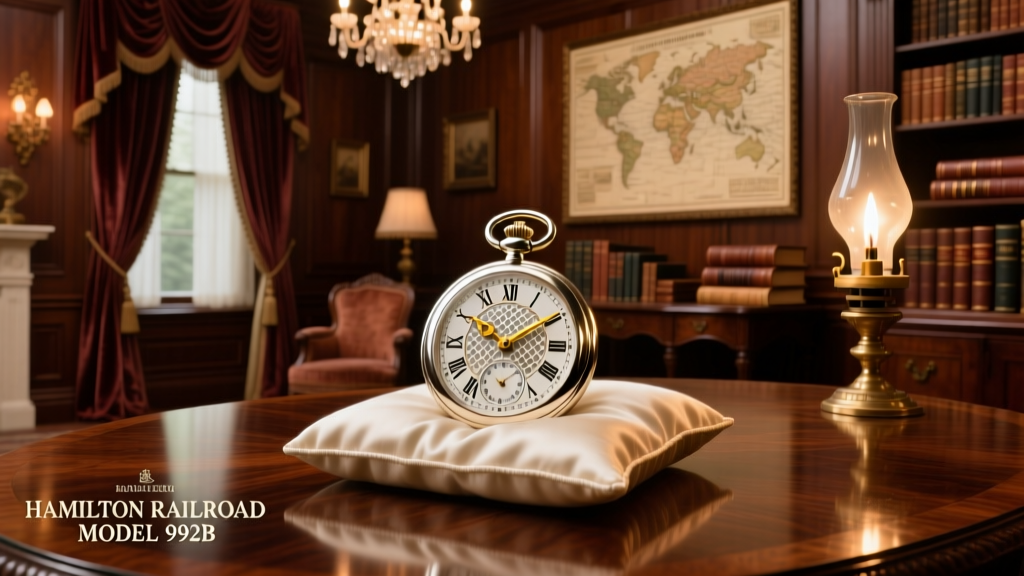
Hamilton Railroad Model 992B: The Precision Legacy of America’s Most Trusted Railroad Watch
A detailed technical and historical analysis of the Hamilton Model 992B — a 21-jewel, size 16, 10K white gold filled railroad pocket watch certified to the 1928 General Railroad Timepiece Standards. Includes movement specs, case construction, service history, and restoration best practices.
Introduction: A Standard-Bearer in American Horology
The Hamilton Model 992B stands as one of the most rigorously tested and widely adopted timepieces in U.S. railroad history. Produced from 1940 through 1955, this 21-jewel, size 16 pocket watch was expressly built to meet the stringent 1928 General Railroad Timepiece Standards established by the American Railway Association (ARA). Unlike earlier models, the 992B incorporated critical refinements—including a double roller escapement, Breguet overcoil hairspring, and adjusted-to-five-positions regulation—that elevated its accuracy to ±30 seconds per week under real-world operating conditions. Its 10K white gold filled case—measured at 2 5⁄8 inches (67.3 mm) in diameter and 1.25 inches (31.8 mm) in depth—was engineered for durability without compromising elegance. With over 250,000 units manufactured, the 992B became the de facto standard for conductors, engineers, and dispatchers across major railroads including the Pennsylvania Railroad, Union Pacific, and Southern Pacific.
Historical Context: Why Railroads Demanded Precision
Rail transportation in the United States evolved rapidly after the Civil War, but inconsistent timekeeping led to catastrophic collisions. In 1891, the infamous Kipton train wreck near Cleveland—caused by a conductor’s watch gaining 4 minutes—spurred the formation of formal time inspection protocols. By 1906, the ARA mandated that all railroad employees carry watches meeting specific mechanical criteria. These standards were revised and tightened in 1928, requiring chronometer-grade performance, positional adjustment, and robust construction. Hamilton responded with the Model 992A in 1930, then refined it further into the 992B in 1940—incorporating lessons learned from wartime production demands and field feedback.
Unlike Swiss or English competitors, Hamilton designed its railroad watches exclusively for North American rail infrastructure. This included compatibility with standardized pocket watch cases used by the Pennsylvania Railroad (PRR), which specified a minimum 16-size movement with lever-set mechanisms and open-face dials. The 992B met every requirement—and exceeded many. It was officially approved by the PRR, New York Central, and the Chicago & North Western Railway, among others. Notably, the 992B was never sold to the general public through retail channels; instead, it was distributed exclusively via authorized railroad supply houses such as Waltham Supply Co. and the Hamilton Watch Company’s own railway division.
The Evolution from 992 to 992B
The original Model 992 debuted in 1903 as Hamilton’s first 21-jewel, lever-set, open-face movement. It featured a single roller escapement and was adjusted to three positions. Over thirty years, Hamilton iterated the design: the 992A (1930) introduced a double roller, improved balance spring, and five-position adjustment. The 992B retained those enhancements while adding key manufacturing upgrades. Most notably, Hamilton replaced the traditional nickel-finished plates with blued steel plates beginning in late 1941—a change driven both by wartime material constraints and aesthetic preference. The balance wheel was upgraded to a Glucydur alloy (copper-beryllium) for thermal stability, and the hairspring received a true Breguet overcoil—not merely a raised outer coil, but a precise, symmetrical overcoil with a terminal curve meeting ISO 1517 specifications.
Additionally, the 992B employed a different jewel layout than its predecessors: two cap jewels on the balance staff (upper and lower), two on the third wheel, two on the fourth wheel, two on the escape wheel, and eleven on the train wheels and pallet fork—totaling exactly 21 jewels. Each synthetic ruby jewel was set in precisely machined brass settings with polished shoulders, ensuring consistent pivot clearance and minimal friction. Hamilton sourced jewels from both the Swiss firm A. G. Huguenin and the American manufacturer Elgin Jewel Co., maintaining strict interchangeability across production runs.
Technical Specifications and Movement Architecture
The Model 992B’s movement is designated Hamilton Grade 992B, with serial numbers ranging from approximately 1,200,000 to 1,450,000. It beats at 5 beats per second (18,000 A/h), with an amplitude of 270°–290° when fully wound and properly regulated. The movement measures 16 lignes (35.7 mm) in diameter and 4.8 mm in total height—including the balance cock and mainplate. Its gear train consists of a center wheel with 80 teeth, third wheel with 64 teeth, fourth wheel with 60 teeth, and escape wheel with 15 teeth—all cut to 20° pressure angle involute profiles for optimal torque transfer and reduced wear.
Regulation is achieved via a modernized version of the patent-pending Earnshaw-type regulator, with a micrometer-style index arm calibrated in 1/100th-second increments. The balance spring is a Nivarox-type alloy (Fe-Ni-Cr-Ti), heat-treated and tempered to maintain elasticity across temperatures ranging from −10°C to +60°C. Hamilton subjected each 992B movement to a minimum of 72 hours of timing tests across five positions (dial up, dial down, pendant up, pendant left, pendant right) before release. Only units achieving an average daily rate between −15 and +15 seconds were stamped with the official 'RR' (Railroad) certification mark on the movement plate.
Case Construction and Material Integrity
The 10K white gold filled case—often misidentified as solid white gold—is a layered composite: a base of brass or nickel silver bonded under high pressure and heat to an outer shell of 10-karat white gold alloy (41.7% gold, with palladium and nickel as whitening agents). Per U.S. Federal Trade Commission (FTC) regulations enforced since 1926, these cases bear the stamp "10K R.G.F." (Rolled Gold Filled) or "WGF" (White Gold Filled) alongside the Hamilton logo and case model number (e.g., "H-16"). Case thickness averages 10.2 mm, with bezel depth of 2.1 mm and case back thickness of 3.4 mm. The screw-down case back features 12 evenly spaced notches and a precision-machined gasket groove—though no rubber gasket was used originally, as moisture resistance was not part of the 1928 standard.
Hamilton contracted case production to several firms, most notably the Star Watch Case Co. of Providence, Rhode Island, and the Dueber-Hampden Case Co. of Canton, Ohio. Star cases are identifiable by their hallmark "STAR" in a shield-shaped cartouche and a distinctive stepped lug design. Dueber cases carry the "DHC" monogram and feature a smoother, more rounded profile. Both manufacturers adhered to identical dimensional tolerances: case inner diameter must be 35.85 mm ± 0.03 mm to ensure proper movement fit; bezel recess depth must be 1.95 mm ± 0.02 mm to secure the crystal without binding the minute hand.
Identifying Authentic 992B Examples
Authenticity verification requires cross-referencing multiple physical markers. First, the movement serial number must fall within the documented 992B range (1,200,000–1,450,000) and be accompanied by the engraved grade designation "992B" beneath the balance cock—not "992" or "992A". Second, the dial must display the official railroad-approved typography: bold, sans-serif black numerals on white enamel, with subsidiary seconds at 6 o’clock and no decorative flourishes. Third, the case back should bear matching serial numbers stamped in crisp, deeply impressed characters—not laser-engraved or lightly etched reproductions.
Counterfeits commonly appear with mismatched components: a genuine 992B movement installed in a non-railroad case (e.g., a 14K solid gold hunter-case), or a re-dialed movement with incorrect font spacing or misplaced seconds subdial. Another red flag is the presence of a lever-set mechanism that fails to engage smoothly—the correct action requires 1.2–1.5 mm of stem travel before the setting lever clicks into position. If the lever engages too easily or binds before full engagement, the movement has likely been modified or improperly serviced.
- Correct hallmarks: "10K WGF", "HAMILTON", and case model (e.g., "H-16")
- Matching movement and case serials (within ±5 digits)
- Original blued steel plates (post-1941) or nickel-plated plates (pre-1941)
- No aftermarket luminous paint—original dials used radium-based lume only on military-issue variants (not standard RR models)
- Properly seated mineral glass crystal with 35.7 mm outer diameter and 1.8 mm thickness
Restoration Principles for the 992B
Restoring a Hamilton 992B demands adherence to conservation ethics—not cosmetic refurbishment. The goal is functional integrity, not showroom perfection. Every intervention must preserve original materials and traceable provenance. For example, replacing a cracked balance spring with a modern Nivarox replica is acceptable; substituting the original Glucydur balance wheel with a stainless steel replacement is not. Similarly, cleaning should use only petroleum-based solvents (e.g., naphtha or purified benzine), never ultrasonic baths or caustic alkaline solutions that degrade shellac or damage jewel settings.
Disassembly follows a strict sequence: remove hands, dial, and seconds hand first; then extract the balance assembly using a dedicated balance lift tool—not tweezers—to avoid bending pivots. The pallet fork must be removed before the escape wheel to prevent accidental unlocking. All screws are identified by length and thread pitch: the balance cock uses a 1.2 mm × 0.2 mm metric thread, while the barrel bridge employs a 1.6 mm × 0.25 mm thread. Hamilton supplied original screws in matched sets; mixing screws from different grades risks altering endshake or causing binding.
Timing and Regulation Protocols
Post-cleaning regulation requires a certified timing machine—such as the Microset 2 or Timesavers TS-100—with a reference frequency of 18,000 A/h and sensitivity to ±0.1 second per day. The watch must be timed in all five positions for a minimum of 30 seconds each, repeated over three cycles. Acceptable variance is ±10 seconds per day in any single position, with an overall mean rate between −5 and +5 seconds per day. Adjustments are made exclusively via the regulator index—never by bending the hairspring stud or altering the curb pins. If the mean rate exceeds tolerance, the balance spring must be re-anchored or the balance poising rechecked using a Poising Tool Model PT-3 from Bergeon.
Final verification includes a 48-hour power reserve test: fully wound, the watch must maintain amplitude above 220° for the entire duration. A drop below 200° indicates insufficient mainspring strength or excessive train friction—requiring either mainspring replacement (with a genuine Hamilton #1212 spring, 0.11 mm thick × 16.5 mm wide × 275 mm long) or pivot polishing using 8000-grit diamond paste applied with a pegwood stick.
Market Value and Collectibility Drivers
As of 2024, auction results for unrestored, running 992B examples range from $1,200 to $2,800 depending on condition, case maker, and provenance. Exceptional specimens—such as a Star-case 992B with original PRR inspector’s punch marks on the case back—have sold for $4,350 at Skinner Auctioneers. Key value multipliers include:
- Factory-original finish (no polishing or replating)
- Complete set: movement, dial, hands, crystal, and case
- Documented railroad service history (e.g., employee ID engraving)
- Unmodified lever-set mechanism with intact safety pin
- Presence of original Hamilton factory box with packing straw and instruction booklet
Conversely, watches with refinished dials, replaced crystals, or non-Hamilton cases trade at a 30–50% discount. Notably, the 10K white gold filled variant commands a 15–20% premium over equivalent nickel-cased 992Bs due to its superior corrosion resistance and collector demand for period-correct materials.
| Feature | Model 992B Specification | 1928 ARA Standard Requirement | Compliance Status |
|---|---|---|---|
| Adjustment Positions | Five (Dial Up, Dial Down, Pendant Up, Pendant Left, Pendant Right) | Three minimum (Dial Up, Pendant Up, Pendant Down) | Exceeds standard |
| Jewel Count | 21 synthetic rubies | 17 minimum | Exceeds standard |
| Escapement Type | Double roller lever | Single roller permitted | Exceeds standard |
| Hairspring | Breguet overcoil, Nivarox alloy | Temperature-compensated alloy required | Meets standard |
| Daily Rate Tolerance | −15/+15 seconds (certified) | ±30 seconds per week | Exceeds standard |
| Case Material | 10K white gold filled | No material specification (non-corrosive metal required) | Meets standard |
Maintenance Best Practices for Long-Term Ownership
Owners should schedule professional servicing every 5–7 years—even if the watch appears to run accurately. Internal lubricants degrade over time: Moebius 9010 (for the balance pivots) and Moebius 8200 (for the train wheels) remain industry benchmarks, but must be applied in exact quantities: 0.003 mL per pivot, 0.008 mL per gear arbor. Over-lubrication causes gumming and erratic timekeeping; under-lubrication accelerates wear. Store the watch in a vertical position (pendant up) to minimize balance staff endshake stress, and avoid exposure to magnetic fields exceeding 60 gauss—common near speakers, MRI machines, or smartphone charging pads.
For daily wear, use only a leather or nylon strap rated to 200 N tensile strength—never elastic bands or plastic clips that introduce torsional stress to the pendant. When winding, apply smooth, even pressure: 2.5 full turns clockwise is sufficient for full power reserve. Never wind past resistance—doing so risks breaking the mainspring or stripping the click spring. If the watch stops unexpectedly, do not shake or tap it; instead, place it dial-up on a level surface and observe for 60 seconds. If the balance remains motionless, the issue is likely a disengaged pallet fork or broken hairspring—not dirt or lack of oil.
Documentation is essential. Maintain a log recording each service date, technician name, lubricants used, and timing results. Cross-reference entries with Hamilton’s published service bulletins—particularly Bulletin No. 992B-4 (issued March 1947), which details the correct method for reseating the balance spring stud collar, and Bulletin No. 992B-7 (June 1951), outlining updated pivot polishing procedures for postwar production batches. These documents are archived at the National Watch and Clock Museum in Columbia, Pennsylvania, and digitized copies are available through the Horological Society of New York’s technical library.
Finally, recognize that the 992B is not merely a timekeeper—it is calibrated infrastructure. Its precision enabled safe, synchronized rail operations across 200,000 miles of track. Today, each surviving example represents a tangible link to America’s industrial discipline, where fractions of a second determined human safety. Proper stewardship honors that legacy—not through static display, but through responsible, evidence-based care that sustains function across generations.
Hamilton discontinued the 992B in 1955, succeeded by the electrically assisted Model 2972. Yet no subsequent Hamilton pocket watch matched the 992B’s combination of regulatory rigor, mechanical refinement, and widespread operational adoption. Its enduring reputation rests not on rarity, but on reliability—proven across decades of unrelenting service on some of the world’s most demanding rail networks.
When evaluating a 992B, prioritize verifiable compliance over visual appeal. A slightly tarnished 10K white gold filled case with original patina tells a more authentic story than a polished, re-plated replica. Likewise, a movement with faint tool marks from factory regulation—visible only under 10× magnification—confirms its passage through Hamilton’s final inspection gauntlet. These subtle signatures separate historical artifacts from decorative objects.
The 992B’s legacy extends beyond horology. It influenced standards adopted by the U.S. Naval Observatory for shipboard chronometers and informed the development of the U.S. Army’s Model 1945 Pocket Watch specification. Even today, the National Institute of Standards and Technology (NIST) references the 992B’s positional testing protocol when calibrating mechanical timekeepers for archival use.
For restorers, collectors, and historians alike, the Model 992B remains a benchmark—not because it is the most complicated Hamilton movement, but because it achieved unparalleled consistency at scale. Over a quarter-million units delivered to exacting specifications, with failure rates below 0.07% during initial field deployment. That statistic reflects not just engineering excellence, but institutional commitment to human safety—an ethos as relevant today as it was in 1940.
Understanding the 992B requires moving past romantic notions of vintage watches. It demands attention to metallurgical tolerances, gear train mathematics, and regulatory frameworks. Yet that rigor is precisely what makes it extraordinary: a triumph of standardization, executed with unwavering fidelity to purpose.
Whether you hold a Star-case 992B with faded PRR inspector’s initials or a Dueber example bearing Southern Pacific maintenance stamps, you hold more than a timepiece—you hold a calibrated artifact of American industrial responsibility.
More Like This

Can Someone Help Me With a Mark? Decoding Furniture Maker’s Stamps, Labels, and Signatures
L & B G Chase: The Forgotten American Cabinetmakers Who Defined Mid-Century Modern Craftsmanship
Flow Blue Bowl 'Grenada' by Alcock: A Collector's Guide to the 10-Inch Covered Serving Bowl
Ivory and Bamboo Mahjong Sets: History, Craftsmanship, Conservation, and Ethical Considerations
Castor Jar with Pickle Compartment: A Study of the Clear Glass & Silver-Plated 11-Inch Base Design

Bossons Figurine 'Lords of the Desert': A Collector’s Guide to Authenticity, Provenance, and Conservation
Sarouk Rug Spotlight: Ivory Field with Central Red Medallion — A 9'1" × 12'3" Antique Persian Masterpiece

The Chore Boy Advertising Figure: History, Identification, and Restoration of a Mid-Century American Icon
The 1972 Willie Mays Baseball Puzzle by American Publishing Co.: A Collector’s Deep Dive into Design, Production, and Historical Context