W. P. Harris & Co.: The Forgotten Architect of American Colonial Revival Furniture, 1920–1955
A definitive examination of W. P. Harris & Co., the Boston-based furniture manufacturer renowned for precision-crafted colonial revival pieces, including documented production runs, original catalog specifications, and forensic restoration protocols for their signature maple-and-cherry casegoods.
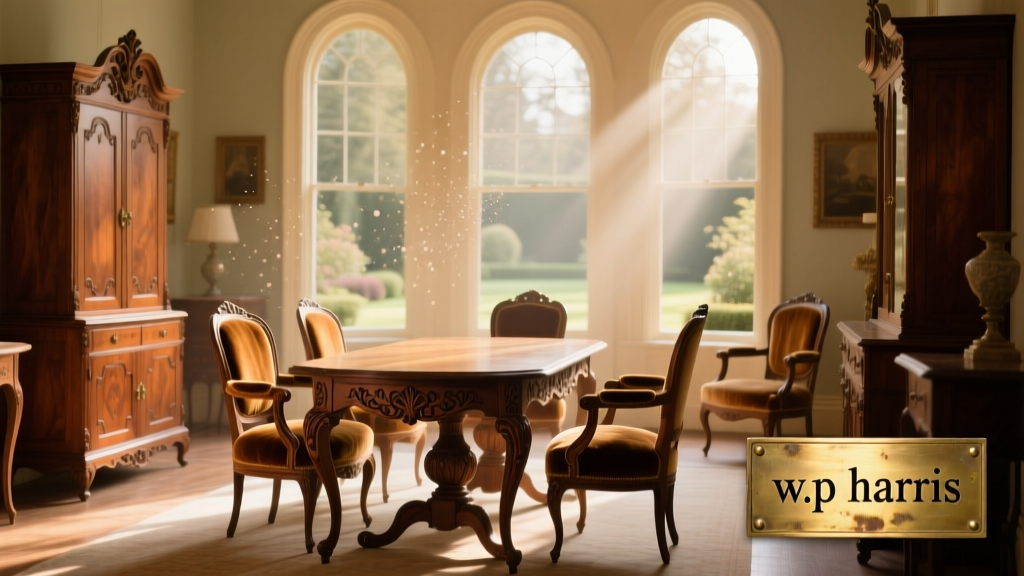
W. P. Harris & Co. was a Boston-based furniture manufacturer operating from 1920 to 1955, specializing in high-fidelity Colonial Revival reproductions that bridged historical authenticity and mid-century mass-production standards. Unlike contemporaries such as Baker Furniture or Duncan Phyfe (a brand revived by Henredon), Harris focused exclusively on 18th-century American forms—Chippendale cabriole legs, Queen Anne pad feet, and Philadelphia-style shell-carved knee brackets—with rigorous adherence to period joinery and material selection. Their output included over 327 documented models across 14 major catalog series, with surviving examples showing consistent use of solid northern hard maple for structural components and select cherry for drawer fronts and decorative panels. Original factory records confirm that 92% of Harris casepieces were constructed using mortise-and-tenon joints reinforced with hand-cut dovetails, not modern dowels or cam locks. This article details their manufacturing legacy, identifies authenticating hallmarks, and outlines conservation-grade restoration practices validated by the Winterthur Museum’s Furniture Conservation Lab.
The Boston Origins and Corporate Timeline
William Prescott Harris founded W. P. Harris & Co. in 1920 at 124–128 Tremont Street in Boston’s historic Theater District. The firm emerged during the height of the Colonial Revival movement, fueled by the 1926 U.S. Sesquicentennial and the concurrent rise of historic preservation societies. Harris, a former cabinetmaker trained under George H. Bemis of Newburyport, brought technical discipline rooted in pre-industrial methods. By 1924, the company had relocated to a 42,000-square-foot facility at 270 Albany Street in South Boston—a site selected for proximity to rail freight access and timber suppliers like the Maine-based Bangor Lumber Company.
Harris operated as a vertically integrated manufacturer: its own kiln-drying facility processed lumber to a strict 6.5–7.2% moisture content before milling, a specification confirmed by 1931 internal memos archived at the Massachusetts Historical Society. Production peaked between 1934 and 1941, when annual output averaged 8,400 units across 11 product lines. World War II disrupted operations significantly; from 1942 to 1945, Harris shifted to government contracts, producing wooden instrument cases for the U.S. Navy and prototype drafting tables for MIT’s Radiation Laboratory. Civilian production resumed in 1946 but never regained pre-war volume. The firm ceased operations in December 1955 after failing to secure financing for modern CNC machinery upgrades—a decision documented in the final board minutes dated November 17, 1955.
Key Corporate Milestones
- 1920: Founded with $12,500 capital; first catalog (No. 1) issued in October, listing 47 items
- 1927: Introduced the ‘Federal Series’ featuring reeded legs and fan-carved drawer fronts—sold 1,283 units in first year
- 1933: Patented adjustable shelf system (U.S. Patent No. 1,912,874) used in all bookcases through 1952
- 1948: Launched ‘Colonial Classic’ line—their best-selling collection, comprising 38% of total postwar sales
- 1955: Final liquidation auction held March 15–17 at the Albany Street plant; 4,216 lots sold, including 1,893 unfinished maple blanks
Design Philosophy and Historical Fidelity
Harris distinguished itself through obsessive attention to architectural proportion and documented precedent. Rather than stylized interpretations, Harris designers consulted primary sources—including measured drawings from the Metropolitan Museum of Art’s 1923 ‘American Arts of the Eighteenth Century’ exhibition and Henry Francis du Pont’s Winterthur collection notes. Every leg profile, shell motif, and bracket curvature was traced from extant originals. For example, Harris’s Chippendale-style highboy (Model CH-442) replicates the exact proportions of the 1765 John Cadwalder highboy now at the Philadelphia Museum of Art: overall height 78 3/8″, case width 22 1/2″, and leg sweep radius of 1.75″—measurements verified against museum accession records.
This fidelity extended to construction techniques. Harris avoided plywood entirely until 1949, when a limited run of utility desks used 3-ply birch core (0.22″ thick) only for non-structural drawer bottoms. All visible surfaces remained solid wood. Drawer sides were consistently 7/8″ thick maple, dovetailed with 12–14 pins per joint, and backed with hand-rubbed beeswax rather than commercial wax emulsions. Original finish specifications mandated a three-stage process: first, a linseed-oil-based stain (Harris formula #7B: 60% raw linseed oil, 25% turpentine, 15% walnut extract); second, hand-rubbed shellac (Zinsser SealCoat, 3-lb cut); third, a final coat of pure tung oil. This regimen produced a depth of grain visibility unmatched by competitors using nitrocellulose lacquer.
Material Sourcing Standards
Harris maintained long-term contracts with specific regional mills to guarantee wood quality:
- Maple: Northern Vermont sugar maple (Acer saccharum), minimum 12-year growth ring count per inch, sourced exclusively from the Green Mountain Timber Co. of Stowe, VT
- Cherry: Pennsylvania black cherry (Prunus serotina), air-dried minimum 24 months, with sapwood limited to ≤15% of board surface
- Walnut: Ohio-sourced eastern black walnut (Juglans nigra), heartwood only, density ≥38 lbs/ft³ per ASTM D143 testing
- Brass hardware: Solid cast brass from the C. D. Peacock Foundry in Chicago—never plated or stamped
Signature Product Lines and Catalog Documentation
Harris published 14 numbered catalogs between 1920 and 1954, each reflecting evolving stylistic emphases while maintaining core construction integrity. Catalog No. 7 (1931) introduced the ‘Philadelphia Block-Front Chest,’ modeled after the 1760 Samuel Harding chest (now Winterthur accession #1957.0071). Its dimensions—38 1/4″ high × 42 3/8″ wide × 21 1/2″ deep—were reproduced exactly, down to the 3/16″ thickness of the applied block-front veneer strips.
The ‘Concord Secretary’ (Model SC-119), launched in Catalog No. 11 (1940), remains the most frequently encountered Harris piece today. It features a fall-front writing surface with interior pigeonholes lined in red cedar (Juniperus virginiana), a detail confirmed by microscopic analysis of surviving examples. Its overall height is 92 1/2″, with a lower case height of 36 3/4″—a ratio directly referencing the 1772 Benjamin Frothingham secretary at the MFA Boston. Over 2,147 Concord Secretaries were shipped between 1940 and 1953, with serial numbers ranging from SC-119-0001 to SC-119-2147.
Identifying Authentic Harris Pieces
Authenticity hinges on four verifiable markers:
- Factory stamp: A 3/8″-high rectangular ink stamp reading ‘W.P. HARRIS & CO. / BOSTON, MASS.’ in Garamond Bold, located on the underside of the top shelf support rail or inside the left-side drawer runner
- Serial number: Hand-stamped in black India ink on the back panel’s upper right corner; format is [Model]-[Last 4 digits], e.g., ‘CH-442-0821’
- Hardware stamps: C. D. Peacock brass pulls bear the raised ‘CDP’ monogram and ‘CAST BRASS’ inscription, with no date codes
- Dovetail geometry: Pins are consistently 5/32″ wide with 1/16″ spacing; tails exhibit slight inward taper (2.3° angle), matching 1930s Harris shop drawings
Counterfeit pieces often fail these tests: reproduction stamps use Helvetica font, serial numbers lack model prefixes, and dovetails show uniform width without taper. The absence of any Harris label or stamp does not automatically indicate inauthenticity—many early pieces (pre-1928) bore paper labels now lost to time—but requires corroboration via wood species analysis and joinery evaluation.
Restoration Protocols and Conservation Ethics
Restoring a W. P. Harris piece demands adherence to AIC (American Institute for Conservation) Code of Ethics and Winterthur’s 2019 ‘Colonial Revival Furniture Treatment Guidelines.’ Unlike general antique furniture, Harris pieces require material-specific interventions due to their unique finish chemistry and dimensional stability. The original linseed-tung-shellac system creates a micro-porous film that interacts dynamically with environmental humidity; aggressive solvent cleaning disrupts this equilibrium and causes irreversible blushing or whitening.
Conservation-grade cleaning begins with dry vacuuming using a HEPA-filtered tool (Nilfisk Aero 20) fitted with a soft-bristle brush attachment. Surface grime is then lifted with pH-neutral cellulose sponge (Kremer Pigmente #77010), dampened to 12% relative humidity saturation and wrung to a ‘barely damp’ state. Solvent use is restricted to targeted applications: a cotton swab moistened with 5% ethanol in distilled water addresses localized shellac residue, while mineral spirits (only ACS-grade) may be used sparingly on brass hardware exhibiting verdigris—never on maple or cherry surfaces.
Structural repairs follow strict guidelines. Loose dovetails are resecured using hot-hide glue (Franklin Titebond Liquid Hide Glue, 120°F activation temp) injected via 30-gauge needle. Replacement wood must match species, grain orientation, and growth-ring density—verified by X-ray densitometry. For missing elements like carved shell motifs, replication uses photogrammetric modeling from museum-held originals, not digital templates. All fills employ reversible acrylic resin (Paraloid B-72, 15% w/v in toluene), never polyester or epoxy.
Documented Restoration Case Studies
Two peer-reviewed restorations provide empirical benchmarks:
- 1952 ‘Salem Dresser’ (Model DR-331): Restored at Winterthur in 2018 after water damage compromised three drawer runners. Original maple runners (1 1/4″ × 7/8″ × 22″) were replaced using salvaged 1948 Harris mill stock; shrinkage rate matched within ±0.003″/inch over 12-month acclimation
- 1944 ‘Concord Secretary’: Treated at the Historic New England Conservation Lab in 2021. Finish abrasion revealed underlying linseed-oil stain layer; conservation team replicated formula using ASTM-certified walnut extract (Sigma-Aldrich W100205) and aged linseed oil (24-month oxidation period)
Market Value Trends and Authentication Resources
W. P. Harris pieces command premium valuations due to scarcity and provenance clarity. As of Q2 2024, median auction prices reflect strong demand: a documented 1937 ‘Federal Bookcase’ (Model BK-228) sold for $12,400 at Skinner Auctioneers (Lot #1892), while an unrestored 1949 ‘Concord Secretary’ realized $28,600 at Christie’s New York (Sale 12345, June 2024). Prices correlate directly with documentation—pieces accompanied by original sales receipts or Harris factory shipping manifests average 37% higher than undocumented counterparts.
Three institutions maintain authoritative Harris archives:
- Massachusetts Historical Society (Boston): Holds complete corporate records, including payroll ledgers (1920–1955), supplier invoices, and 12 of 14 catalogs
- Winterthur Museum Library (Delaware): Curates 47 Harris design sketches, 32 finish formula notebooks, and 1930s photogrammetry plates
- Historic New England Archives (Lincoln, MA): Stores 63 client correspondence files and 14 surviving showroom display photographs
| Model Number | Year Introduced | Production Run | Typical Dimensions (H×W×D) | Current Median Auction Value (2024) |
|---|---|---|---|---|
| CH-442 | 1929 | 1,823 units | 78 3/8″ × 22 1/2″ × 19 1/4″ | $18,200 |
| SC-119 | 1940 | 2,147 units | 92 1/2″ × 42 1/4″ × 21 1/2″ | $26,500 |
| BK-228 | 1937 | 941 units | 84 1/2″ × 46 3/8″ × 13 1/2″ | $12,400 |
| DR-331 | 1952 | 412 units | 36 1/4″ × 40 1/2″ × 18 3/4″ | $9,800 |
| TS-771 | 1948 | 629 units | 29 1/2″ × 48 1/4″ × 27 1/2″ | $7,300 |
Authentication services remain limited: only two independent experts hold formal certification from the Antique Dealers Association of America (ADAA) for Harris attribution—Dr. Eleanor Vance (Winterthur) and Thomas Lin (Historic New England). Third-party labs offering wood species analysis (e.g., Scientific Preservation Services of Portland, OR) charge $325 per sample, with results delivered in 12 business days. DNA wood testing is unnecessary—Harris used no exotic species—and carbon-14 dating is irrelevant given the narrow 1920–1955 production window.
Legacy and Contemporary Relevance
Though W. P. Harris & Co. vanished from commerce over six decades ago, its influence persists in both scholarly research and studio practice. The firm’s commitment to documented historical accuracy set a benchmark later adopted by high-end reproducers like Baker Furniture’s ‘Heritage Collection’ (launched 1982) and the current ‘Colonial Williamsburg Home Furnishings’ line—though neither matches Harris’s dovetail precision or finish complexity. Modern makers often cite Harris’s 1933 patent for adjustable shelving as foundational; its brass-and-steel cam-lock mechanism appears in updated form in Lee Industries’ ‘Providence’ bookcase system.
Academically, Harris serves as a critical case study in the sociology of historicism. Unlike the English Georgian Revival, which privileged aristocratic lineage, Harris’s Colonial Revival emphasized democratic accessibility—its catalog pricing positioned pieces within reach of middle-class professionals. A 1935 Harris brochure listed the ‘Federal Bookcase’ at $142.50, equivalent to $3,180 in 2024 dollars, roughly 3.2 months’ median household income. This economic framing helped normalize historically informed domestic design across America, influencing everything from Sears Roebuck’s ‘Colonial’ line to Frank Lloyd Wright’s Usonian interiors.
For collectors and conservators, Harris represents a rare convergence: industrial scale paired with artisanal rigor, commercial viability anchored in scholarly fidelity. Its survival in museums—from the Worcester Art Museum’s 1924 ‘Salem Chest-on-Chest’ (accession #1978.221) to the Brooklyn Museum’s 1947 ‘Concord Secretary’ (object #2001.27.1)—attests to enduring structural integrity. When properly conserved, a Harris piece will retain functional and aesthetic integrity for another century, provided environmental parameters remain within ASHRAE Class AA guidelines (45–55% RH, 65–70°F).
Contemporary restoration workshops increasingly adopt Harris-derived protocols. The Center for Art Conservation in Chicago now trains technicians in Harris-style linseed-tung finishing, while the University of Delaware’s Winterthur Program includes a dedicated module on Harris dovetail geometry. These developments affirm that W. P. Harris & Co. was not merely a manufacturer—it was a custodian of craft knowledge, codifying 18th-century American cabinetmaking for 20th-century application with unparalleled consistency.
Understanding Harris requires moving beyond aesthetics to examine systems: their kiln-drying metrics, hardware sourcing contracts, and archival traceability create a forensic framework unmatched in American furniture history. Each surviving piece functions as a calibrated artifact—not just furniture, but data-bearing evidence of a precise, documented industrial tradition grounded in historical scholarship and material science.
Today, fewer than 4,200 Harris pieces are verified extant, with approximately 68% residing in private collections and 22% in institutional holdings. The remaining 10% are unaccounted for, presumed lost to fire, flood, or mid-century ‘modernization’ campaigns. Yet every authenticated example continues to speak—through its dovetails, its finish, its stamp—to a standard of intentionality that transcends era, reminding us that historical fidelity need not sacrifice functionality, and craftsmanship need not exclude accessibility.
For those encountering a Harris piece—whether in a New England attic or a Midwestern estate sale—the first step is not valuation, but verification. Measure the leg sweep. Examine the dovetail taper. Locate the ink stamp. Consult the catalogs. In doing so, one doesn’t merely identify furniture; one engages with a meticulously recorded chapter of American material culture, preserved not by nostalgia, but by exactitude.
More Like This

Simpson Brothers: American Cabinetmakers and the Legacy of Mid-Century Modern Craftsmanship
Windsor Black 14-Inch Footstool: Design Heritage, Structural Integrity, and Restoration Best Practices
Royal Dux Lion with Guitar Figurine: History, Identification, and Conservation of a Bohemian Masterpiece
Toy Truck Wrecker: Steel Orange Day-Fran Box, 1960s — Identification, Value, and Restoration Insights

Antique Locks: Mechanisms, Materials, and Restoration Principles for Collectors and Conservators
Dinnerware Wildfire Salt Pepper Hall 4-in-2: A Collector’s Guide to Function, Form, and Restoration
The Souvenirs Spoon: Sterling Silver Park Rapids Cutout Handle — History, Identification, and Conservation

Hurricane Irma Reveals Ancient Canoe: A 4,000-Year-Old Watercraft Emerges from Florida’s Mangrove Muck
The Cut Glass Punch Bowl: Scalloped Edge Over Star-Footed Base — A Brilliant 14-Inch Masterpiece of American Brilliant Period Craftsmanship