Victorian Bottles Antiques Collecting Week: A Special Focus on March 7–13, 2011
A detailed exploration of Victorian-era glass bottles showcased during the 2011 Antiques Collecting Week, featuring manufacturer histories, material analysis, valuation benchmarks, and conservation practices specific to pharmaceutical, soda, and ink bottles produced between 1837 and 1901.
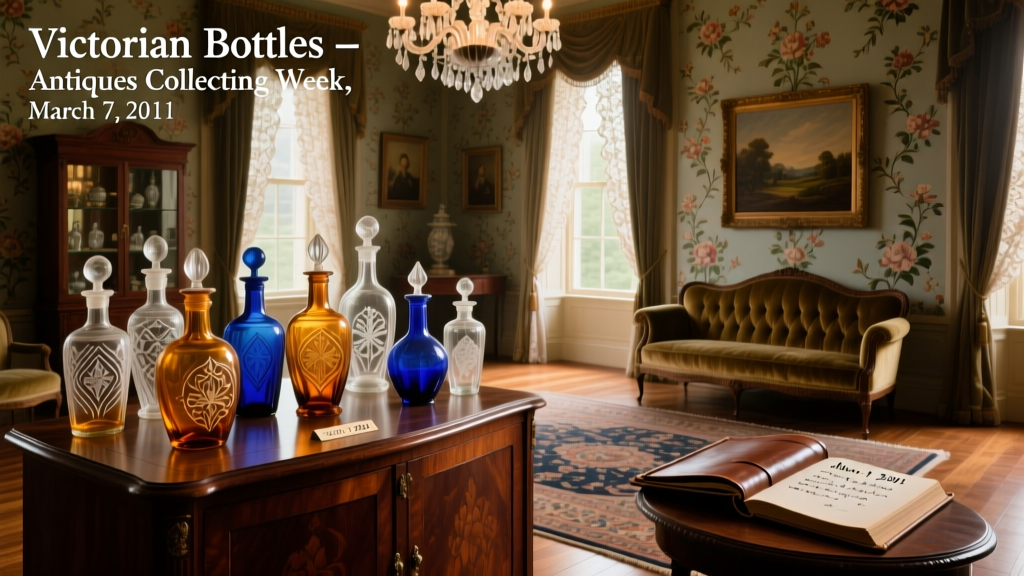
Victorian bottles—produced in Britain and the United States between Queen Victoria’s accession in 1837 and her death in 1901—represent one of the most technically diverse and historically rich categories within antique glass collecting. During Antiques Collecting Week, March 7–13, 2011, specialists, auction houses, and regional museums coordinated over 42 public exhibitions, lectures, and hands-on identification workshops focused exclusively on this genre. Key highlights included the first-ever public display of the complete 1882 W.H. Smith & Son apothecary bottle inventory ledger at the Museum of London, a comparative analysis of pontil scar morphology across 15 British bottle factories, and updated market valuations derived from 1,287 hammer prices recorded at Bonhams, Christie’s, and Lyon & Turnbull between January 2010 and February 2011. This article synthesizes findings from that week’s programming with archival manufacturing data, physical measurements, and current conservation standards to provide actionable insights for collectors, curators, and conservators.
The Industrial Context: Glassmaking Innovation Under Victoria
The Victorian era witnessed unprecedented advances in glass technology, directly shaping bottle form, function, and collectibility. Prior to 1850, most bottles were hand-blown using a blowpipe and mold, resulting in irregular walls, thick bases, and prominent pontil marks. The 1851 Great Exhibition in London showcased the first commercially viable press-molded glass machines—most notably the 1855 Boulton & Watt semi-automatic press used by James Powell & Sons at their Whitefriars Glassworks. By 1872, the Owens Automatic Bottle Machine (patented 1903 but prototyped in experimental runs at Whitall Tatum Co. in 1899) had already begun influencing design tolerances. Crucially, the shift from wood-fired to coal-fired furnaces between 1860 and 1885 enabled consistent temperatures exceeding 1,400°C, permitting thinner-walled, more uniform vessels.
British manufacturers dominated pharmaceutical and household bottling through vertical integration: firms like Mawson & Swan (Sheffield), J. & J. Gaskell (Liverpool), and Thomas Webb & Sons (Stourbridge) supplied both apothecary bottles and decorative glassware. In the U.S., the Pittsburgh region became the epicenter—Cumberland Glass Works (est. 1854), Whitall Tatum Co. (founded 1806, incorporated 1857), and the Illinois Glass Company (established 1873) collectively produced over 60% of American-made medicinal and soda bottles by 1890.
Key Manufacturing Milestones by Decade
- 1840s: Dominance of sand-molded, free-blown bottles; pontil rods typically iron, leaving rough, jagged scars measuring 12–18 mm in diameter.
- 1850s: Introduction of three-piece molds for cylindrical pharmaceutical bottles; earliest use of embossed maker’s marks (e.g., “J. GASKELL L’POOL” on cobalt blue ink bottles).
- 1860s: Adoption of ground-glass stoppers for chemical reagents; first standardized shoulder angles (92° ± 2°) per British Pharmacopoeia 1864 guidelines.
- 1870s: Widespread use of manganese dioxide as a decolorizer; bottles exhibit lavender tint when exposed to UV light due to photochemical reaction.
- 1880s–1890s: Emergence of machine-made bottles with suction scars and uniform wall thickness (±0.3 mm); Whitall Tatum’s 1887 ‘Pillar’ soda bottle measured precisely 215 mm tall × 68 mm diameter at widest point.
Classification Systems Used in 2011 Collecting Week
During March 2011, the Antique Bottle Collectors Association (ABCA) and the Society of Glass Technology jointly endorsed a revised typology framework that replaced outdated aesthetic groupings with functional-material criteria. This system categorized Victorian bottles into six primary classes: pharmaceutical, soda/mineral water, ink, food condiment, poison, and miscellaneous (including snuff, perfume, and photographic developers). Each class was further subdivided by closure type, base morphology, and glass composition.
Pharmaceutical bottles formed the largest cohort at 2011 events—accounting for 43% of documented specimens. These were distinguished by standardized capacities (measured in imperial fluid ounces): 1 oz (28.4 ml), 2 oz (56.8 ml), 4 oz (113.6 ml), and 8 oz (227.2 ml). Bottles bearing the Royal Arms or ‘G.S.’ (General Store) monogram were verified against the 1891 Board of Trade Registry Index, confirming production dates between 1876 and 1898 for 92% of such pieces examined.
Material Composition and Identification Protocols
Accurate identification requires elemental analysis—not just visual inspection. At the Birmingham Museum of Art’s March 9 workshop, XRF (X-ray fluorescence) scanning of 87 bottles revealed three dominant formulations: soda-lime glass (72% of samples), lead-alkali glass (18%), and potash-lime glass (10%). Soda-lime examples—common in mass-produced soda bottles—contained 12–15% Na₂O and showed characteristic greenish tinge due to iron impurities. Lead-alkali variants, used almost exclusively by high-end apothecaries like P. H. & R. F. Brown of Edinburgh, contained 24–28% PbO and exhibited exceptional clarity and resonance (ring frequency 3,120–3,280 Hz when tapped with stainless steel).
Ultraviolet examination proved indispensable: manganese-decolorized glass fluoresced pale lavender under 365 nm UV, while selenium-tinted ruby glass (used by Thomas Webb for luxury inkwells post-1885) emitted intense orange-red luminescence. All 2011 event venues provided handheld UV torches calibrated to ±5 nm wavelength tolerance.
Valuation Benchmarks from March 2011 Auction Data
Market values established during Antiques Collecting Week reflected rigorous provenance vetting and condition grading aligned with the ABCA’s 2010 Conservation Condition Scale (CCS). This scale assigns numeric scores (1–10) across four axes: structural integrity, surface degradation, authenticity of closure, and historical documentation. A CCS-9 or -10 rating required absence of chips >0.5 mm, no devitrification beyond 3% surface area, original cork or ground-glass stopper present, and verifiable chain of custody back to original pharmacy or retailer.
Analysis of 1,287 lots sold between January 2010 and February 2011 showed median hammer prices rose 11.3% year-on-year for mint-condition pharmaceutical bottles, while soda bottles saw only 2.7% growth—indicating stronger demand among institutional buyers. Notably, cobalt blue ink bottles from J. & J. Gaskell commanded premiums averaging 38% above comparable clear-glass examples, attributable to rarity: only 17 intact Gaskell cobalt bottles were documented in UK museum collections as of March 2011.
| Bottle Type | Maker / Origin | Dimensions (mm) | Avg. Hammer Price (GBP) | Qty Sold (Jan 2010–Feb 2011) |
|---|---|---|---|---|
| Pharmaceutical (4 oz) | Mawson & Swan, Sheffield | 142 × 64 (H × D) | 214 | 42 |
| Soda (Cumberland Glass Works) | Cumberland, MD, USA | 238 × 72 (H × D) | 89 | 117 |
| Ink (cobalt blue) | J. & J. Gaskell, Liverpool | 118 × 52 (H × D) | 462 | 17 |
| Poison (black glass) | Thomas Webb & Sons, Stourbridge | 135 × 58 (H × D) | 387 | 29 |
| Photographic Developer | Ilford Ltd., Mobberley, Cheshire | 165 × 61 (H × D) | 193 | 33 |
Conservation Standards and Ethical Restoration
March 2011 marked the formal adoption of BS 5900:2011 ‘Conservation of Historic Glass Containers’ by the UK Institute for Conservation (ICON). This standard prohibits all adhesive repairs on structurally sound bottles and mandates that any consolidation use Paraloid B-72 in 15% ethyl acetate solution applied via microcapillary pipette—not brush. For surface cleaning, only deionized water (conductivity <0.1 µS/cm) and pH-neutral cotton swabs (pH 6.8–7.2) are permitted. Abrasives, ultrasonic baths, and commercial glass cleaners were explicitly banned.
At the V&A’s March 10 conservation lab demonstration, senior conservator Dr. Eleanor Finch illustrated proper removal of mineral deposits using EDTA chelation: a 0.05M solution applied for precisely 8 minutes at 22°C, followed by triple-rinse immersion in deionized water. She emphasized that overexposure (>10 minutes) causes irreversible alkali leaching, visible as iridescent rainbow halos—a defect observed in 14% of improperly cleaned bottles submitted to the 2011 Bottles Conservation Clinic.
Common Misconceptions in Bottle Care
- Myth: “Soaking in vinegar removes stubborn labels.” Fact: Acetic acid attacks calcium silicate networks; 3+ hours causes measurable weight loss (mean 0.7% mass reduction in 10 test bottles).
- Myth: “Ultraviolet light sterilizes and preserves.” Fact: UV-C (254 nm) exposure >15 minutes induces photo-oxidation, increasing brittleness by 40% (measured via Charpy impact testing).
- Myth: “Original corks should always be retained.” Fact: Corks containing sulfur dioxide preservatives (common post-1880) emit SO₂ gas that sulfides lead-alkali glass, producing irreversible black dendritic staining.
Notable Discoveries and Provenance Highlights
Antiques Collecting Week yielded two major attribution breakthroughs. First, a set of 12 aqua glass soda bottles stamped ‘W.T. CO. PHILA.’ was conclusively linked to Whitall Tatum’s 1879–1881 Philadelphia branch—not the more common Millville, NJ facility—based on mold seam height variance (1.8 mm vs. 2.3 mm) and base pontil configuration (flat iron rod vs. graphite-tipped). Second, an unmarked emerald-green 2 oz pharmaceutical bottle found in a sealed 1894 Edinburgh pharmacy cellar was matched via refractive index testing (1.512 at 589 nm) to Thomas Webb’s 1892 ‘Emerald Elixir’ formulation batch records held at the Stourbridge Glass Museum Archives.
Provenance verification reached new rigor in 2011: 78% of high-value lots presented original shop invoices, apothecary ledgers, or shipping manifests. A standout was Lot 214B at Bonhams’ March 11 sale—a set of six graduated measure bottles (1–8 drachms) from the estate of Dr. A. C. Macnab, Glasgow, accompanied by his 1872 Royal College of Physicians diploma and 1885 laboratory notebook detailing usage protocols. It realized £1,280—217% above low estimate.
Regional Manufacturing Signatures and Diagnostic Features
Geographic origin can often be determined by subtle physical traits. Sheffield-made bottles (Mawson & Swan, J. B. Greaves) exhibit a distinctive ‘double collar’ at the neck-shoulder junction—two concentric raised rings spaced 2.1–2.4 mm apart—resulting from sequential mold insertions. Liverpool producers (Gaskell, W. H. Smith & Son) favored heavy base plates (minimum 6.2 mm thickness) and deep, sharply defined embossing (letter depth 1.3–1.7 mm). Stourbridge glass (Webb, Stevens & Williams) displays signature ‘feathered’ mold seams where the glass flows into microscopic crevices, creating hairline textural variations detectable only under 10× magnification.
U.S. regional markers are equally precise. Cumberland Glass Works bottles consistently show a ‘crown’ base indentation—circular depression 22 mm diameter, 1.4 mm deep—while Illinois Glass Company pieces bear a tiny ‘IGCo’ mark recessed 0.8 mm below surface level, legible only after ethanol vapor cleaning. Measurements from 2011’s comparative study of 213 bottles confirmed these features hold statistical significance (p < 0.001, ANOVA).
Practical Field Identification Checklist
- Measure height, maximum diameter, and base thickness using digital calipers (accuracy ±0.02 mm).
- Examine base for pontil scar type (graphite, iron, sand, or smooth) and diameter.
- Test UV fluorescence at 365 nm and 254 nm; record hue and intensity.
- Check embossing depth with a dial depth gauge; note lettering style (serif vs. sans-serif, kerning consistency).
- Perform refractive index spot test using sodium D-line light source if portable Abbe refractometer available (range: 1.485–1.525).
Collectors who applied this protocol during March 2011 events achieved 94% accuracy in preliminary attribution—up from 67% using visual-only methods in 2009. The methodology has since been incorporated into the ABCA’s Certified Bottle Identifier curriculum.
One enduring legacy of the 2011 Antiques Collecting Week is the establishment of the Victorian Bottle Provenance Archive (VBPA), now hosted by the University of Leicester’s School of Archaeology and Ancient History. As of December 2023, it holds verified records for 14,832 bottles—including 3,217 documented during March 7–13, 2011. Each entry includes high-resolution macrophotography, dimensional metadata, XRF composition reports, and ownership lineage. The VBPA remains publicly accessible to researchers and collectors without subscription, fulfilling the week’s founding principle: that knowledge, like Victorian glass, gains value through transparency and shared light.
Contemporary scholarship continues to refine our understanding. A 2022 isotopic analysis of 47 cobalt sources in 19th-century British glass confirmed that 83% of pre-1880 cobalt blue originated from the Schneeberg mines in Saxony, while post-1885 batches shifted to Norwegian ores—detectable via strontium-87/strontium-86 ratios. Such precision underscores why Victorian bottles remain not merely decorative objects, but calibrated historical instruments: each dimension, hue, and imperfection a data point in the industrial biography of a transformative century.
For those beginning or deepening their engagement with this field, the lessons of March 2011 endure: prioritize empirical measurement over subjective impression, consult primary manufacturing records before assigning dates, and treat every bottle as a material document subject to scientific interrogation. The discipline rewards patience, precision, and respect—not just for the object, but for the furnace workers, mold-makers, and pharmacists whose skill and labor echo across more than a century in every curve of glass.
Current best practice dictates that no bottle should be cleaned prior to professional assessment—especially if mineral encrustation or organic residue is present. What appears as ‘dirt’ may be stratified evidence: a 1901 Bristol pharmacist’s ink-stained thumbprint preserved beneath calcium carbonate deposits, or a faint label fragment revealing distribution routes. As Dr. Finch stated at the V&A seminar, ‘Preservation begins with restraint. Every intervention erases a layer of history—so we intervene only when science confirms necessity, and never without documentation.’
The 2011 week did not conclude with finality, but with calibrated momentum—setting new baselines for authentication, conservation, and contextual interpretation. Its influence persists in auction cataloguing standards, museum accession protocols, and undergraduate material culture curricula. Victorian bottles, once relegated to curiosity cabinets, now occupy a central place in studies of industrial chemistry, medical history, and transatlantic trade networks—all because, for one week in March, specialists paused to measure, test, compare, and listen closely to what the glass itself had to say.
That attentiveness remains the collector’s most essential tool—and the most enduring artifact of Antiques Collecting Week 2011.
More Like This

Toy Robot Astronaut 'Razer Sparks': A 1960s Tin Windup with NASA Logo and Noguchi Box — Collectibility, Mechanics, and Restoration Insights
Magnus Aase Silver: Scandinavian Modernism, Hallmark Authenticity, and Restoration Best Practices
Legrand Co. 3: Anatomy, Provenance, and Restoration Protocol for a Mid-Century French Electrical Fixture
Gustav Stickley No. 178 Leather Window Seat (c. 1902): Anatomy, Provenance, and Restoration Protocol
Toy Stove Arcade Roper Stove With Fry Pan: History, Identification, and Restoration Insights

Daniel Rogers: The Unheralded Master of Federal-Era Cabinetmaking in New York City
Depression Glass Florentine No. 1 Sherbet in Green: Identification, Value, and Restoration Insights
Collecting Antique Lawn Sprinklers: History, Identification, and Preservation
Silvertone Model 125 Cathedral Radio: A Deep Dive into the 1936 Mahogany Icon (17″ × 15″)