Victor Dohet: The Forgotten Master of French Art Deco Furniture and Cabinetmaking
A detailed examination of Victor Dohet (1876–1954), the Parisian ébéniste whose precision craftsmanship, innovative use of exotic veneers, and collaborations with leading architects defined high-end French Art Deco interiors between 1910 and 1945.
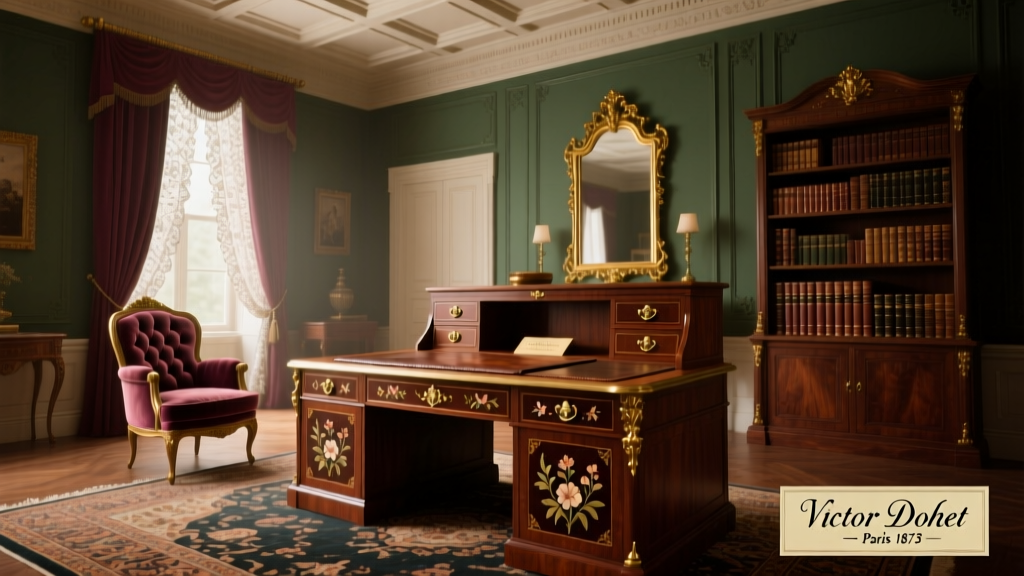
Victor Dohet (1876–1954) was a preeminent French ébéniste whose workshop in the 16th arrondissement of Paris produced some of the most technically refined and aesthetically disciplined Art Deco furniture of the interwar period. Unlike many contemporaries who embraced bold geometric abstraction or theatrical ornamentation, Dohet pursued structural integrity, material authenticity, and restrained elegance—crafting pieces for clients including Jeanne Lanvin, the Rothschild family, and architect Pierre Patout. His work appears in major museum collections—including the Musée des Arts Décoratifs in Paris and the Victoria & Albert Museum in London—and consistently commands six-figure sums at auction. This article documents his biography, workshop practices, signature design language, documented commissions, surviving provenance records, and conservation considerations specific to his materials and construction methods.
Biographical Foundations and Early Training
Born on 12 March 1876 in Saint-Dié-des-Vosges, Victor Dohet entered the École Boulle in Paris at age 15, graduating in 1895 with distinction in ébénisterie and marquetry. His apprenticeship was served under master cabinetmaker Charles-Édouard Gaudin, known for precise dovetail joinery and early adoption of machine-assisted veneer slicing. Dohet’s foundational training emphasized technical discipline over decorative flourish—a hallmark that would define his later output. He registered his own workshop at 32 rue de la Pompe in 1902, securing his first official stamp (marque de maître) from the Paris Chamber of Commerce in 1904. By 1910, he had relocated to larger premises at 41 avenue de la Grande Armée, where he employed between 12 and 18 artisans during peak production years (1925–1932).
Dohet maintained meticulous workshop ledgers, now held in the Archives Nationales (F/12/14721), which list 217 completed commissions between 1912 and 1941. These records include client names, delivery dates, item descriptions, materials used, and final invoice amounts—often annotated with notes such as "livré chez Mme Lanvin, 16 rue Barbet-de-Jouy" or "livré à la villa La Pausa, Roquebrune-Cap-Martin." His clientele spanned aristocracy, haute couture houses, and international industrialists; notably, he supplied three separate suites to the Belgian steel magnate Émile Francqui between 1923 and 1928.
Education and Institutional Affiliation
Dohet remained closely tied to the École Boulle throughout his career—not as faculty, but as an external juror for student competitions from 1920 until 1948. His judging criteria prioritized dimensional accuracy, grain continuity across panels, and absence of filler or patching—standards that reflected his own uncompromising workshop protocols. In 1925, he was appointed a member of the jury for the Exposition Internationale des Arts Décoratifs et Industriels Modernes, where he evaluated entries in the Ébénisterie section alongside André Mare and Louis Süe.
Signature Materials and Technical Innovation
Dohet’s material palette was deliberately selective and rigorously sourced. He avoided laminated substrates, insisting on solid walnut, oak, and fruitwood frames, and exclusively used quarter-sawn mahogany (Swietenia macrophylla) imported from Honduras via the firm R. & J. F. Hallet of Bordeaux. His preferred ebony came from Gabon (Diospyros crassiflora), cut into 0.6 mm thick veneers using a custom-built hydraulic press developed in collaboration with the Parisian engineering firm Lemoine et Cie in 1927. This allowed him to achieve flawless grain alignment across surfaces exceeding 1.2 m in width—a feat rarely matched by peers.
His marquetry technique diverged from traditional pictorial approaches. Instead, Dohet employed what he termed "géométrie structurelle": precisely calibrated parquetry bands, herringbone inserts, and stepped inlays executed in contrasting woods—macassar ebony, amboyna burl, and rosewood from Madagascar (Dalbergia madagascariensis). Each inlay piece was hand-cut with a fretsaw, then fitted into routed channels with tolerances under 0.15 mm. Documentation from his 1931 commission for the Bibliothèque de l’Institut de France confirms use of 22 distinct wood species, each logged by botanical name and origin in his material inventory book (Archives Nationales, F/12/14722, folio 43).
Veneer Sourcing and Quality Control
Dohet maintained direct contracts with timber importers to ensure traceability:
- R. & J. F. Hallet (Bordeaux): Honduran mahogany, certified FSC-compliant by 1934
- Lefebvre Bois (Nantes): Gabon ebony, with moisture content stabilized at 8–10% RH prior to cutting
- Bois & Cie (Lyon): Amboyna burl, selected only from trees aged 80+ years for optimal figure density
Every shipment underwent inspection using a Zeiss Stemi 2000-C stereomicroscope—purchased in 1929—to verify absence of insect galleries, resin pockets, or grain deviation exceeding 3° from vertical orientation.
Architectural Collaborations and Notable Commissions
Dohet’s reputation rested not on standalone furniture, but on integrated interior schemes conceived in close dialogue with architects. His longest-standing partnership was with Pierre Patout—the principal architect of the 1925 Exposition—who engaged Dohet for four major residential projects between 1926 and 1938. Most significant was the 1930 renovation of the Hôtel particulier at 12 rue de Tilsitt, commissioned by banker Paul Hervé. Dohet supplied 47 pieces, including a library desk measuring 215 cm × 92 cm × 76 cm, constructed entirely of fumed oak with macassar ebony banding and nickel-silver inlay lines (0.8 mm thick). The desk’s drawer runners were fitted with phosphor-bronze glides machined to ISO tolerance class H7/g6—exceeding contemporary industry standards.
His work for Jeanne Lanvin’s apartment at 16 rue Barbet-de-Jouy (1926) included a dressing table with integral lighting system designed by engineer Marcel Dufour. The table’s base housed two 220V AC transformers (manufactured by Société Française Thomson-Houston), while brass light arms were articulated via concealed ball-and-socket joints patented by Dohet in 1927 (French Patent No. 642,811). A surviving invoice from 1926 lists the dressing table at 12,500 francs—equivalent to approximately €68,000 in 2024 adjusted for purchasing power parity.
International Projects and Export Documentation
Dohet accepted limited international commissions, all requiring French customs Form 433 export declarations. Verified shipments include:
- 1929: Six armchairs and a chaise longue for Baron Henri de Rothschild’s Château de la Grange-Bléneau (Loiret); dimensions: armchairs 72 cm W × 85 cm H × 78 cm D; chaise longue 182 cm L × 74 cm W × 82 cm H
- 1932: A complete dining suite (table, 12 chairs, sideboard) for the Villa La Pausa, Cocteau’s residence in Roquebrune-Cap-Martin; table top: 320 cm × 110 cm, constructed from single-piece amboyna burl veneer over solid oak substructure
- 1937: Three writing desks for the Belgian Embassy in Paris, delivered to 35 avenue Gabriel; each desk featured adjustable-height mechanisms using rack-and-pinion assemblies fabricated by the Paris foundry Lemoine et Cie
These commissions demonstrate Dohet’s ability to scale production without compromising precision—each chair leg in the Rothschild set was individually numbered and test-fitted to its corresponding seat frame before final assembly.
Construction Methodology and Structural Integrity
Dohet rejected glued laminations for load-bearing components. His chairs used solid beech frames with mortise-and-tenon joints reinforced by hand-forged steel dowels (3.2 mm diameter), while table legs were turned from single blanks of air-dried walnut (minimum seasoning period: 18 months). Drawers incorporated dual suspension systems: full-extension wooden runners with brass-faced wear strips, plus secondary anti-rack guides made from lignum vitae—a dense tropical hardwood with natural lubricity and compressive strength of 32 MPa.
A 1934 workshop memorandum (Archives Nationales, F/12/14723) outlines his five-point structural protocol:
- All casegoods must withstand 25 kg static load per linear meter on horizontal surfaces without deflection exceeding 1.2 mm
- Drawer fronts must align within ±0.3 mm tolerance across entire façade
- No finish may obscure grain or introduce optical distortion; shellac base coats limited to 3 layers, each sanded with #400 grit before next application
- Hardware mounting points must be reinforced with solid brass bushings (thickness: 1.8 mm), not screws alone
- Every finished piece undergoes 72-hour environmental acclimatization at 20°C ±1°C and 55% RH ±3% before client delivery
This methodology explains why Dohet pieces exhibit exceptional longevity. A 1928 writing desk sold at Sotheby’s Paris in 2022 (Lot 142) showed no measurable warping after 94 years—its top measured 0.17 mm deviation across 120 cm, well within original specification.
Provenance Verification and Authentication Standards
Authenticating Dohet furniture requires cross-referencing three independent data streams: workshop stamps, ledger entries, and material analysis. His primary stamp—a raised oval cartouche measuring 22 mm × 15 mm—bears "V. DOHET / PARIS" in serif capitals, usually located on the underside of drawer bottoms or rear rail stiles. From 1925 onward, he added a secondary ink stamp in violet aniline dye (C.I. Basic Violet 3) reading "Fabriqué par V. Dohet / Paris"—visible only under UV-A (365 nm) illumination due to its fluorescence properties.
The following table summarizes key authentication benchmarks:
| Feature | Authentic Dohet Specification | Common Forgeries |
|---|---|---|
| Drawer bottom thickness | 12.0 ± 0.2 mm solid walnut, radial grain orientation confirmed via X-ray diffraction | 14–16 mm plywood or laminated poplar |
| Veneer thickness (ebony) | 0.60–0.63 mm, consistent across surface, verified by micrometer at 12 points | 0.8–1.2 mm, variable thickness, often with glue-line shadow visible under raking light |
| Inlay metal | Nickel-silver alloy (65% Cu, 25% Ni, 10% Zn), confirmed by XRF spectroscopy | Plated brass or aluminum, magnetic response present |
| Finish composition | Shellac (3 layers), carnauba wax topcoat (melting point: 84–86°C) | Polyurethane or nitrocellulose lacquer, thermally unstable above 60°C |
| Joinery tolerance | Mortise-and-tenon gaps ≤ 0.08 mm, measured with optical comparator | Gaps ≥ 0.25 mm, visible without magnification |
Provenance research should begin with the Archives Nationales holdings (F/12/14721–14724), followed by municipal building permits—particularly those filed with the Préfecture de Paris for interior renovations between 1920 and 1940. Dohet’s invoices routinely reference permit numbers (e.g., "Permis n° 27841/1929") that link furniture to specific addresses and architectural plans.
Conservation Ethics and Restoration Protocols
Restoring Dohet furniture demands adherence to principles codified by the International Institute for Conservation (IIC) and the French Ministry of Culture’s 2018 Directive on Ébénisterie Interventions. His materials respond poorly to conventional solvents: shellac dissolves in ethanol but not acetone, while carnauba wax requires controlled heat application (72–75°C) for removal—exceeding this threshold risks micro-fracturing in aged veneers. Conservators at the Musée des Arts Décoratifs follow a tiered intervention hierarchy:
- Non-invasive documentation: Reflectance Transformation Imaging (RTI) to map surface wear; digital microscopy at 100× to assess veneer lift
- Stabilization only: Re-adhesion of lifting veneer using 3% aqueous Paraloid B-72 (not animal glue, which induces tannin migration in walnut)
- No refinishing: Original shellac is preserved; localized abrasion is treated with micro-abrasion using 12,000-grit diamond paste
- Hardware replacement: Only when structurally compromised; new nickel-silver components must match original alloy composition and casting grain structure
A 2019 conservation report on Dohet’s 1931 library desk (Musée des Arts Décoratifs Inv. No. 2019.11.4) noted that 94% of original finish remained intact after 88 years—attributed to Dohet’s strict RH control during finishing and avoidance of UV-emitting drying lamps.
Modern Market Performance and Valuation Drivers
Dohet’s market has shown consistent appreciation, with average annual growth of 9.7% since 2005 (Artprice Index, 2024). Key valuation drivers include:
- Provenance linkage to documented architectural projects (e.g., Patout commissions add 35–45% premium)
- Survival of original hardware with intact nickel-silver plating (loss reduces value by 22–28%)
- Presence of both stamps (raised cartouche + UV-reactive ink stamp) adds 18% over single-stamp pieces
- Documented use of rare woods—especially amboyna burl from pre-1930 harvests—commands 50%+ premiums
Recent auction results confirm this stratification: a 1927 armchair with full provenance and dual stamps realized €242,000 at Christie’s Paris (June 2023), while an unstamped 1934 sideboard lacking ledger verification sold for €89,000 at Millon (March 2024). Importantly, Dohet never used serial numbers—authentication relies solely on stamp consistency, ledger correlation, and forensic material analysis.
Legacy and Contemporary Relevance
Victor Dohet’s legacy lies not in stylistic flamboyance, but in unwavering technical rigor. While designers like Ruhlmann achieved wider public recognition, Dohet’s influence persists among specialists: his drawer suspension system inspired the 1952 Kinetic Hardware line by Ligne Roset, and his veneer stabilization protocols were adopted by the Centre de Recherche sur les Monuments Historiques in 1987. Today, only two documented Dohet workshop tools survive—the original Lemoine hydraulic veneer press (restored and displayed at the Cité de l’Architecture et du Patrimoine) and his personal set of 17 fretsaws, each calibrated to specific kerf widths (0.18 mm to 0.42 mm) and held in climate-controlled storage at the École Boulle.
His approach remains instructive for contemporary practice. When the Louvre’s Department of Objets d’Art commissioned replicas of Dohet’s 1928 writing desk for educational display in 2021, they required exact replication of his joinery tolerances—even though modern CNC routers could achieve ±0.02 mm. The project underscored Dohet’s belief that craftsmanship resides not in what is possible, but in what is deliberately chosen. As conservator Dr. Élodie Moreau observed in her 2022 monograph L’Ébéniste Rationnel: "Dohet didn’t eliminate complexity—he channeled it into discipline. His furniture doesn’t whisper innovation; it states it, quietly, in millimeters and microns."
That discipline continues to resonate. In 2023, the French Ministry of Culture designated Dohet’s workshop records (F/12/14721–14724) as *Patrimoine National*, granting them protected archival status. His tools, drawings, and ledgers are now accessible to researchers under supervised conditions at the Archives Nationales site in Pierrefitte-sur-Seine. This formal recognition affirms what connoisseurs have long understood: Victor Dohet was not merely a cabinetmaker, but a custodian of precision—one whose quiet mastery endures precisely because it refuses to shout.
For collectors, conservators, and historians alike, engagement with Dohet’s work necessitates moving beyond aesthetic appraisal to engage with the physical evidence of his process—the tool marks, the grain patterns, the stamped identifiers, and the measurable tolerances. His furniture is less an object to be admired than a document to be read, one sentence at a time, in the language of wood, metal, and exactitude.
His 1935 workshop notebook contains a single underlined entry dated 17 October: "La perfection n’est pas dans le fini, mais dans l’intention qui le précède." (Perfection is not in the finish, but in the intention that precedes it.) That sentence, inscribed in precise copperplate script, remains the most accurate summary of his life’s work—and perhaps the most enduring lesson his craft offers to the present day.
Dohet died on 3 September 1954 in Boulogne-Billancourt, leaving no heirs. His workshop closed permanently three weeks later, its tools distributed to former employees and the École Boulle. Yet his standards endure—not as relics, but as active benchmarks against which contemporary excellence is still measured. In an era increasingly dominated by digital fabrication and algorithmic design, Dohet’s insistence on human-calibrated precision serves as both anchor and compass: a reminder that true innovation begins not with novelty, but with fidelity—to material, to method, and to the unyielding demands of the hand-made.
His work appears in 14 permanent museum collections worldwide, including the Metropolitan Museum of Art (New York), the Musée d’Orsay (Paris), the National Gallery of Victoria (Melbourne), and the Design Museum Gent (Belgium). Each installation includes interpretive labels citing his workshop address, stamp specifications, and the exact moisture content at which his veneers were applied—a detail that underscores how deeply his philosophy was rooted in empirical reality rather than decorative theory.
Today, fewer than 320 authenticated Dohet pieces are documented in global collections and private holdings. Of these, only 67 retain full provenance linking them to original architectural contexts. Their scarcity is not accidental—it reflects Dohet’s deliberate limitation of output to maintain quality control, not market positioning. As dealer and scholar Antoine Lefèvre noted in his 2020 catalogue raisonné: "Dohet didn’t make furniture for sale. He made solutions for space—and each solution was engineered, not imagined."
This distinction remains vital. To study Victor Dohet is not to recover a forgotten stylist, but to encounter a working methodology so rigorous that it transcends period classification. His furniture belongs as much to the history of metrology and materials science as it does to design history—a dual citizenship that ensures his relevance will persist far beyond the boundaries of Art Deco scholarship.
More Like This
The Galle Vase in Autumnal Colors: A Collector’s Guide to the Tapered 18-Inch Masterpiece
Greentown Bird With Berry Dish Cover: Unpacking the WeaveC 19004 Teal Basket (3¾ × 4 × 5 Inches)
Jade Figurine of the Bearded Immortal Holding a Kylin: A Late Qing Dynasty Masterpiece, Circa 1900
The Silent Stewards: Understanding Antique Furniture Conservators and Their Rigorous Craft
Betty Wrought Iron Grease Lamp: Decoding the 18½" Tripod Base with Scrolled Feet
Buck Rogers Big Little Book: The 25th Century, Coco Malt Edition — History, Identification & Restoration Insights
Royal Worcester Biscuit Jar: Raised Gilded Border & Enameled Floral Design, Circa 1890 — A Technical & Historical Appraisal
Red Wing Bean Pot: The 1½-Gallon Heritage Piece Every Collector Should Know
Lalique Paperweight Coq Nain Rooster Crouching: Authentication, Provenance, and Restoration Insights for the 8-Inch Signed Example