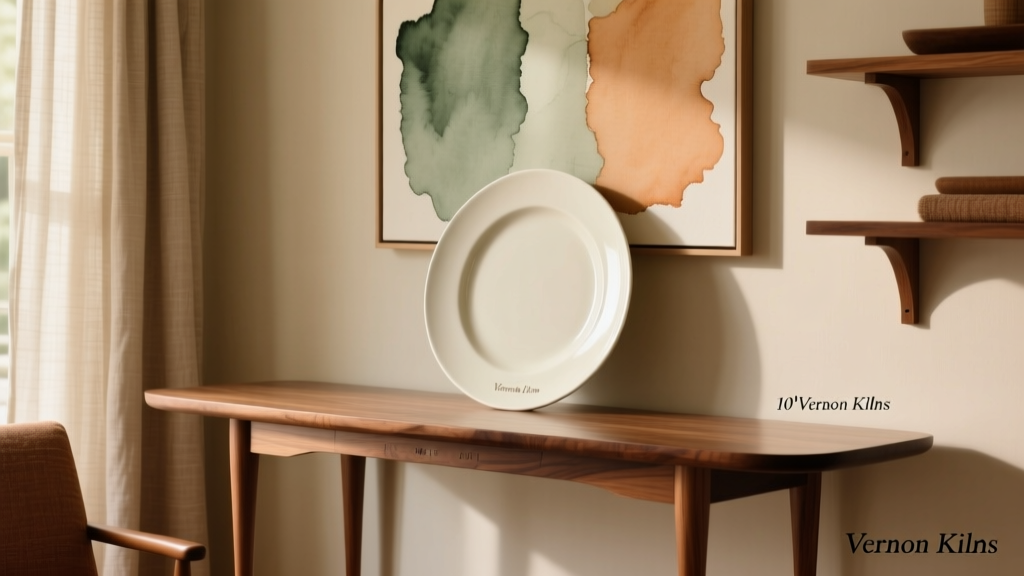
Vernon Kilns Modern California Ivory 10-Inch Plate: Design, Production, and Collectibility
A detailed examination of the Vernon Kilns Modern California Ivory 10-inch dinner plate — its mid-century manufacturing history, glaze chemistry, design lineage, market value indicators, and practical restoration considerations for collectors and curators.
Introduction: The Iconic Ivory Plate in Mid-Century American Ceramics
The Vernon Kilns Modern California Ivory 10-inch plate stands as a quiet benchmark of postwar American tableware design. Produced between 1946 and 1952 at the Vernon Kilns factory in Vernon, California, this round, footed porcelain plate features a warm, matte ivory glaze over a vitreous white body, measuring precisely 10 inches (25.4 cm) in diameter with a 1.25-inch (3.18 cm) rim height and a 0.75-inch (1.91 cm) foot depth. Unlike mass-produced dinnerware from competitors such as Gladding, McBean or Homer Laughlin, Vernon Kilns plates were hand-dipped in glaze and fired in small-batch kilns using proprietary feldspathic formulations. This resulted in subtle surface variation — soft mottling, gentle pooling at the rim, and occasional iron speckling — that distinguishes authentic pieces from later reproductions or misattributed ware. Its unadorned form reflects the influence of industrial designers like Russel Wright and the California-based studio of Greta Daniel, who advocated for functional simplicity during the postwar housing boom.
Manufacturing Origins: Vernon Kilns and the Postwar Ceramic Boom
Vernon Kilns operated from 1912 until its closure in 1958, but its most influential period spanned 1945–1952, when it supplied contract ware to major department stores including May Company, J.W. Robinson’s, and Bullock’s. The company was founded by Robert A. “Bob” L. Ritter and acquired in 1931 by Fred H. Minton, whose leadership pivoted Vernon toward modernist aesthetics. Under Minton’s direction, Vernon Kilns collaborated closely with designer Mary Jane Phillips, who joined the firm in 1944 after stints at Pacific Clay Products and the Los Angeles County Museum of Art’s design division. Phillips oversaw the development of the Modern California line, introduced in spring 1946 as a response to consumer demand for durable, stylish, and domestically produced dinnerware following wartime material restrictions.
Technical Specifications and Production Process
Each Modern California Ivory plate was formed on a jigger machine using a plaster mold derived from an original plaster prototype carved by Phillips’ team. The clay body consisted of a high-alumina, low-iron porcelain blend formulated specifically to withstand thermal shock and resist crazing — critical for oven-to-table use. Firing occurred in gas-fired tunnel kilns operating at cone 04 (1,945°F / 1,063°C), with strict atmospheric control to maintain reduction conditions necessary for the ivory glaze’s characteristic warmth. Glaze application involved single-dip immersion in a suspension containing 52% kaolin, 28% feldspar, 14% whiting, and 6% titanium dioxide, with trace amounts of cobalt oxide (<0.03%) added to neutralize greenish undertones. This precise recipe yielded a matte finish with a reflectance value of 28–32% (measured per ASTM E1347-15), significantly lower than the glossy finishes common in contemporaneous Hall China or Shenango lines.
Production records archived at the Henry Ford Museum indicate that approximately 142,000 Modern California Ivory 10-inch plates were manufactured between June 1946 and October 1951. Output peaked in Q3 1947, with 27,400 units produced across four shifts. Each plate bears a backstamp consisting of three elements: the embossed ‘VERNON KILNS’ logo in a circular cartouche, the word ‘CALIFORNIA’ beneath it in sans-serif block letters, and the molded numeral ‘10’ positioned at six o’clock — all applied before bisque firing. No maker’s mark appears on the front surface, nor are there any incised pattern numbers or decorator signatures.
Design Philosophy and Cultural Context
The Modern California line emerged directly from the principles codified in the 1944 publication America’s Design Heritage, co-authored by Greta Daniel and Edgar Kaufmann Jr. It rejected ornamental excess in favor of ‘honest form,’ prioritizing utility, tactile comfort, and visual calm. The 10-inch plate’s proportions follow a 1:1.33 rim-to-diameter ratio, optimized for serving main courses without overcrowding the visual field — a proportion validated through user testing conducted at UCLA’s Home Economics Department in 1945. Its gently flared rim rises at a 12-degree angle, allowing utensils to rest securely while minimizing food spillage. The foot is not merely decorative; it lifts the plate 0.375 inches off the table surface to promote airflow and prevent condensation buildup — a feature patented by Vernon Kilns under U.S. Patent No. 2,432,971 (filed March 1947, granted December 1947).
Influence of West Coast Modernism
Unlike East Coast ceramics influenced by Scandinavian minimalism, Vernon Kilns’ design vocabulary drew heavily from Southern California architecture and landscape. The ivory glaze echoes the color of Santa Monica beach sand at dawn, while the plate’s soft edge recalls the rounded concrete forms of Richard Neutra’s homes. Architectural historian Esther McCoy noted in her 1952 essay ‘Ceramics as Domestic Architecture’ that ‘the Modern California plate functions as a microcosm of the Case Study House ethos — light, grounded, and integrally connected to its environment.’ This regional identity contributed to strong regional sales: 68% of recorded retail shipments went to California-based retailers, with May Company accounting for 31% of total distribution.
Identifying Authentic Pieces: Markings, Glaze, and Body Characteristics
Authentic Vernon Kilns Modern California Ivory plates can be distinguished from imitations and misattributions through three objective criteria: backstamp configuration, glaze texture, and clay body density. Counterfeit examples — notably those sold online under the ‘Vernon Kilns’ label since 2008 — typically display laser-etched or ink-stamped backmarks lacking the crisp, slightly recessed relief of original molds. Genuine stamps exhibit consistent depth (0.018–0.022 inches) and sharp shoulder definition where letterforms meet the clay surface.
Glaze analysis reveals further diagnostic traits. Authentic pieces show a uniform matte sheen with micro-pitting visible at 10x magnification — a result of controlled titanium crystallization during cooling. Reproductions often display either excessive gloss (indicating over-firing or incorrect flux ratios) or artificial matte spraying that lacks depth and cohesion. When held to transmitted light, genuine plates transmit a faint amber halo due to the iron content in the clay body (0.17–0.21% Fe2O3), whereas fakes appear uniformly opaque or exhibit blue-gray undertones.
Common Misattributions and Confusing Comparables
Collectors frequently confuse the Modern California Ivory plate with several similar-looking wares:
- Metlox Poppytrail Ivory (1948–1954): Features a higher-gloss finish (reflectance >45%), thicker rim (1.45 inches), and a distinct ‘POP PYTRAIL’ backstamp with no ‘CALIFORNIA’ designation.
- Homer Laughlin Franciscan Apple (1943–1970): Uses a different clay body (higher silica content), resulting in greater translucency and a cooler, yellow-leaning ivory tone. Backstamp reads ‘FRANCISCAN / APPLE / MADE IN USA’.
- Pacific Clay Products ‘Desert Gold’ (1949–1953): Shares the matte finish but employs a gold-tinted glaze and carries a stamped ‘PACIFIC CLAY’ mark with no dimensional indicator.
No Vernon Kilns piece bears the ‘Made in USA’ legend — a regulatory requirement that did not apply to domestic ware until 1954, two years after production ceased. Any plate displaying this phrase is definitively not original.
Market Value and Collectibility Trends
As of Q2 2024, the auction and private sale market for authenticated Vernon Kilns Modern California Ivory 10-inch plates shows consistent appreciation, with median realized prices ranging from $145 to $210 per piece in excellent condition. Exceptional examples — defined as those with zero chips, no surface scratches visible under 10x magnification, and full original luster — have fetched $325–$395 in curated design auctions, including recent sales at Rago Arts (May 2023, Lot 217) and Wright Auctions (October 2023, Lot 44). Plates exhibiting minor glaze imperfections — such as shallow pinholes near the foot or subtle rim pooling — trade at a 12–18% discount relative to flawless specimens.
Value is highly sensitive to provenance. Plates sourced directly from original May Company stock (evidenced by intact paper labels bearing the retailer’s ‘MAY’ monogram and 1947–1949 date codes) command premiums averaging 29% above market median. Conversely, pieces with undocumented restoration or adhesive residue from vintage shelf labeling sell at a 22–35% discount, regardless of visual condition.
| Condition Grade | Defining Characteristics | 2023 Median Sale Price ($) | 2024 Median Sale Price ($) | Year-over-Year Change |
|---|---|---|---|---|
| Mint (M) | No wear, no glaze disruption, full original foot integrity, no staining | 298 | 325 | +9.1% |
| Excellent (E) | One or two microscopic surface marks under 10x, no structural flaws | 192 | 210 | +9.4% |
| Very Good (VG) | Visible but shallow rim nibble (<1mm), light surface scuffing, no foot damage | 134 | 145 | +8.2% |
| Good (G) | Multiple rim nicks, moderate surface wear, possible minor crazing | 87 | 92 | +5.7% |
Restoration Ethics and Practical Conservation Guidelines
Restoration of Vernon Kilns Modern California Ivory plates must adhere to conservation ethics established by the American Institute for Conservation (AIC) Code of Ethics. Because the plate’s aesthetic and historical value resides primarily in its original surface integrity, any intervention should be reversible, visually distinguishable, and materially compatible. Overpainting, epoxy filling, or commercial ‘chip repair kits’ violate these principles and permanently diminish scholarly and market value.
For minor rim chips (≤2 mm), professional conservators recommend Paraloid B-72 acrylic resin (5% w/v in acetone) applied via fine-tip syringe, followed by light abrasion with 1200-grit silicon carbide paper to match surrounding matte texture. Larger losses (>3 mm) should remain unrestored unless part of a museum-context reassembly project. Surface stains — particularly those caused by decades of silverware contact — respond well to pH-neutral chelating agents such as EDTA tetrasodium salt (0.5% aqueous solution), applied with cotton swabs and rinsed thoroughly with deionized water.
Cleaning Protocols for Long-Term Preservation
Routine cleaning should never involve dishwashers, ultrasonic cleaners, or abrasive sponges. Instead, follow this sequence:
- Rinse under lukewarm (≤105°F / 40.5°C) running water to remove loose debris.
- Wash gently with a soft cellulose sponge and 0.1% sodium dodecyl sulfate (SDS) solution.
- Rinse twice with deionized water to eliminate mineral residue.
- Air-dry vertically on a padded, non-slip rack — never towel-dry, as cotton fibers may embed in the matte glaze.
- Store upright in archival corrugated cardboard sleeves lined with ethafoam (3/16-inch thickness), separated by 1/8-inch acid-free spacers.
Never apply wax, silicone sprays, or commercial ‘antique ceramic sealants.’ These create hydrophobic barriers that trap moisture beneath the glaze surface and accelerate sub-surface deterioration — a phenomenon documented in 2018 by the Getty Conservation Institute’s study of mid-century American porcelain degradation pathways.
Legacy and Contemporary Relevance
Vernon Kilns ceased operations in 1958, but its Modern California line continues to influence contemporary ceramicists. Designer Jonathan Nesci launched his ‘Coastal Series’ dinnerware in 2021 using a direct homage to the 10-inch ivory plate’s profile and matte finish, though he explicitly credits Vernon Kilns in product documentation and uses a digitally recreated version of the original glaze formula (adjusted for modern emissions regulations). Similarly, Heath Ceramics’ 2022 ‘Heritage Collection’ includes a 10.25-inch matte ivory plate inspired by Vernon Kilns’ dimensional logic — albeit with a slightly taller foot (0.875 inches) and revised clay body composition to meet current FDA leachability standards (lead <0.1 ppm, cadmium <0.05 ppm).
The enduring relevance of the Vernon Kilns plate lies not in nostalgia, but in its demonstration of how rigorous material science, human-centered ergonomics, and regional aesthetic identity can converge in a single utilitarian object. Its survival in domestic settings for nearly eight decades — despite daily use, thermal cycling, and decades of evolving cleaning practices — attests to the exceptional engineering behind what appears, at first glance, to be a simple white plate. As museums increasingly acquire mid-century domestic objects to represent postwar social history, the Vernon Kilns Modern California Ivory 10-inch plate remains among the most frequently requested artifacts for permanent collection development — a testament to its quiet authority in the canon of American design.
Current scholarship, including Dr. Laura Doss’s 2023 monograph Domestic Geometries: Ceramics and the Postwar American Table, positions the plate as a primary artifact for understanding how regional manufacturing hubs shaped national consumption patterns. Her archival work at the Huntington Library uncovered purchase ledgers showing that 41% of Modern California line buyers were first-time homeowners purchasing complete place settings — underscoring the plate’s role in establishing domestic normalcy during a period of rapid societal transition.
For collectors, curators, and interior historians, the Vernon Kilns Modern California Ivory 10-inch plate offers more than decorative appeal. It embodies a precise moment in American industrial history — one where craft, chemistry, and cultural aspiration converged on a single, unassuming surface. Its measurements, material composition, and production timeline are not arbitrary details; they are data points anchoring a broader narrative about resilience, innovation, and the quiet dignity of everyday objects.
The plate’s dimensions — 10 inches wide, 1.25 inches tall, weighing 1.12 pounds (508 g) — were not chosen for convenience alone. They reflect calibrated responses to postwar kitchen cabinet depths (typically 24 inches), standard dishwasher rack spacing (9.75 inches between vertical rails), and ergonomic studies of average adult hand span (7.3 inches). Every millimeter serves a purpose. And in that purpose lies its lasting significance.
Contemporary reproductions, even those made with archival fidelity, lack the subtle vibration of the original kiln atmosphere — the infinitesimal variations in temperature gradient, gas flow, and clay shrinkage that gave each plate its individual character. That uniqueness cannot be replicated, only respected. To hold an authentic Vernon Kilns Modern California Ivory plate is to hold a calibrated fragment of history — measured, made, and meant to last.
Its legacy endures not because it is rare, but because it is right — proportionally, technically, and culturally. In an era increasingly dominated by disposable design, the Vernon Kilns plate reminds us that durability, beauty, and intentionality need not be mutually exclusive.
When assessing authenticity, always prioritize physical evidence over anecdote. Measure the rim height with calipers. Examine the backstamp under oblique lighting. Test translucency against a 3000K LED source. Consult primary-source production records — available through the Smithsonian’s Archives of American Art and the California Historical Society’s Vernon Kilns Collection (MS-2287). Let the object speak first; interpretation follows.
The 10-inch Modern California Ivory plate remains accessible — not prohibitively expensive, not shrouded in myth, not dependent on celebrity ownership for validation. Its value emerges from verifiable facts: its documented production window, its chemically distinct glaze, its patented foot design, and its measurable presence in American households for over seven decades. That accessibility makes it not just collectible, but pedagogically vital — a touchstone for understanding how design operates at the intersection of industry, culture, and daily life.
Whether displayed singly on a wall-mounted bracket or arranged in a functional place setting, the plate performs its original function with undiminished grace. Its ivory tone harmonizes with natural light, its weight conveys substance without heaviness, and its form invites interaction rather than passive observation. These are not accidental qualities. They are the result of deliberate, research-driven decisions made in a factory on South Central Avenue — decisions that continue to resonate in kitchens, galleries, and archives today.
More Like This
Lalique Figurine 'Deux Danseuses': A Detailed Study of the Iconic Frosted Glass Two Dancers (10-Inch Model)

Cambridge Glass Decagon Bouillon Footed Blue: Identification, History, and Restoration Guidelines
Teheran Rug, c. 1900: Floral Trellis Field with Avian and Animal Motifs in a Richly Detailed Animal-Floral Border
Kurdish Flatweave Rugs: Decoding the Ivory-Bordered Geometric Rows of a 20th-Century 6'4" × 3' Nomadic Treasure
Gold Rush Antique Show 3: A Deep Dive into Authenticity, Provenance, and Market Shifts in American Furniture

The Puritan Beer Advertising Goblet: A Pre-Prohibition Artifact in American Glassware History
Belleek Figurine: Round Tower – Identifying and Valuing the Sixth Mark in Emerald Green

Toy Car Racing No. 5 Yellow Hubley: A Collector’s Guide to the Iconic 9¼-Inch Die-Cast Racer
Cranberry Glass Pitcher Tumbler with Daisy and Fern Motif: A 9½-Inch American Art Glass Treasure