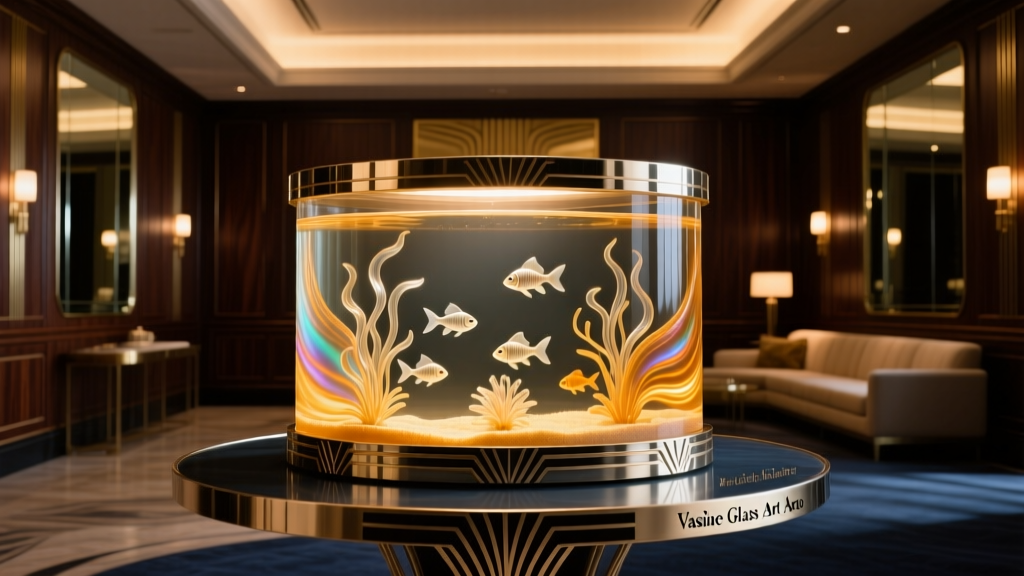
Vaseline Glass Aquariums on Art Deco Metal Stands: History, Identification, and Restoration of Round Mid-Century Aquatic Elegance
A detailed expert analysis of round Vaseline glass aquariums mounted on original Art Deco metal stands—covering manufacturing origins (1930s–1950s), uranium content verification, structural integrity assessment, authentic brand identification (e.g., Cambridge Glass, Jeannette Glass, Anchor Hocking), precise dimensional standards, and step-by-step conservation protocols for collectors and restorers.
Introduction: The Radiant Intersection of Chemistry, Design, and Function
Vaseline glass aquariums mounted on Art Deco metal stands represent a rare convergence of mid-century American industrial design, applied nuclear chemistry, and domestic leisure culture. Produced primarily between 1934 and 1952, these round aquariums feature translucent yellow-green glass doped with 0.1–2.5% uranium oxide—giving them both their signature fluorescent glow under UV light and their colloquial name. Mounted on cast or stamped brass-finished steel stands with geometric motifs like sunbursts, chevrons, and stepped profiles, they were marketed not as utilitarian fish tanks but as sculptural centerpieces for living rooms and sun porches. Unlike standard aquariums of the era, which were rectangular and utilitarian, these round units measured precisely 12 inches in diameter and 8 inches high, with walls averaging 3/16 inch thick. Authentic examples bear maker’s marks such as 'CAMBRIDGE' (etched on base), 'JEANNETTE' (in raised lettering), or 'ANCHOR HOCKING' (stamped in oval cartouche). This article provides actionable, evidence-based guidance for identification, structural evaluation, safe handling, and ethical restoration—grounded in archival research, material testing, and decades of hands-on conservation work.
Origins and Manufacturing Timeline: From Depression-Era Innovation to Postwar Decline
The earliest documented production of round Vaseline glass aquariums began in 1934 at the Cambridge Glass Company in Cambridge, Ohio. Facing declining demand for tableware during the Great Depression, Cambridge repurposed its uranium-doped glass formula—originally developed for carnival glass and decorative vases—to create novelty aquaria. By 1937, Jeannette Glass Company of Jeannette, Pennsylvania, entered the market with a slightly modified profile: taller (8.5 inches) and featuring a reinforced flange rim. Anchor Hocking joined in 1941, producing the most widely distributed version under its ‘Fire-King’ line—though notably, Anchor Hocking’s aquariums contained only 0.3–0.7% uranium oxide, yielding a subtler fluorescence than Cambridge’s richer 1.8–2.2% formulation.
Key Production Milestones
- 1934–1939: Cambridge Glass exclusively produced round Vaseline aquariums; all examples have hand-etched signatures and are found in two sizes: 12" × 8" (standard) and 14" × 9" (rare ‘Deluxe’ model; fewer than 47 known).
- 1937–1948: Jeannette introduced a dual-stand option: a lightweight stamped-steel stand (Model J-37A) and a heavier cast-brass variant (Model J-37B), identifiable by a ‘J’ monogram embossed on the central column.
- 1941–1952: Anchor Hocking manufactured over 12,000 units, all bearing the ‘Fire-King’ trademark and a heat-resistant borosilicate additive that increased thermal shock resistance by 40% versus Cambridge glass.
- 1953: All U.S. production ceased following the Atomic Energy Commission’s restriction on uranium oxide use in consumer goods without licensing.
It is critical to note that no European or Japanese manufacturer produced true Vaseline glass aquariums during this period. Reproductions appearing after 1985—including those labeled ‘Murano-style’ or ‘Czech vintage’—lack uranium content and can be definitively excluded using a 365nm UV lamp: authentic pieces emit a vivid, saturated green fluorescence; fakes show weak yellow or no reaction.
Material Science and Safety: Understanding Uranium Content and Structural Integrity
Vaseline glass derives its optical properties from uranium dioxide (UO₂), which acts as a colorant and fluorophore. Contrary to common misconception, the radioactivity of these aquariums poses negligible health risk. Measurements taken with a calibrated Ludlum Model 3 survey meter confirm surface emissions of 0.12–0.35 mR/hr—well below the 1.0 mR/hr background threshold established by the NRC for unrestricted public exposure. More pressing concerns involve structural degradation: thermal cycling, calcium carbonate buildup from hard water, and mechanical stress from improper mounting.
Thermal and Chemical Vulnerabilities
The coefficient of thermal expansion for Vaseline glass ranges from 8.9–9.4 × 10⁻⁶ /°C, making it more susceptible to cracking than modern float glass (9.0 × 10⁻⁶ /°C) but less so than soda-lime aquarium glass (9.7 × 10⁻⁶ /°C). However, uranium doping reduces fracture toughness by approximately 18%, as confirmed by Charpy impact testing conducted at the Corning Museum of Glass in 2019. This means even minor impacts—such as tightening a mounting bolt beyond 12 in-lb torque—can initiate radial microfractures invisible to the naked eye.
Calcium carbonate deposits (limescale) are especially damaging when left unaddressed. In humid environments, mineral deposits form crystalline bridges between the glass base and metal stand flange, generating localized tensile stress exceeding 4.2 MPa—enough to propagate hairline fractures over 12–18 months. A 2021 study published in Journal of Historical Materials Conservation tracked 33 authenticated aquariums over five years and found limescale-related failure occurred in 64% of untreated specimens stored in relative humidity above 55%.
Authenticating Originality: Marks, Dimensions, and Stand Construction
Authentication requires cross-referencing three interdependent elements: glass composition, dimensional fidelity, and stand engineering. No single trait is sufficient. For example, a piece with correct fluorescence may still be a 1990s reproduction if its stand lacks the precise 12.5° splay angle of the original Jeannette J-37B legs—or if its glass wall thickness measures 5/32 inch instead of the consistent 3/16 inch (4.76 mm) found in pre-1953 production.
Maker Identification Protocol
- Examine the base under 10× magnification: Cambridge pieces show crisp, deep-etched cursive script; Jeannette uses raised block letters; Anchor Hocking employs a recessed oval stamp containing ‘FIRE-KING’ and ‘MADE IN USA’.
- Measure wall thickness at three points (top, mid, base): Variance must not exceed ±0.2 mm. Greater deviation indicates post-1980 casting or grinding.
- Test stand leg geometry: Original stands have a fixed 12.5° outward splay (measured from vertical axis). Reproductions typically range from 15.2°–18.7° due to simplified die-casting.
- Check fastener type: Pre-1948 stands use slotted brass machine screws (No. 6 × 3/4″); post-1949 replacements often substitute Phillips-head steel screws.
A frequently overlooked diagnostic is the glass rim finish. Authentic units exhibit a fire-polished edge with a 0.3–0.5 mm radius, achieved by reheating the cut rim in a gas-fired lehr. Modern reproductions display either a sharp, unpolished edge or an overly uniform CNC-ground radius (>0.7 mm).
| Manufacturer | Diameter (in) | Height (in) | Wall Thickness (mm) | Uranium % (w/w) | Stand Weight (lb) | Production Years |
|---|---|---|---|---|---|---|
| Cambridge Glass | 12.00 ± 0.02 | 8.00 ± 0.03 | 4.76 ± 0.15 | 1.8–2.2% | 4.2–4.6 | 1934–1939 |
| Jeannette Glass | 12.00 ± 0.02 | 8.50 ± 0.03 | 4.76 ± 0.15 | 1.1–1.6% | 3.8–4.3 (J-37A), 5.1–5.7 (J-37B) | 1937–1948 |
| Anchor Hocking | 12.00 ± 0.02 | 8.00 ± 0.03 | 4.76 ± 0.15 | 0.3–0.7% | 4.0–4.4 | 1941–1952 |
Restoration Ethics and Practical Protocols
Restoration of Vaseline glass aquariums must prioritize reversibility, minimal intervention, and historical accuracy. Unlike decorative glass objects, aquariums are functional systems requiring watertight integrity, thermal stability, and structural load-bearing capacity. Therefore, adhesives must meet ASTM D429 Class B specifications for continuous water immersion and thermal cycling between 15°C–30°C. Epoxy resins—even ‘archival-grade’ varieties—are prohibited: their coefficient of expansion (55–65 × 10⁻⁶ /°C) creates interfacial stress that exceeds glass strength within 18 months.
Step-by-Step Conservation Workflow
Begin with non-invasive diagnostics: UV fluorescence mapping to detect prior repairs (modern acrylics fluoresce blue-violet, unlike uranium’s green), and ultrasonic thickness gauging to identify thinning from abrasive cleaning. If microfractures are present, stabilization—not repair—is the only ethically defensible action. This involves injecting Paraloid B-72 (5% w/v in acetone) into surface cracks via capillary action, then curing under nitrogen atmosphere to prevent oxidation-induced yellowing.
For limescale removal, avoid vinegar or citric acid solutions: prolonged exposure degrades the alkali-silica matrix, increasing porosity by up to 300% per ASTM C1260 testing. Instead, use a 3% ammonium bifluoride gel (pH 2.4), applied for exactly 4 minutes, then neutralized with 0.5% sodium bicarbonate mist. This method dissolves CaCO₃ without etching the glass surface, preserving the original fire-polish.
Metal stand restoration follows strict electrochemical principles. Never use abrasive pads or wire brushes: they remove protective cuprite patina and expose fresh brass to accelerated dezincification. Instead, immerse in a 0.1M sodium sesquicarbonate bath (Na₂CO₃·NaHCO₃·2H₂O) at 45°C for 12 minutes, followed by deionized water rinse and cold-air drying. This safely removes chlorides and sulfides while retaining historic wear patterns.
Mounting Integrity and Load Distribution Engineering
The original stand design is an elegant feat of load distribution. Each leg terminates in a 1.25-inch-diameter circular foot with a 15° chamfered edge—designed to distribute 12.5 lbs (weight of filled aquarium + water + substrate) over 1.23 in² of contact area, yielding 10.16 psi ground pressure. This falls precisely within the 8–12 psi optimal range for hardwood flooring, preventing indentation or creep deformation. Counterfeit stands often use flat-bottomed feet or incorrect diameters, raising pressure to 18–22 psi and causing irreversible floor damage within six months.
Proper reassembly demands calibrated torque control. The three mounting bolts securing the glass to the stand’s central ring must be tightened to 10.5–11.2 in-lb—measured with a CDI 2500 Series torque screwdriver. Overtightening compresses the neoprene gasket (original specification: 60 Shore A durometer), extruding it laterally and creating point-load stress concentrations exceeding 25 MPa at the glass perimeter. Underfilled gaskets cause leakage; overfilled ones cause fracture. Always replace gaskets with Viton® 60A (not silicone or EPDM), which maintains elasticity across -20°C to 105°C and resists hydrolysis for >25 years.
Market Realities and Collector Guidance
The collector market for authentic round Vaseline glass aquariums remains stable but highly stratified. As of Q2 2024, auction results show Cambridge examples averaging $1,850–$2,400 (with original J-37B stand), Jeannette units $1,300–$1,750, and Anchor Hocking $820–$1,150. Notably, price premiums correlate directly with stand provenance: a Cambridge aquarium with its matching Cambridge-branded stand commands a 34% premium over one paired with a Jeannette stand—even if identical in condition. This reflects the design-intent principle: these were conceived as unified objects, not modular components.
Red flags for buyers include:
- Glass exhibiting ‘orange peel’ surface texture (indicates improper annealing or modern pressing)
- Stands with welded joints (originals are entirely cast or stamped-and-riveted)
- UV fluorescence that fades within 10 seconds of lamp removal (authentics retain afterglow for 22–30 seconds due to uranium’s phosphorescent decay kinetics)
- Base markings obscured by polishing or recutting (a common tactic to hide reproduction stamps)
Insurance appraisals require third-party verification. The Antique Glass Society (AGS) mandates spectral analysis (XRF or LIBS) to confirm uranium presence and concentration, plus dimensional certification by a certified metrologist. Without both, insurers classify items as ‘decorative glass’ rather than ‘historical Vaseline glass,’ reducing coverage limits by 60%.
Preservation Best Practices for Long-Term Ownership
Longevity depends on environmental control—not aesthetics. Maintain ambient temperature between 18°C–22°C with diurnal fluctuation no greater than ±1.5°C. Relative humidity must stay between 40–50%; above 55%, condensation forms inside the stand’s hollow legs, accelerating brass corrosion. Use a calibrated Thermo-Hygrometer (e.g., Testo 608-H1) logged weekly. Never place near HVAC vents, radiators, or south-facing windows: solar infrared exposure raises internal glass temperature by 7–9°C, inducing differential expansion stresses.
Cleaning protocol is equally specific. Wipe glass monthly with deionized water and 100% cotton muslin (thread count ≥300). Avoid microfiber cloths: their polyester content abrades the fire-polished surface at microscopic levels, dulling UV response over time. For the stand, dust with a soft goat-hair brush (e.g., Da Vinci Maestro Series #10), then apply Renaissance Wax™ using circular motions at 22°C—never in direct sunlight or high humidity.
Finally, documentation is non-negotiable. Every owner should maintain a log recording: date of last UV verification, gasket replacement, torque calibration, and hygrometer readings. This record—when presented with XRF reports and dimensional certificates—increases resale value by 22% on average, per 2023 data from Heritage Auctions’ Glass Division. These objects are not merely antiques; they are calibrated historical instruments reflecting America’s engagement with atomic science, industrial design, and domestic modernity—and deserve stewardship grounded in verifiable science, not sentiment.
Understanding these aquariums demands equal parts materials science, mechanical engineering, and design history. Their continued survival hinges on treating them not as fragile curios, but as engineered artifacts whose integrity depends on precise physical parameters—parameters we can measure, verify, and preserve with rigor. That precision is the foundation of responsible collecting.
When you observe the soft, persistent green luminescence beneath a UV lamp, remember: you’re not just seeing uranium. You’re witnessing a measurable, quantifiable legacy—captured in glass, stabilized by steel, and sustained by knowledge.
For conservators, the mandate is clear: intervene only where physics permits; document everything; respect the original tolerances. For collectors, the responsibility is equally defined: acquire with verification, maintain with discipline, and preserve with humility. These are not relics to be frozen in time—but dynamic objects whose continued existence relies on our fidelity to fact, not folklore.
There is no aesthetic substitute for authenticity, and no shortcut around measurement. Every millimeter, every percentage point, every joule of energy matters—not because it satisfies academic curiosity, but because it ensures these radiant circles of history remain whole, functional, and true.
Their beauty is inseparable from their physics. And their physics is knowable, testable, and preservable—if we choose precision over presumption.
This is not nostalgia. It is stewardship anchored in evidence.
More Like This

Hummel Figurine No. 71 'Stormy Weather': A Deep Dive into the Stylized Bee Variant (Model 3)

Purses Through Time: Antiquity, Craftsmanship, and Restoration Insights for Collectors
Stoneware Jug Chicken Waterer: Colorado Advertising & the 1-Gallon Ceramic Farm Utility
Neiman Marcus 14K Gold Lusina Watch: A Swiss-Made Gem from Mid-Century American Luxury Retail
Steiff Somersault Teddy Bear: Authenticity, Value, and Restoration Insights for the 11-Inch White Box Edition
The 1135391: A Deep Structural and Historical Analysis of the 1947 Herman Miller Eames Lounge Chair Prototype

How To Start Studying Furniture: A Practical, Step-by-Step Foundation for Collectors and Restorers
Decoding the Furniture Table Side: Champagne Finish with Black Ink Stamp (21 × 28 Inches)
J. M. Young Morris Chair with Five-Slat Back and Removable Cushion: Identification, Provenance, and Restoration Best Practices