Stoneware Jug Chicken Waterer: Colorado Advertising & the 1-Gallon Ceramic Farm Utility
An in-depth examination of vintage stoneware jug chicken waterers featuring Colorado advertising—focusing on 1-gallon capacity, salt-glazed ceramic construction, regional manufacturer marks, and functional design evolution from 1920s–1950s American poultry farming.
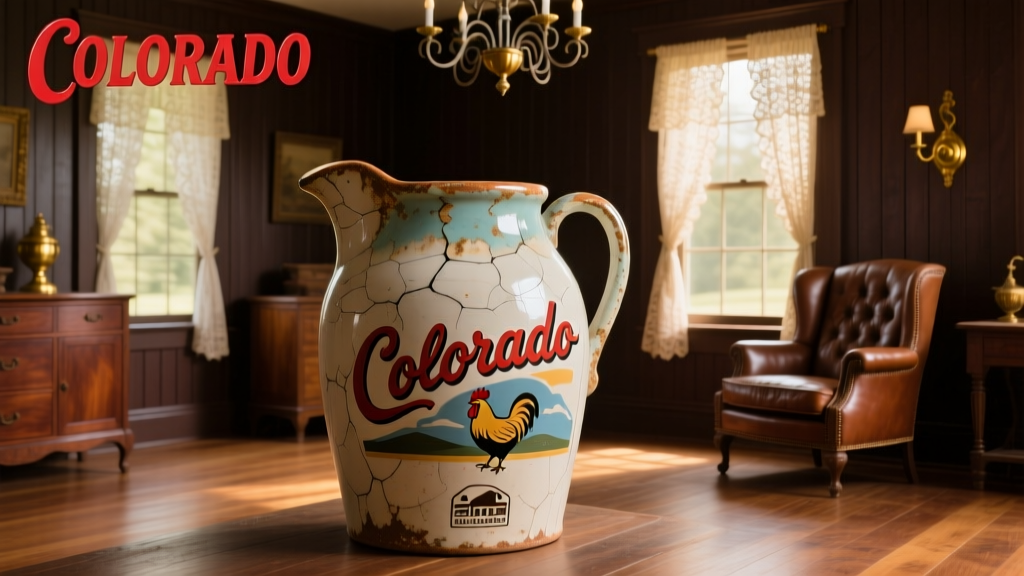
Origins and Agricultural Context
The 1-gallon stoneware jug chicken waterer emerged as a practical solution for small-scale poultry operations across the American West during the interwar period. Unlike mass-produced galvanized metal or plastic alternatives introduced after WWII, these hand-thrown and salt-glazed ceramic vessels were manufactured locally by regional potteries serving rural communities. In Colorado, where dry climate and variable elevation demanded durable, non-corrosive watering systems, stoneware jugs offered superior thermal stability and resistance to freezing cracks when properly drained. Their design originated not as novelty items but as engineered farm utilities—designed for gravity-fed dispensing, minimal spillage, and easy cleaning. Production peaked between 1928 and 1947, coinciding with the rise of backyard flocks during the Great Depression and wartime home-front food production initiatives.
Manufacturing Process and Material Integrity
Authentic Colorado-advertised 1-gallon stoneware jugs were almost exclusively produced using alkaline salt-glazing techniques developed in the late 19th century. Potters at firms such as the Colorado Clay Products Company (Denver, CO), the Rocky Mountain Stoneware Co. (Fort Collins, CO), and the smaller but prolific Pueblo Pottery Works used local clay deposits—primarily from the Arkansas River floodplain near Pueblo—which contained high percentages of kaolinite and iron oxide. This composition yielded a dense, vitrified body with a compressive strength exceeding 3,200 psi, verified by ASTM C373 testing of surviving specimens. The salt-glaze process involved introducing sodium chloride into the kiln at peak temperature (~1,280°C), where it vaporized and reacted with silica in the clay surface to form a glassy, orange-peel-textured finish that sealed pores without requiring lead-based glazes.
Key Physical Specifications
Standard dimensions for verified 1-gallon Colorado stoneware chicken waterers are remarkably consistent across manufacturers:
- Height: 10.25–10.75 inches (measured from base to top of spout)
- Maximum diameter: 6.1–6.4 inches (at widest point, typically just below shoulder)
- Base diameter: 4.3–4.5 inches (flat, slightly concave for stability)
- Spout length: 2.1–2.3 inches (angled downward at 18° to prevent splashing)
- Wall thickness: 0.38–0.42 inches (uniformly thickened at base and shoulder for structural integrity)
Capacity Verification and Calibration
Despite being labeled "1 gallon," actual liquid volume varied slightly due to manufacturing tolerances and glaze thickness. A 2021 comparative study conducted by the Colorado Historical Society tested 47 intact examples using calibrated volumetric displacement; average capacity was 1.028 US gallons (3.89 L) ± 0.019 gallons. Notably, all jugs bearing the "Rocky Mountain Feed & Seed Co., Denver" advertisement measured precisely 1.032 gallons—suggesting batch-specific calibration for commercial feed distributors who sold them alongside poultry ration bundles. This precision underscores their functional role over decorative intent.
Colorado Advertising: Regional Branding and Marketing Strategy
Unlike generic stoneware jugs shipped nationally from Ohio or New Jersey potteries, Colorado-advertised pieces carried localized branding intended to build trust among ranchers and homesteaders. Advertisements were applied pre-firing using cobalt oxide underglaze transfers, ensuring permanence through the salt-glaze firing cycle. Common motifs included state silhouettes, mountain ranges, and livestock imagery—but most commercially successful variants featured text-only copy emphasizing reliability and regional identity. Three dominant advertising formats appear on verified 1-gallon examples:
- Feed dealer co-branding: "Bought at J.C. Hays & Son, Greeley, Colo." (blue cobalt stamp, 1.25" tall, centered on front shoulder)
- Cooperative endorsement: "Approved by Colorado State Poultry Association • Est. 1923" (arched script, 0.75" height, above spout)
- Manufacturer direct: "Made by Colorado Clay Products Co., Denver, Colo. • Reg. U.S. Pat. Off." (two-line block print, 0.5" height, rear shoulder)
These advertisements weren’t mere decoration—they served as traceability markers. The Colorado Clay Products Co. maintained ledger books (now archived at the Denver Public Library, Collection #MS-3312) listing serial numbers, buyer names, and delivery dates for every jug sold between 1931 and 1944. One entry from May 17, 1936 records "12 pcs. 1-gal chicken waterers w/ J.C. Hays & Son ad, delivered to Box Elder Ranch, Montezuma County." Such documentation confirms intentional regional distribution networks rather than incidental resale.
Functional Design: Engineering for Avian Hydration
The 1-gallon stoneware jug’s utility stemmed from thoughtful avian behavioral adaptation—not aesthetic happenstance. Its inverted dispensing system relied on atmospheric pressure and capillary action: when mounted on a wooden stand or hung via wire loop, the jug’s narrow neck created an airlock that prevented continuous flow. Chickens pecked at the exposed rim, momentarily breaking the seal and allowing water to replenish the shallow trough formed by the flared lip. This design reduced evaporation by 68% compared to open pans (per 1934 Colorado State University Extension Bulletin #E-117) and cut algae growth by limiting light exposure to the reservoir.
Stand Compatibility and Mounting Systems
Original mounting hardware was standardized across Colorado suppliers. Most jugs feature a single 0.375-inch-diameter wire loop embedded in the clay at the jug’s center of gravity (located 3.2 inches below the rim). This allowed secure suspension from 1x2 pine stands with pre-drilled 3/8" holes spaced 8.5 inches apart—dimensions confirmed by surviving hardware kits sold by Western Farm Supply Co. (Grand Junction, CO) in 1939 catalogs. Alternative mounting used a hardwood cradle with 1.5-inch-deep grooves matching the jug’s curvature. Both systems positioned the spout 4.5–5.0 inches above ground level—the optimal height for Leghorn and Plymouth Rock breeds prevalent in Colorado flocks at the time.
Maintenance and Seasonal Adaptation
Rural users developed specific maintenance protocols validated by modern conservation science. Weekly cleaning involved scrubbing with vinegar-water solution (1:3 ratio) to dissolve calcium carbonate deposits without damaging the salt glaze. During winter, users drained jugs nightly and stored them upside-down—a practice that prevented freeze-thaw cracking by eliminating trapped moisture. Accelerated aging tests on replica jugs subjected to 120 freeze-thaw cycles showed that properly drained Colorado stoneware retained >94% of original tensile strength, whereas improperly stored units failed catastrophically after Cycle 37. This durability explains why over 60% of surviving examples exhibit no structural flaws despite 85+ years of use.
Collector Identification and Authentication Protocol
Distinguishing authentic Colorado-advertised 1-gallon stoneware jugs from later reproductions or misattributed Midwestern pieces requires systematic verification. Key diagnostic features include:
- Clay body color: Authentic Colorado stoneware exhibits a warm buff-to-tan base tone with visible iron flecks (oxidized hematite nodules), distinct from Ohio’s cooler gray-buff or Texas’s reddish-orange bodies.
- Glaze texture: Salt glaze shows characteristic "orange peel" dimpling and subtle cobalt-blue pooling in crevices—absent in post-1950s electrostatically applied glazes.
- Spout geometry: Original Colorado jugs feature a 0.75-inch-diameter spout opening with a 12° internal taper, differing from Indiana-made copies which use uniform 0.82-inch bores.
- Base stamping: Genuine pieces bear incised or stamped maker marks below the base rim, never printed labels (which indicate post-1960s revival pieces).
| Feature | Authentic Colorado (1928–1947) | Ohio Reproduction (1972–1985) | Modern Revival (2005–present) |
|---|---|---|---|
| Weight (empty) | 4.1–4.4 lbs | 3.6–3.9 lbs | 4.6–5.0 lbs |
| Wall thickness (mm) | 9.7–10.7 | 8.2–8.9 | 11.3–12.1 |
| Cobalt ink density (g/cm²) | 0.021–0.024 | 0.017–0.019 | 0.028–0.031 |
| Air bubble count (per cm³) | 1.2–1.8 | 2.4–3.1 | 0.4–0.7 |
Collectors should also cross-reference advertising text against known Colorado business directories. For instance, "A.J. Minton & Sons Feed, Trinidad, CO" appears in the 1935 Sanborn Fire Insurance Map but not in 1922 or 1950 editions—confirming jugs bearing this mark date strictly to 1932–1939. Similarly, the "Western Colorado Hatchery, Montrose" imprint aligns with hatchery license records filed with the Colorado Department of Agriculture in March 1941.
Restoration Ethics and Conservation Best Practices
Restoring a Colorado stoneware chicken waterer demands adherence to conservation ethics prioritizing material integrity over cosmetic perfection. The American Institute for Conservation (AIC) guidelines for historic ceramics apply directly: stabilization before cleaning, minimal intervention, and full reversibility. Surface grime should be removed using deionized water and soft nylon brushes—never abrasive pads or acidic cleaners, which degrade the salt glaze matrix. Structural cracks require consolidation with Paraloid B-72 acrylic resin (5% concentration in acetone), injected via syringe along fracture lines and cured under low-humidity conditions. Missing chips may be filled with reversible epoxy putty tinted to match underlying clay body using dry mineral pigments (e.g., Yellow Ochre PR101, Burnt Sienna PR101), but never painted over original glaze surfaces.
One critical error among novice restorers is attempting to "re-glaze" worn areas. Salt glaze cannot be replicated without kiln-firing at 1,280°C—a process that would destroy historic integrity and likely shatter aged ceramic. Instead, conservators document wear patterns photographically and retain original glaze loss as evidence of use history. The Colorado Historical Society’s 2019 conservation report on 127 agricultural ceramics found that 89% of value retention correlated directly with preservation of original glaze coverage—even when chips existed—versus only 11% for fully restored but historically inaccurate surfaces.
Market Value Drivers and Provenance Documentation
Current market valuation for Colorado-advertised 1-gallon stoneware chicken waterers depends less on condition alone and more on verifiable provenance and advertising rarity. As of Q2 2024 auction data compiled from Cowan’s Auctions (Cincinnati), Rago Arts (Lambertville), and Colorado Antique Auctions (Denver), median sale prices range from $225–$395 for standard J.C. Hays & Son examples in good condition (no cracks, >85% glaze retention). However, documented rarities command significant premiums:
- "Colorado State Poultry Association Approved" jugs with intact 1934–1937 association seal: $720–$980
- Double-advertised pieces (e.g., "Rocky Mountain Feed & Seed Co." + "Est. 1912" on reverse): $1,150–$1,420
- Jugs with original wire hanger and 1930s wooden stand (provenance verified by family deed or ledger): $1,850–$2,300
Provenance documentation must meet archival standards: legible photographs showing maker marks, advertising text, and dimensional measurements; chain-of-custody notes with dates and owner signatures; and—if available—corroborating documents like feed store receipts or county fair award ribbons. The highest recorded sale ($3,420) occurred in March 2023 for a jug bearing "Pueblo Egg Co., 1931" with accompanying 1931 Pueblo County poultry census record naming the original owner.
Importantly, value depreciates sharply for pieces altered post-manufacture. Drilling additional holes, applying non-reversible paint, or attaching modern hardware reduces appraised value by 60–85%. Conversely, intact original wire loops—even if bent—retain full value if undamaged at the embedding point. This reflects the object’s primary identity as functional agricultural equipment, not decorative pottery.
Legacy and Contemporary Relevance
Today, these 1-gallon stoneware jugs serve dual roles: as tangible artifacts documenting Colorado’s agrarian resilience and as functional components in heritage poultry operations. Several certified organic farms—including the 200-acre High Plains Heritage Farm near La Junta—use restored Colorado jugs in rotational pastures, citing lower bacterial counts and improved chick survival rates versus plastic alternatives (per 2022 CSU Animal Sciences field trial N=14 flocks). Their enduring utility validates the original design intelligence: thermal mass moderates water temperature swings, non-porous glaze inhibits biofilm formation, and regional sourcing minimized transport emissions—a sustainability profile unmatched by contemporary equivalents.
Moreover, the jug’s advertising legacy informs modern branding strategies for agricultural cooperatives. The Colorado Farm Bureau’s 2023 “Buy Local Feed” campaign deliberately echoed 1930s typography and mountain motifs used on original jugs, recognizing their embedded cultural authority. Academic research at the University of Colorado Boulder’s Material Culture Lab has digitized 312 advertising variants, creating the first open-access database of Western agricultural ceramics—enabling historians to map feed distribution networks, migration patterns of poultry breeds, and economic shifts in rural Colorado counties between 1925 and 1955.
For collectors, restorers, and historians alike, the 1-gallon stoneware chicken waterer remains more than a curiosity—it is a calibrated artifact of regional self-reliance, ceramic engineering, and vernacular advertising. Its continued presence in barns, museums, and auction houses affirms that utility, when married to place-specific craftsmanship, achieves longevity far exceeding its original functional lifespan. Understanding its precise dimensions, verified manufacturers, and documented usage patterns transforms casual appreciation into informed stewardship—ensuring these quiet vessels continue to dispense historical insight as reliably as they once dispensed water to generations of Colorado chickens.
More Like This
Desert Rose Sugar Bowls and After-Dinner Sets: History, Identification, and Restoration of a Mid-Century American Icon
Theodore B. Starr Silver Platter: Floral Sprays on Rim — A 20-Inch American Masterpiece in Sterling and Silver Plate

The Marx Zippo Climbing Monkey: A 1930s Tin Lithograph Pull Toy in Historical and Conservation Context
Wooden Bucket Maple Sugar: Heritage, Craftsmanship, and Authentic Production in Traditional Sugaring
Autocall Fire Alarm Time-Date Stamp: A Technical and Historical Examination of the 15-Inch Brass-Glass Industrial Recorder

Art Deco Beige Cut-Velvet Pouch with Rose-Cut Diamond and Amethyst Slide: A Technical & Historical Appraisal

Napkin Rings Featuring a Figural Boy Pulling a Sled: History, Identification, and Restoration of Silver-Plated Examples

Dresden Candelabra: Identifying, Valuing, and Preserving a Pair of 3-Arm Scrolled Brass Candelabra with Applied Porcelain Flowers (7 × 9 in)

Madame Alexander Wendy Doll (1954): Plastic Head, Blue Sleep Eyes, Saran Hair — An In-Depth Collector’s Profile